

Trading
Explore a wide range of markets with competitive pricing, deep liquidity, and advanced trading tools.
Learn More 
Platform
Trade seamlessly with TMGM's powerful platform, built for speed, precision, and a superior trading experience.
Learn More Trading Platform
Academy
Learn the fundamentals of trading with beginner-friendly resources, including guides, webinars, and market insights.
Learn More News & Analysis
Get real-time market updates and expert analysis to stay ahead of trading opportunities
Learn More News & Analysis
About
Learn what sets TMGM apart — our global presence, regulatory strength, and commitment to innovation in trading.
Learn More Why Choose TMGM
Sponsorship
78.6% Fibo Near 0.6600 Marks Next Support: AUD/USD Price Forecast
- 0.6645 remains in focus as AUD/USD stays lower amid an extended US Dollar rally.
- A hawkish Fed tone continues to underpin the US Dollar.
- Further RBA monetary tightening is in doubt, according to market experts.
AUD/USD trades around 0.6645. In early European trading on Friday, the Australian Dollar (AUD) remains near its latest low against the US Dollar (USD) in almost 11 months. A hawkish Federal Reserve (Fed) narrative is driving US Dollar outperformance. Meanwhile, hopes that the Reserve Bank of Australia’s (RBA) tightening cycle has ended continue to weigh on the Australian currency, keeping the pair under pressure.

US Dollar performance this week
This week’s percentage moves in the US Dollar (USD) against the major currencies listed are set out below. The Australian Dollar recorded the largest loss against the US Dollar.
| USD | EUR | GBP | JPY | CAD | AUD | NZD | CHF | |
|---|---|---|---|---|---|---|---|---|
| USD | 0.44% | 0.84% | -0.35% | 0.50% | 1.64% | 0.63% | 0.40% | |
| EUR | -0.44% | 0.37% | -0.75% | 0.01% | 1.18% | 0.14% | -0.08% | |
| GBP | -0.84% | -0.37% | -1.11% | -0.36% | 0.80% | -0.24% | -0.45% | |
| JPY | 0.35% | 0.75% | 1.11% | 0.69% | 1.92% | 0.83% | 0.72% | |
| CAD | -0.50% | -0.01% | 0.36% | -0.69% | 1.25% | 0.15% | -0.09% | |
| AUD | -1.64% | -1.18% | -0.80% | -1.92% | -1.25% | -1.03% | -1.24% | |
| NZD | -0.63% | -0.14% | 0.24% | -0.83% | -0.15% | 1.03% | -0.22% | |
| CHF | -0.40% | 0.08% | 0.45% | -0.72% | 0.09% | 1.24% | 0.22% |
Percentage movements between major currencies are displayed in the heat map. Select the base currency in the left-hand column and the quote currency in the top row. Selecting the US Dollar on the left and following that row across to the Japanese Yen, for instance, gives the percentage change for USD (base)/JPY (quote) in the intersecting cell.
At the time of writing, the US Dollar Index (DXY) has slipped 0.12% to around 103.80. Tracking the Greenback against six major currencies, the index remains close to 104.00, the fresh 19-month level reached the day before.
Two more Fed hikes remain baseline as larger move risks rise
Recent policy signals reinforce a firmly hawkish Federal Reserve stance, according to economists at UOB Group, who are “maintaining our view of two more rate hikes (Dec and 1Q 2027), while recognizing rising risks of an outsized hike.” Reviewing the 27–28 October 2026 FOMC meeting, they say policymakers “decided to maintain the Fed Funds Target Rate (FFTR) at 3.75–4.00%, following the 25-bps increase delivered in September.” The unchanged-rate decision secured a “10–2 vote,” but the minutes indicated that “almost all participants viewed further policy tightening as likely to be appropriate in coming months under their baseline outlooks.”
UOB says the October FOMC minutes “confirmed a firmly hawkish consensus, with almost all participants judging that additional tightening would be needed under their baseline outlooks for inflation and the labor market.” Later Fed remarks strengthened that message. During a CNBC interview on Wednesday (18 November), Fed Governor Waller, characterised as a “permanent voter,” “escalated the policy debate by urging officials to consider a 50 bps hike at the Dec FOMC meeting, citing annualized inflation running near 3.5% in the last three months and that inflation is headed in the wrong direction and spreading beyond energy.”
UOB nevertheless distinguishes further tightening from a prolonged hiking cycle. It reiterates that “we continue to emphasize we do not think this is a ‘one-and-done hike’ from the Fed, and as per previous rate hike cycles, the Fed usually does not stop at one.” The bank also stresses, “we do not believe this is the start of a long series of hikes.” Its central projection remains: “we still expect two additional 25-bps hikes, in Dec 2026 and 1Q 27, thereafter on hold for the rest of 2027 as inflation fades in a more durable fashion in the later part of 2027 as the most likely course of action,” while “recognising growing risks of a larger-than-expected tightening response if inflation remains persistent.”
Weaker Australian jobs data reduce prospects of further RBA hikes
A softer Australian labour market is reducing the likelihood of further RBA tightening, in Rabobank analysts’ assessment. They point to an economy where “unemployment is spiking (from 4.7% to 4.9%) and jobs growth was -43.5K vs. an expected +25K,” describing these developments as “making further rate hikes less likely.” However, they warn that October CPI, due next week, “could still show a sharp headline lift,” keeping the policy outlook finely balanced despite weaker employment figures tempering expectations for additional tightening.
AUD/USD technical outlook
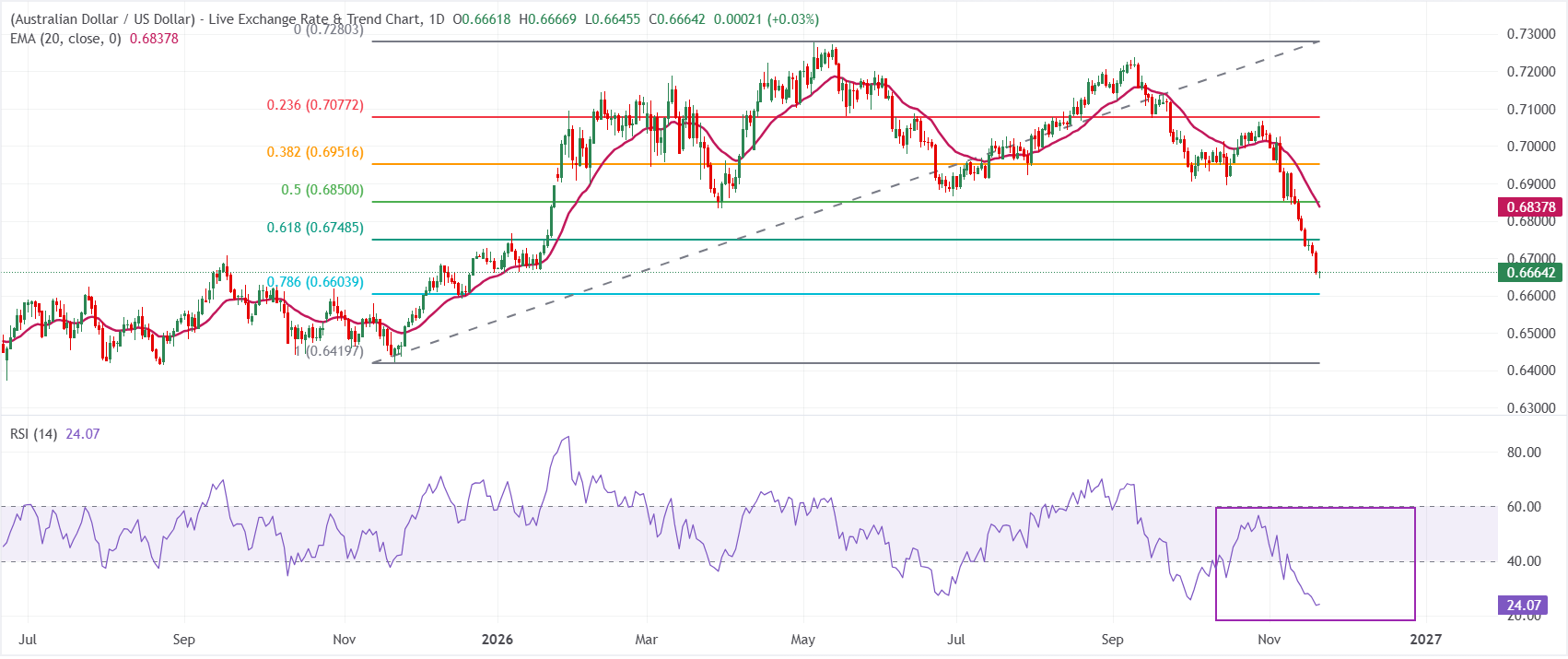
At 0.6665 on the daily chart, AUD/USD retains a clear bearish bias. Spot is below both the 20-period exponential moving average (EMA) at 0.6838 and key Fibonacci retracement levels. With the Relative Strength Index (14) around 24, near oversold territory, downside momentum appears stretched. A meaningful recovery has yet to emerge, however, as successive resistance levels continue to cap the price.
The first upside barrier is the 61.8% Fibonacci retracement at 0.6748. Beyond that lie the 20-day EMA at 0.6838 and the 50% retracement near 0.6850, followed by the 38.2% level around 0.6952 and then 0.7077. Immediate downside support sits at the 78.6% retracement at 0.6604. A break below it would bring the lower Fibonacci anchor around 0.6420 into view as the next potential bearish target.
(The technical analysis of this story was written with the help of an AI tool. Know more.)
Economic data indicator
Seasonally adjusted unemployment rate
Published by the Australian Bureau of Statistics, the Unemployment Rate measures unemployed workers as a percentage of the total civilian labour force. A rise signals a lack of growth in Australia’s labour market and weakness in the economy. For the Australian Dollar (AUD), a lower reading is regarded as bullish, whereas a higher reading is regarded as bearish.
Find out more.Latest release: Thu 19 Nov 2026 00:30
Publication frequency: Monthly
Reported figure: 4.9%
Consensus forecast: 4.7%
Prior reading: 4.7%
Data source: Australian Bureau of Statistics
Around 15 days after month-end, the unemployment rate is released. This closely followed indicator forms part of the Australian Bureau of Statistics (ABS) overview of Australian labour market trends. Its strong correlation with consumer spending and inflation offers insight into broader economic conditions. Although it is a lagging indicator, the rate influences interest rate decisions by the Reserve Bank of Australia (RBA), which in turn affect the Australian dollar. A positive reading generally supports the AUD.
POPULAR ARTICLES
1Swiss Franc stays firm as US Dollar slips despite hawkish Fed outlook2Seven-month high: Indian Rupee reaches fresh peak against US Dollar3Indonesian Rupiah trades near record lows478.6% Fibo Near 0.6600 Marks Next Support: AUD/USD Price Forecast5Above 1.0950: EUR/USD Price Forecast as Pair Firms but Remains Capped by 100-day SMA Resistance6YTD low: British Pound rebounds as USD retreats ahead of UK retail sales7AI spending fears overshadow record Anthropic IPO as Asian stocks plunge8$83.00 remains out of reach: WTI Price Forecast retains bearish bias; 200-EMA remains pivotal9India Gold price today: FXStreet data shows Gold prices declining

Get Started!
Sign up and access the Global Markets in less than 3 minutes

Connect With Us









Contacts
Phone: +61 2 8036 8388
Fax: +61 2 8036 8388
Email: support@tmgm.com



The information provided on this website is of a general nature only and does not constitute personal financial advice. Before acting on any information on this website, you should consider the suitability of the information in relation to your objectives, financial situation and needs. Investing in CFDs and FX Margin Contracts carries significant risks and is not suitable for all investors. You may lose more than your initial deposit. You do not own, or have, any interest in the underlying asset. We recommend that you seek independent advice and ensure you fully understand the risks involved before trading. It is important that you read and consider the disclosure document before you acquire any product listed on the website. The information and advertisements offered on this website are not intended for use by any person in any country or jurisdiction where such use would be contrary to local laws and regulations. The Products and Services offered on this website are not intended for residents of the United States, Malaysia and Thailand.
TMGM is authorized and regulated in various jurisdictions.
Trademax Australia Limited, trading as TMGM, is regulated by the Australian Securities and Investments Commission (ASIC), AFSL no. 436416 and is located at Level 28, One International Tower, 100 Barangaroo Avenue, 2000 Sydney, NSW Australia.
Email: support@tmgm.com.au
Trademax Global Limited, trading as TMGM, is authorized and regulated by the Vanuatu Financial Services Commission (VFSC), registration number 40356 and registered at 1276, Kumul Highway, Port Vila, Vanuatu, Republic of Vanuatu.
Email: support@tmgm.com
Trademax Global Markets (SE) Limited, trading as TMGM, is authorized and regulated by the Financial Services Authority (FSA) of Seychelles, with license number SD224. The company is registered at Office No 13, Providence Estate ABIS Centre, Mahe, Seychelles.
Email: support@tmgm.com
Trademax Global Markets (International) Pty Ltd, trading as TMGM, is authorized and regulated by the Financial Services Commission, Mauritius (FSC) with license no. GB22201012, and registered at 33, Edith Cavell Street C/o IQ EQ Fund Services (Mauritius) Ltd Port Louis, 11324 Mauritius.
Email: support@tmgm.com
Copyright © TMGM. All rights reserved