

Trading
Explore a wide range of markets with competitive pricing, deep liquidity, and advanced trading tools.
Learn More 
Platform
Trade seamlessly with TMGM's powerful platform, built for speed, precision, and a superior trading experience.
Learn More Trading Platform
Academy
Learn the fundamentals of trading with beginner-friendly resources, including guides, webinars, and market insights.
Learn More News & Analysis
Get real-time market updates and expert analysis to stay ahead of trading opportunities
Learn More News & Analysis
About
Learn what sets TMGM apart — our global presence, regulatory strength, and commitment to innovation in trading.
Learn More Why Choose TMGM
Sponsorship
Bitcoin Price Forecast: Ahead of US PCE, BTC faces risk of new yearly low
- Below $58,700, Bitcoin continues to fall on Wednesday. Its yearly low of $55,130 is back in view.
- $231.56 million flowed out of US-listed BTC spot ETFs on Tuesday, taking the run of withdrawals to six consecutive days.
- With US PCE inflation figures pending, market participants are looking for signals on the Fed’s policy direction and a new catalyst for risk assets.
Below $58,700, Bitcoin (BTC) extends its correction on Wednesday. The yearly low of $55,130 is again in focus. Persistent withdrawals from BTC spot exchange-traded funds (ETFs), alongside wider market uncertainty weighing on sentiment, reinforce the bearish outlook. Attention now shifts to US Personal Consumption Expenditures (PCE) data. Investors will assess the release for signals on the Federal Reserve’s (Fed) policy outlook, potentially bringing renewed volatility to the leading cryptocurrency.

Persistent Selling Keeps Pressure on Bitcoin
$231.56 million in net withdrawals hit BTC spot ETFs on Tuesday, according to SoSoValue. That was the sixth consecutive day of outflows, as institutional appetite for Bitcoin has weakened so far this week.
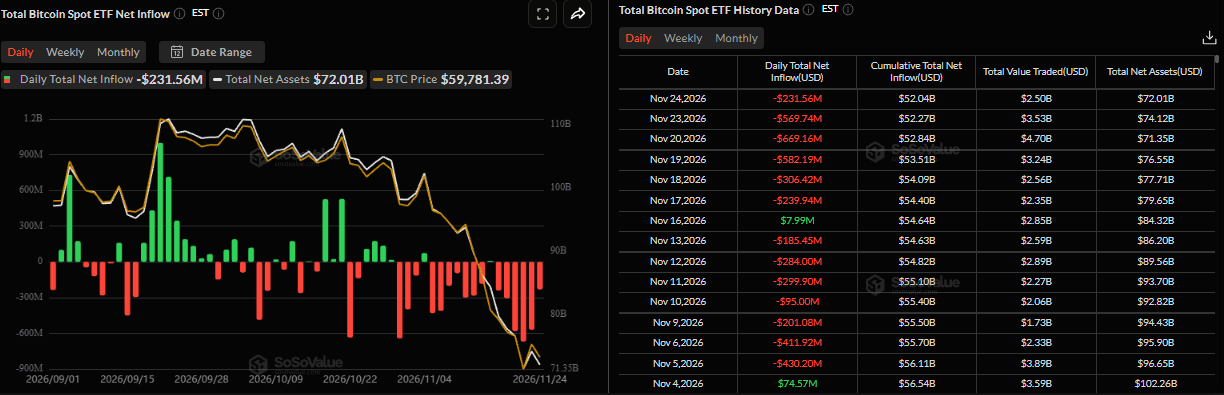
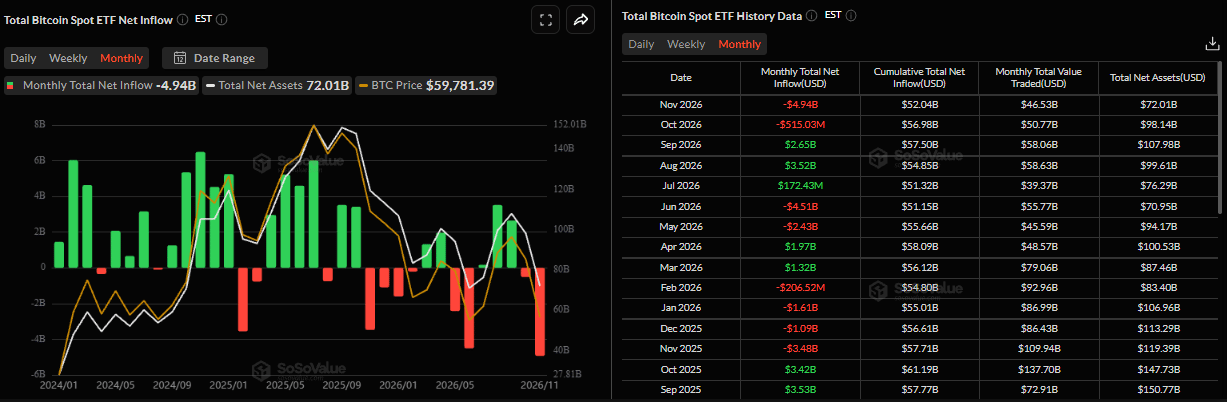
November net outflows from BTC spot ETFs have reached $4.94 billion so far, the largest monthly withdrawals since the funds launched in January 2024. Should withdrawals continue or gather pace through the week, ongoing selling could add to Bitcoin’s losses. That would raise the likelihood of a retest of the yearly low at $55,130.
US PCE Release Puts Fed Outlook in Focus
Due later in the North American session, the US Personal Consumption Expenditures (PCE) Price Index will be released alongside the second estimate of US Q3 Gross Domestic Product (GDP). As the Fed’s preferred measure of inflation, PCE could reshape monetary policy expectations. Both releases could affect demand for the US Dollar (USD) and appetite for risk.
Heightened geopolitical tensions could also underpin the USD, constraining attempts by BTC to recover. Attacks on shipping near the Strait of Hormuz, combined with stalled diplomacy aimed at ending the US-Iran conflict, have sustained elevated geopolitical risks.
According to Iran’s Islamic Revolutionary Guard Corps (IRGC), it has targeted a non-compliant container ship transiting the strategic waterway illegally. Separately, Iran-backed Houthis threatened attacks on Saudi Arabia’s Red Sea ports in retaliation for a Saudi-led coalition strike on Yemen’s Hodeidah port. These developments maintain the geopolitical risk premium and favour USD bulls.
Against this backdrop, a BTC rebound is more likely to attract selling and remain limited. Neither the earlier optimism over Nvidia’s reinstatement of Jensen Huang as CEO nor a wave of short liquidations signalled a lasting improvement in market sentiment. The outlook for BTC therefore remains cautious.
$55,130 in Focus: Bitcoin Technical Outlook Points to Fresh Yearly Low Risk
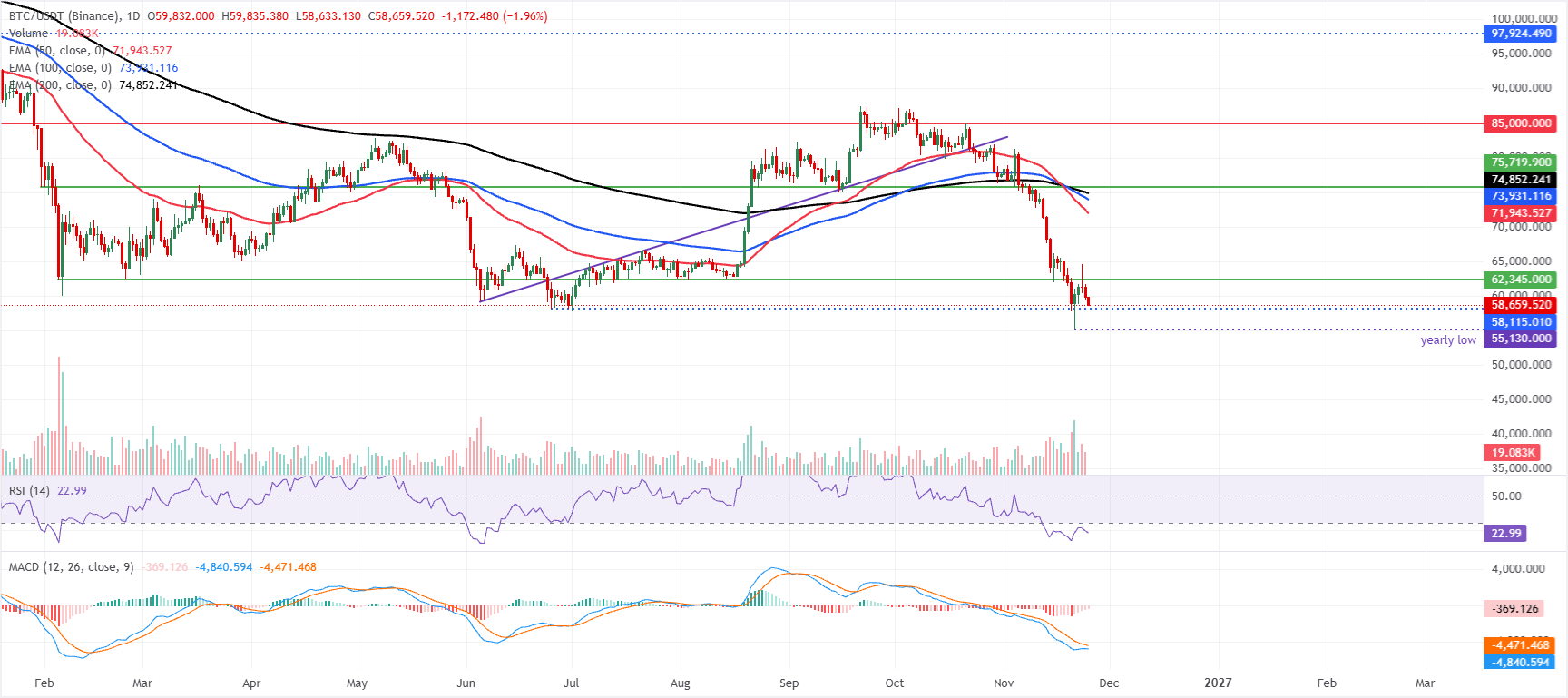
After failing earlier this week to close above key resistance at $62,345, Bitcoin remains in a bearish phase, trading below $58,700 at the time of writing on Wednesday. BTC also sits well beneath its 50-day, 100-day and 200-day Exponential Moving Averages (EMAs). These are grouped within a range of roughly $71,943 to $74,852.
At 22, the daily Relative Strength Index (RSI) is in oversold territory. The Moving Average Convergence Divergence (MACD) histogram is also still negative. Together, these indicators suggest downside pressure persists, although the sell-off risks becoming overstretched.
Any advance would first encounter horizontal resistance at $62,345. Beyond that sit the 50-day EMA near $71,943, the 100-day EMA at $73,931 and the 200-day EMA at $74,852. This concentrated overhead supply zone would have to be reclaimed to reduce the bearish bias. A larger obstacle lies at the horizontal level around $85,000; a sustained break above it would be needed to indicate a more lasting recovery. Until then, Bitcoin remains exposed to further weakness, with its yearly low of $55,130 again in view.
(The technical analysis of this story was written with the help of an AI tool. Know more.)
FAQs: Bitcoin, Altcoins and Stablecoins
Designed to function as money, Bitcoin is a virtual currency and the largest cryptocurrency by market capitalisation. No single person, group or entity can control this payment method, removing the need for a third party to participate in financial transactions.
The term altcoin covers cryptocurrencies other than Bitcoin. Some also exclude Ethereum, however, on the basis that forks originate from these two cryptocurrencies. Under that interpretation, Litecoin is the first altcoin: it was forked from the Bitcoin protocol and is therefore an “improved” version of it.
A stablecoin is a cryptocurrency intended to maintain a stable price, backed by reserves of the asset it represents. Its value is tied to a commodity or financial instrument, such as the US Dollar (USD), while an algorithm or demand regulates its supply. Stablecoins primarily give investors a way to enter and exit cryptocurrency trading and investment. They also offer a means of storing value, as cryptocurrencies generally experience volatility.
By comparing Bitcoin’s market capitalisation with the combined market capitalisation of all cryptocurrencies, Bitcoin dominance indicates the level of investor interest in Bitcoin. High BTC dominance typically precedes and accompanies a bull run, when investors favour relatively stable cryptocurrencies with large market capitalisations, such as Bitcoin. Falling BTC dominance generally signals that investors are shifting capital and/or profits into altcoins to seek higher returns. This usually sparks a surge in altcoin rallies.
POPULAR ARTICLES
1Swedish Krona: Assessing PPM-flow effects and seasonality – Nordea2Bitcoin Price Forecast: Ahead of US PCE, BTC faces risk of new yearly low3Downbeat German GDP fails to prevent Euro from paring losses against British Pound4CEE FX: Downside contained by hawkish signals – ING550% Fibo Retracement Gives Way: AUD/USD Price Forecast Signals Further Downside6Hungarian Forint: Constrained by policy and fiscal pressures – Commerzbank7Swiss Franc: Upside Risk Within Trading Range Against US Dollar – UOB8Hot services inflation and trade tariffs: Japanese Yen bears lose momentum9British Pound downside against Euro signalled by positioning – BNY


Get Started!
Sign up and access the Global Markets in less than 3 minutes

Connect With Us









Contacts
Phone: +61 2 8036 8388
Fax: +61 2 8036 8388
Email: support@tmgm.com



The information provided on this website is of a general nature only and does not constitute personal financial advice. Before acting on any information on this website, you should consider the suitability of the information in relation to your objectives, financial situation and needs. Investing in CFDs and FX Margin Contracts carries significant risks and is not suitable for all investors. You may lose more than your initial deposit. You do not own, or have, any interest in the underlying asset. We recommend that you seek independent advice and ensure you fully understand the risks involved before trading. It is important that you read and consider the disclosure document before you acquire any product listed on the website. The information and advertisements offered on this website are not intended for use by any person in any country or jurisdiction where such use would be contrary to local laws and regulations. The Products and Services offered on this website are not intended for residents of the United States, Malaysia and Thailand.
TMGM is authorized and regulated in various jurisdictions.
Trademax Australia Limited, trading as TMGM, is regulated by the Australian Securities and Investments Commission (ASIC), AFSL no. 436416 and is located at Level 28, One International Tower, 100 Barangaroo Avenue, 2000 Sydney, NSW Australia.
Email: support@tmgm.com.au
Trademax Global Limited, trading as TMGM, is authorized and regulated by the Vanuatu Financial Services Commission (VFSC), registration number 40356 and registered at 1276, Kumul Highway, Port Vila, Vanuatu, Republic of Vanuatu.
Email: support@tmgm.com
Trademax Global Markets (SE) Limited, trading as TMGM, is authorized and regulated by the Financial Services Authority (FSA) of Seychelles, with license number SD224. The company is registered at Office No 13, Providence Estate ABIS Centre, Mahe, Seychelles.
Email: support@tmgm.com
Trademax Global Markets (International) Pty Ltd, trading as TMGM, is authorized and regulated by the Financial Services Commission, Mauritius (FSC) with license no. GB22201012, and registered at 33, Edith Cavell Street C/o IQ EQ Fund Services (Mauritius) Ltd Port Louis, 11324 Mauritius.
Email: support@tmgm.com
Copyright © TMGM. All rights reserved