

Trading
Explore a wide range of markets with competitive pricing, deep liquidity, and advanced trading tools.
Learn More 
Platform
Trade seamlessly with TMGM's powerful platform, built for speed, precision, and a superior trading experience.
Learn More Trading Platform
Academy
Learn the fundamentals of trading with beginner-friendly resources, including guides, webinars, and market insights.
Learn More News & Analysis
Get real-time market updates and expert analysis to stay ahead of trading opportunities
Learn More News & Analysis
About
Learn what sets TMGM apart — our global presence, regulatory strength, and commitment to innovation in trading.
Learn More Why Choose TMGM
Sponsorship
British Pound lags despite strong UK flash PMI data
- Sterling retreats despite an unexpectedly strong October flash UK S&P Global PMI reading.
- 53.1: UK S&P Global Composite PMI beats the 51.8 forecast.
- A November interest rate rise by the BoE is widely anticipated.
A 0.1% fall leaves the British Pound (GBP) near 1.3380 against the US Dollar (USD) in Friday’s European session. Sterling is also lower against its other major currency peers. Selling pressure persists despite unexpectedly strong October flash Purchasing Managers’ Index (PMI) figures for the United Kingdom (UK) from S&P Global.

Pound Sterling: Today’s Currency Moves
Today’s percentage moves in the British Pound (GBP) against the major currencies listed appear below. Sterling recorded its weakest performance against the Japanese Yen.
| USD | EUR | GBP | JPY | CAD | AUD | NZD | CHF | |
|---|---|---|---|---|---|---|---|---|
| USD | 0.14% | 0.14% | -0.06% | -0.04% | 0.03% | -0.07% | 0.27% | |
| EUR | -0.14% | 0.01% | -0.23% | -0.18% | -0.13% | -0.20% | 0.14% | |
| GBP | -0.14% | -0.01% | -0.23% | -0.17% | -0.13% | -0.21% | 0.12% | |
| JPY | 0.06% | 0.23% | 0.23% | 0.05% | 0.10% | 0.01% | 0.36% | |
| CAD | 0.04% | 0.18% | 0.17% | -0.05% | 0.07% | -0.04% | 0.31% | |
| AUD | -0.03% | 0.13% | 0.13% | -0.10% | -0.07% | -0.09% | 0.25% | |
| NZD | 0.07% | 0.20% | 0.21% | -0.01% | 0.04% | 0.09% | 0.34% | |
| CHF | -0.27% | -0.14% | -0.12% | -0.36% | -0.31% | -0.25% | -0.34% |
Percentage movements between the major currencies are displayed in the heat map. Select the base currency from the left-hand column and the quote currency from the top row. To read GBP (base)/USD (quote), for instance, start with the British Pound on the left and follow that row across to the US Dollar column. The intersecting cell gives the percentage change for that pair.
At 53.1, the Composite PMI substantially exceeded September’s final reading of 52.0, defying forecasts for a decline to 51.8. Significant output growth across manufacturing and services kept overall business activity robust, according to the report.
“The UK economy has picked up momentum in October, with early PMI data indicating the strongest rate of growth since February. This encouraging sign of economic resilience is underscored by firms taking on additional workers for the first time since hiring was hit by the 2024 Autumn Budget,” said Chris Williamson, Chief Business Economist at S&P Global Market Intelligence.
Retail Sales figures released earlier in the day undershot projections. September sales fell 0.4% Month-on-Month (MoM), the Office for National Statistics (ONS) reported. A decline had been forecast, but at a smaller 0.1%.
For monetary policy, an interest rate increase at the Bank of England (BoE)’s November meeting appears almost certain.
UK inflation and wage surprises point to a more hawkish BoE
A rate rise by the BoE is effectively “nailed on in November,” according to strategists at Societe Generale. They cite a “brace of upside surprises for CPI and PPI output price inflation, and firmer wage data” as the principal drivers. In their view, these developments will “alert the MPC to the budding risk of second round effects” and “will almost certainly trigger a hawkish response on interest rates” at the next policy meeting in two weeks.
Heading into the weekend, the US Dollar is recovering, ending a four-day run of losses. Market attention is firmly on October’s preliminary United States (US) S&P Global PMI figures, due at 13:45 GMT.
GBP/USD: Technical Outlook
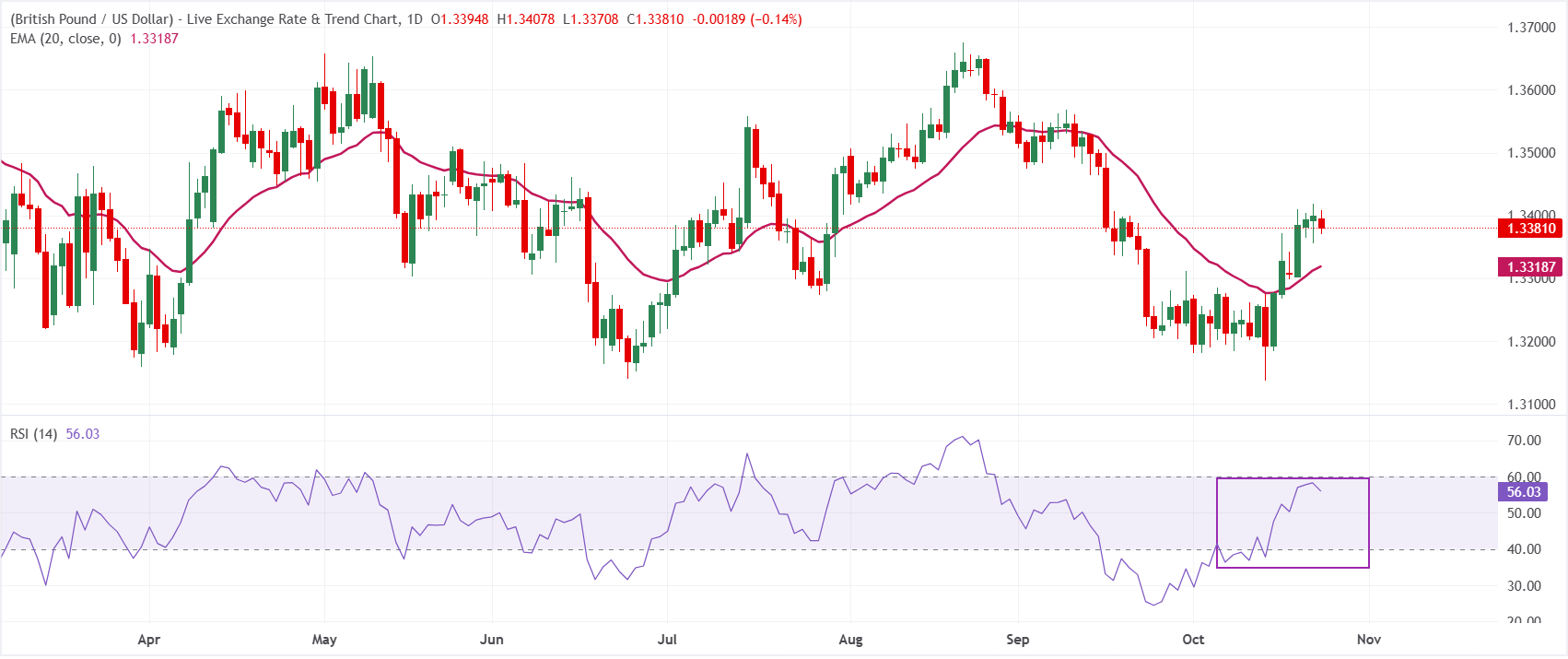
At 1.3381 on the daily chart, GBP/USD remains above its 20-period exponential moving average (EMA) of 1.3319. That positioning supports a mildly bullish short-term outlook as the recovery from recent lows extends. A Relative Strength Index (RSI) reading of 56 indicates positive momentum without overbought conditions, pointing to steady gains rather than an exhausted advance.
The current pivot zone near 1.3381 provides immediate downside support. Below it, the 20-period EMA at 1.3319 marks a stronger area of underlying demand. Holding that average would preserve the broader recovery structure. As the dataset contains no nearby technical resistance levels, further attempts to move higher look likely while support holds. However, a sustained drop below 1.3319 would suggest bullish pressure is weakening.
(The technical analysis of this story was written with the help of an AI tool. Know more.)
Economic Data Indicator
S&P Global Composite PMI
Published monthly, the Composite Purchasing Managers Index (PMI) from S&P Global provides a leading gauge of UK private-sector activity across manufacturing and services. It draws on surveys of senior executives. Responses are weighted by company size and by the contribution to total manufacturing or services output made by the company’s sub-sector. Respondents report any change in the current month relative to the previous month. Their answers can flag shifts ahead of official statistics, including Gross Domestic Product (GDP), industrial production, employment and inflation. On a scale of 0 to 100, a reading of 50.0 denotes no month-on-month change. Readings above 50 suggest broad expansion in the UK private economy, a bullish signal for Pound Sterling (GBP). Below 50, the index points to a general contraction in activity and is regarded as bearish for GBP.
View details.Latest release: Fri 23 October 2026 08:30 (Prel)
Release frequency: Monthly
Actual reading: 53.1
Consensus forecast: 51.8
Previous reading: 52
Data source: S&P Global
POPULAR ARTICLES
1$1.30 support: XRP holds its ground as Ripple teams up with Arf to bring RLUSD settlement liquidity to XRPL2Gold: OCBC cautious on near-term outlook3Japanese Yen gains on safe-haven demand despite US Dollar’s yield advantage4British Pound: BoE tightening expectations face scrutiny – BBH50.8250 in sight: USD/CHF Price Forecast as Dollar recovers some momentum6US Dollar: AI pressures cast doubt on safe-haven status – ING7$4,000: Gold battles to defend support after steep sell-off8Brent prices rise amid geopolitical tensions - Commerzbank9Australian Dollar: Gains Against US Dollar Capped by Consolidation – UOB
LIVE QUOTES


Get Started!
Sign up and access the Global Markets in less than 3 minutes

Connect With Us









Contacts
Phone: +61 2 8036 8388
Fax: +61 2 8036 8388
Email: support@tmgm.com



The information provided on this website is of a general nature only and does not constitute personal financial advice. Before acting on any information on this website, you should consider the suitability of the information in relation to your objectives, financial situation and needs. Investing in CFDs and FX Margin Contracts carries significant risks and is not suitable for all investors. You may lose more than your initial deposit. You do not own, or have, any interest in the underlying asset. We recommend that you seek independent advice and ensure you fully understand the risks involved before trading. It is important that you read and consider the disclosure document before you acquire any product listed on the website. The information and advertisements offered on this website are not intended for use by any person in any country or jurisdiction where such use would be contrary to local laws and regulations. The Products and Services offered on this website are not intended for residents of the United States, Malaysia and Thailand.
TMGM is authorized and regulated in various jurisdictions.
Trademax Australia Limited, trading as TMGM, is regulated by the Australian Securities and Investments Commission (ASIC), AFSL no. 436416 and is located at Level 28, One International Tower, 100 Barangaroo Avenue, 2000 Sydney, NSW Australia.
Email: support@tmgm.com.au
Trademax Global Limited, trading as TMGM, is authorized and regulated by the Vanuatu Financial Services Commission (VFSC), registration number 40356 and registered at 1276, Kumul Highway, Port Vila, Vanuatu, Republic of Vanuatu.
Email: support@tmgm.com
Trademax Global Markets (SE) Limited, trading as TMGM, is authorized and regulated by the Financial Services Authority (FSA) of Seychelles, with license number SD224. The company is registered at Office No 13, Providence Estate ABIS Centre, Mahe, Seychelles.
Email: support@tmgm.com
Trademax Global Markets (International) Pty Ltd, trading as TMGM, is authorized and regulated by the Financial Services Commission, Mauritius (FSC) with license no. GB22201012, and registered at 33, Edith Cavell Street C/o IQ EQ Fund Services (Mauritius) Ltd Port Louis, 11324 Mauritius.
Email: support@tmgm.com
Copyright © TMGM. All rights reserved