

Trading
Explore a wide range of markets with competitive pricing, deep liquidity, and advanced trading tools.
Learn More 
Platform
Trade seamlessly with TMGM's powerful platform, built for speed, precision, and a superior trading experience.
Learn More Trading Platform
Academy
Learn the fundamentals of trading with beginner-friendly resources, including guides, webinars, and market insights.
Learn More News & Analysis
Get real-time market updates and expert analysis to stay ahead of trading opportunities
Learn More News & Analysis
About
Learn what sets TMGM apart — our global presence, regulatory strength, and commitment to innovation in trading.
Learn More Why Choose TMGM
Sponsorship
Dow Jones Industrial Average posts modest gain as funds rotate out of tech stocks
- About two-thirds of the DJIA's advance has unwound. The index remains above Friday's close.
- Over 7% slide in Crude Oil on Iran developments; Sherwin-Williams and Home Depot lead gains.
- Tuesday brings the midterms, followed by October payrolls on Friday.
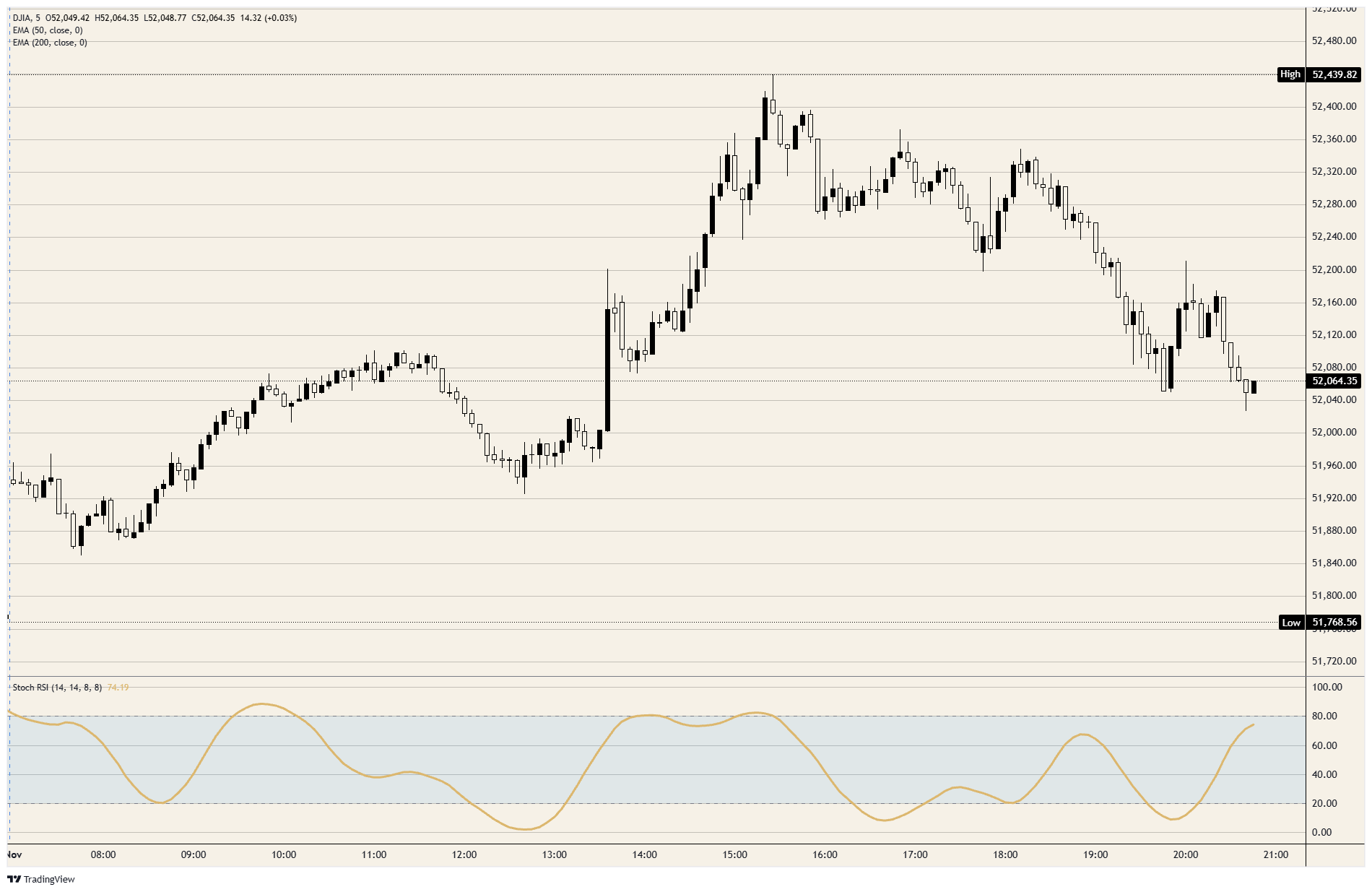
$20 billion is the amount Oracle (ORCL) filed to raise for artificial intelligence (AI). Investors responded by selling technology shares and buying the industrial and retail stocks that make up the Dow Jones Industrial Average. After advancing from just above 51,800 to just below 52,500, the index surrendered about two-thirds of the gain to trade just above 52,000. Trading throughout the session has remained within Friday's range.

Gains of 5.6% for Sherwin-Williams (SHW) and 3.3% for Home Depot (HD) came as construction spending recorded its biggest monthly fall since April 2020, driven largely by housing. Funding and deal developments sent Oracle, Marvell (MRVL) and Lumentum (LITE) down 6%-18%. None belongs to the Dow. Losses among the index's technology constituents were smaller: Nvidia (NVDA) slipped about 0.5%, while Apple (AAPL) shed 2% ahead of its results.
President Trump's statement that he was in no hurry to resume the war with Iran sent Crude Oil more than 7% lower. At 55.5, the Institute for Supply Management (ISM) factory index exceeded the 54.6 forecast, while its prices index declined to 75.2. With orders expanding and fuel costs falling, Dow manufacturers Honeywell (HON), 3M (MMM) and Boeing (BA) each gained more than 2%.
65K Payrolls Forecast: The Week's Data Calendar
Friday's October nonfarm payrolls release at 13:30 GMT is expected to show 65K, up from 29K, while unemployment is forecast to remain at 4.2%. Before that, September job openings arrive on Tuesday at 15:00 GMT. Wednesday's ISM services index, also due at 15:00 GMT, is forecast at 54.8 versus 54.9 previously. All these releases have implications for demand at the industrial and retail companies driving the Dow's advance.
52,100: Dow Trades Below 50-Day EMA
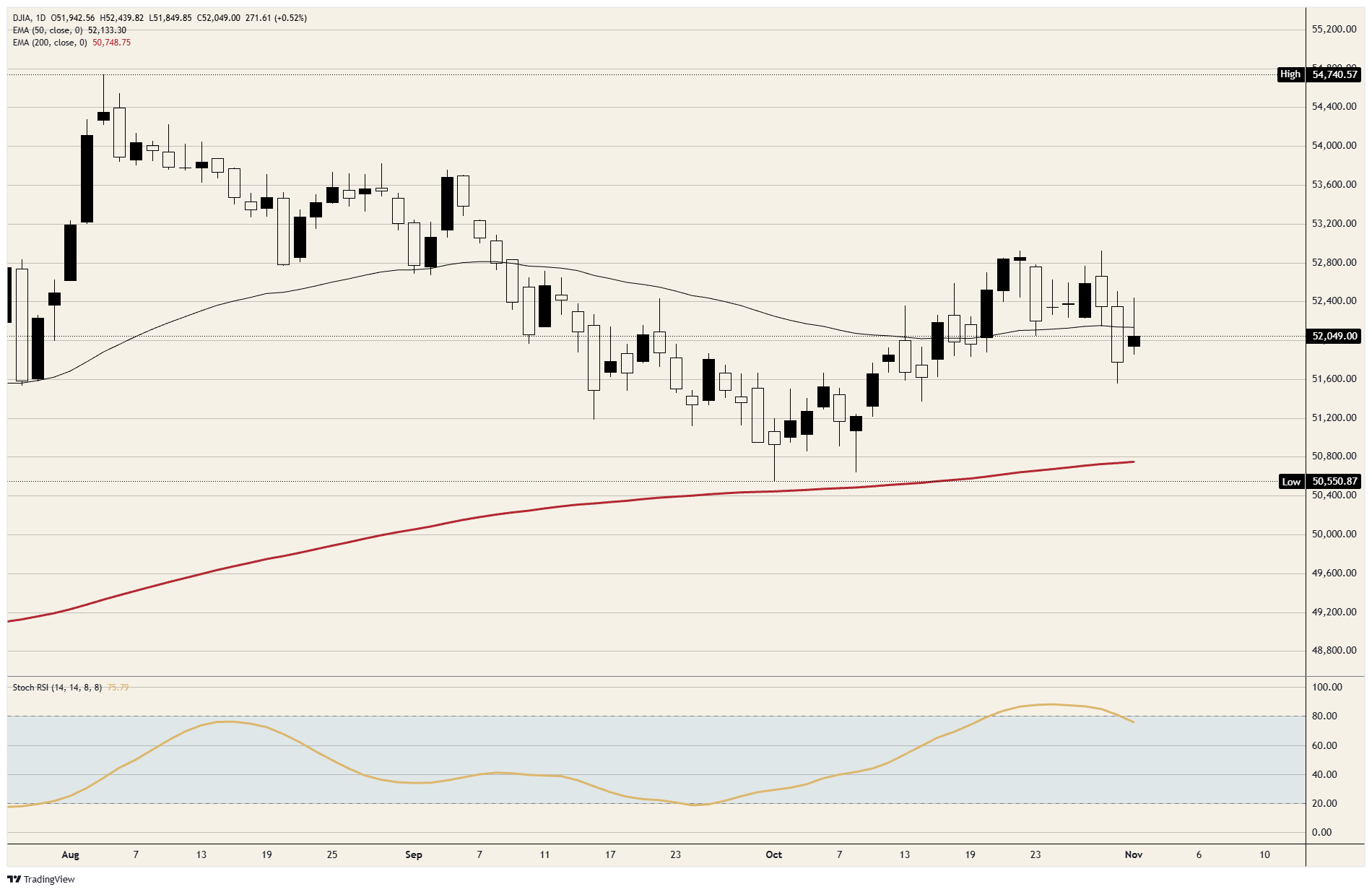
More than a third of the advance from the October 1 low just above 50,500 to the late-October high near 52,900 has been erased. The index now sits just beneath its 50-day Exponential Moving Average (EMA), near 52,100, but remains comfortably above the 200-day EMA near 50,750. After two weeks in overbought territory, daily momentum has moved out of that zone.
5-minute chart: Dow Jones
Daily chart: Dow Jones
Dow Jones: Key Questions Answered
Among the world's oldest stock market indices, the Dow Jones Industrial Average comprises the 30 most actively traded US stocks. Weightings are based on share prices, not market capitalisation. To calculate the index, the constituent share prices are added together and divided by a factor, currently 0.152. Its founder, Charles Dow, also established the Wall Street Journal. In subsequent years, critics have questioned how broadly the index represents the market: it follows only 30 conglomerates, unlike wider benchmarks such as the S&P 500.
Quarterly earnings reports provide the principal driver of the Dow Jones Industrial Average (DJIA), revealing the combined performance of its constituent businesses. Other influences include US and global macroeconomic releases, which shape investor sentiment. Interest rates determined by the Federal Reserve (Fed) also matter: they affect borrowing costs for the many companies that depend heavily on credit. Inflation, alongside other indicators informing Fed decisions, can therefore be a significant force behind the index.
Developed by Charles Dow, Dow Theory seeks to identify the stock market's primary trend. It calls for comparing the direction of the Dow Jones Industrial Average (DJIA) with that of the Dow Jones Transportation Average (DJTA). A trend should only be followed when both indices move in the same direction, with trading volume providing confirmation. Peak-and-trough analysis also forms part of the method. Dow's framework identifies three phases: accumulation, as smart money begins buying or selling; public participation, as the broader public enters; and distribution, as smart money leaves.
Investors can access the DJIA through several instruments. ETFs offer a way to trade the index as one security without purchasing shares in each of its 30 constituent companies. The SPDR Dow Jones Industrial Average ETF (DIA) is a prominent example. Futures contracts allow traders to speculate on the DJIA's future value. Options, by contrast, confer the right, without an obligation, to buy or sell the index at a pre-agreed price on a future date. Mutual funds offer another route: investors purchase a share in a diversified portfolio of DJIA stocks, gaining exposure to the index as a whole.
POPULAR ARTICLES
1Half its gain erased: Euro pulls back on US-Iran diplomacy2Iran talks lift pound to highest level since mid-September3$52.50 Resistance Tests Silver’s Oversold Rebound: Price Forecast4Dow Jones Industrial Average posts modest gain as funds rotate out of tech stocks516% October decline for Ethereum as ETF outflows reach record $1.61B6Forex Today: US elections and RBA in focus as US Dollar weakens7Four-year high for Chinese Yuan despite weak data – Commerzbank8Indonesian Rupiah: MSCI risks and external pressures – OCBC9Mexico's GDP surprise: Mexican Peso surges back as USD/MXN falls


Get Started!
Sign up and access the Global Markets in less than 3 minutes

Connect With Us









Contacts
Phone: +61 2 8036 8388
Fax: +61 2 8036 8388
Email: support@tmgm.com



The information provided on this website is of a general nature only and does not constitute personal financial advice. Before acting on any information on this website, you should consider the suitability of the information in relation to your objectives, financial situation and needs. Investing in CFDs and FX Margin Contracts carries significant risks and is not suitable for all investors. You may lose more than your initial deposit. You do not own, or have, any interest in the underlying asset. We recommend that you seek independent advice and ensure you fully understand the risks involved before trading. It is important that you read and consider the disclosure document before you acquire any product listed on the website. The information and advertisements offered on this website are not intended for use by any person in any country or jurisdiction where such use would be contrary to local laws and regulations. The Products and Services offered on this website are not intended for residents of the United States, Malaysia and Thailand.
TMGM is authorized and regulated in various jurisdictions.
Trademax Australia Limited, trading as TMGM, is regulated by the Australian Securities and Investments Commission (ASIC), AFSL no. 436416 and is located at Level 28, One International Tower, 100 Barangaroo Avenue, 2000 Sydney, NSW Australia.
Email: support@tmgm.com.au
Trademax Global Limited, trading as TMGM, is authorized and regulated by the Vanuatu Financial Services Commission (VFSC), registration number 40356 and registered at 1276, Kumul Highway, Port Vila, Vanuatu, Republic of Vanuatu.
Email: support@tmgm.com
Trademax Global Markets (SE) Limited, trading as TMGM, is authorized and regulated by the Financial Services Authority (FSA) of Seychelles, with license number SD224. The company is registered at Office No 13, Providence Estate ABIS Centre, Mahe, Seychelles.
Email: support@tmgm.com
Trademax Global Markets (International) Pty Ltd, trading as TMGM, is authorized and regulated by the Financial Services Commission, Mauritius (FSC) with license no. GB22201012, and registered at 33, Edith Cavell Street C/o IQ EQ Fund Services (Mauritius) Ltd Port Louis, 11324 Mauritius.
Email: support@tmgm.com
Copyright © TMGM. All rights reserved