

Trading
Explore a wide range of markets with competitive pricing, deep liquidity, and advanced trading tools.
Learn More 
Platform
Trade seamlessly with TMGM's powerful platform, built for speed, precision, and a superior trading experience.
Learn More Trading Platform
Academy
Learn the fundamentals of trading with beginner-friendly resources, including guides, webinars, and market insights.
Learn More News & Analysis
Get real-time market updates and expert analysis to stay ahead of trading opportunities
Learn More News & Analysis
About
Learn what sets TMGM apart — our global presence, regulatory strength, and commitment to innovation in trading.
Learn More Why Choose TMGM
Sponsorship
14-month low: Gold holds near trough as traders prepare for US PCE inflation data
- 14-month low remains close for Gold ahead of Wednesday’s packed US economic calendar.
- With the Fed outlook hawkish, attention turns to US PCE inflation and preliminary Q3 GDP data.
- $3,500 provides immediate support, but the technical picture stays bearish even as conditions remain oversold.
Gold (XAU/USD) trades around $3,531 at the time of writing. The metal is consolidating its losses on Wednesday, sitting just above last week’s 14-month low near $3,502. Traders are adopting a cautious stance before the US Personal Consumption Expenditures (PCE) Price Index release at 13:30 GMT.

All of Gold’s gains from the start of the week have now been erased. Early optimism surrounding Jensen Huang’s return as Nvidia CEO is fading, while renewed questions over the sustainability of the AI boom are weighing on global equities again.
Fading risk appetite has prompted some investors to sell Gold to generate cash and cover margin calls. Others are seeking US government bonds, driving Treasury yields down. Lower yields offer bullion little respite, however, with the US Dollar (USD) remaining firm.
At 4.85%, the benchmark 10-year US Treasury yield has fallen to its lowest level since 9 November. Meanwhile, the US Dollar Index (DXY) remains around 104.00, not far from Monday’s 20-month peak of 104.59.
For Gold, the greater obstacle remains the hawkish outlook for the Federal Reserve (Fed). Warnings from policymakers about persistent inflation risks have led markets to price in consecutive rate increases. Wednesday’s PCE release therefore takes centre stage: it is the last reading of the Fed’s preferred inflation gauge before the December policy meeting.
According to analysts at Commerzbank, “the focus today will be on the October PCE deflator.” Their assessment cites expectations that “the Bloomberg consensus expects headline PCE inflation to pick up to 3.8% yoy from 3.6% in September,” alongside a forecast that “the core PCE deflator is expected at 3.2% yoy from 3.1% previously.” Even with the risk surrounding the release, Commerzbank notes that “the Fed funds futures continue to fully price in a 25bp rate hike in December” and adds that “they are pricing in a total hike of 62bp by end-2027.”
If PCE exceeds forecasts, expectations for additional rate increases beyond December could strengthen, supporting the US Dollar and intensifying pressure on Gold. Conversely, a weaker reading could ease those expectations and allow bullion to regain some ground. Investors will also scrutinise the initial estimate of US third-quarter Gross Domestic Product (GDP). Annualised growth is forecast at 3.4%, unchanged from the previous quarter’s pace.
Technical analysis: Sub-30 RSI leaves Gold sellers in command
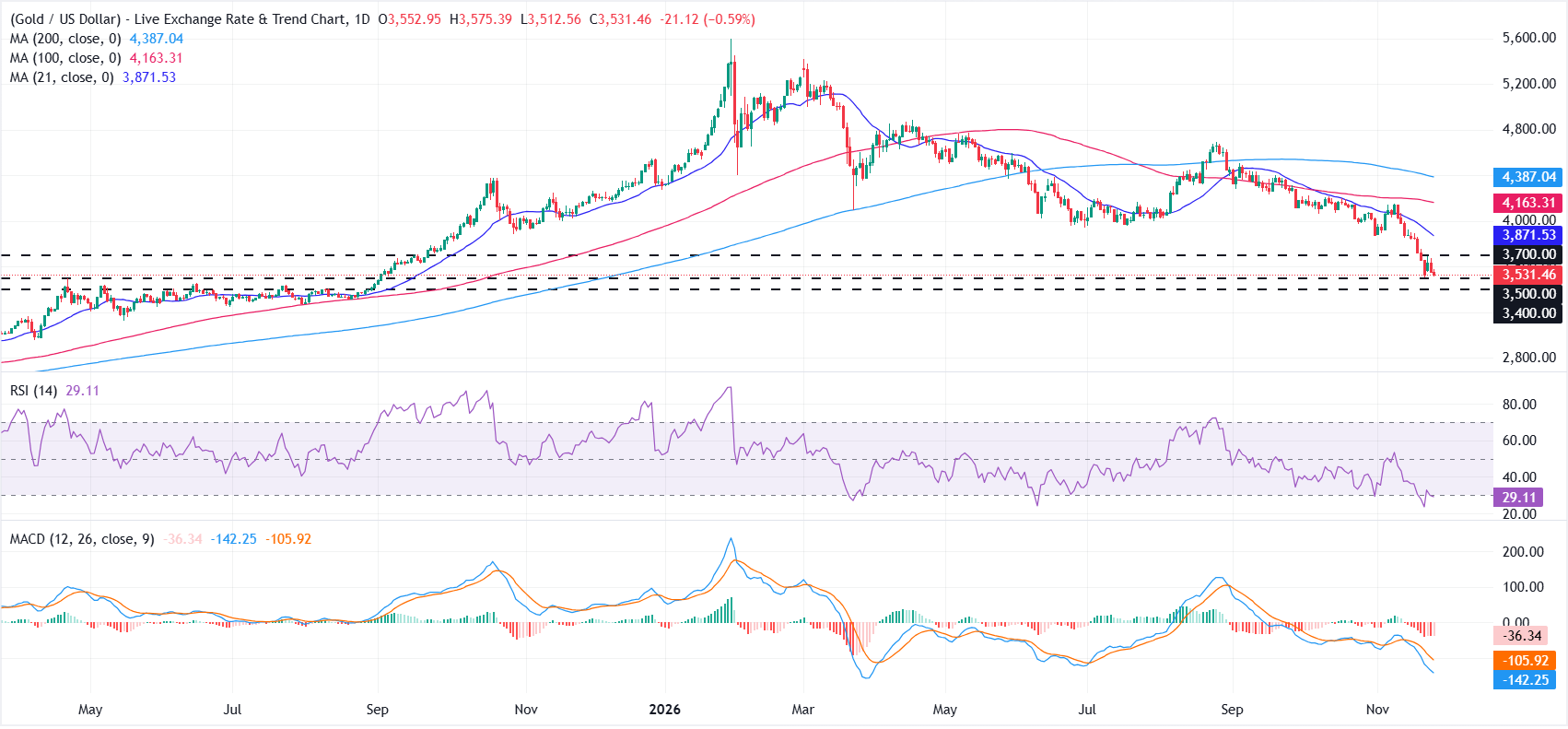
Trading well beneath its 21-day, 100-day and 200-day Simple Moving Averages (SMAs), XAU/USD retains a distinctly bearish daily-chart profile. Those moving averages form an overhead cluster that continues to limit upside. A Relative Strength Index (RSI) reading of 29 signals oversold conditions and suggests the latest decline is stretched, although a convincing recovery has yet to emerge. Meanwhile, the Moving Average Convergence Divergence (MACD) indicator stays below zero. Its weak momentum points to continued selling pressure despite the oversold RSI.
The first upside hurdle is the horizontal resistance near $3,700, followed by the 21-day SMA at $3,871. Beyond that, the 100-day and 200-day SMAs offer resistance at $4,163 and $4,387 respectively. Immediate downside support lies at $3,500, with a more substantial structural floor around $3,400. A clear break beneath this zone would leave scope for additional declines. If the zone holds, however, a corrective recovery towards resistance around $3,700 could follow.
(The technical analysis of this story was written with the help of an AI tool. Know more.)
Inflation: Key questions answered
The increase in prices across a representative basket of goods and services is measured by inflation. Headline readings are generally reported as percentage changes month-on-month (MoM) and year-on-year (YoY). By excluding volatile components such as food and fuel, whose prices can move with geopolitical developments and seasonal influences, core inflation provides the measure economists concentrate on. Central banks also target this measure in fulfilling their mandate to maintain manageable inflation, typically around 2%.
Changes in the cost of a basket of goods and services over time are tracked by the Consumer Price Index (CPI). The measure is generally reported as a percentage change month-on-month (MoM) and year-on-year (YoY). Central banks target Core CPI, which strips out volatile food and fuel components. Readings above 2% typically lead to higher interest rates, while readings below 2% tend to produce the reverse response. Higher rates support a currency, so rising inflation generally strengthens it. Falling inflation usually has the opposite effect.
A country’s currency tends to appreciate when inflation is high and weaken when inflation is low, even if that relationship appears counter-intuitive. Central banks normally respond to elevated inflation by raising interest rates. Those higher rates draw additional international capital from investors seeking attractive returns on their funds.
Historically, investors sought Gold during periods of high inflation for its ability to retain value. They still often buy the metal as a safe haven during extreme market disruption, but this pattern does not apply most of the time. Elevated inflation prompts central banks to raise interest rates to bring price pressures under control. For Gold, higher rates are a headwind: they raise the opportunity cost of holding the metal rather than an interest-bearing asset or a cash deposit. Conversely, lower inflation generally supports Gold by bringing interest rates down and improving its appeal as an alternative investment.
POPULAR ARTICLES
1Below 0.5500: NZD/USD Price Forecast points to continued Kiwi vulnerability as rallies stall2Market pricing not entirely unreasonable, ECB's Kocher suggests - Bloomberg3Euro weathers Dollar turbulence – ING4US PCE inflation tests Fed tightening bets as euro retreats5Brazilian Real: Cautious recovery underpinned by fiscal progress – Societe Generale6104.38: Australian Dollar hits fresh YTD low versus Japanese Yen714-month low: Gold holds near trough as traders prepare for US PCE inflation data8Above $81.00 again: WTI oil rises as Strait of Hormuz attacks intensify9Crypto Today: Recovery outlook dims for Bitcoin, Ethereum and XRP


Get Started!
Sign up and access the Global Markets in less than 3 minutes

Connect With Us









Contacts
Phone: +61 2 8036 8388
Fax: +61 2 8036 8388
Email: support@tmgm.com



The information provided on this website is of a general nature only and does not constitute personal financial advice. Before acting on any information on this website, you should consider the suitability of the information in relation to your objectives, financial situation and needs. Investing in CFDs and FX Margin Contracts carries significant risks and is not suitable for all investors. You may lose more than your initial deposit. You do not own, or have, any interest in the underlying asset. We recommend that you seek independent advice and ensure you fully understand the risks involved before trading. It is important that you read and consider the disclosure document before you acquire any product listed on the website. The information and advertisements offered on this website are not intended for use by any person in any country or jurisdiction where such use would be contrary to local laws and regulations. The Products and Services offered on this website are not intended for residents of the United States, Malaysia and Thailand.
TMGM is authorized and regulated in various jurisdictions.
Trademax Australia Limited, trading as TMGM, is regulated by the Australian Securities and Investments Commission (ASIC), AFSL no. 436416 and is located at Level 28, One International Tower, 100 Barangaroo Avenue, 2000 Sydney, NSW Australia.
Email: support@tmgm.com.au
Trademax Global Limited, trading as TMGM, is authorized and regulated by the Vanuatu Financial Services Commission (VFSC), registration number 40356 and registered at 1276, Kumul Highway, Port Vila, Vanuatu, Republic of Vanuatu.
Email: support@tmgm.com
Trademax Global Markets (SE) Limited, trading as TMGM, is authorized and regulated by the Financial Services Authority (FSA) of Seychelles, with license number SD224. The company is registered at Office No 13, Providence Estate ABIS Centre, Mahe, Seychelles.
Email: support@tmgm.com
Trademax Global Markets (International) Pty Ltd, trading as TMGM, is authorized and regulated by the Financial Services Commission, Mauritius (FSC) with license no. GB22201012, and registered at 33, Edith Cavell Street C/o IQ EQ Fund Services (Mauritius) Ltd Port Louis, 11324 Mauritius.
Email: support@tmgm.com
Copyright © TMGM. All rights reserved