

Trading
Explore a wide range of markets with competitive pricing, deep liquidity, and advanced trading tools.
Learn More 
Platform
Trade seamlessly with TMGM's powerful platform, built for speed, precision, and a superior trading experience.
Learn More Trading Platform
Academy
Learn the fundamentals of trading with beginner-friendly resources, including guides, webinars, and market insights.
Learn More News & Analysis
Get real-time market updates and expert analysis to stay ahead of trading opportunities
Learn More News & Analysis
About
Learn what sets TMGM apart — our global presence, regulatory strength, and commitment to innovation in trading.
Learn More Why Choose TMGM
Sponsorship
Gold falls as Fed rate-hike bets outweigh US Dollar weakness
- Nearly 1.90% lower, XAU/USD trades around $3,570 despite a softer US.
- 96% nears for Fed rate-hike odds, eclipsing the decline in US Treasury yields.
- Rate expectations could shift with the US Core PCE and GDP releases.
Gold (XAU/USD) is down almost 1.90% at around $3,570 at the time of writing. Prices drift lower in Tuesday’s North American session as risk appetite weakens. Investors appear confident of a Federal Reserve (Fed) rate rise at the December meeting as they prepare for key US inflation figures.

December rate-hike bets keep Gold under pressure despite lower yields
Following Nvidia’s reinstatement of Jensen Huang as CEO, Tuesday’s trading has brought sharp declines in US equities, Treasury yields, Gold and the US Dollar. Reports that the Trump administration is considering additional strikes on Iran have also intensified, after NBC reported that the White House is assessing whether to target Iranian leaders.
Following the Nvidia scandal, attention has returned to Trump’s tariffs. Sanctions have been imposed by the US Treasury on subsidiaries of Chinese companies in Singapore. Separately, the Wall Street Journal reported that the US is preparing tariff increases on China, the European Union (EU), and 14 other countries.
November Consumer Confidence climbed to 103.3 from 91.9, beating the 92.5 forecast, according to the Conference Board (CB). Earlier figures showed the ADP Employment Change 4-week average easing to 21K from 23K. That points to a softening US labour market that remains stable.
Positive data failed to lift the Greenback as declining US Treasury yields weighed on the currency. The US Dollar Index (DXY), which tracks the currency against six peers, has fallen 0.45% to 103.85. The yield on the US 10-year Treasury note is five basis points lower at 4.892%.
A 25 basis point Fed rate increase at the December 8-9 meeting carries a nearly 96% probability in money-market pricing, according to the CME FedWatch Tool.
New York Fed President John Williams said a day earlier that more work was needed to bring inflation down. His forecast puts inflation near 3.5% at the end of 2026, with the 2% target reached in 2028.
Wednesday brings a full US economic calendar in a week shortened by the Thanksgiving holidays. Traders await the Core Personal Consumption Expenditures (PCE) Price Index inflation report, with Gross Domestic Product (GDP) figures due afterwards.
Separately, JPMorgan projects a recovery in Gold to $4,500 an ounce by the end of 2027.
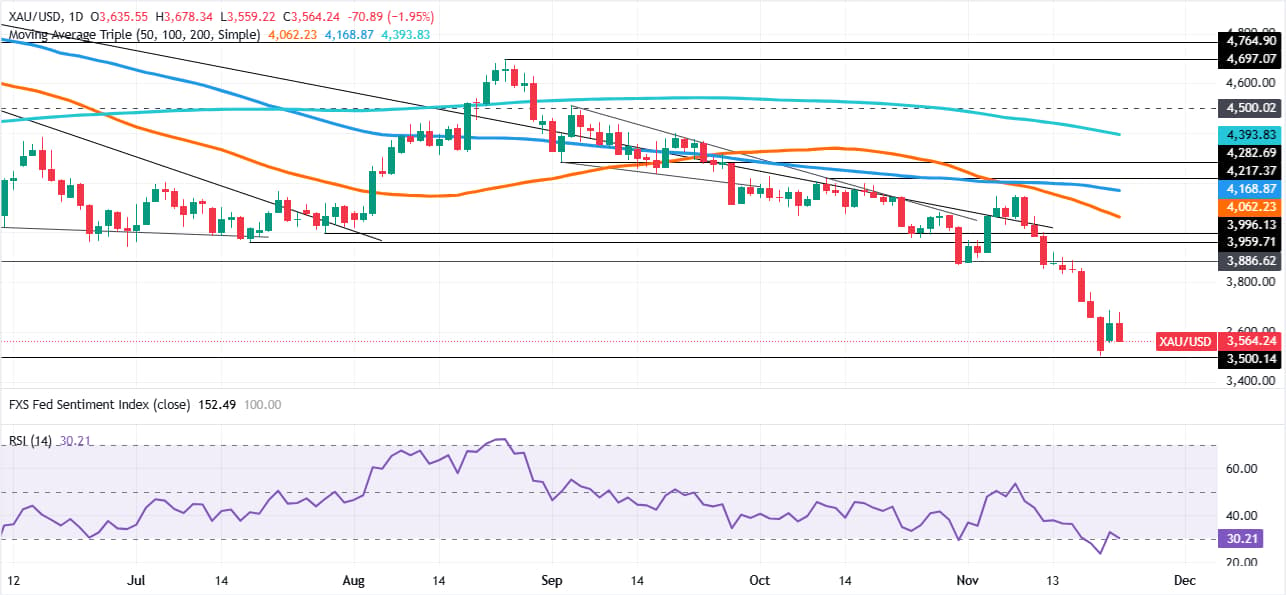
$3,500 in focus as Gold resumes decline: XAU/USD technical analysis
Gold is reversing course after Monday’s price action. A close on Tuesday below the previous session’s low of the day (LOD) at $3,554 would complete a ‘bearish engulfing’ candlestick pattern, opening the way for additional losses.
The Relative Strength Index (RSI) is close to returning to oversold territory, signalling the strength of sellers. Sentiment has shifted sharply from the previous day.
A break by XAU/USD below $3,500, the April 22, 2025, swing high that now acts as support, would leave traders considering further downside. Support would next come at the July 30, 2025, swing low of $3,268, followed by $3,000.
For a recovery, bullion must first overcome last week’s high at $3,901 before reaching $4,000. Breaking above $4,000 would bring the 50-day Simple Moving Average (SMA) at $4,062 into view.
Gold: frequently asked questions
Widely used to store value and facilitate exchange, Gold has held an important place throughout human history. Beyond its lustre and use in jewellery, the precious metal is now broadly regarded as a safe-haven asset and therefore a good investment in turbulent periods. Its independence from any particular issuer or government also underpins its widespread role as a hedge against inflation and currency depreciation.
The largest holders of Gold are central banks. To support their currencies during turbulent periods, they typically diversify reserves and purchase Gold, strengthening perceptions of their economies and currencies. Substantial Gold reserves can bolster confidence in a country’s solvency. World Gold Council data show that central banks increased their reserves by 1,136 tonnes in 2022, worth around $70 billion. No higher annual purchase has been recorded since records began. Emerging-economy central banks, including those in China, India and Turkey, are rapidly expanding their Gold holdings.
The US Dollar and US Treasuries, both major reserve and safe-haven assets, have an inverse relationship with Gold. Dollar depreciation typically supports Gold prices, allowing investors and central banks to diversify holdings during unsettled periods. Risk assets also tend to move in the opposite direction to Gold. Equity-market rallies generally put pressure on the metal, whereas selling in riskier markets tends to support it.
Many factors influence Gold prices. Its safe-haven appeal means geopolitical instability or concerns over a deep recession can trigger rapid gains. Because Gold pays no yield, lower interest rates typically support it, while higher borrowing costs usually weigh on the metal. Most price movements nevertheless hinge on the US Dollar (USD), as Gold is quoted in dollars (XAU/USD). Dollar strength tends to restrain Gold prices; a weaker Dollar is more likely to lift them.
POPULAR ARTICLES
1Canadian Dollar gains as BoC Governor highlights lingering inflation risks2Oil shock fuels inflation: BoC’s Macklem flags rate hike risk3Gold falls as Fed rate-hike bets outweigh US Dollar weakness4GBP/USD rebounds as BoE rate-hike bets offset USD strength: Pound Sterling price news and forecast527% November decline: Dogecoin price forecast puts $0.05 in focus for DOGE6Renewed US tariff concerns drive safe-haven demand for Japanese Yen7BoE hike bets drive British Pound rebound despite USD strength8December rate hike by European Central Bank viewed as almost certain – Nordea9103.3 in November: US CB Consumer Confidence Index rises


Get Started!
Sign up and access the Global Markets in less than 3 minutes

Connect With Us









Contacts
Phone: +61 2 8036 8388
Fax: +61 2 8036 8388
Email: support@tmgm.com



The information provided on this website is of a general nature only and does not constitute personal financial advice. Before acting on any information on this website, you should consider the suitability of the information in relation to your objectives, financial situation and needs. Investing in CFDs and FX Margin Contracts carries significant risks and is not suitable for all investors. You may lose more than your initial deposit. You do not own, or have, any interest in the underlying asset. We recommend that you seek independent advice and ensure you fully understand the risks involved before trading. It is important that you read and consider the disclosure document before you acquire any product listed on the website. The information and advertisements offered on this website are not intended for use by any person in any country or jurisdiction where such use would be contrary to local laws and regulations. The Products and Services offered on this website are not intended for residents of the United States, Malaysia and Thailand.
TMGM is authorized and regulated in various jurisdictions.
Trademax Australia Limited, trading as TMGM, is regulated by the Australian Securities and Investments Commission (ASIC), AFSL no. 436416 and is located at Level 28, One International Tower, 100 Barangaroo Avenue, 2000 Sydney, NSW Australia.
Email: support@tmgm.com.au
Trademax Global Limited, trading as TMGM, is authorized and regulated by the Vanuatu Financial Services Commission (VFSC), registration number 40356 and registered at 1276, Kumul Highway, Port Vila, Vanuatu, Republic of Vanuatu.
Email: support@tmgm.com
Trademax Global Markets (SE) Limited, trading as TMGM, is authorized and regulated by the Financial Services Authority (FSA) of Seychelles, with license number SD224. The company is registered at Office No 13, Providence Estate ABIS Centre, Mahe, Seychelles.
Email: support@tmgm.com
Trademax Global Markets (International) Pty Ltd, trading as TMGM, is authorized and regulated by the Financial Services Commission, Mauritius (FSC) with license no. GB22201012, and registered at 33, Edith Cavell Street C/o IQ EQ Fund Services (Mauritius) Ltd Port Louis, 11324 Mauritius.
Email: support@tmgm.com
Copyright © TMGM. All rights reserved