

Trading
Explore a wide range of markets with competitive pricing, deep liquidity, and advanced trading tools.
Learn More 
Platform
Trade seamlessly with TMGM's powerful platform, built for speed, precision, and a superior trading experience.
Learn More Trading Platform
Academy
Learn the fundamentals of trading with beginner-friendly resources, including guides, webinars, and market insights.
Learn More News & Analysis
Get real-time market updates and expert analysis to stay ahead of trading opportunities
Learn More News & Analysis
About
Learn what sets TMGM apart — our global presence, regulatory strength, and commitment to innovation in trading.
Learn More Why Choose TMGM
Sponsorship
Surprise RBNZ rate hold sends New Zealand Dollar tumbling
- An unchanged policy rate from the RBNZ leaves the New Zealand Dollar trailing its peers.
- A 25 bps OCR increase to 3% had been expected from the RBNZ.
- An unchanged interest rate decision is expected from the Fed by investors.
The New Zealand Dollar (NZD) is down 1.28% against the US Dollar (USD), near 0.5600. The kiwi is also sharply weaker against its other major currency peers on Wednesday.
New Zealand Dollar: Today's Currency Moves
Today's percentage moves in the New Zealand Dollar (NZD) against the major currencies listed appear in the table below. Its largest decline was against the Australian Dollar.
| USD | EUR | GBP | JPY | CAD | AUD | NZD | CHF | |
|---|---|---|---|---|---|---|---|---|
| USD | 0.07% | 0.16% | -0.02% | 0.08% | -0.11% | 1.21% | 0.19% | |
| EUR | -0.07% | 0.09% | -0.09% | 0.01% | -0.18% | 1.13% | 0.12% | |
| GBP | -0.16% | -0.09% | -0.17% | -0.08% | -0.28% | 1.05% | 0.02% | |
| JPY | 0.02% | 0.09% | 0.17% | 0.09% | -0.10% | 1.21% | 0.18% | |
| CAD | -0.08% | -0.01% | 0.08% | -0.09% | -0.19% | 1.12% | 0.11% | |
| AUD | 0.11% | 0.18% | 0.28% | 0.10% | 0.19% | 1.33% | 0.30% | |
| NZD | -1.21% | -1.13% | -1.05% | -1.21% | -1.12% | -1.33% | -1.00% | |
| CHF | -0.19% | -0.12% | -0.02% | -0.18% | -0.11% | -0.30% | 1.00% |
Percentage movements between the major currencies are displayed in the heat map. Select the base currency in the left-hand column and the quote currency in the top row. Selecting the New Zealand Dollar on the left and following its row across to the US Dollar, for instance, gives the percentage change for NZD (base)/USD (quote) in the corresponding cell.

At 2.75%, the Official Cash Rate (OCR) was unexpectedly left unchanged by the Reserve Bank of New Zealand (RBNZ) at its policy meeting. Markets had widely expected a 25 basis points (bps) increase to 3%.
Further tightening nevertheless remains an option for RBNZ Governor Anna Breman, who has signalled more tightening than previously expected.
In its monetary policy statement, the RBNZ said: “More OCR hikes probable, but dependent on economic outlook,” while Reuters reported RBNZ Governor Breman as saying: “They may even be higher than we said at the September meeting.”
Ahead of the Federal Reserve’s (Fed) monetary policy announcement, the US Dollar is extending its gains into a fourth consecutive trading day on Wednesday. At the time of writing, the US Dollar Index (DXY) is marginally higher near 101.43. The index measures the Greenback against six major currencies.
With the Fed widely expected to maintain interest rates in the 3.75%-4.00% range, its communication takes centre stage as a key influence on the US Dollar’s outlook.
Limited developments in formal communication are expected by economists at Deutsche Bank at the upcoming Fed decision. They anticipate “the statement itself [is] to contain only limited changes, although dissents to a hold are possible.” For the economists, “the interest will therefore be in Chair Warsh’s press conference and how the Fed balances still-elevated inflation and solid growth against the recent tightening in financial conditions,” as markets are likely to examine his comments for any change in the policy narrative.
NZD/USD: Bearish Near-Term Technical Outlook
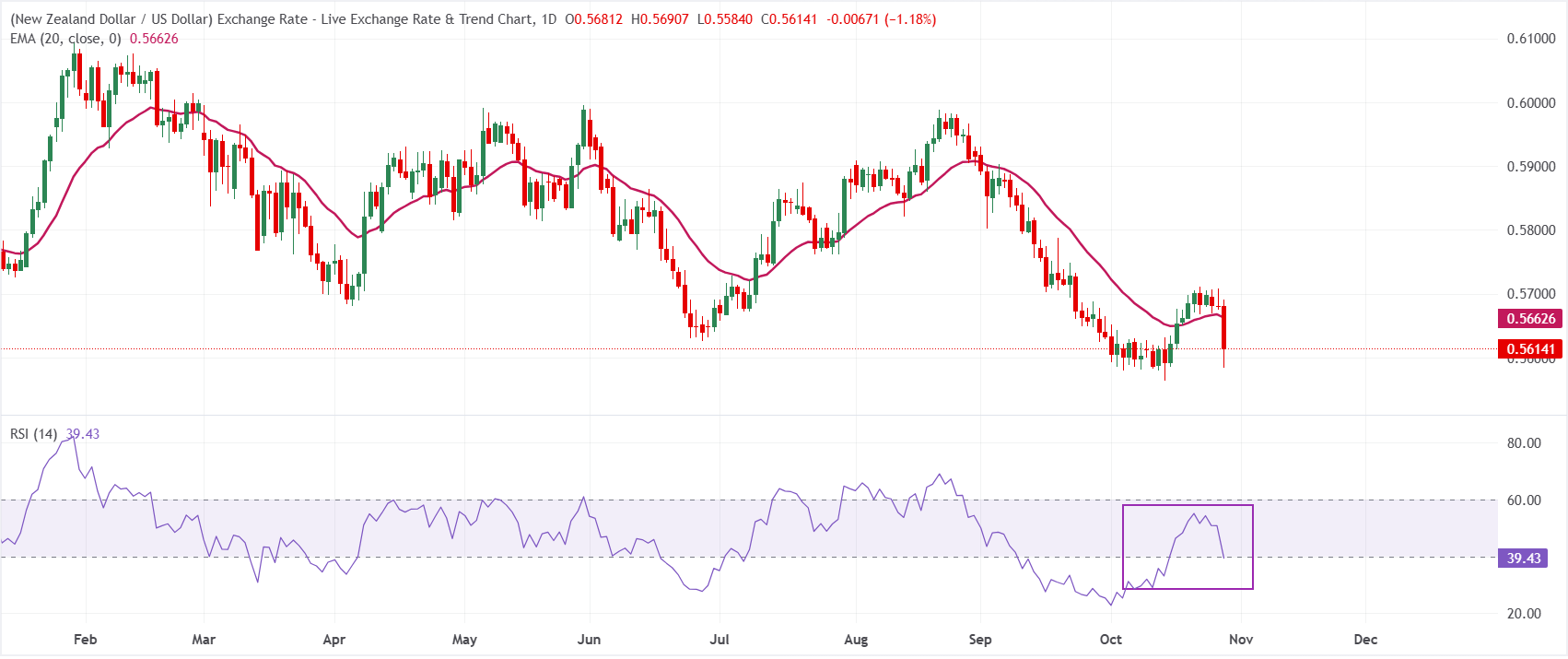
At 0.5614 on the daily chart, NZD/USD retains a bearish near-term bias below the 20-day Exponential Moving Average (EMA) of 0.5663. Recent sessions have seen the pair fail to hold this moving average, leaving it under pressure. Although the Relative Strength Index (RSI), at 39, is recovering from oversold territory, it remains tilted to the downside. Rebounds below the 0.57 area may therefore continue to attract sellers.
The 20-day EMA around 0.5663 marks the first resistance level. A daily close above it would reduce immediate downside pressure and clear a path towards last week’s highs. With no nearby technical support mapped in the current dataset, recent lows provide only a tentative floor. A decisive break below the 0.56 handle would therefore be likely to leave the pair exposed to further losses within the broader downtrend.
Economic Data Release
RBNZ Policy Rate Decision
Following each of its seven scheduled policy meetings a year, the Reserve Bank of New Zealand (RBNZ) releases its interest rate decision. A hawkish RBNZ that identifies rising inflationary pressure increases the Official Cash Rate (OCR) to curb inflation. Higher rates draw in more capital, supporting the New Zealand Dollar (NZD). Conversely, when the central bank judges inflation to be too low, it cuts the OCR, typically weakening the NZD.
Read further.Latest release: Wed 28 Oct 2026 01:00
Release frequency: No fixed schedule
Reported figure: 2.75%
Market consensus: 3%
Prior reading: 2.75%
Data source: Reserve Bank of New Zealand
Seven times a year, the Reserve Bank of New Zealand (RBNZ) meets to decide monetary policy. It then announces its interest rate decision and the economic assessments behind it. Signals about the economic outlook and future policy direction are particularly important for NZD valuation. Stronger economic conditions and an optimistic outlook could prompt the RBNZ to raise interest rates to tighten policy, a move that typically supports the NZD. Interim Governor Christian Hawkesby usually holds a press conference after the policy announcements.
(The technical analysis of this story was written with the help of an AI tool. Know more.)
POPULAR ARTICLES
1Euro seems vulnerable near yearly low, Fed-ECB policy is under spotlight2US Dollar: Dovish Fed surprise may trigger Dollar weakness, says MUFG3Above 102.00: US Dollar Index Price Forecast as DXY Hovers Near Two-Week High Ahead of FOMC4Dow Jones futures fall with Fed decision and big tech earnings in focus5Hot CPI strengthens hawkish RBA expectations, driving Australian Dollar outperformance6RBNZ pause points to New Zealand Dollar downside risk against US Dollar – Commerzbank7BoC rate decision nears as Euro maintains gains against Canadian Dollar8Euro posts modest recovery from yearly lows as British Pound eases ahead of UK budget9Equities: AI enthusiasm drives further global tech gains – Deutsche Bank
LIVE QUOTES


Get Started!
Sign up and access the Global Markets in less than 3 minutes

Connect With Us









Contacts
Phone: +61 2 8036 8388
Fax: +61 2 8036 8388
Email: support@tmgm.com



The information provided on this website is of a general nature only and does not constitute personal financial advice. Before acting on any information on this website, you should consider the suitability of the information in relation to your objectives, financial situation and needs. Investing in CFDs and FX Margin Contracts carries significant risks and is not suitable for all investors. You may lose more than your initial deposit. You do not own, or have, any interest in the underlying asset. We recommend that you seek independent advice and ensure you fully understand the risks involved before trading. It is important that you read and consider the disclosure document before you acquire any product listed on the website. The information and advertisements offered on this website are not intended for use by any person in any country or jurisdiction where such use would be contrary to local laws and regulations. The Products and Services offered on this website are not intended for residents of the United States, Malaysia and Thailand.
TMGM is authorized and regulated in various jurisdictions.
Trademax Australia Limited, trading as TMGM, is regulated by the Australian Securities and Investments Commission (ASIC), AFSL no. 436416 and is located at Level 28, One International Tower, 100 Barangaroo Avenue, 2000 Sydney, NSW Australia.
Email: support@tmgm.com.au
Trademax Global Limited, trading as TMGM, is authorized and regulated by the Vanuatu Financial Services Commission (VFSC), registration number 40356 and registered at 1276, Kumul Highway, Port Vila, Vanuatu, Republic of Vanuatu.
Email: support@tmgm.com
Trademax Global Markets (SE) Limited, trading as TMGM, is authorized and regulated by the Financial Services Authority (FSA) of Seychelles, with license number SD224. The company is registered at Office No 13, Providence Estate ABIS Centre, Mahe, Seychelles.
Email: support@tmgm.com
Trademax Global Markets (International) Pty Ltd, trading as TMGM, is authorized and regulated by the Financial Services Commission, Mauritius (FSC) with license no. GB22201012, and registered at 33, Edith Cavell Street C/o IQ EQ Fund Services (Mauritius) Ltd Port Louis, 11324 Mauritius.
Email: support@tmgm.com
Copyright © TMGM. All rights reserved