

Trading
Explore a wide range of markets with competitive pricing, deep liquidity, and advanced trading tools.
Learn More 
Platform
Trade seamlessly with TMGM's powerful platform, built for speed, precision, and a superior trading experience.
Learn More Trading Platform
Academy
Learn the fundamentals of trading with beginner-friendly resources, including guides, webinars, and market insights.
Learn More News & Analysis
Get real-time market updates and expert analysis to stay ahead of trading opportunities
Learn More News & Analysis
About
Learn what sets TMGM apart — our global presence, regulatory strength, and commitment to innovation in trading.
Learn More Why Choose TMGM
Sponsorship
Polkadot Price Forecast: DOT surges after dotUSD stablecoin launch
- Polkadot gains momentum and trades around $1.1800 on Friday as bulls return.
- Polkadot’s DAO-governed dotUSD has gone live on the protocol, promising a community-led stablecoin.
- DOT’s recovery builds on a robust technical structure, backed by the 50-day and 100-day EMAs.
Polkadot (DOT) maintains a short-term bullish outlook on Friday, approaching $1.1800 at the time of writing. The token is broadly supported by short-term and medium-term moving averages, underpinning a firm technical structure.
Nonetheless, investors should remain cautious, as significant supply persists near $1.1800. A decisive daily close above this threshold would further strengthen the bullish momentum.

Polkadot launches dotUSD stablecoin
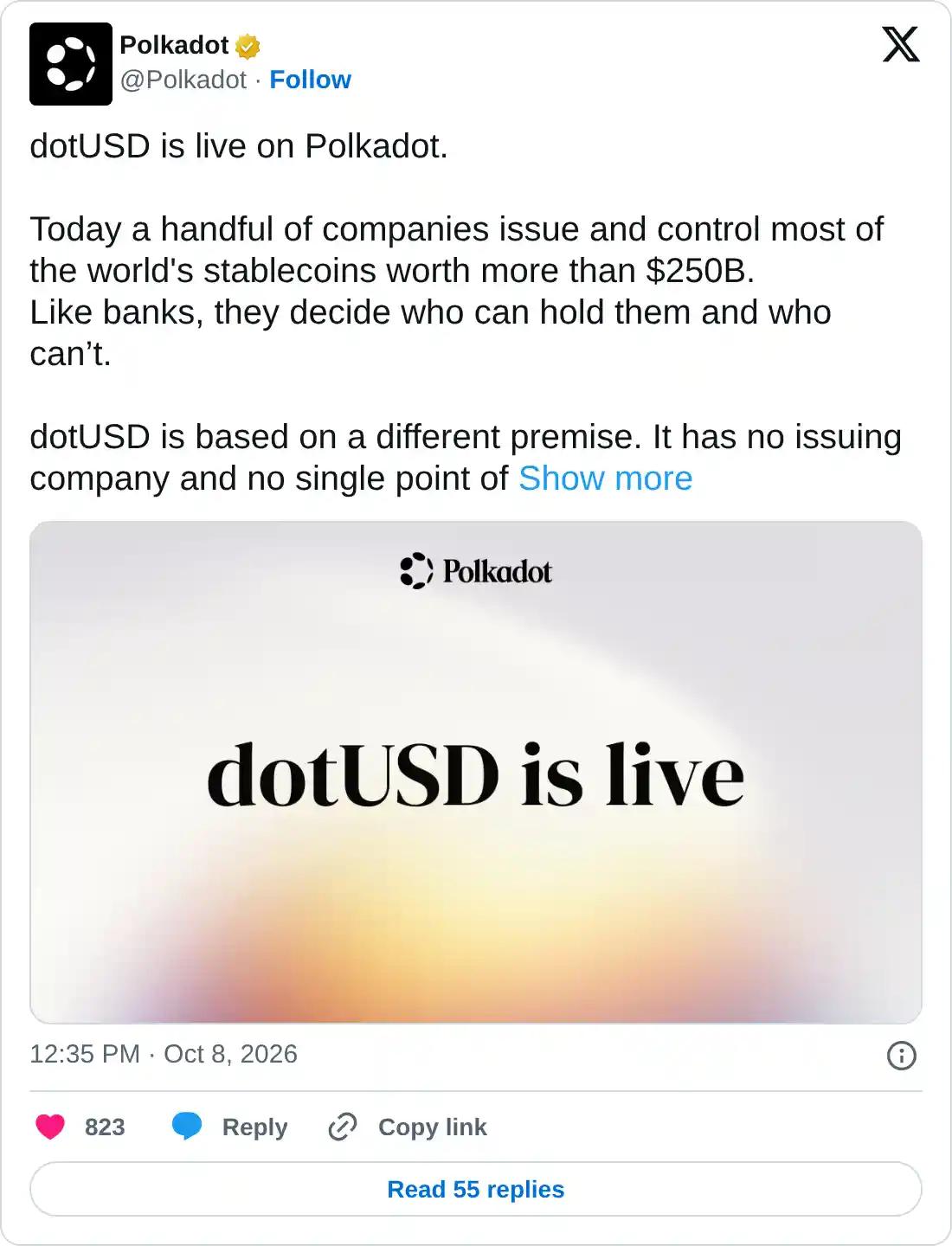
Polkadot announced the launch of a new stablecoin, dotUSD, on Thursday, seeking to tap into the sector's $292 billion market capitalization. The network said dotUSD is fundamentally different from most leading stablecoins, which companies issue and control.
These companies, like banks, “decide who can hold them (stablecoins) and who can’t,” Polkadot said on X. DotUSD operates on a different premise, with no issuing company nor a single point of control. The stablecoin is governed by the DOT DAO through OpenGov. A DAO is a decentralized autonomous organization.
Technical analysis: Polkadot bulls tighten grip
Polkadot rises as buyers take on more risk against the backdrop of dotUSD launching. The token now trades at $1.1780, holding above the short- and medium-term Exponential Moving Averages (EMAs) but still capped by the longer-term 200-day EMA at $1.1864, which keeps the near-term bias mildly bearish despite the recent recovery.
The 50-day EMA at $1.0749 and the 100-day EMA at $1.0341 sit comfortably below price, suggesting an improving underlying trend, while the SuperTrend indicator at $0.9842 reinforces a broader support base. Momentum is mixed, as the Relative Strength Index (RSI) at 54 leans slightly positive, but the Moving Average Convergence Divergence (MACD) remains in negative territory, hinting that upside attempts could still face selling pressure while price trades beneath the 200-day EMA.
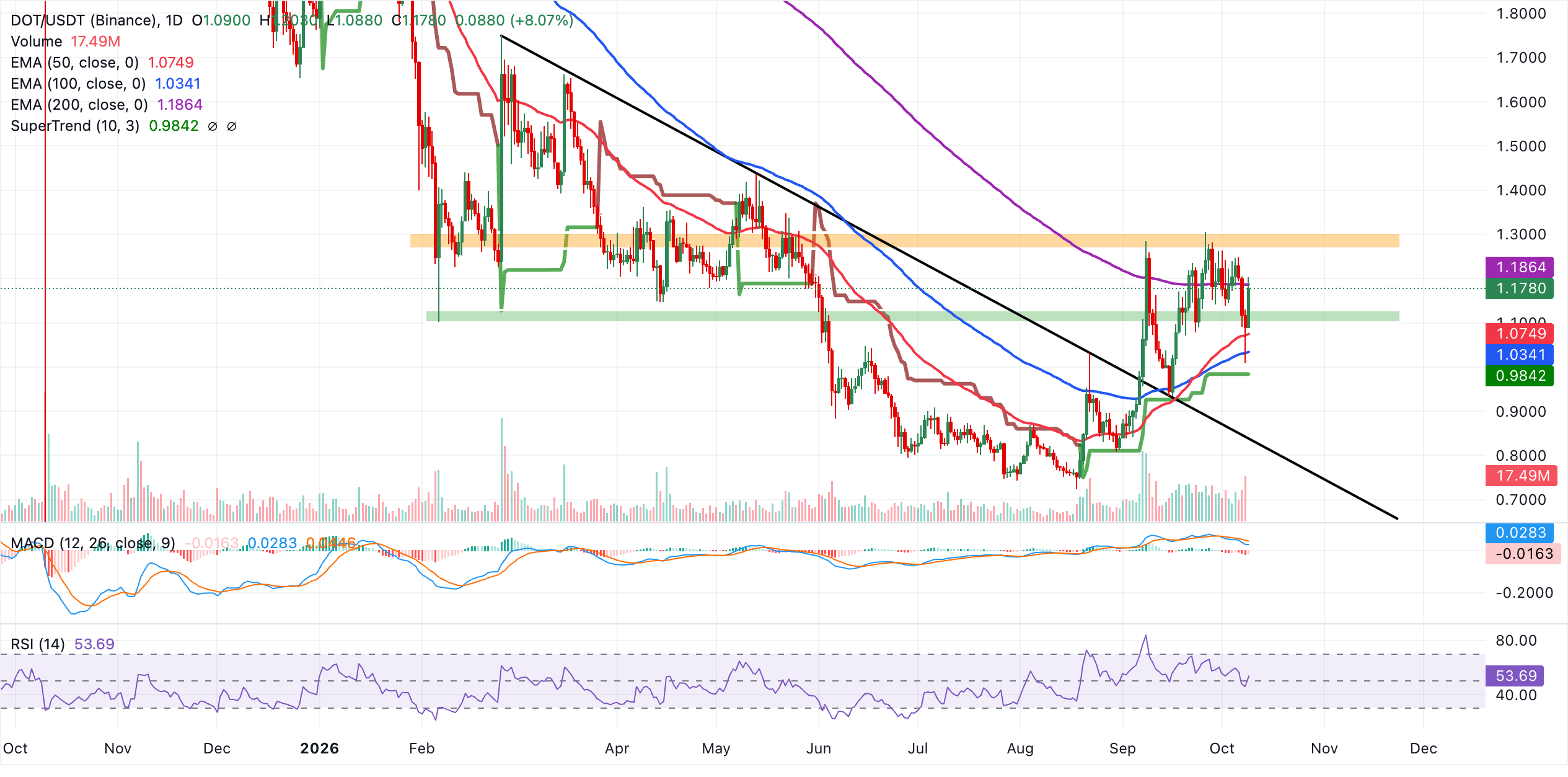
Initial resistance is defined by the 200-day EMA at $1.1864, and a daily close above this barrier would be needed to soften the prevailing bearish cap and open the way for a more sustained advance. On the downside, immediate support is located at the 50-day EMA at $1.0749, followed by the 100-day EMA at $1.0341, before a deeper corrective move could test the SuperTrend line near $0.9842, where buyers are likely to defend the broader bullish recovery structure.
(The technical analysis of this story was written with the help of an AI tool. Know more.)
Bitcoin, altcoins, stablecoins FAQs
Bitcoin is the largest cryptocurrency by market capitalization, a virtual currency designed to serve as money. This form of payment cannot be controlled by any one person, group, or entity, which eliminates the need for third-party participation during financial transactions.
Altcoins are any cryptocurrency apart from Bitcoin, but some also regard Ethereum as a non-altcoin because it is from these two cryptocurrencies that forking happens. If this is true, then Litecoin is the first altcoin, forked from the Bitcoin protocol and, therefore, an “improved” version of it.
Stablecoins are cryptocurrencies designed to have a stable price, with their value backed by a reserve of the asset it represents. To achieve this, the value of any one stablecoin is pegged to a commodity or financial instrument, such as the US Dollar (USD), with its supply regulated by an algorithm or demand. The main goal of stablecoins is to provide an on/off-ramp for investors willing to trade and invest in cryptocurrencies. Stablecoins also allow investors to store value since cryptocurrencies, in general, are subject to volatility.
Bitcoin dominance is the ratio of Bitcoin's market capitalization to the total market capitalization of all cryptocurrencies combined. It provides a clear picture of Bitcoin’s interest among investors. A high BTC dominance typically happens before and during a bull run, in which investors resort to investing in relatively stable and high market capitalization cryptocurrency like Bitcoin. A drop in BTC dominance usually means that investors are moving their capital and/or profits to altcoins in a quest for higher returns, which usually triggers an explosion of altcoin rallies.
POPULAR ARTICLES
1Poland: Inflation outlook stabilises – ING2WTI holds steady as traders weigh US-Iran tensions and supply risks3Canada: Gradual improvement expected – RBC4United States UoM 1-year Consumer Inflation Expectations increased to 4.7% in October from previous 4.6%5United States UoM 5-year Consumer Inflation Expectation up to 3.5% in October from previous 3.4%6United States Michigan Consumer Sentiment Index came in at 46.3, below expectations (47.6) in October7Gold: Short covering signals renewed bullish momentum - TD Securities8Indian Rupee: RBI seen keeping hike option open – DBS9Polkadot Price Forecast: DOT surges after dotUSD stablecoin launch
LIVE QUOTES


ALL ABOUT TECHNICAL
What Is the Dark Cloud Cover Pattern and How Do You Trade It?
What Is the Piercing Line Candlestick Pattern and How Do You Trade It?
What Are Tweezer Top and Bottom Candlestick Patterns?
Inside Bar Candlestick Pattern: What It Is, How to Identify It, and How to Trade It
Hanging Man Candlestick Pattern: How to Identify and Trade It
How to Draw Fibonacci Retracement: Mastering the Golden Ratio in Trading
What is MACD & How to Identify Entry & Exit Points
What is the Relative Strength Index (RSI)
What is Scalping in Trading & How Does It Work
Get Started!
Sign up and access the Global Markets in less than 3 minutes

Connect With Us









Contacts
Phone: +61 2 8036 8388
Fax: +61 2 8036 8388
Email: support@tmgm.com



The information provided on this website is of a general nature only and does not constitute personal financial advice. Before acting on any information on this website, you should consider the suitability of the information in relation to your objectives, financial situation and needs. Investing in CFDs and FX Margin Contracts carries significant risks and is not suitable for all investors. You may lose more than your initial deposit. You do not own, or have, any interest in the underlying asset. We recommend that you seek independent advice and ensure you fully understand the risks involved before trading. It is important that you read and consider the disclosure document before you acquire any product listed on the website. The information and advertisements offered on this website are not intended for use by any person in any country or jurisdiction where such use would be contrary to local laws and regulations. The Products and Services offered on this website are not intended for residents of the United States, Malaysia and Thailand.
TMGM is authorized and regulated in various jurisdictions.
Trademax Australia Limited, trading as TMGM, is regulated by the Australian Securities and Investments Commission (ASIC), AFSL no. 436416 and is located at Level 28, One International Tower, 100 Barangaroo Avenue, 2000 Sydney, NSW Australia.
Email: support@tmgm.com.au
Trademax Global Limited, trading as TMGM, is authorized and regulated by the Vanuatu Financial Services Commission (VFSC), registration number 40356 and registered at 1276, Kumul Highway, Port Vila, Vanuatu, Republic of Vanuatu.
Email: support@tmgm.com
Trademax Global Markets (SE) Limited, trading as TMGM, is authorized and regulated by the Financial Services Authority (FSA) of Seychelles, with license number SD224. The company is registered at Office No 13, Providence Estate ABIS Centre, Mahe, Seychelles.
Email: support@tmgm.com
Trademax Global Markets (International) Pty Ltd, trading as TMGM, is authorized and regulated by the Financial Services Commission, Mauritius (FSC) with license no. GB22201012, and registered at 33, Edith Cavell Street C/o IQ EQ Fund Services (Mauritius) Ltd Port Louis, 11324 Mauritius.
Email: support@tmgm.com
Copyright © TMGM. All rights reserved