

Trading
Explore a wide range of markets with competitive pricing, deep liquidity, and advanced trading tools.
Learn More 
Platform
Trade seamlessly with TMGM's powerful platform, built for speed, precision, and a superior trading experience.
Learn More Trading Platform
Academy
Learn the fundamentals of trading with beginner-friendly resources, including guides, webinars, and market insights.
Learn More News & Analysis
Get real-time market updates and expert analysis to stay ahead of trading opportunities
Learn More News & Analysis
About
Learn what sets TMGM apart — our global presence, regulatory strength, and commitment to innovation in trading.
Learn More Why Choose TMGM
Sponsorship
$1.30 breached: Ripple Price Forecast as XRP sellers strengthen their grip
- XRP retreats below $1.30. Persistent losses across the wider cryptocurrency market accompany the correction.
- Perpetual futures open interest climbs to 2.21 billion XRP as retail demand strengthens, while spot ETF activity remains subdued.
- Overhead moving averages and the SuperTrend line leave XRP’s technical structure weak.
$1.30 remains above Ripple (XRP) on Tuesday. A deteriorating technical structure is weighing on the token, while bearish conditions persist across the wider crypto market before the Federal Reserve’s (Fed) October 28 monetary policy decision. Elevated United States (US) inflation, confirmed by last week's Consumer Price Index (CPI) report, has cast doubt on the more likely scenario of rates staying within the 3.75-4.00% range.

A 25 basis point Fed rate increase is expected by just 17% of interest rate traders. The proportion anticipating a December hike, however, is considerably higher.
In an emailed analysis, Crypto Finance said: “Markets currently assign approximately an 85% probability to unchanged rates at the 28 October meeting, although expectations for another rate hike in December remain elevated,”
2.21 billion XRP in derivatives as ETF demand weakens
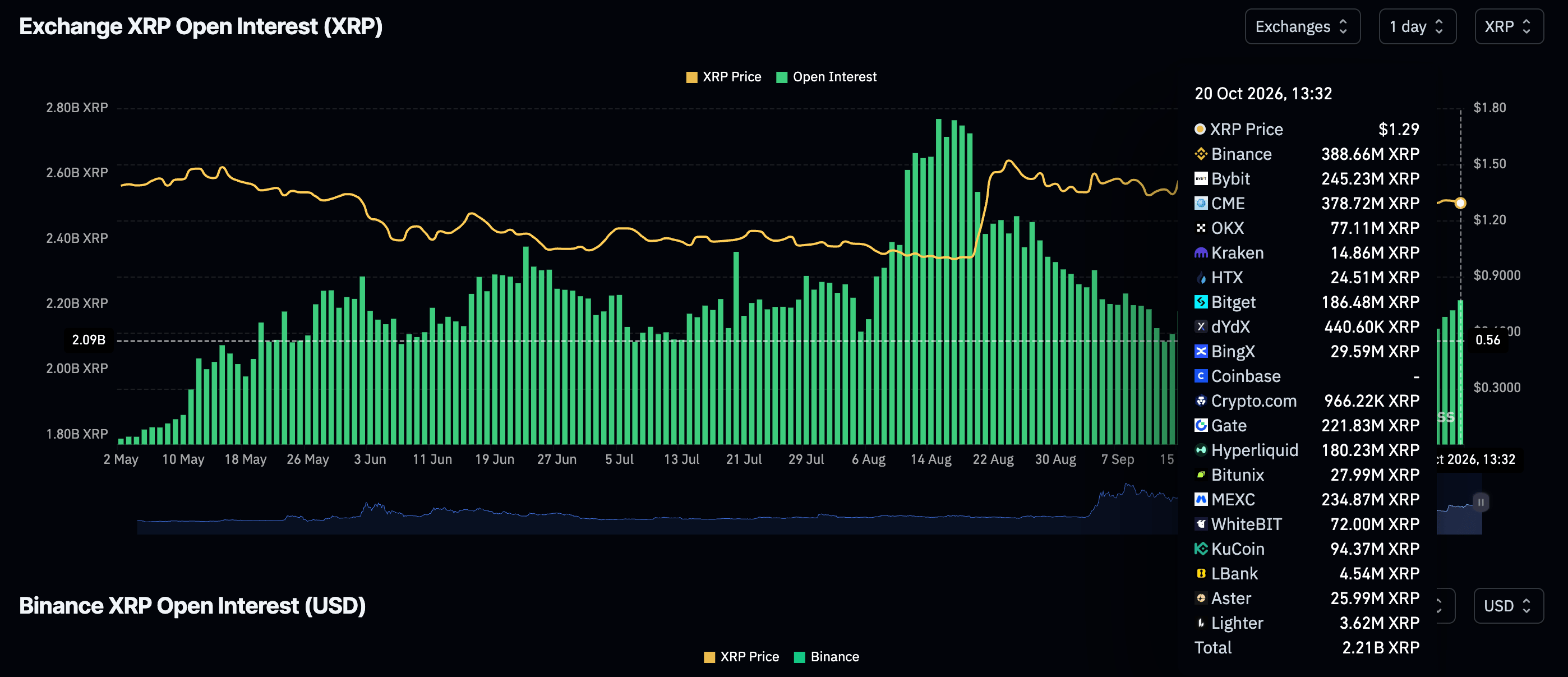
Ahead of the Fed decision, traders are reviewing their positions and overall investor activity remains subdued. A modest improvement in retail demand is evident in derivatives: perpetual futures Open Interest (OI) averaged 2.21 billion XRP on Tuesday, compared with 2.16 billion XRP a day earlier.
Despite recovering from October lows of 2.12 billion XRP, OI is still substantially below September highs of 2.46 billion XRP and August highs of 2.77 billion XRP.
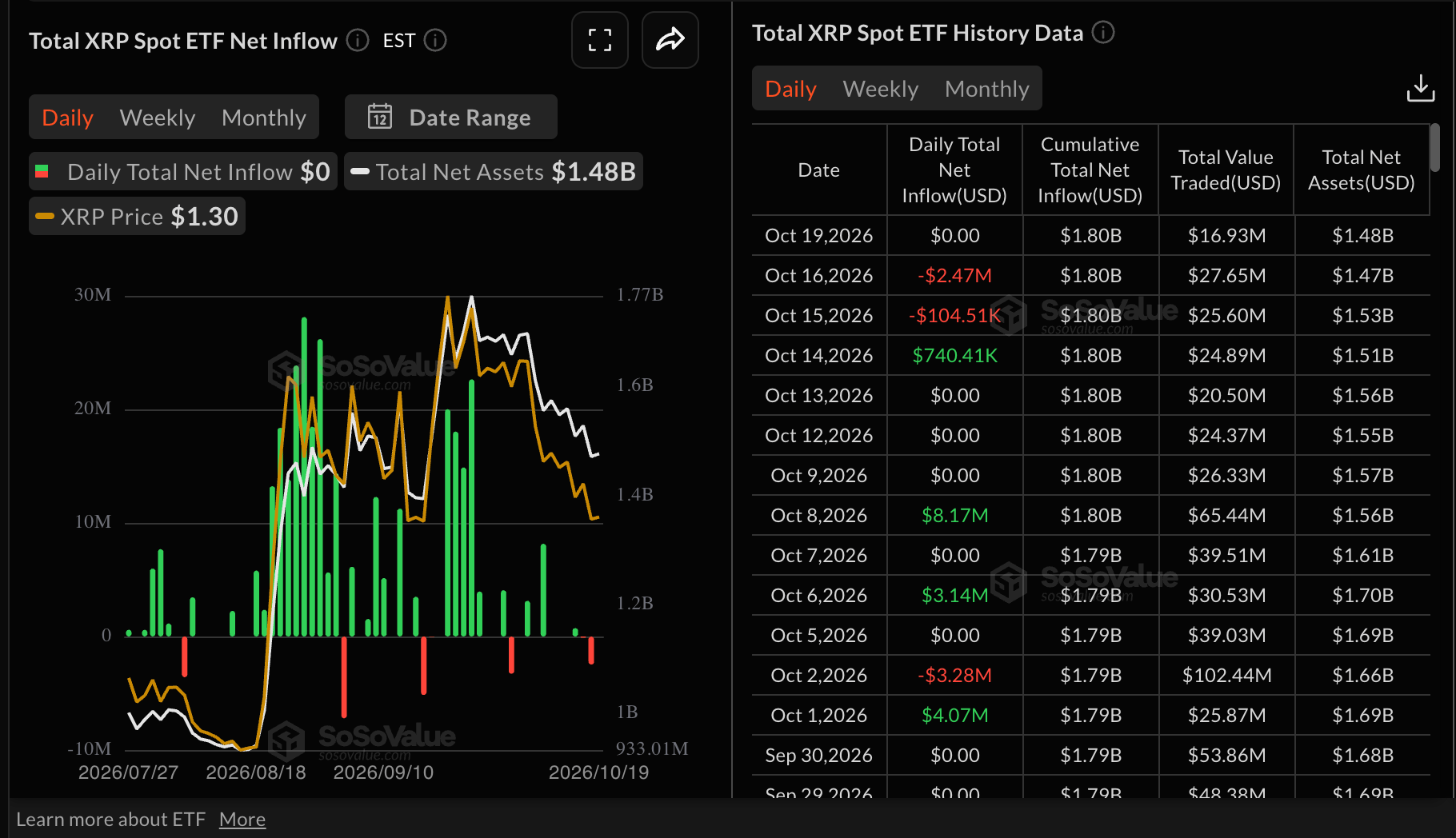
Institutional activity was subdued on Monday after XRP spot Exchange-Traded Funds (ETFs) recorded outflows of $105,000 on Thursday and $2.5 million on Friday. The longer-term outlook nevertheless remains constructive. According to SoSoValue, cumulative inflows stand at $1.8 billion, with net assets of $1.5 billion providing support.
$1.30 remains out of reach: XRP technical downside risks
Below $1.30, XRP continues to retreat beneath all major Exponential Moving Averages (EMAs), leaving the near-term outlook bearish. The 100-day EMA stands overhead at $1.34, while the 50-day and 200-day EMAs converge around $1.38. These successive layers of trend resistance suggest that recent recoveries are being capped.
A Relative Strength Index (RSI) reading of 35, just above oversold territory, underscores fragile momentum. The Moving Average Convergence Divergence (MACD) also remains negative. Together, the indicators suggest that selling pressure continues, even as the sell-off loses some pace.
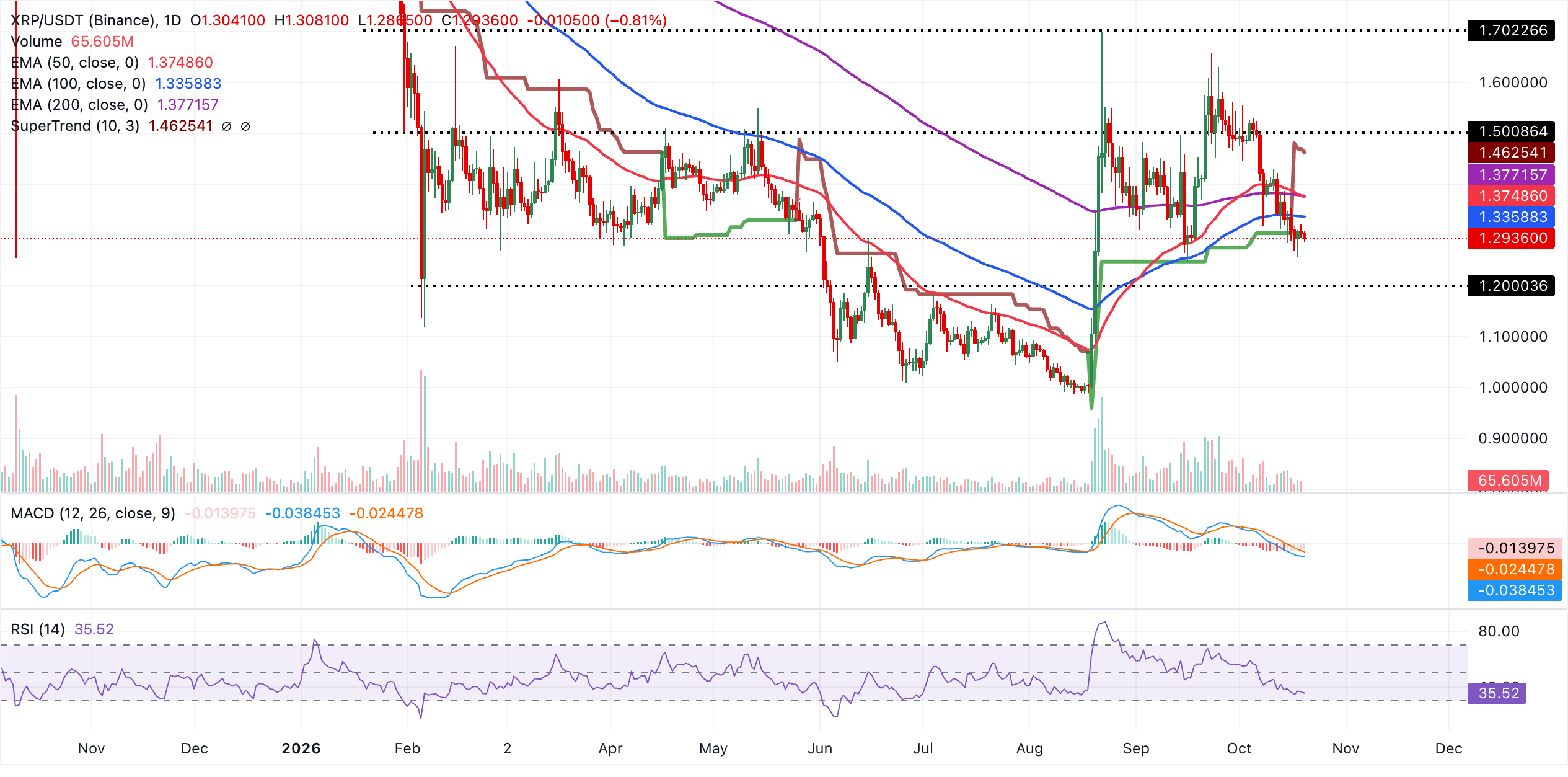
The 100-day EMA at $1.34 presents the first resistance hurdle. Beyond it, the 50-day and 200-day EMAs form a more concentrated barrier around $1.38. A further recovery target is the SuperTrend line at $1.46, which price would need to regain to alleviate the broader bearish structure. The current indicators identify no clear structural support below $1.30. Until buyers lift the pair above the cluster of daily EMAs, further losses remain a risk.
(The technical analysis of this story was written with the help of an AI tool. Know more.)
Crypto ETFs: key questions
Investors use an Exchange-Traded Fund (ETF) to obtain exposure to a particular asset. An ETF is an investment vehicle or index that follows the price of an underlying asset, but its scope can also extend to a group of assets and sectors rather than a single holding. A Bitcoin ETF, for instance, follows Bitcoin’s price.
Yes. In October 2021, the US Securities & Exchange Commission approved the first US Bitcoin futures ETF. Seven Bitcoin futures ETFs have received approval in total, while more than 20 await regulatory permission. Over the last few years, the SEC has delayed crypto-related futures ETFs because, it says, the cryptocurrency industry is new and vulnerable to manipulation.
Yes. Several Bitcoin spot Exchange-Traded Funds received SEC approval for listing and trading in January 2024. This opened access for institutional capital and mainstream investors to trade the leading cryptocurrency. The industry welcomed the decision as a game changer.
Exposure to a cryptocurrency without owning it is the chief benefit of crypto ETFs, reducing the risks and costs of holding the asset directly. Investors also face a less demanding learning curve and benefit from greater security, as ETFs take responsibility for safeguarding the underlying holdings. The principal drawback is the absence of direct asset ownership, captured by the crypto saying “not your keys, not your coins.” Fees for active management are another disadvantage, adding to the costs associated with holding crypto. Finally, while ETFs reduce the risks of holding an asset, fluctuations in the underlying cryptocurrency’s price are still likely to feed through to the investment vehicle.
POPULAR ARTICLES
1Euro Recovery Against US Dollar Limited by French Spread Tensions: Scotiabank2Australian Dollar strengthens as US tech jitters weigh on US Dollar3Brazilian Real: Downside Bias in Run-off Risks Against US Dollar – ING4Euro holds steady as markets assess French budget risks and Fed outlook5British Pound: BoE rate hikes supported by firmer labour data – MUFG6Two-Phase Euro Weakness: Recovery Prospects Against US Dollar – Commerzbank7Canadian Dollar: Standard Chartered sees BoC rate hike bets as overdone80.7015 limits Australian Dollar upside against US Dollar – UOB9UK jobs data bolsters BoE hike bets, lifting British Pound against Euro
LIVE QUOTES


ALL ABOUT TECHNICAL
What Is the Dark Cloud Cover Pattern and How Do You Trade It?
What Is the Piercing Line Candlestick Pattern and How Do You Trade It?
What Are Tweezer Top and Bottom Candlestick Patterns?
Inside Bar Candlestick Pattern: What It Is, How to Identify It, and How to Trade It
Hanging Man Candlestick Pattern: How to Identify and Trade It
How to Draw Fibonacci Retracement: Mastering the Golden Ratio in Trading
What is the Relative Strength Index (RSI)
What is Scalping in Trading & How Does It Work
Get Started!
Sign up and access the Global Markets in less than 3 minutes

Connect With Us









Contacts
Phone: +61 2 8036 8388
Fax: +61 2 8036 8388
Email: support@tmgm.com



The information provided on this website is of a general nature only and does not constitute personal financial advice. Before acting on any information on this website, you should consider the suitability of the information in relation to your objectives, financial situation and needs. Investing in CFDs and FX Margin Contracts carries significant risks and is not suitable for all investors. You may lose more than your initial deposit. You do not own, or have, any interest in the underlying asset. We recommend that you seek independent advice and ensure you fully understand the risks involved before trading. It is important that you read and consider the disclosure document before you acquire any product listed on the website. The information and advertisements offered on this website are not intended for use by any person in any country or jurisdiction where such use would be contrary to local laws and regulations. The Products and Services offered on this website are not intended for residents of the United States, Malaysia and Thailand.
TMGM is authorized and regulated in various jurisdictions.
Trademax Australia Limited, trading as TMGM, is regulated by the Australian Securities and Investments Commission (ASIC), AFSL no. 436416 and is located at Level 28, One International Tower, 100 Barangaroo Avenue, 2000 Sydney, NSW Australia.
Email: support@tmgm.com.au
Trademax Global Limited, trading as TMGM, is authorized and regulated by the Vanuatu Financial Services Commission (VFSC), registration number 40356 and registered at 1276, Kumul Highway, Port Vila, Vanuatu, Republic of Vanuatu.
Email: support@tmgm.com
Trademax Global Markets (SE) Limited, trading as TMGM, is authorized and regulated by the Financial Services Authority (FSA) of Seychelles, with license number SD224. The company is registered at Office No 13, Providence Estate ABIS Centre, Mahe, Seychelles.
Email: support@tmgm.com
Trademax Global Markets (International) Pty Ltd, trading as TMGM, is authorized and regulated by the Financial Services Commission, Mauritius (FSC) with license no. GB22201012, and registered at 33, Edith Cavell Street C/o IQ EQ Fund Services (Mauritius) Ltd Port Louis, 11324 Mauritius.
Email: support@tmgm.com
Copyright © TMGM. All rights reserved