

Trading
Explore a wide range of markets with competitive pricing, deep liquidity, and advanced trading tools.
Learn More 
Platform
Trade seamlessly with TMGM's powerful platform, built for speed, precision, and a superior trading experience.
Learn More Trading Platform
Academy
Learn the fundamentals of trading with beginner-friendly resources, including guides, webinars, and market insights.
Learn More News & Analysis
Get real-time market updates and expert analysis to stay ahead of trading opportunities
Learn More News & Analysis
About
Learn what sets TMGM apart — our global presence, regulatory strength, and commitment to innovation in trading.
Learn More Why Choose TMGM
Sponsorship
200-week SMA in focus: Silver price forecast as XAG/USD faces persistent selling pressure
- September 2025 lows are back in view as Silver falls further, on course for its weakest week since March.
- Rising expectations of Fed rate increases and a worldwide equity sell-off put Silver under pressure.
- The 200-week SMA draws closer for XAG/USD as RSI nears oversold levels.
Silver (XAG/USD) trades around $42 at the time of writing. Friday’s selling has pushed the metal to its lowest levels since September 2025, roughly 65% below January’s record near $121. XAG/USD is heading for its sharpest weekly loss since March.

Recent hawkish comments from the Federal Reserve (Fed) have intensified selling pressure. Policymakers have indicated that tighter monetary policy may be necessary to return inflation to the 2% target, prompting traders to position for a succession of interest rate increases.
According to the CME FedWatch Tool, a 25-basis-point increase in December is almost fully priced in. Traders are also wagering on a further rise in January, followed by additional tightening later in 2027. As a non-interest-bearing asset, Silver becomes less appealing when borrowing costs are expected to rise.
Selling across global equities is another drag on Silver. Following Anthropic’s record IPO, which failed to ease concerns about the AI trade, the Nasdaq Composite has lost more than 6% this week. Some investors appear to be liquidating precious metals to generate cash and offset losses in other holdings.
$39.79 Support in Focus: Technical Analysis
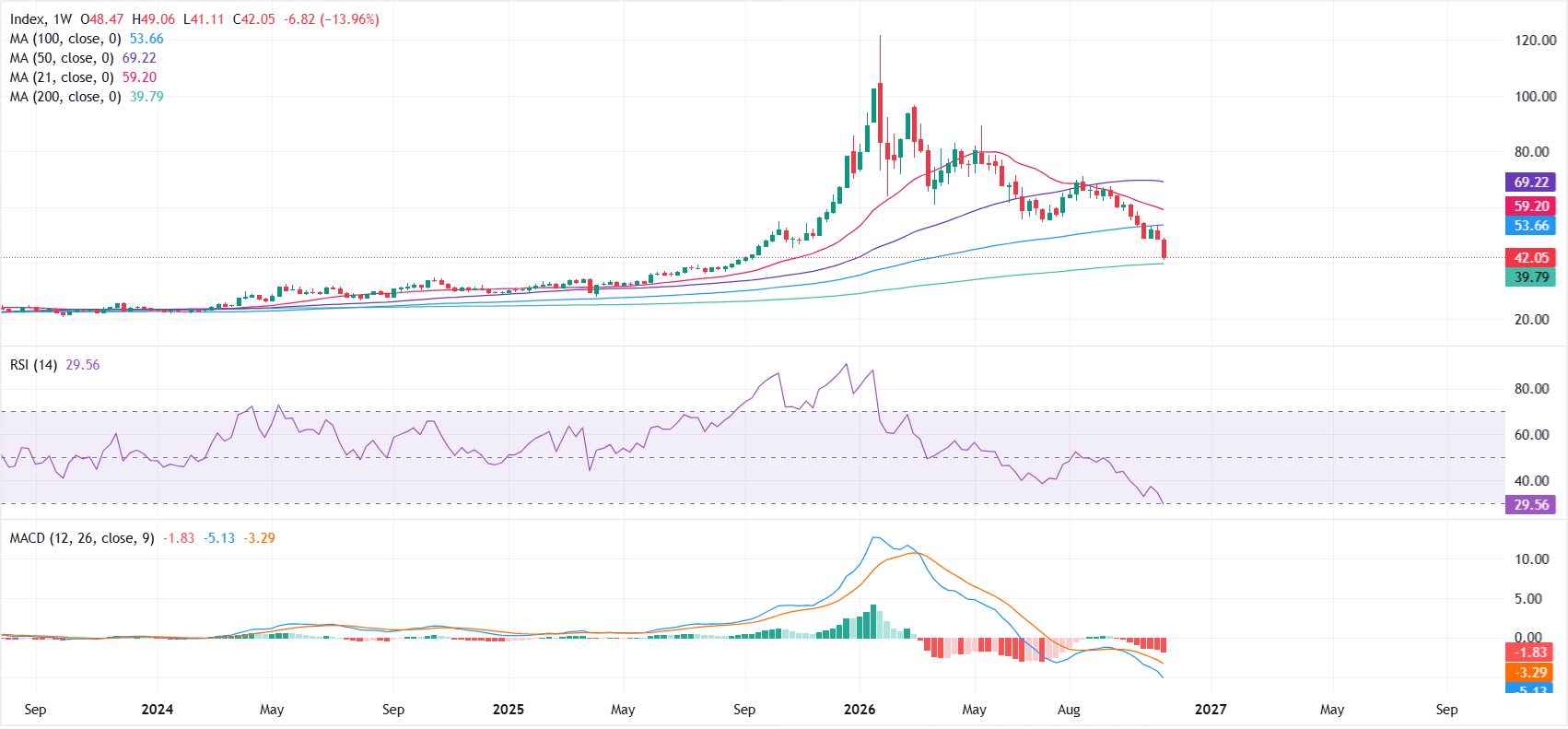
Trading well beneath its 21-, 50- and 100-week Simple Moving Averages (SMAs), XAG/USD retains a bearish weekly outlook. All three averages represent overhead supply. The 200-week SMA at $39.79 remains below the price and provides a final line of medium-term support. Momentum is still weak: the Relative Strength Index (RSI) is entering oversold territory near 30, while the Moving Average Convergence Divergence (MACD) indicator sits deep below zero. Together, these readings suggest that rebounds are likely to remain corrective within the broader downtrend.
The first upside barrier is the 100-week SMA around $53.66. Above that, the 21-week SMA near $59.20 adds to resistance, followed by the more distant 50-week SMA around $69.22. For support, attention centres on the 200-week SMA at $39.79. A sustained breach of this long-term floor would leave scope for further losses on the weekly chart.
(An AI tool assisted in preparing this story’s technical analysis. Find out more.)
Silver: Key Facts
Investors trade Silver extensively as a precious metal with a long history as both a store of value and a means of exchange. While Gold attracts greater interest, Silver may appeal to traders seeking portfolio diversification, intrinsic value or a potential hedge against high inflation. Exposure can take the form of physical coins and bars, or instruments such as Exchange Traded Funds that follow Silver’s price in international markets.
A broad range of influences can shift Silver prices. Its safe-haven appeal can lift prices during geopolitical turmoil or concerns about a severe recession, though the effect is generally smaller than for Gold. Lower interest rates also tend to support Silver because it offers no yield. With Silver quoted in US Dollar (USD) terms as XAG/USD, currency movements matter too: Dollar strength typically restrains the metal, while Dollar weakness is likely to lift it. Investment demand, mine supply and recycling rates are further influences. Silver is far more abundant than Gold.
Among metals, Silver has one of the highest levels of electrical conductivity, exceeding both Copper and Gold. This makes it widely used in industry, notably electronics and solar energy. Stronger demand can push prices higher, whereas weaker demand tends to depress them. Economic developments in the US, China and India can also drive price fluctuations. Large industrial sectors in the US and especially China consume Silver in a range of processes. In India, consumer demand for Silver jewellery is another important influence on prices.
Gold and Silver share similar safe-haven characteristics, so gains in Gold typically bring a corresponding rise in Silver. Silver prices therefore tend to track Gold’s direction. Relative valuations can be assessed using the Gold/Silver ratio, which measures how many ounces of Silver equal the value of one ounce of Gold. A high ratio may be interpreted by some investors as a sign that Silver is undervalued or Gold overvalued. Conversely, a low reading might indicate that Gold is undervalued compared with Silver.
POPULAR ARTICLES
1Gold: Bullish case holds despite setback – TD Securities2Q4 outlook: RBC expects modest Canadian growth despite Q3 weakness3200-week SMA in focus: Silver price forecast as XAG/USD faces persistent selling pressure4Moderate PMI growth in euro area, but French risk remains – Commerzbank5Record trade surplus for Malaysia as external risks mount – UOB62027: Singapore growth and inflation outlook remains stable – DBS7Global equity sell-off boosts safe-haven demand as Japanese Yen outperforms8Ethereum Price Forecast: ETF outflows outweigh renewed retail demand as ETH falters9China: Macro weakness offset by policy support – BNY

Get Started!
Sign up and access the Global Markets in less than 3 minutes

Connect With Us









Contacts
Phone: +61 2 8036 8388
Fax: +61 2 8036 8388
Email: support@tmgm.com



The information provided on this website is of a general nature only and does not constitute personal financial advice. Before acting on any information on this website, you should consider the suitability of the information in relation to your objectives, financial situation and needs. Investing in CFDs and FX Margin Contracts carries significant risks and is not suitable for all investors. You may lose more than your initial deposit. You do not own, or have, any interest in the underlying asset. We recommend that you seek independent advice and ensure you fully understand the risks involved before trading. It is important that you read and consider the disclosure document before you acquire any product listed on the website. The information and advertisements offered on this website are not intended for use by any person in any country or jurisdiction where such use would be contrary to local laws and regulations. The Products and Services offered on this website are not intended for residents of the United States, Malaysia and Thailand.
TMGM is authorized and regulated in various jurisdictions.
Trademax Australia Limited, trading as TMGM, is regulated by the Australian Securities and Investments Commission (ASIC), AFSL no. 436416 and is located at Level 28, One International Tower, 100 Barangaroo Avenue, 2000 Sydney, NSW Australia.
Email: support@tmgm.com.au
Trademax Global Limited, trading as TMGM, is authorized and regulated by the Vanuatu Financial Services Commission (VFSC), registration number 40356 and registered at 1276, Kumul Highway, Port Vila, Vanuatu, Republic of Vanuatu.
Email: support@tmgm.com
Trademax Global Markets (SE) Limited, trading as TMGM, is authorized and regulated by the Financial Services Authority (FSA) of Seychelles, with license number SD224. The company is registered at Office No 13, Providence Estate ABIS Centre, Mahe, Seychelles.
Email: support@tmgm.com
Trademax Global Markets (International) Pty Ltd, trading as TMGM, is authorized and regulated by the Financial Services Commission, Mauritius (FSC) with license no. GB22201012, and registered at 33, Edith Cavell Street C/o IQ EQ Fund Services (Mauritius) Ltd Port Louis, 11324 Mauritius.
Email: support@tmgm.com
Copyright © TMGM. All rights reserved