

Trading
Explore a wide range of markets with competitive pricing, deep liquidity, and advanced trading tools.
Learn More 
Platform
Trade seamlessly with TMGM's powerful platform, built for speed, precision, and a superior trading experience.
Learn More Trading Platform
Academy
Learn the fundamentals of trading with beginner-friendly resources, including guides, webinars, and market insights.
Learn More News & Analysis
Get real-time market updates and expert analysis to stay ahead of trading opportunities
Learn More News & Analysis
About
Learn what sets TMGM apart — our global presence, regulatory strength, and commitment to innovation in trading.
Learn More Why Choose TMGM
Sponsorship
Above 1.31 again: Pound awaits US inflation data
- 1.3100 regained by GBP/USD. The recovery follows Monday's slide to its November 2025 low.
- Five-month low for UK services growth coincides with softer Dollar demand.
- Wednesday brings US PCE inflation; the next BoE decision is not until 17 December.
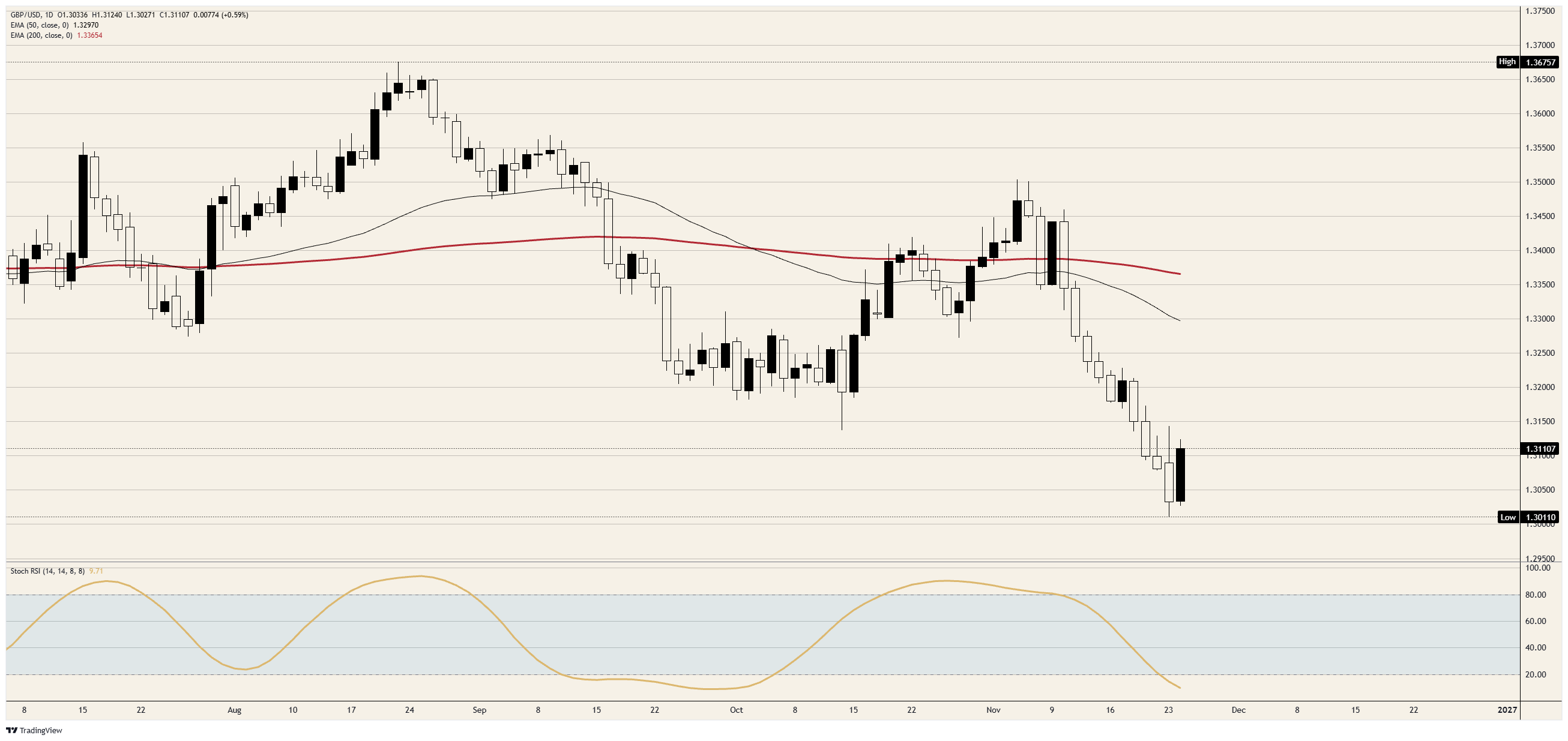
GBP/USD has recovered to just above 1.3100. A decline of about 500 pips over three weeks ended at the Pound's November 2025 low. Starting from the 4 November high near 1.3500, the pair fell to just above 1.3000 on Monday before reversing.

Monday's Dollar advance alongside US equities followed Nvidia (NVDA)'s reinstatement of its chief executive. Selling in artificial intelligence (AI) shares subsequently erased the currency's gains. The Pound reclaimed 1.3100 after Treasury Secretary Bessent also cautioned against excessive monetary tightening. Markets still assign a probability above 95% to a Fed rate rise on 9 December. Speaking on Monday, New York Fed President Williams said policy would have to adjust to return inflation to 2%.
November's UK flash surveys put services growth at its weakest in five months, while manufacturing output reached its highest level since August 2024. Retail sales increased 0.7% in October. With the UK's Bank Rate at 4.00%, markets anticipate at least two further Bank of England (BoE) rate rises. Sterling has nevertheless tracked the Dollar more closely than these domestic developments.
13:30 GMT: US data in focus
At 13:30 GMT on Wednesday, October's Personal Consumption Expenditures Price Index (PCE) is released alongside revised third-quarter Gross Domestic Product (GDP) and weekly jobless claims. The US Thanksgiving holiday follows on Thursday. As the priced-in probability of a December Fed rate rise exceeds 95%, the releases mainly inform the outlook for a further increase in January. The BoE announces its next decision on 17 December, eight days after the Fed. UBS anticipates the next BoE rate rise in February.
1.3300: 50-day EMA slips below
Only a few pips separate Monday's low from the November 2025 trough. These are the two lowest readings on the chart, which begins in September 2025. While the 50-day Exponential Moving Average (EMA) has fallen below 1.3300, the 200-day EMA sits just below 1.3400. Daily momentum has entered oversold territory for the first time since early October.
GBP/USD: Daily price chart
Pound Sterling: Frequently Asked Questions
Dating back to 886 AD, Pound Sterling (GBP) is the world's oldest currency and the United Kingdom's official currency. According to 2022 data, it ranks fourth globally by foreign exchange (FX) trading activity, representing 12% of all transactions with average daily turnover of $630 billion. Among its principal pairs, GBP/USD, known as ‘Cable’, represents 11% of FX trading. GBP/JPY, called the ‘Dragon’ by traders, accounts for 3%, while EUR/GBP represents 2%. The Bank of England (BoE) issues Pound Sterling.
Monetary policy set by the Bank of England has the greatest influence on Pound Sterling's value. Decisions depend on whether the BoE is meeting its central objective of “price stability”, meaning inflation held steadily at around 2%. Adjusting interest rates is its main means of achieving that goal. To curb excessive inflation, the BoE seeks to raise borrowing costs for households and businesses by increasing interest rates. GBP generally benefits because higher rates make the UK more attractive to international investors seeking a home for their funds. Inflation that falls too low signals slower economic growth. The BoE would then consider cutting interest rates to make credit cheaper, encouraging businesses to borrow more for investment in projects that generate growth.
By indicating the economy's health, data releases can affect Pound Sterling's value. GDP, Manufacturing and Services PMIs, and employment figures are among the indicators that can determine GBP's direction. Sterling benefits from a robust economy, which draws in foreign investment and may prompt the BoE to raise interest rates. Such increases directly strengthen GBP. Conversely, weak economic figures are likely to weigh on Pound Sterling.
The Trade Balance is another influential release for Pound Sterling. It records the gap between a country's export earnings and its spending on imports during a specified period. Strong overseas demand for a country's exports creates additional demand for its currency as foreign buyers seek to purchase those goods. A positive net Trade Balance therefore supports the currency; a negative balance has the opposite effect.
POPULAR ARTICLES
119-month low: euro recovers ahead of ECB minutes and US inflation2Above 1.31 again: Pound awaits US inflation data3$53,200 downside risk for BTC as Bitcoin realised losses reach FTX-era levels450,000: Dow Jones Industrial Average revisits level as Nvidia leads tech lower5Below $1,700: Ethereum price forecast as ETH drops amid tariff concerns weighing on crypto6Australia CPI likely to complicate matters for the RBA7Chinese Yuan: Scope for gains against US Dollar remains limited – UOB8Forex Today: Australian inflation in focus ahead of packed pre-Thanksgiving US calendar9$40 Support Under Threat: Silver Price Forecast as XAG/USD Slides


Get Started!
Sign up and access the Global Markets in less than 3 minutes

Connect With Us









Contacts
Phone: +61 2 8036 8388
Fax: +61 2 8036 8388
Email: support@tmgm.com



The information provided on this website is of a general nature only and does not constitute personal financial advice. Before acting on any information on this website, you should consider the suitability of the information in relation to your objectives, financial situation and needs. Investing in CFDs and FX Margin Contracts carries significant risks and is not suitable for all investors. You may lose more than your initial deposit. You do not own, or have, any interest in the underlying asset. We recommend that you seek independent advice and ensure you fully understand the risks involved before trading. It is important that you read and consider the disclosure document before you acquire any product listed on the website. The information and advertisements offered on this website are not intended for use by any person in any country or jurisdiction where such use would be contrary to local laws and regulations. The Products and Services offered on this website are not intended for residents of the United States, Malaysia and Thailand.
TMGM is authorized and regulated in various jurisdictions.
Trademax Australia Limited, trading as TMGM, is regulated by the Australian Securities and Investments Commission (ASIC), AFSL no. 436416 and is located at Level 28, One International Tower, 100 Barangaroo Avenue, 2000 Sydney, NSW Australia.
Email: support@tmgm.com.au
Trademax Global Limited, trading as TMGM, is authorized and regulated by the Vanuatu Financial Services Commission (VFSC), registration number 40356 and registered at 1276, Kumul Highway, Port Vila, Vanuatu, Republic of Vanuatu.
Email: support@tmgm.com
Trademax Global Markets (SE) Limited, trading as TMGM, is authorized and regulated by the Financial Services Authority (FSA) of Seychelles, with license number SD224. The company is registered at Office No 13, Providence Estate ABIS Centre, Mahe, Seychelles.
Email: support@tmgm.com
Trademax Global Markets (International) Pty Ltd, trading as TMGM, is authorized and regulated by the Financial Services Commission, Mauritius (FSC) with license no. GB22201012, and registered at 33, Edith Cavell Street C/o IQ EQ Fund Services (Mauritius) Ltd Port Louis, 11324 Mauritius.
Email: support@tmgm.com
Copyright © TMGM. All rights reserved