

Trading
Explore a wide range of markets with competitive pricing, deep liquidity, and advanced trading tools.
Learn More 
Platform
Trade seamlessly with TMGM's powerful platform, built for speed, precision, and a superior trading experience.
Learn More Trading Platform
Academy
Learn the fundamentals of trading with beginner-friendly resources, including guides, webinars, and market insights.
Learn More News & Analysis
Get real-time market updates and expert analysis to stay ahead of trading opportunities
Learn More News & Analysis
About
Learn what sets TMGM apart — our global presence, regulatory strength, and commitment to innovation in trading.
Learn More Why Choose TMGM
Sponsorship
Below $1.00: Are XRP’s legal clarity, payment utility and ETFs still relevant in a risk-off market?
$0.97 is Ripple’s (XRP) trading level on Friday. The token is less than 1% higher on the day, but remains in a six-week decline towards prices last recorded in November 2024. At roughly 73% below its July 2025 record of $3.66, XRP has suffered steeper losses than most major cryptocurrencies. That is despite a strong combination of United States (US) regulatory clarity, rapid growth in the Ripple Payments network, the institutional-grade RLUSD stablecoin, strategic acquisitions and partnerships, and the November 2025 launch of XRP spot Exchange-Traded Funds (ETFs).
Investors who entered at the peak face severe losses. The contradiction is stark: robust fundamentals, spot ETFs, legal clarity, the Securities and Exchange Commission (SEC) settlement and wider global utility through Ripple Payments infrastructure have not prevented the collapse. What explains the price decline?
A potentially straightforward answer is nevertheless difficult to accept: macro liquidity almost always outweighs fundamentals. Once capital starts leaving an asset class, regulatory certainty, increased utility and institutional investment products typically carry much less weight.
Hawkish Fed policy compounds macro pressures
Heavy losses across the wider crypto market provide the backdrop to XRP’s continuing crash. Several forces are at work. Chief among them is the Federal Reserve’s (Fed) hawkish shift, which continues to withdraw liquidity from risk assets at an alarming pace.
October’s US inflation figures undermined expectations of monetary easing, despite the Fed holding rates within the 3.75-4.00% range. The Consumer Price Index (CPI) increased 0.4% MoM in October, above the 0.3% market forecast. Excluding volatile food and energy prices, core CPI advanced 0.3%, against expectations of 0.2%. Meanwhile, Producer Price Index (PPI) inflation reached 6.5% YoY in October, its highest reading since November 2022.
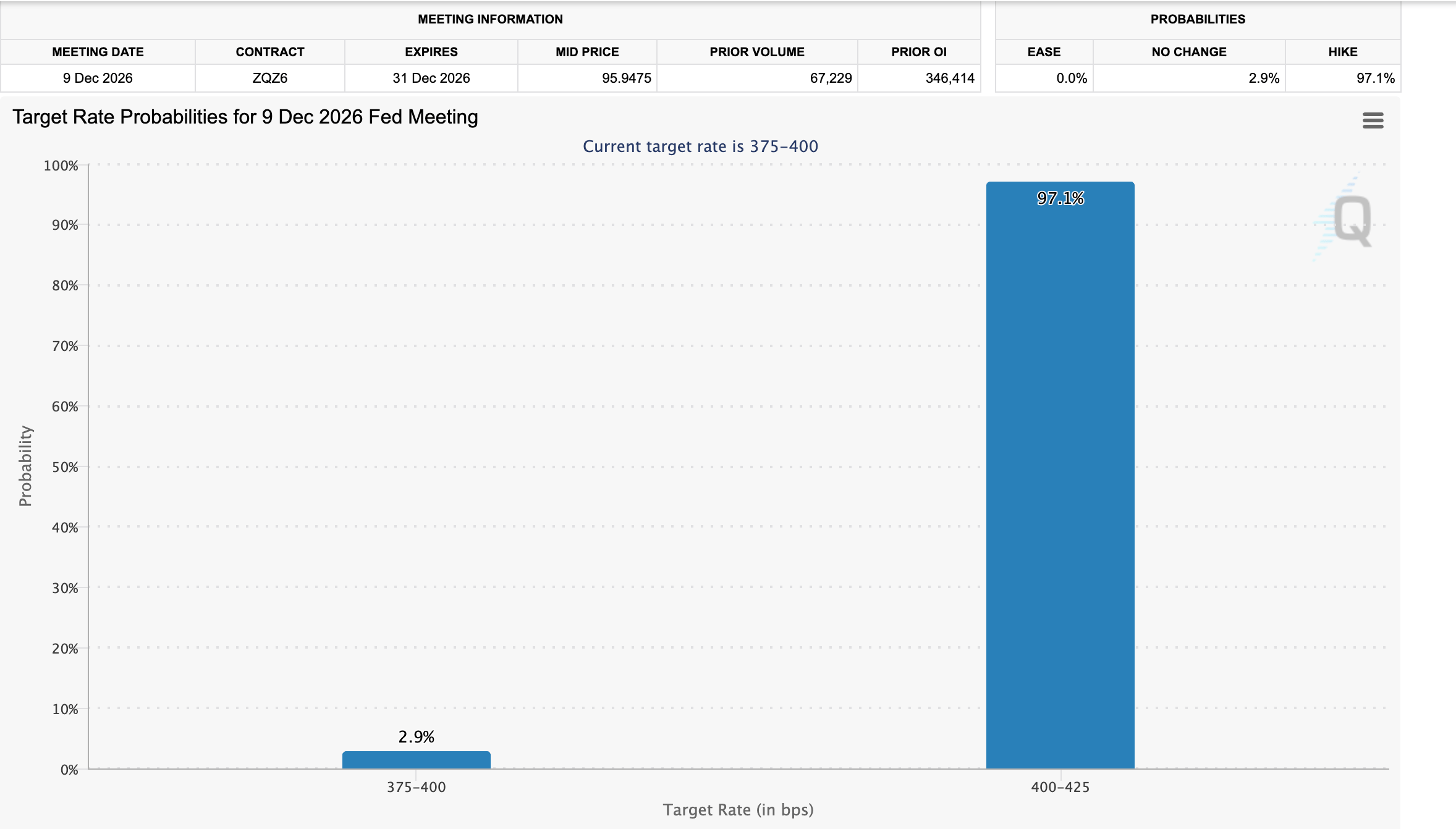
According to the CME FedWatch tool, derivatives pricing now implies roughly a 97% probability of a 25 basis points Fed rate increase at the forthcoming December meeting, taking rates to 4.00-4.25%.
Another significant driver of sustained risk aversion is the recent Binance hack, affecting approximately $6.3 billion in assets. Binance protected customers by covering the full loss from its own assets and an internal insurance fund programme. Even so, the incident remains fresh in investors’ minds, and a return to normal conditions could take time.
Capital flight is also reinforcing the risk-off mood. The 10-year US Treasury yield, for example, recently reached 5.14%, a level last seen in 2007, signalling a reassessment of interest rate expectations by traders. With relatively low-risk Treasury bills offering yields above 5%, investors may question why they should accept crypto assets’ volatility.
Spot ETF data put clear figures on the withdrawals. Bitcoin (BTC) spot ETFs recorded $1.07 billion in outflows during the week ending 13 November. Cumulative outflows for November alone have averaged $2.35 billion so far. Ethereum (ETH) spot ETFs lost $399 million over the same week, bringing November’s total withdrawals to $764 million.
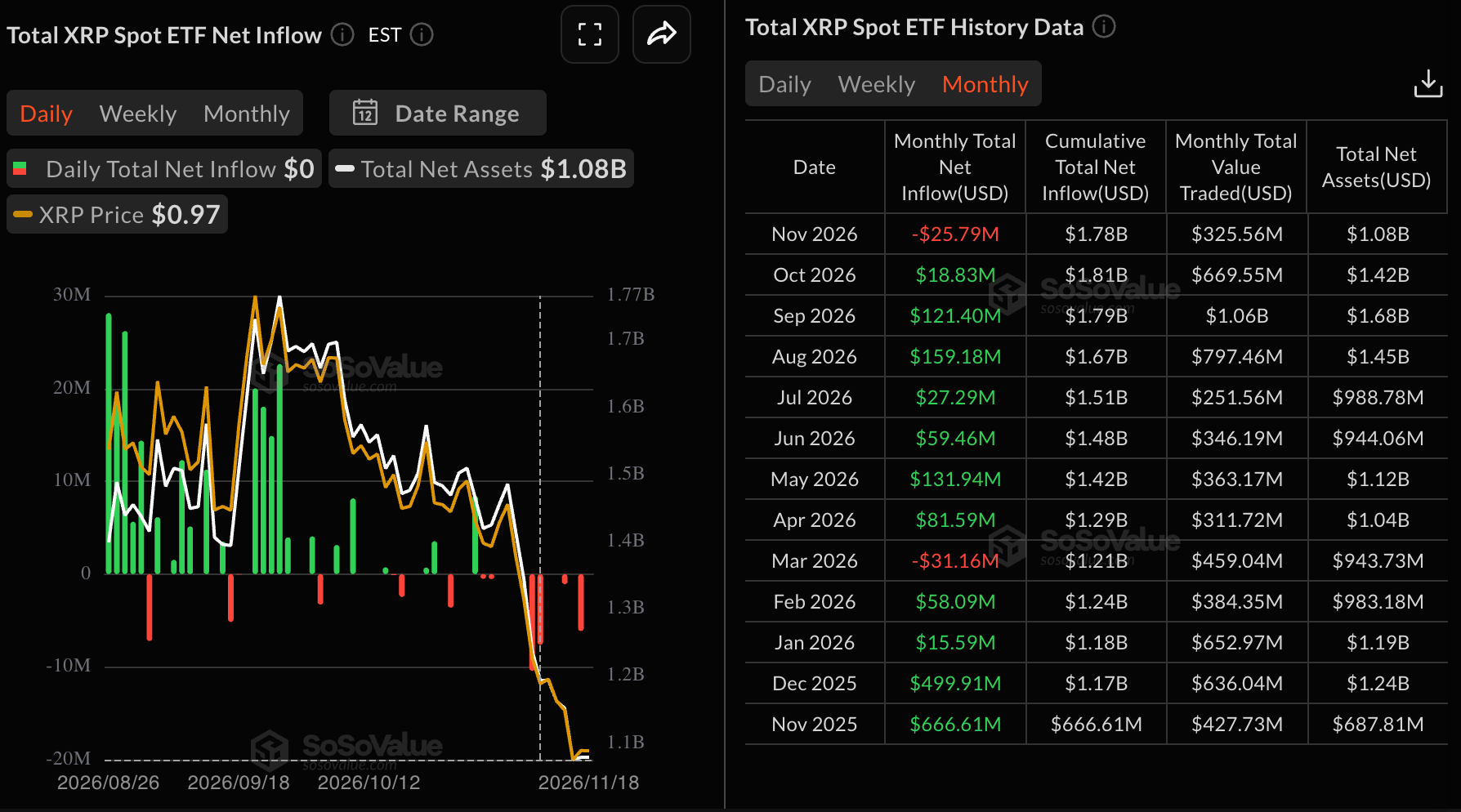
For XRP spot ETFs, outflows averaged $19 million over the week ending 13 November. Cumulative withdrawals this week through Wednesday stand at $6 million, while November’s total has reached $26 million, weakening institutional demand.
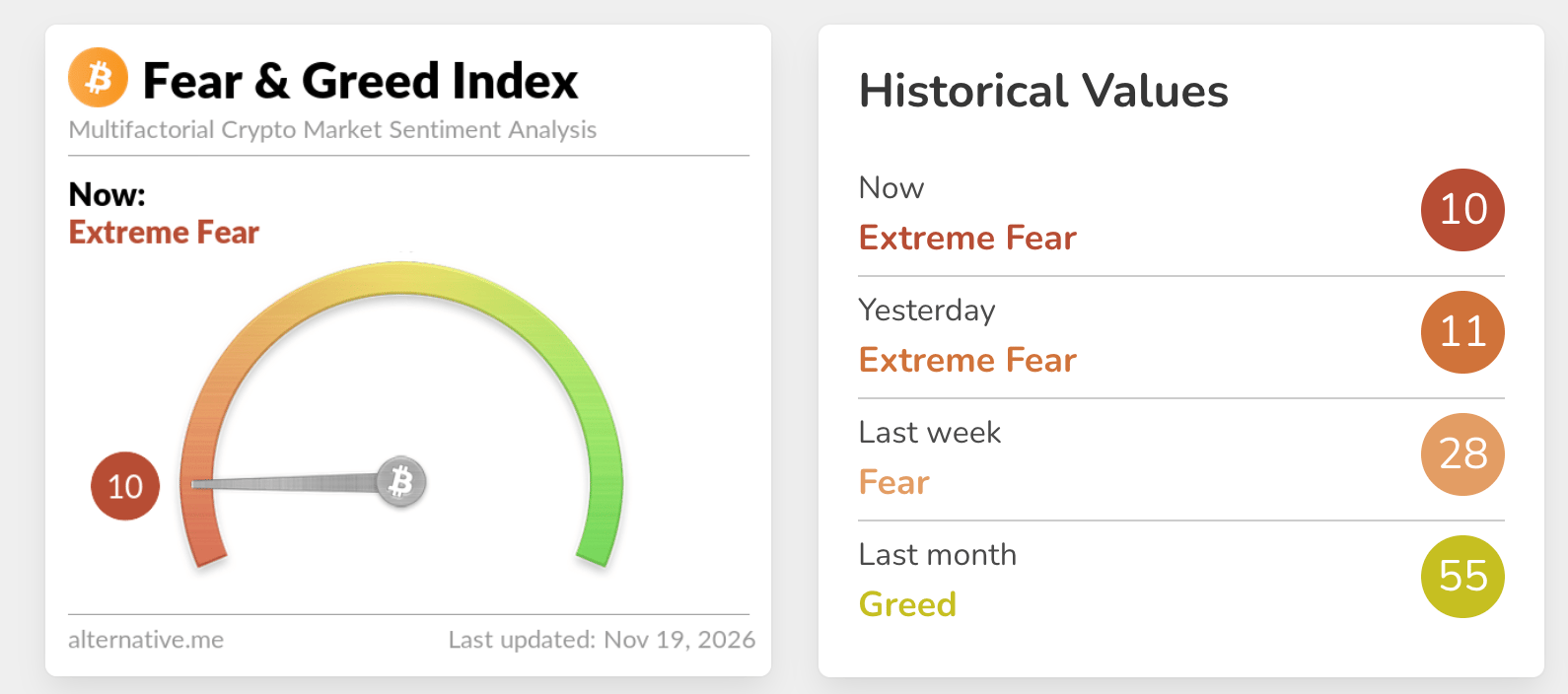
Thursday’s reading of 10 placed the Fear & Greed Index in Extreme Fear territory. That was only marginally below the previous day’s 11, signalling weak appetite for crypto assets across the market.
XRP therefore faces a difficult macroeconomic backdrop. Its losses, however, have been substantially deeper than those of its peers.
November’s sell-off has hit all cryptocurrencies, but XRP ranks among the worst performers. A weekend plunge to $0.89, its lowest price since November 2024, took the monthly decline to around 29%. A modest rebound subsequently lifted the token to highs near $1.00, before it eased back to $0.97.
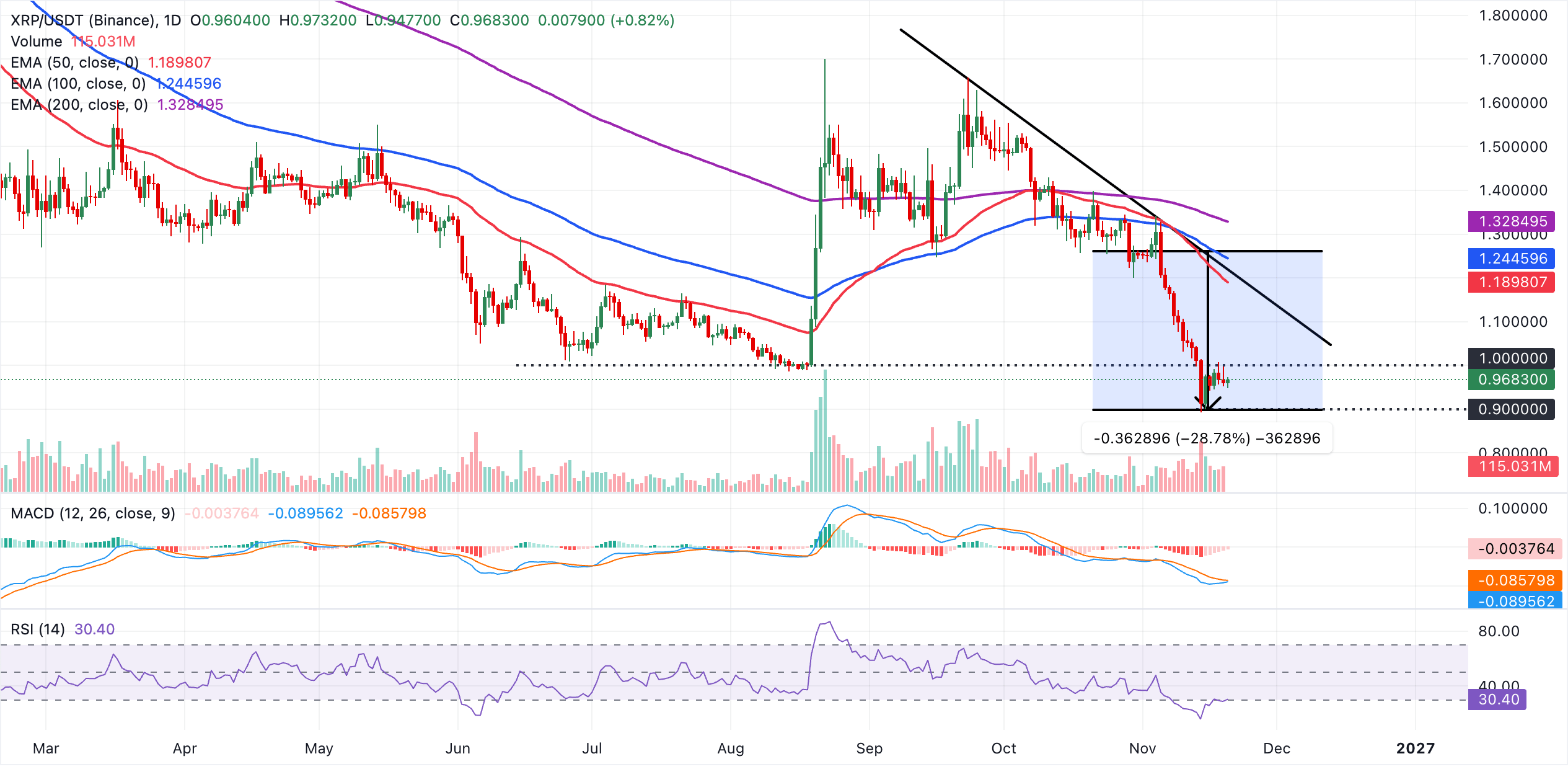
From its July 2026 peak of $3.66, XRP has lost around 73%. In an analysis published on 16 October, CoinDesk stated that “XRP has failed to make holders rich like Bitcoin and Ether.”
XRP price lags a strengthening ecosystem
Fundamentally, the XRP ecosystem has never been stronger, yet the token remains subject to relentless corrections. Ripple spent years contesting the US Securities and Exchange Commission (SEC) lawsuit filed in 2020. It secured a partial victory when XRP sales through third-party platforms, including exchanges, were found not to constitute securities. In August 2025, Ripple settled with the SEC, paying a $125 million penalty over direct sales to institutional clients. That closed the case.
A further step towards much-needed regulatory clarity came in March 2026. The SEC and the Commodity Futures Trading Commission (CFTC) moved to issue a joint interpretation treating XRP as a “digital commodity,” rather than a security.
Regulators then approved a rule change in September 2026 allowing Nasdaq Texas to list XRP commodity trust shares, reinforcing the token’s commodity status. Yet XRP fell approximately 60% between January and November, despite obtaining the regulatory standing Ripple had fought for throughout its multi-year court battle.
The implication is that regulatory clarity can lower investment barriers without necessarily generating sustained demand. Institutional exposure and participation are required, but are not sufficient on their own. That is particularly true in a risk-off market, where investors are seeking the stability of Treasuries or adding exposure to the booming Artificial Intelligence (AI) market.
For the US-based blockchain company, Ripple USD (RLUSD) has become a success story since its official launch in December 2024. The regulated stablecoin targets institutions and ranks seventh in the market, with a November market capitalisation of $2.8 billion. Despite a contraction in the wider sector, the token has expanded by around $102 million over the past week. Strategic partnerships have accelerated RLUSD adoption. An October agreement with Cross River Bank provided access to thousands of financial institutions, while the October DriveWealth partnership enables RLUSD to support settlements for more than 100 brokerages. Standard Chartered provides institutional RLUSD custody in Dubai. Robinhood RLUSD also launched in October on the Robinhood chain and Bitstamp. Ripple’s June strategic investment in Flutterwave additionally positioned the network to serve African payment corridors.
For now, however, RLUSD’s progress neither supports nor changes XRP’s outlook. Its direct link is to Ripple Lab’s revenue, leaving XRP holders alienated. More enterprises are holding RLUSD without any need for XRP. Stablecoin transactions earn fees for the company but do not generate demand for XRP. The investment is strategic for Ripple, rather than a catalyst for the token.
With a substantial $2.7 billion committed to strategic acquisitions, Ripple is also emerging as a conglomerate in its own right. Its ambitions suggest a shift towards building a financial services empire.
Hidden Road, subsequently renamed Ripple Prime, was acquired in a $1.25 billion deal completed in October 2025. Ripple bought GTreasury for $1 billion in December, according to a CoinDesk report. The corporate treasury platform serves more than 1,000 clients and handles at least $13 trillion in annual transaction volume. These deals follow Ripple’s $200 million acquisition of stablecoin platform Rail in August 2025.
As with RLUSD, revenue from these acquisitions accrues to Ripple. Profits remain within the company, benefiting Ripple Labs and its shareholders.
Payment liquidity and XRP demand
XRP was launched by Ripple as a bridge currency for cross-border payments, and that architecture continues to operate as intended. The network has consistently sought to broaden its payment liquidity reach across jurisdictions worldwide. Strategic agreements with financial institutions and payment processors have helped demonstrate the technology’s effectiveness.
The fundamental distinction is that XRP primarily serves as a monetary bridge, rather than a store of value. A bank using RippleNet to send a payment from the US Dollar (USD) to the Euro (EUR), for example, is likely to hold XRP for only three to four seconds while the transaction takes place. It immediately converts the funds into fiat to avoid crypto holding volatility, rather than accumulating XRP as a reserve currency. From an institutional user’s perspective, at least, this utility model does little to build demand or encourage accumulation.
Supply has also increased markedly over time. During the 2017-2018 bull market, roughly 38.7 billion XRP tokens were circulating; the current figure is approximately 63.5 billion, according to CoinGecko. The 64% expansion in less than eight years dilutes the tokens’ notional value.
A more significant concern is Ripple Labs’ holding of approximately 31.1 billion XRP locked in ledger escrow accounts. Ripple operates a periodic release schedule and sometimes releases considerably less than the authorised monthly batch. Nevertheless, the supply overhang creates a psychological barrier, as investors know additional tokens could expand the circulating supply.
Against its peers, XRP’s utility falls short. Bitcoin has established itself as a store of value, or digital gold, and gained institutional adoption. By contrast, Ethereum’s (ETH) liquidity draws on its extensive smart contract platform, Decentralised Finance (DeFi) ecosystem and non-fungible token (NFT) marketplaces.
Conclusion: XRP’s investment case remains divided
Amid the continuing sell-off, I suspect a central question troubling XRP holders is whether to stay invested or cut their losses.
No single answer suits everyone. For investors prepared to weigh the decision, however, I will set out a balanced framework.
Macro pressures remain entrenched. The Fed is widely expected to raise rates in December and maintain elevated levels in the near term to combat persistent US inflation. As a result, there is less impetus for a risk-on rotation into crypto and associated digital assets.
Technically, XRP’s structure is weak and, in some respects, broken. It trades beneath the key 50-week, 100-week and 200-week Exponential Moving Averages (EMAs). With November’s low reaching $0.89, there is no indication of immediate technical support.
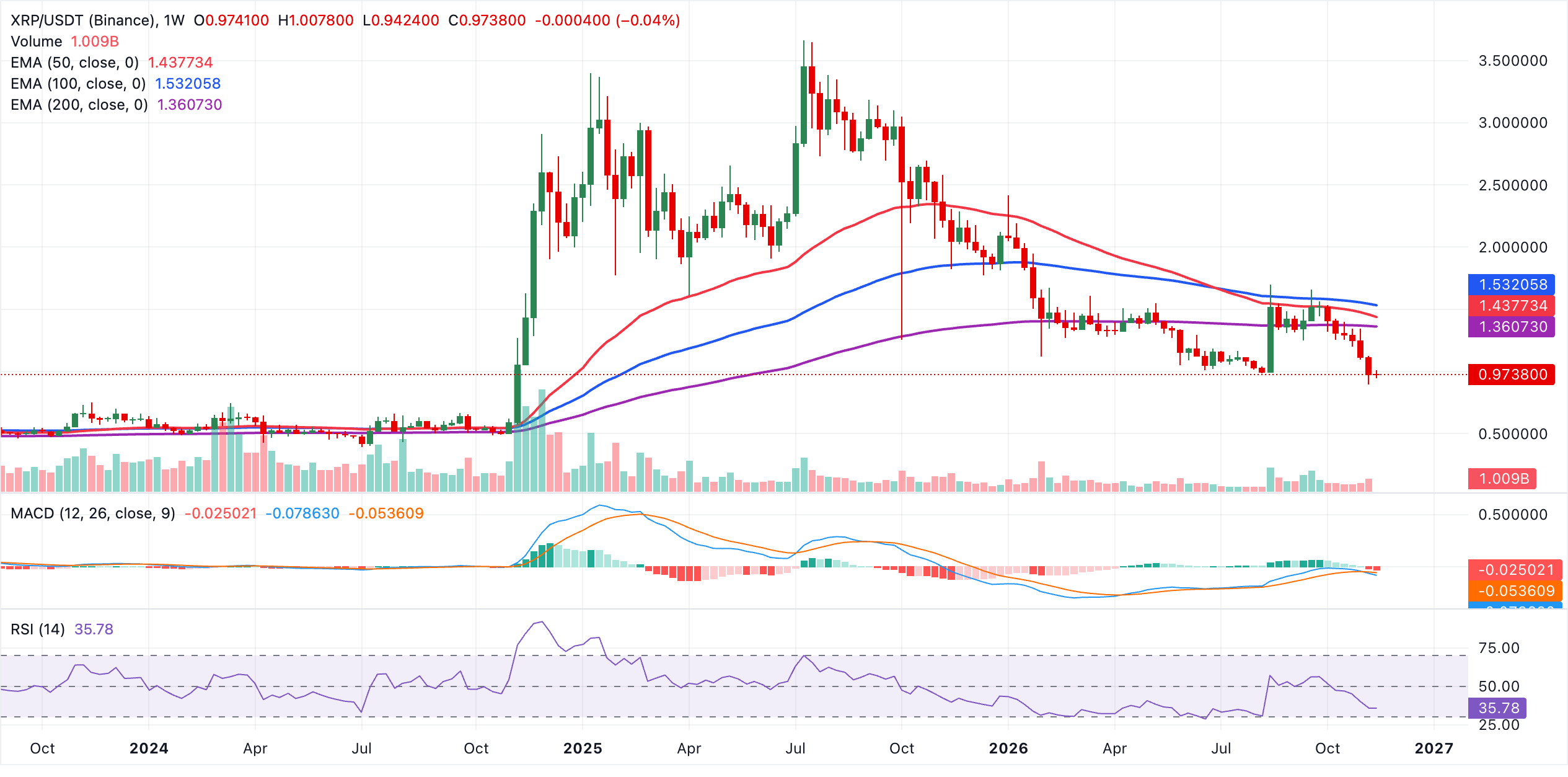
One year after launch, XRP spot ETFs remain substantially undersubscribed relative to Bitcoin and Ethereum ETFs. They have attracted close to $1.8 billion in cumulative inflows and hold $1.1 billion in net assets under management. November’s monthly outflows have averaged $26 million so far, marking the first withdrawal since March 2026.
The bullish argument nevertheless remains intact. It rests on XRP’s legal clarity, RLUSD’s growth, Ripple’s expanding enterprise infrastructure and ETF inflows that remain positive at $1.8 billion. The token is also deeply oversold. Reduced overleveraged long orders leave a potential route to recovery, while long-term investors are likely to retain their holdings, limiting supply available for sale on the open market.
At the heart of XRP’s crisis lies a contradiction. Ripple is constructing global financial services infrastructure through partnerships, acquisitions and strategic expansion. XRP, meanwhile, is missing the much-needed utility, demand and potential revenue-sharing models its holders require.
Ultimately, whether to retain or sell XRP depends on each investor’s risk tolerance and conviction in both the token and its ecosystem.
Ripple: frequently asked questions
Specialising in cross-border remittances, Ripple is a payments company that uses blockchain technology to deliver its services. Ripple Labs Inc. created RippleNet, a payment transfer network available to financial institutions around the world. The company also makes use of the XRP token.
The decentralised XRPLedger blockchain has XRP as its native token. Ripple Labs uses XRP to facilitate transactions on XRPLedger, enabling financial institutions to transfer value across borders. By supporting instant, trustless payments on the XRPLedger chain, the token helps financial firms reduce the cost of transacting globally.
Built on distributed ledger technology and blockchain, XRPLedger uses XRP to power transactions. Its built-in inflammatory protocol distinguishes the ledger from other blockchains and helps counter spam and distributed denial-of-service (DDOS) attacks. Maintenance of XRPL is handled by a peer-to-peer network called the global XRP Ledger community.
The interledger standard used by XRP is a blockchain protocol supporting payments between different networks. XRP’s blockchain can, for example, link the ledgers of two or more banks, effectively eliminating intermediaries and the need for centralisation within the system. Jed McCaleb, Arthur Britto and David Schwartz engineered the XRPLedger blockchain, for which XRP serves as the native token.
POPULAR ARTICLES
1Euro edges up within range following hot German factory inflation2Indian Rupee: Further Gains Supported by RBI Tightening – Commerzbank3Below $1.00: Are XRP’s legal clarity, payment utility and ETFs still relevant in a risk-off market?4Upbeat UK Retail Sales lift British Pound modestly; stronger JPY limits recovery5Middle East attacks put upward pressure on WTI despite record supply forecasts6Equities: Broadening tech losses drag global stocks lower - Danske Bank7UK sales top expectations as British Pound builds on recovery from yearly lows8$3,500 in focus: Gold falls further despite US Dollar retreat | Forex Today9Strong UK Retail Sales: Euro Remains Lower Against British Pound


Get Started!
Sign up and access the Global Markets in less than 3 minutes

Connect With Us









Contacts
Phone: +61 2 8036 8388
Fax: +61 2 8036 8388
Email: support@tmgm.com



The information provided on this website is of a general nature only and does not constitute personal financial advice. Before acting on any information on this website, you should consider the suitability of the information in relation to your objectives, financial situation and needs. Investing in CFDs and FX Margin Contracts carries significant risks and is not suitable for all investors. You may lose more than your initial deposit. You do not own, or have, any interest in the underlying asset. We recommend that you seek independent advice and ensure you fully understand the risks involved before trading. It is important that you read and consider the disclosure document before you acquire any product listed on the website. The information and advertisements offered on this website are not intended for use by any person in any country or jurisdiction where such use would be contrary to local laws and regulations. The Products and Services offered on this website are not intended for residents of the United States, Malaysia and Thailand.
TMGM is authorized and regulated in various jurisdictions.
Trademax Australia Limited, trading as TMGM, is regulated by the Australian Securities and Investments Commission (ASIC), AFSL no. 436416 and is located at Level 28, One International Tower, 100 Barangaroo Avenue, 2000 Sydney, NSW Australia.
Email: support@tmgm.com.au
Trademax Global Limited, trading as TMGM, is authorized and regulated by the Vanuatu Financial Services Commission (VFSC), registration number 40356 and registered at 1276, Kumul Highway, Port Vila, Vanuatu, Republic of Vanuatu.
Email: support@tmgm.com
Trademax Global Markets (SE) Limited, trading as TMGM, is authorized and regulated by the Financial Services Authority (FSA) of Seychelles, with license number SD224. The company is registered at Office No 13, Providence Estate ABIS Centre, Mahe, Seychelles.
Email: support@tmgm.com
Trademax Global Markets (International) Pty Ltd, trading as TMGM, is authorized and regulated by the Financial Services Commission, Mauritius (FSC) with license no. GB22201012, and registered at 33, Edith Cavell Street C/o IQ EQ Fund Services (Mauritius) Ltd Port Louis, 11324 Mauritius.
Email: support@tmgm.com
Copyright © TMGM. All rights reserved