

Trading
Explore a wide range of markets with competitive pricing, deep liquidity, and advanced trading tools.
Learn More 
Platform
Trade seamlessly with TMGM's powerful platform, built for speed, precision, and a superior trading experience.
Learn More Trading Platform
Academy
Learn the fundamentals of trading with beginner-friendly resources, including guides, webinars, and market insights.
Learn More News & Analysis
Get real-time market updates and expert analysis to stay ahead of trading opportunities
Learn More News & Analysis
About
Learn what sets TMGM apart — our global presence, regulatory strength, and commitment to innovation in trading.
Learn More Why Choose TMGM
Sponsorship
Ripple and Robinhood broaden partnership scope as XRP rebound stalls
- $1.33 marks a supply barrier for XRP. The token advances but faces pressure ahead of the Fed’s forthcoming interest rate decision.
- To accelerate RLSUD stablecoin adoption and combine prime brokerage with treasury management, Ripple broadens its Robinhood partnership.
- With the 50-day EMA constraining its recovery, XRP’s technical outlook remains challenging.
With the 50-day EMA constraining its recovery, XRP’s technical outlook remains challenging.
$1.33 is Ripple’s (XRP) approximate trading level on Wednesday. Short-term obstacles persist for the remittance token, which shows signs that its two-day recovery from the weekly low of $1.27 could end.

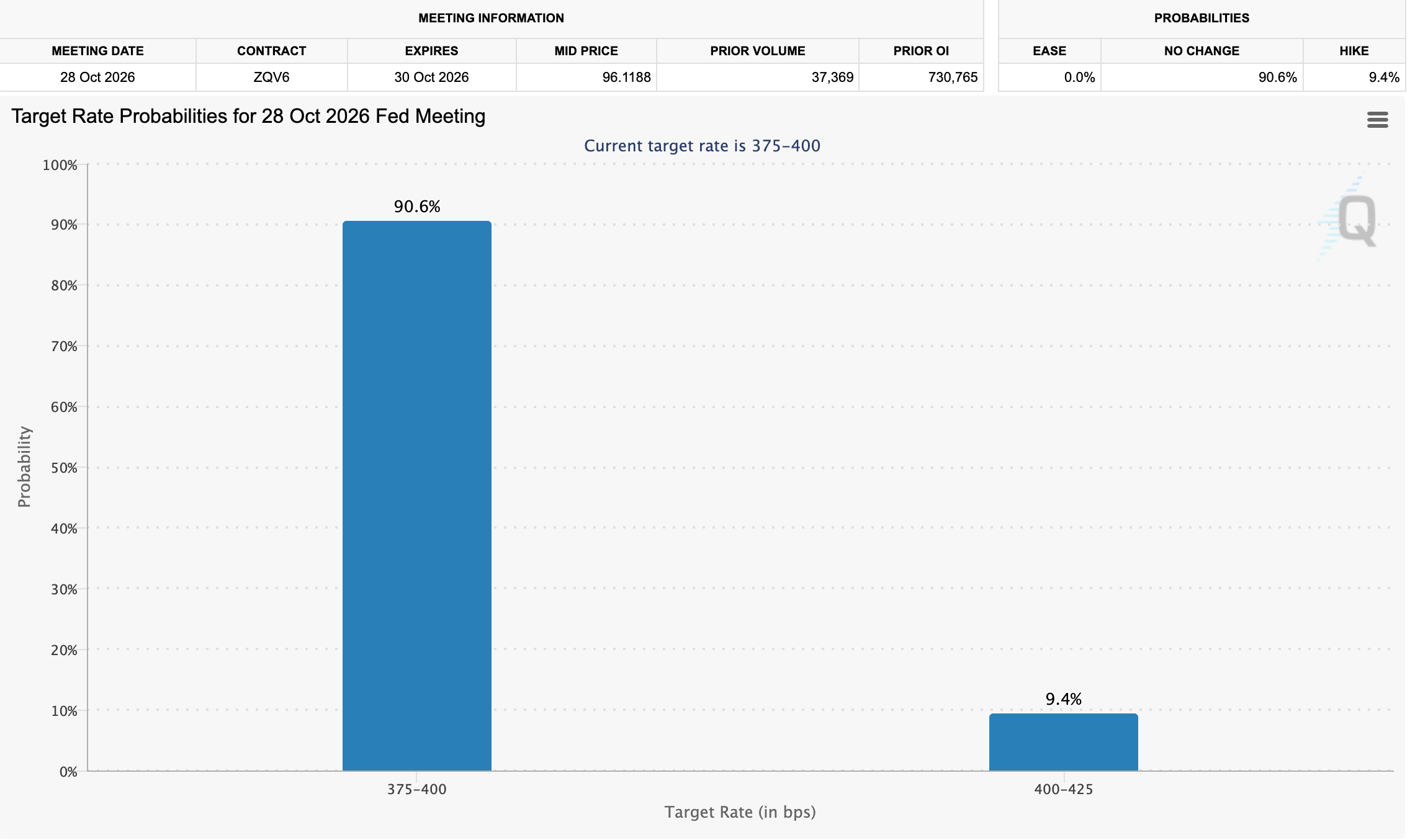
A 91% probability of unchanged interest rates in the 3.75-4.00% range is priced in by market participants. This week’s main focus remains the Federal Reserve’s (Fed) forthcoming rate decision.
Traders are also awaiting the post-meeting press conference from Fed Chair Kevin Warsh for likely guidance on the future direction of policy. Economists already assign a greater probability to a December rate increase, a prospect that could pressure risk assets.
In emailed commentary, CoinRoutes Co-founder and CEO Ian Weisberger said: “This is a nervy week for crypto. Traders face a Fed rate decision, results from the biggest tech companies in the world, and around $12 billion worth of Bitcoin bets expiring on Friday. Then the US midterms land next Tuesday.”
RLUSD adoption: Ripple broadens Robinhood partnership
A single access point for Ripple’s stablecoin, institutional markets and treasury management infrastructure is the aim of its expanded partnership with financial services provider Robinhood, announced on Tuesday.
Under the arrangement, Ripple USD (RLUSD) serves as the principal stablecoin throughout Robinhood’s digital asset ecosystem for retail and institutional clients. Already available on Robinhood Chain and Bitstamp by Robinhood, RLUSD is set for wider availability in the Robinhood app before year-end under current plans.
Ripple said in its press release: “Robinhood will leverage RLUSD on the XRPL for institutional settlement, extending the stablecoin’s utility across Bitstamp by Robinhood’s growing institutional business,”
By using the XRP Ledger (XRPL) to integrate Ripple Treasury, Robinhood aims to enhance and automate global operations, including cash and liquidity management. Building on existing collaborations and market access, the partnership also encompasses Ripple Prim.
Total supply across the broader stablecoin market currently exceeds $300 million, while RLUSD has a market capitalisation of $2.4 billion. Earlier this week, Ripple also reported that its National Trust Bank had received final approval from the Office of the Comptroller of Currency (OCC).
$1.33 resistance stalls XRP recovery: Technical analysis
After advancing for two days from near $1.27, XRP trades close to $1.33. The limited rebound has not removed the token’s bearish bias or overhead constraints. It sits just below the Bollinger Bands’ middle line near $1.33 and beneath the 50-day Exponential Moving Average (EMA) around $1.36.
Although price is effectively challenging the established descending resistance line, its inability to sustain a move above the mid-Bollinger band keeps the broader structure under pressure. The Moving Average Convergence Divergence (MACD) is edging marginally above zero, but a Relative Strength Index (RSI) reading near 46 points to neutral-to-soft momentum only.
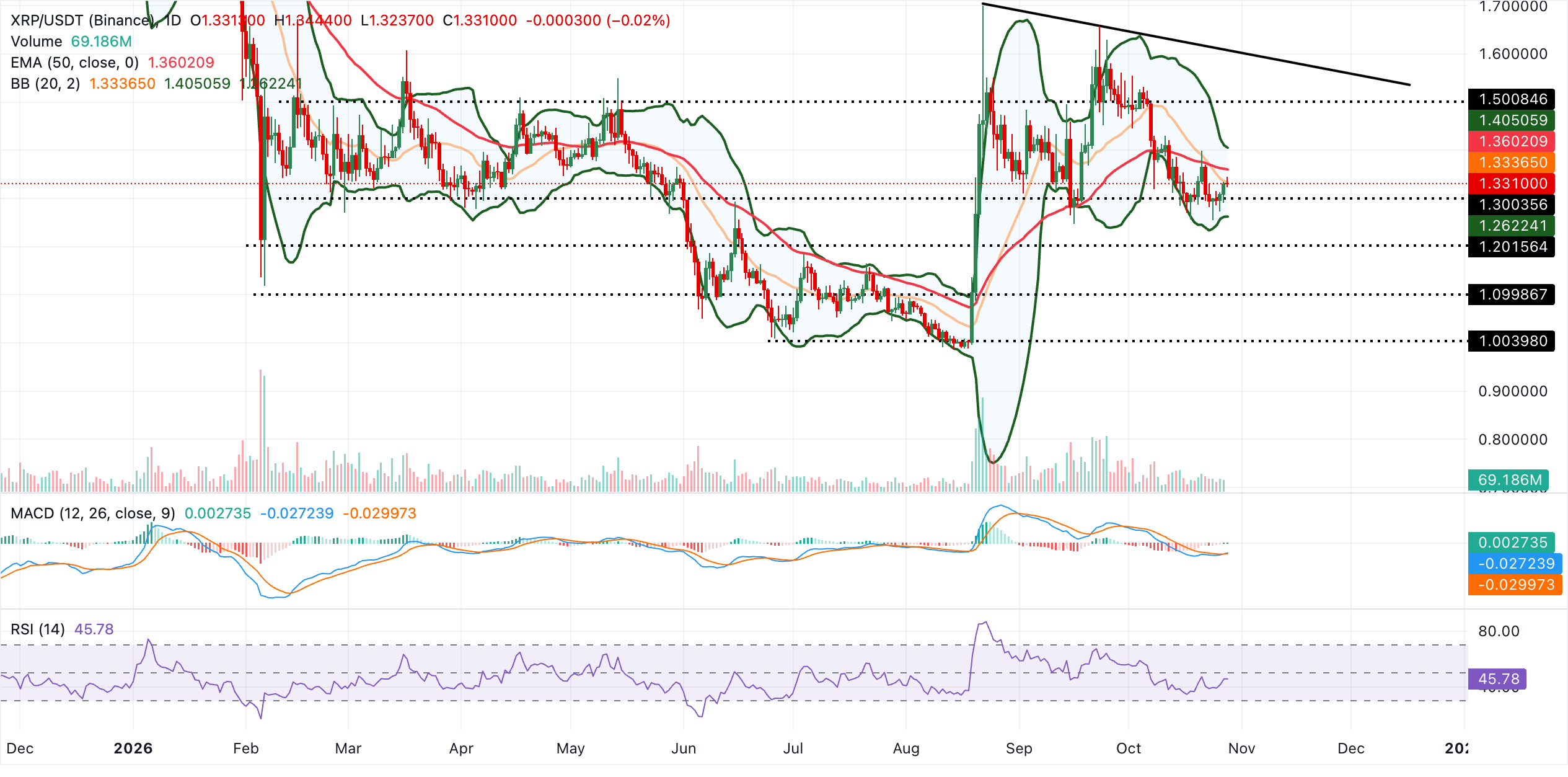
At around $1.33, the Bollinger mid-line provides the nearest resistance. Additional supply is expected near the 50-period EMA at $1.36, followed by a firmer hurdle at the upper Bollinger band around $1.41. Should sellers deepen the pullback, the lower Bollinger band, currently near $1.26, marks the next significant support and a possible clearer demand zone.
(The technical analysis of this story was written with the help of an AI tool. Know more.)
Ripple: Frequently asked questions
Specialising in cross-border remittances, payments company Ripple uses blockchain technology to deliver its services. Ripple Labs Inc. created RippleNet, a payment transfer network available to financial institutions globally. The XRP token is also used by the company.
As the native token of the decentralised XRPLedger blockchain, XRP is used by Ripple Labs to enable transactions and help financial institutions move value across borders. By supporting instant payments on the XRPLedger chain without requiring trust between parties, XRP helps financial firms reduce the cost of global transactions.
Built on distributed ledger technology and blockchain, XRPLedger uses XRP to power transactions. A built-in inflammatory protocol distinguishes the ledger from other blockchains and helps counter spam and distributed denial-of-service (DDOS) attacks. Maintenance of XRPL is handled by a peer-to-peer network called the global XRP Ledger community.
The interledger standard used by XRP is a blockchain protocol designed to support payments between different networks. XRP’s blockchain can, for example, link the ledgers of two or more banks, effectively eliminating intermediaries and the system’s need for centralisation. Engineered by Jed McCaleb, Arthur Britto and David Schwartz, the XRPLedger blockchain uses XRP as its native token.
POPULAR ARTICLES
1New Zealand Dollar: Inflation mounts while RBNZ postpones rate rises – Standard Chartered217-month lows remain close as euro stabilises ahead of Fed rate decision3Federal Reserve poised to leave interest rates unchanged despite stubborn inflation4AI relief and hawkish Fed underpin US Dollar – ING5Japanese Yen: Fiscal backdrop and debate over safe-haven status – Rabobank6Australian Dollar: RBA hike prospects strengthen on hot CPI – BBH72027 growth outlook dims: Healey faces fiscal tightrope in UK Budget8Silver Price Forecast: Sellers retain control within descending channel ahead of Fed9December hike still in play amid RBNZ split: New Zealand Dollar - UOB
LIVE QUOTES


ALL ABOUT TECHNICAL
What Is the Dark Cloud Cover Pattern and How Do You Trade It?
What Is the Piercing Line Candlestick Pattern and How Do You Trade It?
What Are Tweezer Top and Bottom Candlestick Patterns?
Inside Bar Candlestick Pattern: What It Is, How to Identify It, and How to Trade It
Hanging Man Candlestick Pattern: How to Identify and Trade It
How to Draw Fibonacci Retracement: Mastering the Golden Ratio in Trading
What is the Relative Strength Index (RSI)
What is Scalping in Trading & How Does It Work
Get Started!
Sign up and access the Global Markets in less than 3 minutes

Connect With Us









Contacts
Phone: +61 2 8036 8388
Fax: +61 2 8036 8388
Email: support@tmgm.com



The information provided on this website is of a general nature only and does not constitute personal financial advice. Before acting on any information on this website, you should consider the suitability of the information in relation to your objectives, financial situation and needs. Investing in CFDs and FX Margin Contracts carries significant risks and is not suitable for all investors. You may lose more than your initial deposit. You do not own, or have, any interest in the underlying asset. We recommend that you seek independent advice and ensure you fully understand the risks involved before trading. It is important that you read and consider the disclosure document before you acquire any product listed on the website. The information and advertisements offered on this website are not intended for use by any person in any country or jurisdiction where such use would be contrary to local laws and regulations. The Products and Services offered on this website are not intended for residents of the United States, Malaysia and Thailand.
TMGM is authorized and regulated in various jurisdictions.
Trademax Australia Limited, trading as TMGM, is regulated by the Australian Securities and Investments Commission (ASIC), AFSL no. 436416 and is located at Level 28, One International Tower, 100 Barangaroo Avenue, 2000 Sydney, NSW Australia.
Email: support@tmgm.com.au
Trademax Global Limited, trading as TMGM, is authorized and regulated by the Vanuatu Financial Services Commission (VFSC), registration number 40356 and registered at 1276, Kumul Highway, Port Vila, Vanuatu, Republic of Vanuatu.
Email: support@tmgm.com
Trademax Global Markets (SE) Limited, trading as TMGM, is authorized and regulated by the Financial Services Authority (FSA) of Seychelles, with license number SD224. The company is registered at Office No 13, Providence Estate ABIS Centre, Mahe, Seychelles.
Email: support@tmgm.com
Trademax Global Markets (International) Pty Ltd, trading as TMGM, is authorized and regulated by the Financial Services Commission, Mauritius (FSC) with license no. GB22201012, and registered at 33, Edith Cavell Street C/o IQ EQ Fund Services (Mauritius) Ltd Port Louis, 11324 Mauritius.
Email: support@tmgm.com
Copyright © TMGM. All rights reserved