

Trading
Erkunden Sie eine breite Palette von Märkten mit wettbewerbsfähigen Preisen, tiefer Liquidität und fortschrittlichen Trading-Tools.
Mehr erfahren 
Plattform
Handeln Sie nahtlos mit TMGMs leistungsstarker Plattform, die für Geschwindigkeit, Präzision und ein überlegenes Trading-Erlebnis entwickelt wurde.
Mehr erfahren Trading-Plattform
Akademie
Lernen Sie die Grundlagen des Tradings mit anfängerfreundlichen Ressourcen, einschließlich Leitfäden, Webinaren und Markteinblicken.
Mehr erfahren Nachrichten & Analyse
Erhalten Sie Echtzeit-Markt-Updates und Expertenanalysen, um Trading-Gelegenheiten voraus zu sein
Mehr erfahren Nachrichten & Analyse
Über uns
Erfahren Sie, was TMGM auszeichnet — unsere globale Präsenz, regulatorische Stärke und unser Engagement für Innovation im Trading.
Mehr erfahren Warum TMGM wählen
New Zealand Dollar trades with caution as NASDAQ revival boosts US Dollar’s outlook
- New Zealand Dollar is under pressure near its 17-year low of 0.5433 against the US Dollar.
- The US Dollar extends rally as global AI trade unwinding takes a U-turn.
- Investors keenly await the US PCE Inflation data for October scheduled for Wednesday.
The New Zealand Dollar (NZD) trades close to its 17-year low at around 0.5433 against the US Dollar (USD) in the Asian trading session on Tuesday. The Kiwi pair plummets to its multi-year low the previous day after a strong revival in demand of global Artificial Intelligence (AI) stocks lifted the US Dollar.

As of writing, the US Dollar Index (DXY), which gauges the Greenback’s value against six major currencies, trades close to its fresh 20-month high of 104.53 posted on Monday.
On Monday, global AI stocks, notably Nvidia, witnessed strong buying interest after giant chipmaker confirmed the return of Jensen Huang to the board. Last week, Huang was fired after he confirmed extra-marital affairs, including one with alleged Chinese spy.
The oust of Jense Huang led to further acceleration in Global AI trade unwinding, which were already under pressure following Democrats victory in United States (US) midterm elections.
Going forward, the next major trigger for the US Dollar will be the US Personal Consumption Expenditure (PCE) Price Index data for October, which is scheduled for Wednesday.
TD Securities said lingering supply-side frictions and sector-specific forces are likely to keep price pressures elevated for longer. The bank argues that “with supply chains still stressed amid AI-led price pressures, we do not see room for inflation progress in the near-term,” and projects that “core CPI inflation [will] be 2.9% y/y in Q4 2026, higher than the end of 2025, while the core PCE version should end the year firmer.” TD Securities also expects that “most of the impact of higher oil prices will filter into headline inflation,” delaying the return to target-consistent outcomes. In their view, only “gradual disinflation” is likely to “resume by the middle of 2027.”
The inflation data is expected to have a significant impact on Federal Reserve’s (Fed) monetary policy outlook.
Currently, the CME FedWatch tool shows traders are confident that the Fed will hike interest rates in the December policy meeting.
NZD/USD Technical Analysis
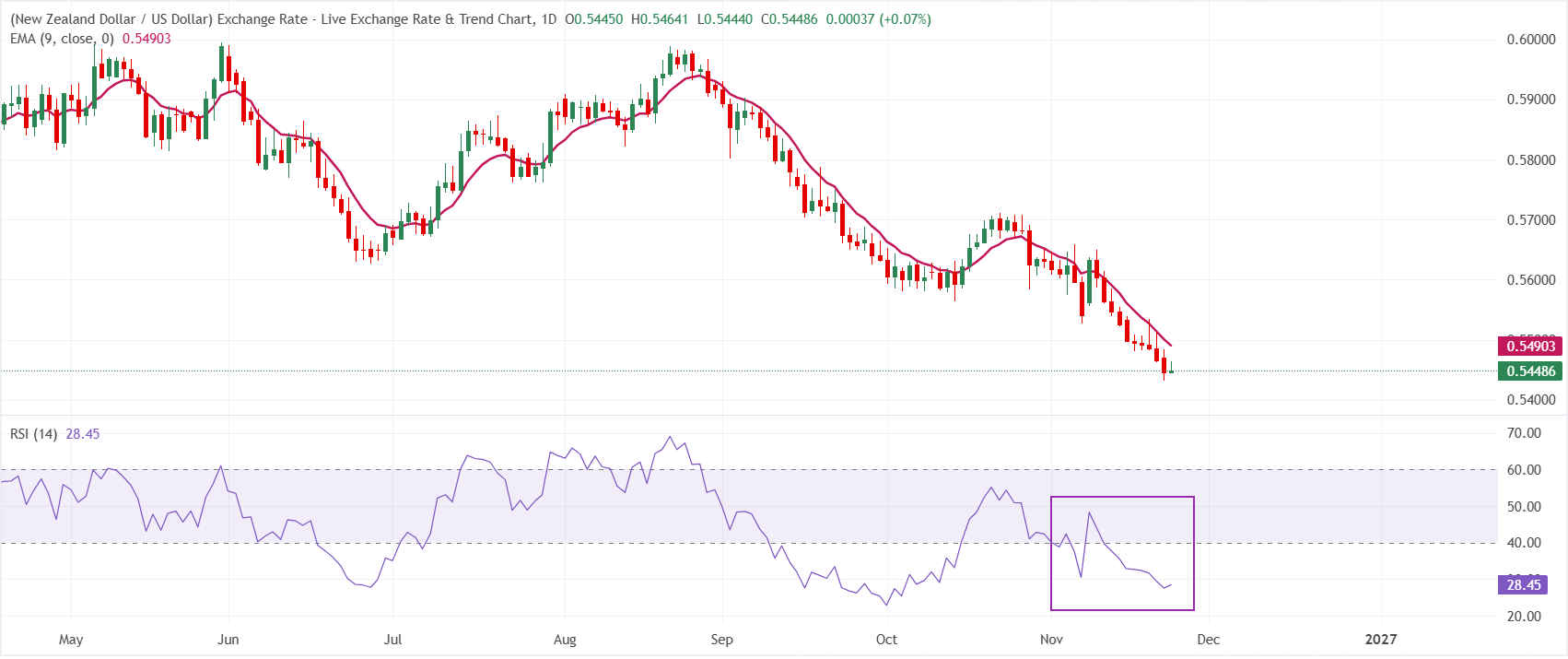
In the daily chart, NZD/USD trades at 0.5449, extending a bearish near-term tone as spot holds beneath the 9-period exponential moving average (EMA) at 0.5490. The pair trades below this short-term trend proxy, suggesting rallies remain capped for now, while the Relative Strength Index (14) around 28 drifts into oversold territory, hinting that downside momentum is stretched but not yet decisively reversing.
On the topside, initial resistance is located at the 9-period EMA near 0.5490, which guards any attempt at a corrective bounce and defines the first hurdle for a more sustained recovery. With no nearby structural supports highlighted in the current dataset, traders may look to the latest low around the current price as a fragile floor, mindful that the oversold RSI could allow for brief stabilisation but leaves the broader bearish bias intact while price remains under the EMA.
(The technical analysis of this story was written with the help of an AI tool. Know more.)
AI stocks FAQs
First and foremost, artificial intelligence is an academic discipline that seeks to recreate the cognitive functions, logical understanding, perceptions and pattern recognition of humans in machines. Often abbreviated as AI, artificial intelligence has a number of sub-fields including artificial neural networks, machine learning or predictive analytics, symbolic reasoning, deep learning, natural language processing, speech recognition, image recognition and expert systems. The end goal of the entire field is the creation of artificial general intelligence or AGI. This means producing a machine that can solve arbitrary problems that it has not been trained to solve.
There are a number of different use cases for artificial intelligence. The most well-known of them are generative AI platforms that use training on large language models (LLMs) to answer text-based queries. These include ChatGPT and Google’s Bard platform. Midjourney is a program that generates original images based on user-created text. Other forms of AI utilize probabilistic techniques to determine a quality or perception of an entity, like Upstart’s lending platform, which uses an AI-enhanced credit rating system to determine credit worthiness of applicants by scouring the internet for data related to their career, wealth profile and relationships. Other types of AI use large databases from scientific studies to generate new ideas for possible pharmaceuticals to be tested in laboratories. YouTube, Spotify, Facebook and other content aggregators use AI applications to suggest personalized content to users by collecting and organizing data on their viewing habits.
Nvidia (NVDA) is a semiconductor company that builds both the AI-focused computer chips and some of the platforms that AI engineers use to build their applications. Many proponents view Nvidia as the pick-and-shovel play for the AI revolution since it builds the tools needed to carry out further applications of artificial intelligence. Palantir Technologies (PLTR) is a “big data” analytics company. It has large contracts with the US intelligence community, which uses its Gotham platform to sift through data and determine intelligence leads and inform on pattern recognition. Its Foundry product is used by major corporations to track employee and customer data for use in predictive analytics and discovering anomalies. Microsoft (MSFT) has a large stake in ChatGPT creator OpenAI, the latter of which has not gone public. Microsoft has integrated OpenAI’s technology with its Bing search engine.
Following the introduction of ChatGPT to the general public in late 2022, many stocks associated with AI began to rally. Nvidia for instance advanced well over 200% in the six months following the release. Immediately, pundits on Wall Street began to wonder whether the market was being consumed by another tech bubble. Famous investor Stanley Druckenmiller, who has held major investments in both Palantir and Nvidia, said that bubbles never last just six months. He said that if the excitement over AI did become a bubble, then the extreme valuations would last at least two and a half years or long like the DotCom bubble in the late 1990s. At the midpoint of 2023, the best guess is that the market is not in a bubble, at least for now. Yes, Nvidia traded at 27 times forward sales at that time, but analysts were predicting extremely high revenue growth for years to come. At the height of the DotCom bubble, the NASDAQ 100 traded for 60 times earnings, but in mid-2023 the index traded at 25 times earnings.
BELIEBTE ARTIKEL
1Australischer Dollar behauptet sich gegenüber US-Dollar, Inflationsdaten aus Australien und den USA im Fokus2Silberpreisprognose: XAG/USD hält an Erholung über 43 US-Dollar fest; Ausblick bleibt verhalten3WTI fällt trotz Spannungen zwischen den USA und dem Iran auf Dreimonatstief nach Wiederinbetriebnahme libyscher Pipeline4Kanadischer Dollar schwächelt gegenüber dem US-Dollar, US-PCE-Daten im Fokus5Japanischer Yen legt angesichts von Interventionsbefürchtungen zu, Händler warten auf US-PCE-Inflationsdaten6PBOC legt USD/CNY-Referenzkurs auf 6,7111 fest, nach zuvor 6,71207Euro behauptet Gewinne über 1,0900 bei erhöhter Risikobereitschaft8Pfund auf 19-Monats-Tief: Als Nächstes spricht BoE-Vertreterin Greene9Katar warnt: Naher Osten kann sich keine weitere Eskalation zwischen den USA und dem Iran leisten

Jetzt loslegen!
Registrieren Sie sich und erhalten Sie in weniger als 3 Minuten Zugang zu den globalen Märkten

Verbinden Sie sich mit uns









Kontakte
Telefon: +61 2 8036 8388
Fax: +61 2 8036 8388
E-Mail: support@tmgm.com



Die auf dieser Website bereitgestellten Informationen sind ausschließlich allgemeiner Natur und stellen keine persönliche Finanzberatung dar. Bevor Sie auf Grundlage von Informationen auf dieser Website handeln, sollten Sie die Eignung dieser Informationen im Hinblick auf Ihre Ziele, Ihre finanzielle Situation und Ihre Bedürfnisse prüfen. Investitionen in CFDs und FX-Margin-Kontrakte sind mit erheblichen Risiken verbunden und nicht für alle Anleger geeignet. Sie können mehr als Ihre ursprüngliche Einzahlung verlieren. Sie besitzen weder das zugrunde liegende Vermögenswert noch haben Sie ein Interesse daran. Wir empfehlen Ihnen, unabhängigen Rat einzuholen und sicherzustellen, dass Sie die damit verbundenen Risiken vor dem Handel vollständig verstehen. Es ist wichtig, dass Sie das Offenlegungsdokument lesen und berücksichtigen, bevor Sie ein auf der Website aufgeführtes Produkt erwerben. Die auf dieser Website angebotenen Informationen und Werbeanzeigen sind nicht für die Nutzung durch Personen in Ländern oder Rechtsordnungen bestimmt, in denen eine solche Nutzung gegen lokale Gesetze und Vorschriften verstoßen würde. Die auf dieser Website angebotenen Produkte und Dienstleistungen sind nicht für Einwohner der Vereinigten Staaten, Malaysias und Thailands bestimmt.
TMGM ist in verschiedenen Gerichtsbarkeiten autorisiert und reguliert.
Trademax Australia Limited, handelnd als TMGM, wird von der Australian Securities and Investments Commission (ASIC) reguliert, AFSL Nr. 436416 und befindet sich in Level 28, One International Tower, 100 Barangaroo Avenue, 2000 Sydney, NSW Australien.
E-Mail: support@tmgm.com.au
Trademax Global Limited, handelnd als TMGM, ist von der Vanuatu Financial Services Commission (VFSC) autorisiert und reguliert, Registrierungsnummer 40356 und registriert unter 1276, Kumul Highway, Port Vila, Vanuatu, Republik Vanuatu.
E-Mail: support@tmgm.com
Die Trademax Global Markets (SE) Limited, tätig unter dem Namen TMGM, ist durch die Financial Services Authority (FSA) der Seychellen autorisiert und reguliert, Lizenznummer SD224. Das Unternehmen ist registriert im Büro Nr. 13, Providence Estate ABIS Centre, Mahé, Seychellen.
E-Mail: support@tmgm.com
Trademax Global Markets (International) Pty Ltd, handelnd als TMGM, ist von der Financial Services Commission, Mauritius (FSC) autorisiert und reguliert mit der Lizenznummer GB22201012 und registriert unter 33, Edith Cavell Street C/o IQ EQ Fund Services (Mauritius) Ltd Port Louis, 11324 Mauritius.
E-Mail: support@tmgm.com
Copyright © TMGM. Alle Rechte vorbehalten