
News & AnalysisCareer

With the United States (US) Nonfarm Payrolls (NFP) figures for October due at 13:30 GMT, a recovering US Dollar (USD) is weighing on GBP/USD. The British Pound (GBP) has extended its retreat from an almost eight-week high of 1.3500, trading lower near 1.3425 during Friday's European session.
The US Dollar Index (DXY) stands near 101.77 at the time of writing, up 0.2%. The index measures the Greenback's value against a basket of six major currencies.

Turning to the forthcoming release, MUFG/BTMU analysts say that “attention turns to today’s US nonfarm payrolls report, with markets expecting 70k jobs added in October, up from 29k in September.” In their assessment, “stronger-than-expected JOLTS and ADP data suggest a better-than-expected US labour demand, raising the risk of further Fed tightening”.
Expectations for Federal Reserve (Fed) interest rates are likely to be shaped by the US NFP release.
For sterling, Thursday brought the Bank of England's (BoE) first interest rate increase of 2026, a rise of 25 basis points (bps) that took the rate to 4%. The increase had been anticipated as a response to intensifying inflationary pressures.
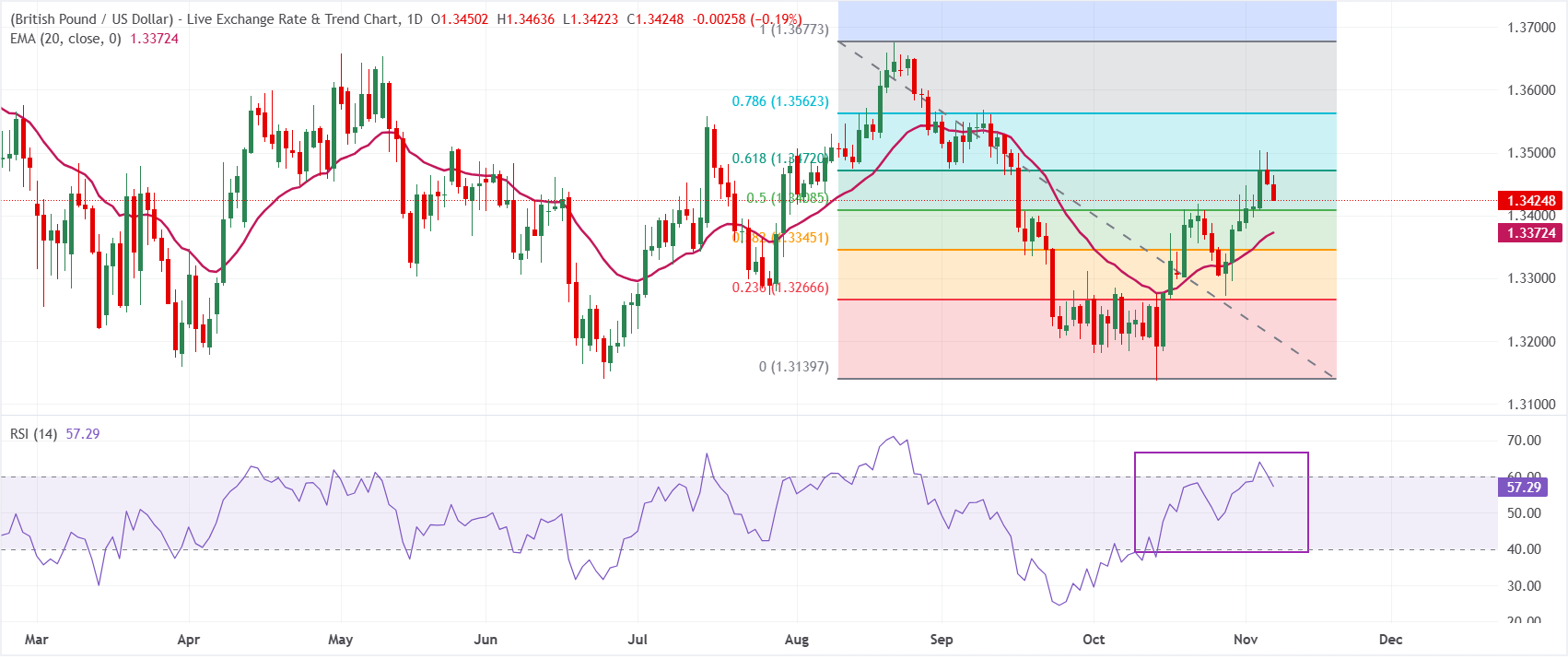
On the daily chart, the short-term outlook for GBP/USD remains constructive, with the pair trading at 1.3425. It is holding above both the 20-period Exponential Moving Average (EMA) at 1.3372 and the 50% Fibonacci retracement of the latest decline at 1.3409, indicating that buyers are defending higher levels. A Relative Strength Index (14) reading of 57 also points to a positive bias: upward momentum appears intact, although the indicator remains below overbought territory.
The first upside barrier is the 61.8% Fibonacci retracement near 1.3472. Beyond that lie the 78.6% retracement around 1.3562 and the recent cycle high area near 1.3677. Initial downside support comes from the 50% retracement at 1.3409, ahead of the 20-EMA at 1.3372. A more pronounced decline would bring the 38.2% level at 1.3345 and the 23.6% retracement near 1.3267 into view, before the stronger demand area around the 1.3140 cycle low.
(The technical analysis of this story was written with the help of an AI tool. Learn more.)
Published by the US Bureau of Labor Statistics (BLS), Nonfarm Payrolls measures the number of new jobs created across US non-agricultural businesses in the preceding month. Month-to-month payroll changes can fluctuate sharply, while substantial revisions to the figures can also prompt volatility in the foreign exchange market. A stronger reading is generally regarded as supportive of the US Dollar (USD), whereas a weaker figure is usually viewed as negative. However, revisions to earlier months and the Unemployment Rate matter as much as the headline number. The market response therefore hinges on investors' assessment of the BLS report in its entirety.
Find out more.Next publication: Fri 06 Nov 2026 13:30
Publication frequency: Every month
Consensus forecast: 65K
Previous reading: 29K
Data source: US Bureau of Labor Statistics
The monthly change in US employment, published on the first Friday after the month under review, is widely regarded as the most important economic indicator for forex traders. Closely linked to the economy’s overall performance, the change in job numbers is also watched by policymakers. With full employment among its mandates, the Federal Reserve takes labour market developments into account when setting policy, which in turn affects currencies. Although several leading indicators inform forecasts, Nonfarm Payrolls frequently catch markets by surprise, generating considerable volatility. Readings above the consensus forecast generally support the USD.







Phone: +61 2 8036 8388
Fax: +61 2 8036 8388
Email: support@tmgm.com



The information provided on this website is of a general nature only and does not constitute personal financial advice. Before acting on any information on this website, you should consider the suitability of the information in relation to your objectives, financial situation and needs. Investing in CFDs and FX Margin Contracts carries significant risks and is not suitable for all investors. You may lose more than your initial deposit. You do not own, or have, any interest in the underlying asset. We recommend that you seek independent advice and ensure you fully understand the risks involved before trading. It is important that you read and consider the disclosure document before you acquire any product listed on the website. The information and advertisements offered on this website are not intended for use by any person in any country or jurisdiction where such use would be contrary to local laws and regulations. The Products and Services offered on this website are not intended for residents of the United States, Malaysia and Thailand.
TMGM is authorized and regulated in various jurisdictions.
Trademax Australia Limited, trading as TMGM, is regulated by the Australian Securities and Investments Commission (ASIC), AFSL no. 436416 and is located at Level 28, One International Tower, 100 Barangaroo Avenue, 2000 Sydney, NSW Australia.
Email: support@tmgm.com.au
Trademax Global Limited, trading as TMGM, is authorized and regulated by the Vanuatu Financial Services Commission (VFSC), registration number 40356 and registered at 1276, Kumul Highway, Port Vila, Vanuatu, Republic of Vanuatu.
Email: support@tmgm.com
Trademax Global Markets (SE) Limited, trading as TMGM, is authorized and regulated by the Financial Services Authority (FSA) of Seychelles, with license number SD224. The company is registered at Office No 13, Providence Estate ABIS Centre, Mahe, Seychelles.
Email: support@tmgm.com
Trademax Global Markets (International) Pty Ltd, trading as TMGM, is authorized and regulated by the Financial Services Commission, Mauritius (FSC) with license no. GB22201012, and registered at 33, Edith Cavell Street C/o IQ EQ Fund Services (Mauritius) Ltd Port Louis, 11324 Mauritius.
Email: support@tmgm.com
Copyright © TMGM. All rights reserved

