
News & AnalysisCareer

Support around 0.6710 provides a temporary floor for the Australian Dollar (AUD), which recovers to near 0.6735 against the US Dollar (USD) in Wednesday’s European session. The rebound comes as the Australian currency recoups its sizeable early losses. Nevertheless, uncertainty surrounds the outlook amid hopes that the Reserve Bank of Australia’s (RBA) monetary policy cycle has ended.

Having raised interest rates five times so far this year, the RBA has pointed to downside risks to the economy in remarks suggesting that the hurdle for a further increase is very high.
Following the RBA’s recent increase in its policy rate to 4.85%, Commerzbank analysts say the latest minutes “underscore once again that the threshold for another rate hike is likely to be rather high,” with the rate at “its highest level since the global financial crisis in 2008.” In their assessment, policymakers’ apparent reluctance to tighten further is reinforced by a rate that is “already well above the RBA’s estimate of the neutral rate of around 3-4%,” as they emphasise. Commerzbank also draws attention to the warning that “the three members who voted against the latest rate hike warned that the economy could already be close to a sharper downturn,” which, in the analysts’ view, “suggests that the RBA is likely to be cautious about further rate hikes for now.”
October’s labour market figures, due on Thursday, will be the next major catalyst for the Australian Dollar. Forecasts point to an unchanged Unemployment Rate of 4.7%, alongside an increase in employment of 25.2K following 39.3K job losses in September.
Expectations that the Federal Reserve (Fed) has embarked on an extended monetary tightening cycle are, meanwhile, helping the US Dollar outperform.
A fresh 19-month high of around 103.86 is reached during the European session by the US Dollar Index (DXY), which tracks the Greenback against six major currencies.
Today’s percentage moves in the US Dollar (USD) against the major currencies listed are set out below. Its largest gain was against the Euro.
| USD | EUR | GBP | JPY | CAD | AUD | NZD | CHF | |
|---|---|---|---|---|---|---|---|---|
| USD | 0.34% | 0.33% | -0.03% | 0.12% | 0.08% | -0.05% | 0.24% | |
| EUR | -0.34% | -0.02% | -0.35% | -0.23% | -0.26% | -0.40% | -0.10% | |
| GBP | -0.33% | 0.02% | -0.34% | -0.22% | -0.25% | -0.38% | -0.08% | |
| JPY | 0.03% | 0.35% | 0.34% | 0.13% | 0.09% | -0.04% | 0.26% | |
| CAD | -0.12% | 0.23% | 0.22% | -0.13% | -0.04% | -0.17% | 0.13% | |
| AUD | -0.08% | 0.26% | 0.25% | -0.09% | 0.04% | -0.13% | 0.16% | |
| NZD | 0.05% | 0.40% | 0.38% | 0.04% | 0.17% | 0.13% | 0.31% | |
| CHF | -0.24% | 0.10% | 0.08% | -0.26% | -0.13% | -0.16% | -0.31% |
Percentage movements between the major currencies are displayed in the heat map. Select the base currency in the left-hand column and the quote currency in the top row. Selecting the US Dollar on the left and following its row across to the Japanese Yen, for instance, gives the percentage change for USD (base)/JPY (quote) in the corresponding cell.
Despite a “large drop in crude oil prices and some diminished enthusiasm for all things AI-related.” MUFG analysts note that the US Dollar “hit a new high as market participants continue to position for a series of Fed rate hikes”.
Turning to the forthcoming policy minutes, ING wrote that “the minutes of the FOMC meeting in October will be released this evening and will likely reflect the growing consensus amongst FOMC members that there is more work to do, signalling further rate hikes in Q1 next year.”
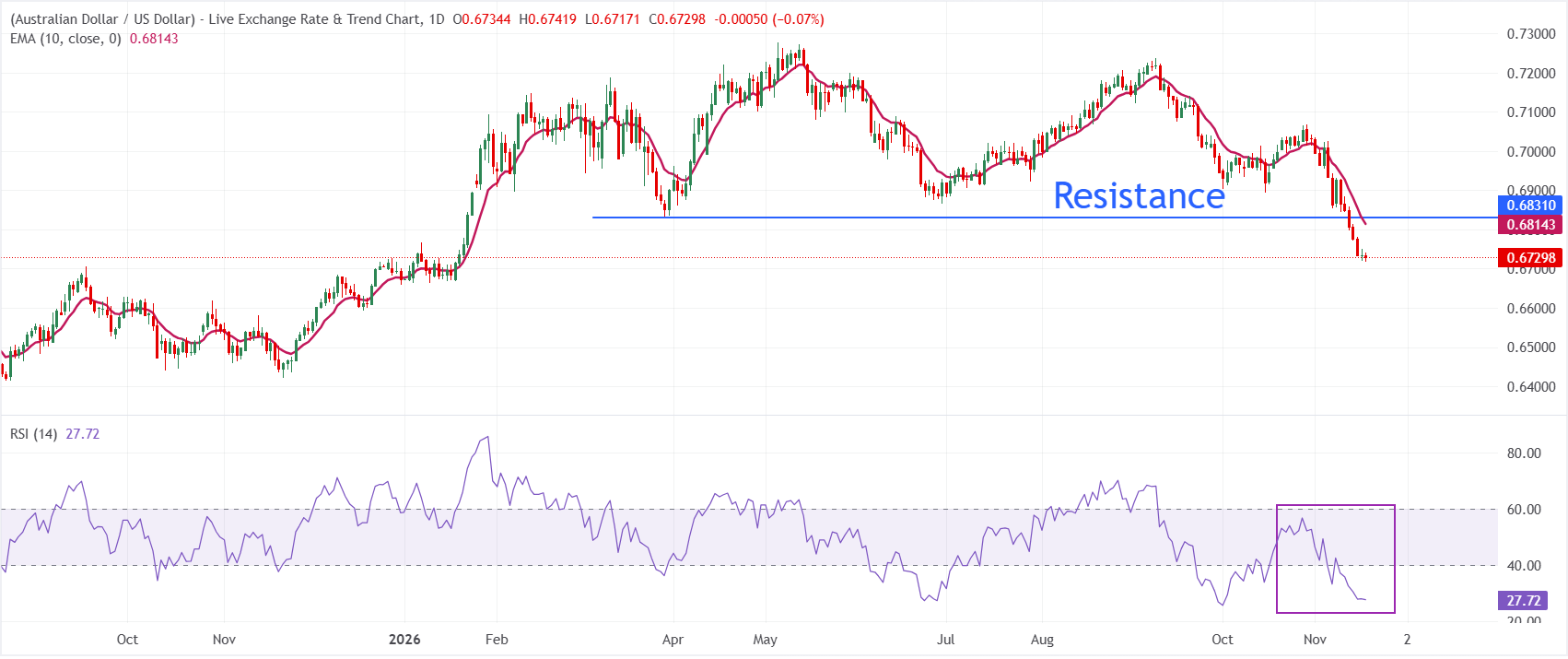
At 0.6730 on the daily chart, AUD/USD retains a bearish short-term outlook below its 10-day exponential moving average (EMA) of 0.6814. Further losses from the recent highs have left the pair well beneath this short-term trend indicator, pointing to continued seller control. Meanwhile, the Relative Strength Index (RSI) stands at 27.7 in oversold territory, suggesting that downward momentum may be overstretched, although it has yet to reverse.
The 10-day EMA near 0.6814 provides the first resistance level on the upside. A daily close above it would be required to relieve immediate selling pressure and allow a more substantial corrective recovery. Until AUD/USD regains that level, it is likely to remain susceptible to further declines. With no nearby structural support evident on the chart, renewed bearish pressure would leave the pair at risk of fresh lows.
(The technical analysis of this story was written with the help of an AI tool. Know more.)
Published by the Australian Bureau of Statistics, Employment Change tracks movements in the number of people employed in Australia, with seasonal influences removed from the figures. An increase generally supports consumer spending and economic growth, making it positive for the Australian Dollar (AUD). Conversely, a low reading is regarded as negative for the currency.
Read further.Forthcoming release: Thu 19 Nov 2026 00:30
Release frequency: Monthly
Consensus forecast: 25.2K
Previous reading: -39.3K
Data source: Australian Bureau of Statistics







Phone: +61 2 8036 8388
Fax: +61 2 8036 8388
Email: support@tmgm.com



The information provided on this website is of a general nature only and does not constitute personal financial advice. Before acting on any information on this website, you should consider the suitability of the information in relation to your objectives, financial situation and needs. Investing in CFDs and FX Margin Contracts carries significant risks and is not suitable for all investors. You may lose more than your initial deposit. You do not own, or have, any interest in the underlying asset. We recommend that you seek independent advice and ensure you fully understand the risks involved before trading. It is important that you read and consider the disclosure document before you acquire any product listed on the website. The information and advertisements offered on this website are not intended for use by any person in any country or jurisdiction where such use would be contrary to local laws and regulations. The Products and Services offered on this website are not intended for residents of the United States, Malaysia and Thailand.
TMGM is authorized and regulated in various jurisdictions.
Trademax Australia Limited, trading as TMGM, is regulated by the Australian Securities and Investments Commission (ASIC), AFSL no. 436416 and is located at Level 28, One International Tower, 100 Barangaroo Avenue, 2000 Sydney, NSW Australia.
Email: support@tmgm.com.au
Trademax Global Limited, trading as TMGM, is authorized and regulated by the Vanuatu Financial Services Commission (VFSC), registration number 40356 and registered at 1276, Kumul Highway, Port Vila, Vanuatu, Republic of Vanuatu.
Email: support@tmgm.com
Trademax Global Markets (SE) Limited, trading as TMGM, is authorized and regulated by the Financial Services Authority (FSA) of Seychelles, with license number SD224. The company is registered at Office No 13, Providence Estate ABIS Centre, Mahe, Seychelles.
Email: support@tmgm.com
Trademax Global Markets (International) Pty Ltd, trading as TMGM, is authorized and regulated by the Financial Services Commission, Mauritius (FSC) with license no. GB22201012, and registered at 33, Edith Cavell Street C/o IQ EQ Fund Services (Mauritius) Ltd Port Louis, 11324 Mauritius.
Email: support@tmgm.com
Copyright © TMGM. All rights reserved

