
News & AnalysisCareer

USD/JPY is trading in a consolidation range near 159.75 at the time of writing on Monday. Japan’s third-quarter Gross Domestic Product (GDP) report showed a marginal, unexpected contraction, accompanied by an upward revision to second-quarter growth. Near-term directional momentum remains muted after the pair briefly reached 160.18 on Friday before pulling back. The GDP figures are being assessed alongside a loss of upward technical momentum, which points to range-bound trading in the short term. Strategists at UOB and Commerzbank suggest that underlying Japanese corporate investment and improving real wages leave the Bank of Japan (BoJ) on course to raise rates in December, containing the immediate downside implications for the Japanese Yen (JPY).

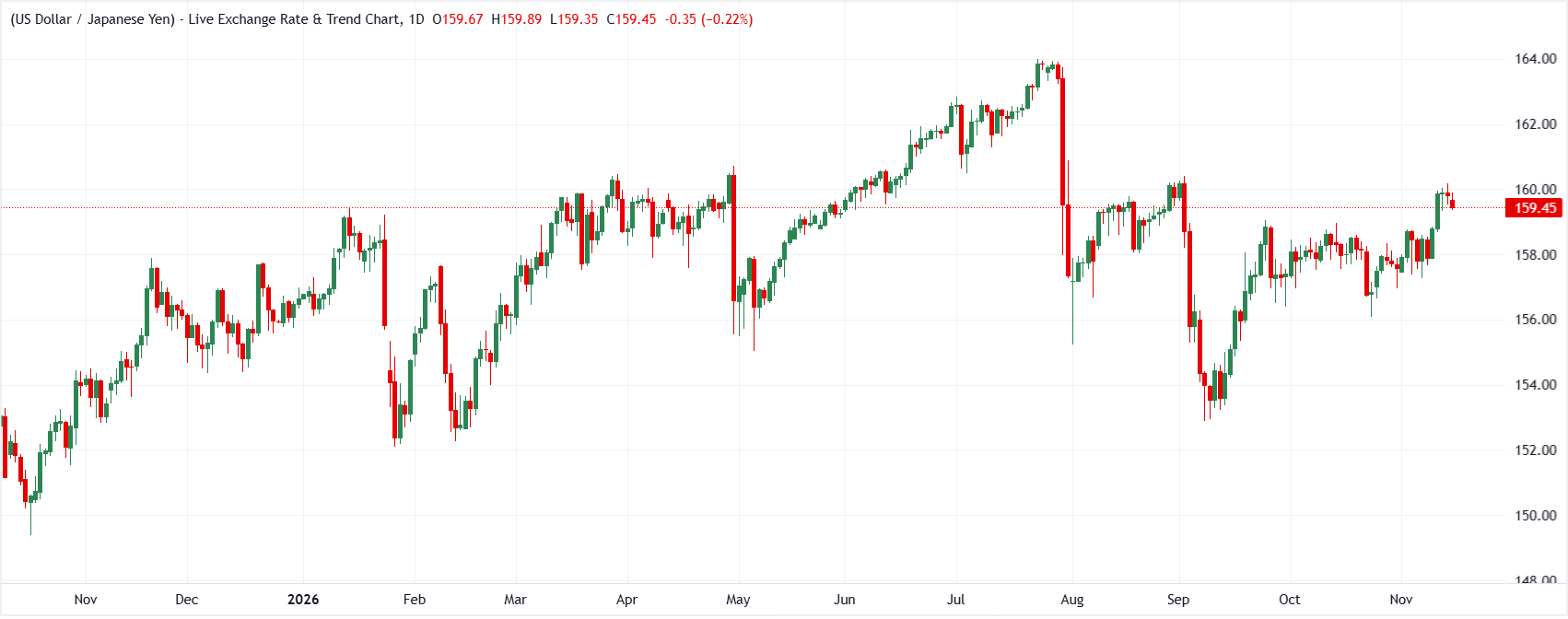
A move between 159.50 and 160.18, followed by a close around 159.66, provided little fresh guidance on USD/JPY’s direction, according to Quek Ser Leang and Lee Sue Ann at UOB. They expect intraday trading to stay within 159.35–160.15. Over 1–3 weeks, however, a test and possible break of 160.25 remain on the cards, provided strong support at 159.20 holds.
"24-HOUR VIEW: We expected USD “to trade in a range of 159.55/160.10” last Friday. USD fluctuated between 159.50 and 160.18 before settling at 159.66 (-0.12%). The price action provides no fresh clues. Today, USD could trade between 159.35 and 160.15... 1-3 WEEKS VIEW: ... USD rose to a fresh high of 160.18 on Friday, but it retreated quickly from the high. Although upward momentum is starting to slow, USD has the potential to test and possibly break above 160.25. On the downside, a breach of 159.20 (‘strong support’ level was at 159.00 last Friday) would indicate that USD has entered a range-trading phase."
The unexpectedly negative Q3 GDP reading in Japan was less concerning than the headline suggested, according to Volkmar Baur at Commerzbank. The contraction was negligible, while Q2 growth was revised upwards. Baur retains his forecast for a further Bank of Japan rate increase in December, citing strong corporate investment and improving real wages as offsets to weak private consumption. He expects little impact on the Japanese Yen.
"Japan’s third-quarter GDP figures disappointed at first glance, with the economy unexpectedly contracting. However, the decline was extremely small and only becomes apparent when growth is annualized or the quarterly figure is taken to two decimal places. Together with a slight upward revision to second-quarter growth, the overall picture is therefore hardly alarming... More noteworthy is the composition. Corporate investment continued to expand at a robust pace, while private consumption fell again. Consumption in the second quarter was also revised into negative territory... The GDP report is therefore somewhat weaker than expected, but in our view not weak enough to keep the Bank of Japan from hiking rates again in December. We therefore see little reason to change our BoJ call, and the implications for the yen should remain minimal."
A weak headline GDP reading has been counterbalanced by domestic fundamentals, leaving the Japanese Yen steady in the face of near-term technical pressure. In the view of UOB, USD/JPY retains scope to challenge 160.25 over the coming weeks, as long as strong support at 159.20 remains intact. Meanwhile, Commerzbank argues that solid corporate investment and improving real wages keep the Bank of Japan firmly on track for another rate increase in December, helping to contain broader Japanese Yen volatility.
(This article was created with the help of an Artificial Intelligence tool and reviewed by an editor. Know more.)







Phone: +61 2 8036 8388
Fax: +61 2 8036 8388
Email: support@tmgm.com



The information provided on this website is of a general nature only and does not constitute personal financial advice. Before acting on any information on this website, you should consider the suitability of the information in relation to your objectives, financial situation and needs. Investing in CFDs and FX Margin Contracts carries significant risks and is not suitable for all investors. You may lose more than your initial deposit. You do not own, or have, any interest in the underlying asset. We recommend that you seek independent advice and ensure you fully understand the risks involved before trading. It is important that you read and consider the disclosure document before you acquire any product listed on the website. The information and advertisements offered on this website are not intended for use by any person in any country or jurisdiction where such use would be contrary to local laws and regulations. The Products and Services offered on this website are not intended for residents of the United States, Malaysia and Thailand.
TMGM is authorized and regulated in various jurisdictions.
Trademax Australia Limited, trading as TMGM, is regulated by the Australian Securities and Investments Commission (ASIC), AFSL no. 436416 and is located at Level 28, One International Tower, 100 Barangaroo Avenue, 2000 Sydney, NSW Australia.
Email: support@tmgm.com.au
Trademax Global Limited, trading as TMGM, is authorized and regulated by the Vanuatu Financial Services Commission (VFSC), registration number 40356 and registered at 1276, Kumul Highway, Port Vila, Vanuatu, Republic of Vanuatu.
Email: support@tmgm.com
Trademax Global Markets (SE) Limited, trading as TMGM, is authorized and regulated by the Financial Services Authority (FSA) of Seychelles, with license number SD224. The company is registered at Office No 13, Providence Estate ABIS Centre, Mahe, Seychelles.
Email: support@tmgm.com
Trademax Global Markets (International) Pty Ltd, trading as TMGM, is authorized and regulated by the Financial Services Commission, Mauritius (FSC) with license no. GB22201012, and registered at 33, Edith Cavell Street C/o IQ EQ Fund Services (Mauritius) Ltd Port Louis, 11324 Mauritius.
Email: support@tmgm.com
Copyright © TMGM. All rights reserved


