
News & AnalysisCareer

At around 1.1234 in Thursday’s European session, the Euro (EUR) is little changed against the US Dollar (USD), having relinquished its earlier gains. Several headwinds facing the single currency are weighing on the major currency pair.

The Euro’s latest retreat has largely reflected sentiment, according to strategists at Danske Bank, who emphasise that “the decline in the pair is driven by the combination of high energy prices and EUR-pessimism on the back of French debt worries.” In their view, these pressures have deepened the caution already surrounding the single currency. Investors remain reluctant to increase their Euro exposure, even without a clear directional catalyst from wider markets.
The continent’s heavy dependence on imported energy leaves the Euro exposed to rising oil prices. At the time of writing, WTI Oil is up 2%, trading near $99.50.
Friday brings the preliminary October PMI releases for the Eurozone and the United States (US), which investors are awaiting. Aggregate business activity is forecast to have grown once more in both economies, albeit at a moderate rate.
Next week’s monetary policy decisions from the European Central Bank (ECB) and the Federal Reserve (Fed) will provide key catalysts for the Euro and the US Dollar. Both central banks are expected to keep interest rates on hold.
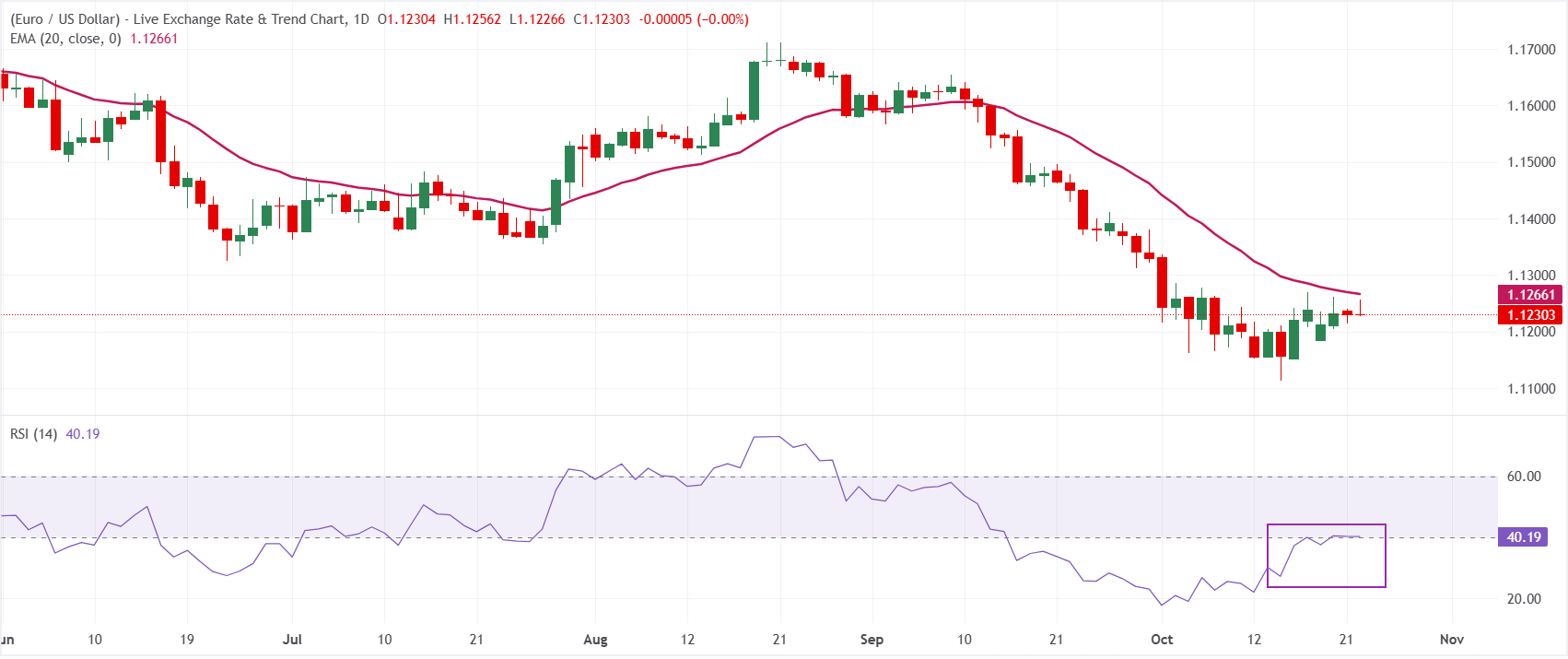
Trading at 1.1231 on the daily chart, EUR/USD remains beneath its 20-day Exponential Moving Average (EMA) of 1.1266, leaving the outlook mildly bearish. Continued resistance from this short-term EMA indicates that rallies are still attracting sellers. Meanwhile, a Relative Strength Index (RSI) reading near 40 points to weak but stabilising downward momentum, rather than outright oversold conditions.
An initial hurdle for buyers is the 20-day EMA at 1.1266: reclaiming it would relieve the prevailing pressure and pave the way for a more sustained recovery. With no nearby measured support levels in the data set, however, spot remains exposed to further declines towards previous price lows. Sentiment is likely to remain fragile for as long as EUR/USD holds below the short-term EMA.
(The technical analysis of this story was written with the help of an AI tool. Know more.)
Used by the 20 European Union countries within the Eurozone, the Euro ranks second only to the US Dollar among the world’s most traded currencies. Its share of all foreign exchange transactions stood at 31% in 2022, when average daily turnover exceeded $2.2 trillion. With an estimated 30% of all transactions, EUR/USD is the world’s most actively traded currency pair. Next come EUR/JPY (4%), EUR/GBP (3%) and EUR/AUD (2%).
Based in Frankfurt, Germany, the European Central Bank (ECB) acts as the Eurozone’s reserve bank, determining interest rates and overseeing monetary policy. Maintaining price stability is the ECB’s principal mandate, requiring it either to contain inflation or to support growth. Raising and lowering interest rates is its main policy instrument. The Euro generally benefits when rates are relatively high, or are expected to rise, while the reverse also applies. Monetary policy is decided by the ECB Governing Council at eight meetings each year. Those decisions are taken by the heads of the Eurozone’s national banks alongside six permanent members, among them ECB President Christine Lagarde.
Measured using the Harmonised Index of Consumer Prices (HICP), Eurozone inflation is a key economic indicator for the Euro. An unexpectedly strong rise in inflation, particularly above the ECB’s 2% target, requires the central bank to increase interest rates to regain control of prices. When interest rates are relatively high compared with those elsewhere, the Euro usually benefits: the region becomes a more attractive destination for global investors’ funds.
By revealing the economy’s health, data releases can affect the Euro. GDP, manufacturing and services PMIs, employment figures and consumer sentiment surveys are among the indicators capable of steering the single currency. Economic strength supports the Euro by drawing in more foreign investment and potentially encouraging the ECB to raise interest rates, which would directly strengthen the currency. Weak economic figures, by contrast, are likely to leave the Euro lower. Particular weight is attached to releases from Germany, France, Italy and Spain. As the euro area’s four largest economies, they represent 75% of the Eurozone’s economy.
The trade balance is another important release for the Euro, showing the gap between a country’s export earnings and its spending on imports during a specified period. Strong demand for a country’s exports generates additional demand for its currency as overseas buyers seek to purchase those goods, thereby increasing its value. A positive net trade balance therefore strengthens a currency, whereas a negative balance has the opposite effect.







Phone: +61 2 8036 8388
Fax: +61 2 8036 8388
Email: support@tmgm.com



The information provided on this website is of a general nature only and does not constitute personal financial advice. Before acting on any information on this website, you should consider the suitability of the information in relation to your objectives, financial situation and needs. Investing in CFDs and FX Margin Contracts carries significant risks and is not suitable for all investors. You may lose more than your initial deposit. You do not own, or have, any interest in the underlying asset. We recommend that you seek independent advice and ensure you fully understand the risks involved before trading. It is important that you read and consider the disclosure document before you acquire any product listed on the website. The information and advertisements offered on this website are not intended for use by any person in any country or jurisdiction where such use would be contrary to local laws and regulations. The Products and Services offered on this website are not intended for residents of the United States, Malaysia and Thailand.
TMGM is authorized and regulated in various jurisdictions.
Trademax Australia Limited, trading as TMGM, is regulated by the Australian Securities and Investments Commission (ASIC), AFSL no. 436416 and is located at Level 28, One International Tower, 100 Barangaroo Avenue, 2000 Sydney, NSW Australia.
Email: support@tmgm.com.au
Trademax Global Limited, trading as TMGM, is authorized and regulated by the Vanuatu Financial Services Commission (VFSC), registration number 40356 and registered at 1276, Kumul Highway, Port Vila, Vanuatu, Republic of Vanuatu.
Email: support@tmgm.com
Trademax Global Markets (SE) Limited, trading as TMGM, is authorized and regulated by the Financial Services Authority (FSA) of Seychelles, with license number SD224. The company is registered at Office No 13, Providence Estate ABIS Centre, Mahe, Seychelles.
Email: support@tmgm.com
Trademax Global Markets (International) Pty Ltd, trading as TMGM, is authorized and regulated by the Financial Services Commission, Mauritius (FSC) with license no. GB22201012, and registered at 33, Edith Cavell Street C/o IQ EQ Fund Services (Mauritius) Ltd Port Louis, 11324 Mauritius.
Email: support@tmgm.com
Copyright © TMGM. All rights reserved


