
News & AnalysisCareer

The Federal Reserve’s (Fed) monetary policy announcement at 18:00 GMT is the focus for investors on Wednesday, as Gold (XAU/USD) sees its recovery lose momentum. Over the previous two days, softer oil prices had supported bullion’s rebound from its lowest levels since July. A renewed rise in oil prices, alongside a stable US Dollar (USD), is now constraining further gains.

At the time of writing, a 0.36% daily decline leaves XAU/USD trading at around $4,046. Meanwhile, the US Dollar Index (DXY) is broadly steady at around 102.40, close to two-week highs. The index measures the Greenback against a basket of six major currencies.
A Wall Street Journal report that Washington had warned Gulf states of a possible military operation against Iran after the US midterms has prompted a recovery in oil prices. West Texas Intermediate (WTI) is up 1.0% on the day, trading at around $100.50 a barrel.
Since the Middle East war began in late February, rising energy costs have sustained inflationary pressure, leading major central banks, notably the Fed, to tighten monetary policy. In September, the US central bank increased interest rates by 25 basis points (bps) and indicated that a further rise would follow before year-end. It also reiterated its commitment to bringing inflation back to its 2% target.
For the October meeting, the broad expectation is that policymakers will leave interest rates at 3.75%-4.00%. According to the CME FedWatch Tool, traders assign an 85% probability to an increase in December.
Recent US data developments allow the Fed to pause for now, according to analysts at ABN Amro. In their assessment, “combined with the recent softer PCE readings, the labour data remove much of the pressure to hike immediately,” meaning policymakers can “afford another six weeks to assess whether the latest inflation strength represents persistent pressure or another temporary bump.”
ABN Amro’s assessment is that “the mix of persistent near-term inflation risk and a cooling labour market argues for patience rather than complacency.” The bank therefore expects the Fed “to hold in October, deliver one final 25bp hike in December, and then keep rates unchanged for an extended period.”
Markets could respond more strongly to guidance on future policy than to the decision itself, given that a pause is already widely expected. An indication that policymakers are still considering further rate increases could lift the US Dollar and threaten Gold’s $4,000 support level. As interest rates rise, so does the opportunity cost of holding the non-yielding metal. Conversely, a less hawkish message could put pressure on the Greenback, allowing bullion a short-term relief rally.
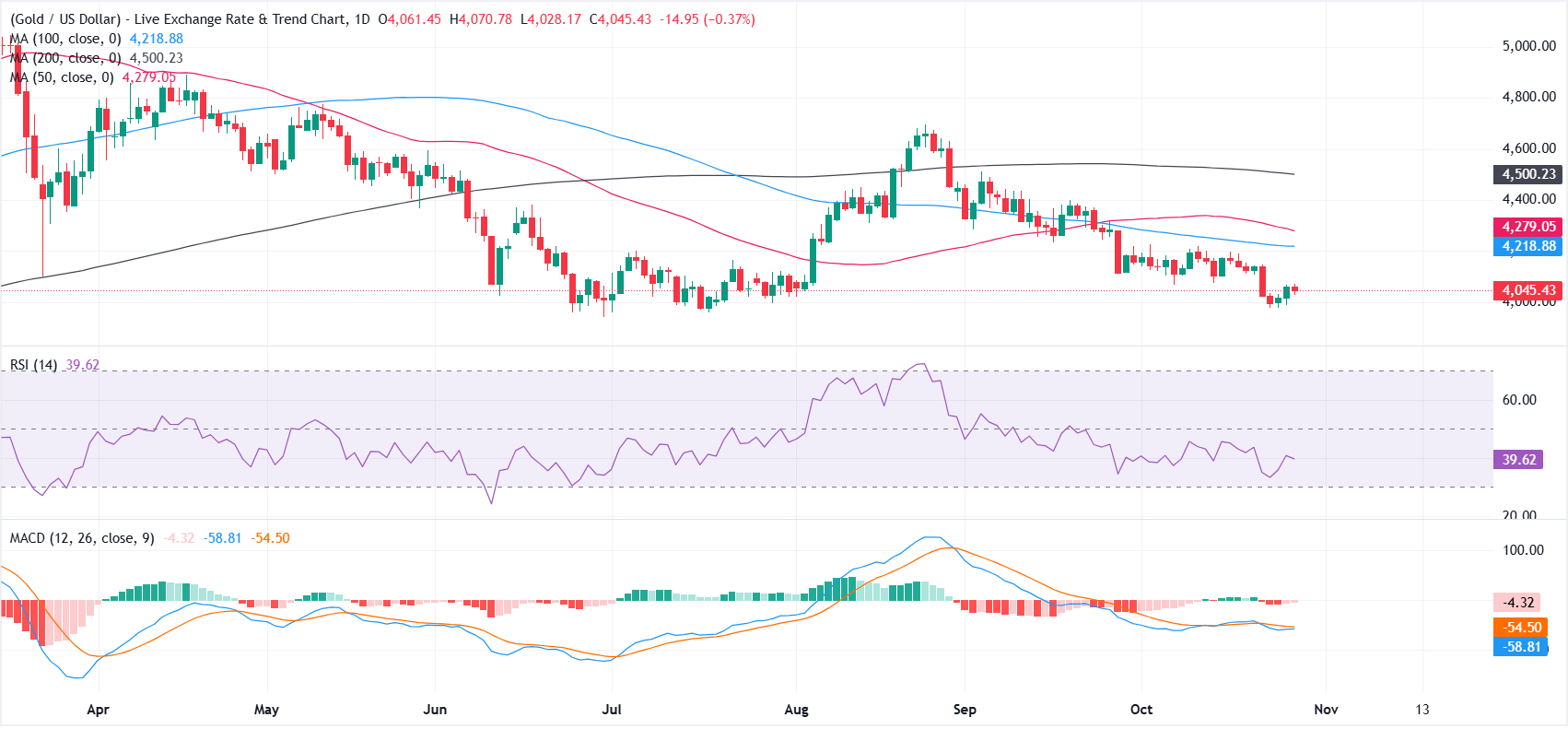
Sellers retain control on the daily chart, where XAU/USD trades beneath its 50-day, 100-day and 200-day Simple Moving Averages (SMAs), leaving the near-term outlook bearish. A Relative Strength Index (RSI) reading of 40 indicates subdued buying momentum. Meanwhile, the Moving Average Convergence Divergence (MACD) is still in negative territory, signalling continued downward pressure.
Any advance would first encounter resistance at the 100-day SMA near $4,219, with the 50-day SMA at $4,288 providing the next hurdle. A more substantial rebound could shift attention to horizontal resistance at $4,400, followed by the 200-day SMA around $4,503.
Immediate support lies in the $4,000-$3,950 zone, a break below which would leave scope for a deeper retracement. Recovery attempts are likely to face difficulty while the price remains beneath the cluster of daily moving averages.
(The technical analysis of this story was written with the help of an AI tool. Know more.)







Phone: +61 2 8036 8388
Fax: +61 2 8036 8388
Email: support@tmgm.com



The information provided on this website is of a general nature only and does not constitute personal financial advice. Before acting on any information on this website, you should consider the suitability of the information in relation to your objectives, financial situation and needs. Investing in CFDs and FX Margin Contracts carries significant risks and is not suitable for all investors. You may lose more than your initial deposit. You do not own, or have, any interest in the underlying asset. We recommend that you seek independent advice and ensure you fully understand the risks involved before trading. It is important that you read and consider the disclosure document before you acquire any product listed on the website. The information and advertisements offered on this website are not intended for use by any person in any country or jurisdiction where such use would be contrary to local laws and regulations. The Products and Services offered on this website are not intended for residents of the United States, Malaysia and Thailand.
TMGM is authorized and regulated in various jurisdictions.
Trademax Australia Limited, trading as TMGM, is regulated by the Australian Securities and Investments Commission (ASIC), AFSL no. 436416 and is located at Level 28, One International Tower, 100 Barangaroo Avenue, 2000 Sydney, NSW Australia.
Email: support@tmgm.com.au
Trademax Global Limited, trading as TMGM, is authorized and regulated by the Vanuatu Financial Services Commission (VFSC), registration number 40356 and registered at 1276, Kumul Highway, Port Vila, Vanuatu, Republic of Vanuatu.
Email: support@tmgm.com
Trademax Global Markets (SE) Limited, trading as TMGM, is authorized and regulated by the Financial Services Authority (FSA) of Seychelles, with license number SD224. The company is registered at Office No 13, Providence Estate ABIS Centre, Mahe, Seychelles.
Email: support@tmgm.com
Trademax Global Markets (International) Pty Ltd, trading as TMGM, is authorized and regulated by the Financial Services Commission, Mauritius (FSC) with license no. GB22201012, and registered at 33, Edith Cavell Street C/o IQ EQ Fund Services (Mauritius) Ltd Port Louis, 11324 Mauritius.
Email: support@tmgm.com
Copyright © TMGM. All rights reserved

