
News & AnalysisCareer

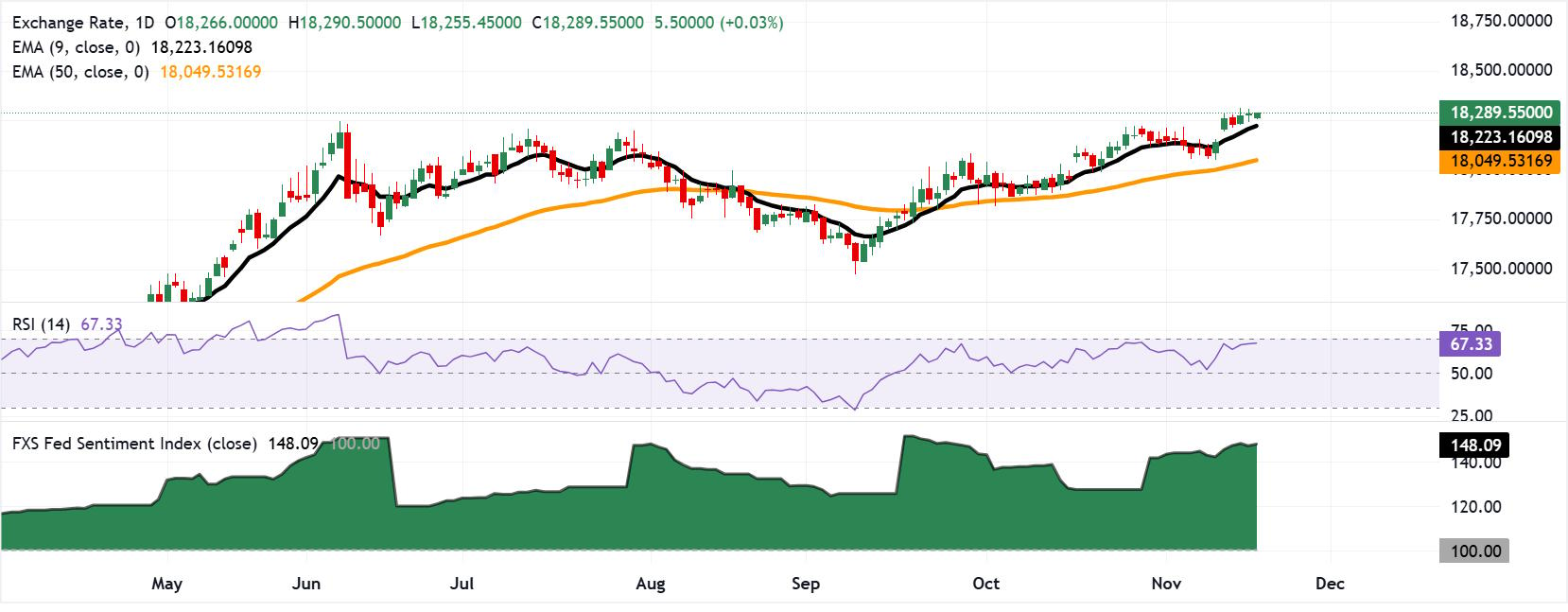
A benchmark policy rate of 5.75% for a fifth consecutive month is the widely anticipated outcome of Bank Indonesia’s (BI) decision later on Wednesday. The expected hold would follow cumulative interest rate increases of 100 basis points in May and June. Ahead of the announcement, USD/IDR is advancing after gapping lower at the open, with the pair trading around 18,290 in the Asian session as market participants await the decision.

Resilience in third-quarter economic activity could underpin the Indonesian Rupiah (IDR). Further support may come from MSCI and FTSE Russell, both of which retained Indonesia’s emerging-market classification in their November reviews. Bank Indonesia has also stepped up intervention in spot, forward and bond markets in an effort to further stabilise the currency.
Nevertheless, further gains in USD/IDR remain possible, with hawkish comments from Federal Reserve officials supporting the US Dollar (USD). Attention is now turning to the FOMC October Meeting Minutes, due for release later in the day.
Several rate increases may be necessary to curb high inflation, St. Louis Fed President Alberto Musalem indicated on Tuesday. He called for swift action to stop the problem deteriorating, while robust US economic figures lent further weight to the hawkish tone.
October Retail Sales increased by 0.2% month-on-month, in line with market forecasts, according to the US Census Bureau. Beneath the headline, the figures showed greater strength. Sales excluding autos gained 0.6%, exceeding expectations of 0.4%, and the retail sales control group rose 0.6% after a 0.1% increase in the previous month. The latter is a key input into calculations of consumer spending in GDP.
Against this backdrop, traders assign roughly a 95.7% probability to a quarter-point rate rise in December, according to the CME FedWatch tool. The probability of a larger 50-basis-point increase stands at 4.3%.
At 18,290 on the daily chart, USD/IDR continues to trade above its nine- and 50-period Exponential Moving Averages (EMAs). This positioning maintains a bullish near-term bias, with the short- and medium-term trends aligned to the upside. Meanwhile, the 14-day Relative Strength Index (RSI) stands at 67.33, within bullish territory but short of overbought levels. The reading points to continuing upward pressure, although momentum may be easing rather than moving into a blow-off phase.
Should the pair retreat, the nine-period EMA around 18,223.16 offers the first support level, where initial buying interest could emerge. A more pronounced correction would likely bring the 50-period EMA near 18,049.53 into focus as the next important support area. Only a daily close below that zone would materially undermine the currently constructive technical picture.
(The technical analysis of this story was written with the help of an AI tool. Know more.)
Global market conditions, domestic economic fundamentals, changing commodity prices and proactive central bank intervention all influence the Indonesian Rupiah (IDR). Its path as an emerging-market currency is closely linked to the resilience of the domestic economy as well as the pace of international economic activity.
Monetary policy strategy and direct market operations place Bank Indonesia (BI) at the heart of efforts to stabilise the Rupiah. Changes to benchmark interest rates allow BI to manage yield differentials relative to major central banks, including the US Federal Reserve, in order to attract and retain foreign portfolio investment. Its "triple-intervention" framework spans the spot, derivative (DNDF) and government bond markets to moderate currency volatility. Alongside this, monetary instruments such as Sekuritas Rupiah Bank Indonesia (SRBI) help strengthen capital inflows.
The IDR’s fundamental strength rests on domestic inflation, trade performance and the overall state of public finances. These macroeconomic fundamentals are closely connected to Indonesia’s trade and current account balances. Exchange rate movements also respond directly to wider global influences, including international investors’ appetite for, or aversion to, risk and trends in global liquidity.
Higher global commodity prices benefit Indonesia through its substantial exports of palm oil, coal, nickel and natural gas. The resulting trade surpluses and increased foreign currency inflows support the Rupiah. The effect of higher crude oil prices is different, however, because the country is a net crude importer. More expensive oil raises the foreign exchange burden, widens the current account deficit and puts downward pressure on the currency.







Phone: +61 2 8036 8388
Fax: +61 2 8036 8388
Email: support@tmgm.com



The information provided on this website is of a general nature only and does not constitute personal financial advice. Before acting on any information on this website, you should consider the suitability of the information in relation to your objectives, financial situation and needs. Investing in CFDs and FX Margin Contracts carries significant risks and is not suitable for all investors. You may lose more than your initial deposit. You do not own, or have, any interest in the underlying asset. We recommend that you seek independent advice and ensure you fully understand the risks involved before trading. It is important that you read and consider the disclosure document before you acquire any product listed on the website. The information and advertisements offered on this website are not intended for use by any person in any country or jurisdiction where such use would be contrary to local laws and regulations. The Products and Services offered on this website are not intended for residents of the United States, Malaysia and Thailand.
TMGM is authorized and regulated in various jurisdictions.
Trademax Australia Limited, trading as TMGM, is regulated by the Australian Securities and Investments Commission (ASIC), AFSL no. 436416 and is located at Level 28, One International Tower, 100 Barangaroo Avenue, 2000 Sydney, NSW Australia.
Email: support@tmgm.com.au
Trademax Global Limited, trading as TMGM, is authorized and regulated by the Vanuatu Financial Services Commission (VFSC), registration number 40356 and registered at 1276, Kumul Highway, Port Vila, Vanuatu, Republic of Vanuatu.
Email: support@tmgm.com
Trademax Global Markets (SE) Limited, trading as TMGM, is authorized and regulated by the Financial Services Authority (FSA) of Seychelles, with license number SD224. The company is registered at Office No 13, Providence Estate ABIS Centre, Mahe, Seychelles.
Email: support@tmgm.com
Trademax Global Markets (International) Pty Ltd, trading as TMGM, is authorized and regulated by the Financial Services Commission, Mauritius (FSC) with license no. GB22201012, and registered at 33, Edith Cavell Street C/o IQ EQ Fund Services (Mauritius) Ltd Port Louis, 11324 Mauritius.
Email: support@tmgm.com
Copyright © TMGM. All rights reserved


