
News & AnalysisCareer

Two-year inflation expectations for the fourth quarter of 2026 edged up to 2.36% from 2.34% in the third quarter, according to the Reserve Bank of New Zealand (RBNZ) Inflation Expectations survey, while the one-year forward projection stood at 2.92%. Following the release, the New Zealand Dollar (NZD) remains under pressure. NZD/USD is trading around 0.5490 in Tuesday’s Asian session, declining for a sixth consecutive day and moving towards lows not far from those seen 18 months ago.

A firmer US Dollar (USD) is also weighing on NZD/USD after last week’s stronger-than-expected US inflation report revived expectations of another Federal Reserve (Fed) interest rate rise in December. Adding to the hawkish outlook, Kansas City Fed President Jeffrey Schmid said on Sunday that inflation was still too high and that more work was required to contain price pressures.
For the Fed’s December 8–9 policy meeting, markets assign a 95.7% probability to a 25-basis-point rate rise and a 4.3% chance to a 50-basis-point increase, according to the CME FedWatch tool.
Attention now turns to the US October Retail Sales figures, scheduled for release later on Tuesday. Forecasts point to a 0.2% month-on-month increase in headline sales, with sales excluding cars expected to rise by 0.4%.
Trading at 0.5490 on the daily chart, NZD/USD continues to retreat below its nine-day and 50-day Exponential Moving Averages (EMAs), reinforcing a clearly bearish near-term outlook. With the pair pinned beneath these averages, dynamic resistance appears to be limiting recovery attempts. Meanwhile, the 14-day Relative Strength Index (RSI) is hovering around 30, signalling selling pressure that is nearing oversold territory without yet being firmly within it.
The nine-day EMA at 0.5546 provides the first upside hurdle, ahead of the 50-day EMA at 0.5651. A recovery would probably falter at these levels unless momentum strengthens decisively. Further up, horizontal resistance at 0.5850 precedes a more formidable medium-term barrier near 0.6100. Together, these levels mark the wider resistance zone the kiwi would have to regain to challenge the prevailing bearish structure.
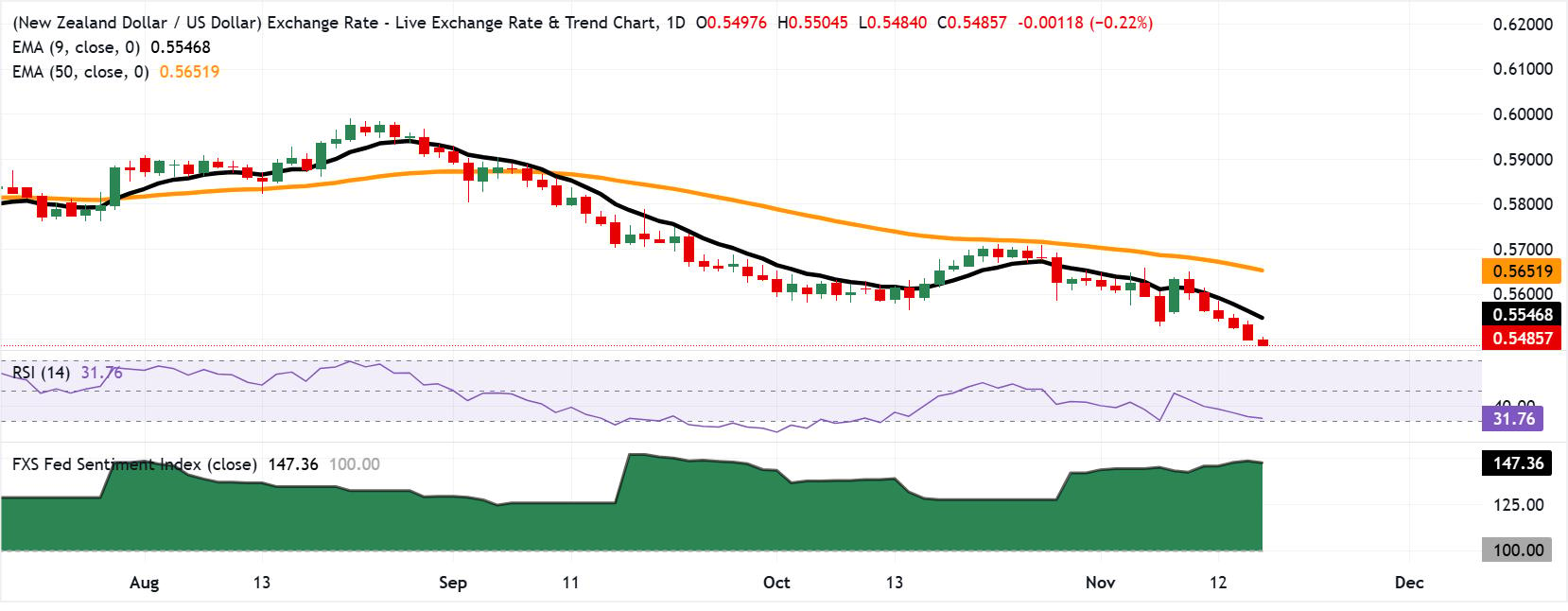
(An AI tool assisted in preparing this article’s technical analysis. Learn more.)
Known as the Kiwi, the New Zealand Dollar (NZD) is a familiar currency among investors. New Zealand’s economic health and its central bank’s policy broadly determine its value, although several distinctive factors also influence its movements. China’s economic performance matters because it is New Zealand’s largest trading partner. Disappointing Chinese economic news is likely to imply fewer New Zealand exports to that market, weighing on the domestic economy and, in turn, the currency. Dairy prices are another important influence, as dairy products are New Zealand’s principal export. Higher prices lift export earnings, supporting both the economy and the NZD.
Keeping inflation within a 1% to 3% range over the medium term, with an emphasis on the 2% midpoint, is the Reserve Bank of New Zealand’s (RBNZ) objective. It sets interest rates at a level intended to achieve that aim. If inflation becomes too high, the RBNZ raises rates to slow the economy. Higher rates also lift bond yields, making investment in New Zealand more attractive and thereby supporting the NZD. Rate cuts, by contrast, tend to weaken the currency. NZD/USD can also be heavily influenced by the interest rate differential: the gap between current or expected New Zealand rates and those set by the US Federal Reserve.
New Zealand’s macroeconomic releases help investors gauge the health of its economy and can affect the valuation of the New Zealand Dollar (NZD). Robust growth, low unemployment and strong confidence underpin an economy that is supportive of the currency. Rapid economic growth draws foreign investment and, when accompanied by elevated inflation, may prompt the Reserve Bank of New Zealand to raise interest rates. Weak economic figures, on the other hand, are likely to leave the NZD depreciating.
During periods of strong risk appetite, the New Zealand Dollar (NZD) generally appreciates as investors judge wider market risks to be low and take an optimistic view of growth. Such conditions typically improve the outlook for commodities and the so-called ‘commodity currencies’, including the Kiwi. In periods of market turmoil or economic uncertainty, the opposite tends to occur: investors sell riskier assets in favour of more stable safe havens, leaving the NZD weaker.







Phone: +61 2 8036 8388
Fax: +61 2 8036 8388
Email: support@tmgm.com



The information provided on this website is of a general nature only and does not constitute personal financial advice. Before acting on any information on this website, you should consider the suitability of the information in relation to your objectives, financial situation and needs. Investing in CFDs and FX Margin Contracts carries significant risks and is not suitable for all investors. You may lose more than your initial deposit. You do not own, or have, any interest in the underlying asset. We recommend that you seek independent advice and ensure you fully understand the risks involved before trading. It is important that you read and consider the disclosure document before you acquire any product listed on the website. The information and advertisements offered on this website are not intended for use by any person in any country or jurisdiction where such use would be contrary to local laws and regulations. The Products and Services offered on this website are not intended for residents of the United States, Malaysia and Thailand.
TMGM is authorized and regulated in various jurisdictions.
Trademax Australia Limited, trading as TMGM, is regulated by the Australian Securities and Investments Commission (ASIC), AFSL no. 436416 and is located at Level 28, One International Tower, 100 Barangaroo Avenue, 2000 Sydney, NSW Australia.
Email: support@tmgm.com.au
Trademax Global Limited, trading as TMGM, is authorized and regulated by the Vanuatu Financial Services Commission (VFSC), registration number 40356 and registered at 1276, Kumul Highway, Port Vila, Vanuatu, Republic of Vanuatu.
Email: support@tmgm.com
Trademax Global Markets (SE) Limited, trading as TMGM, is authorized and regulated by the Financial Services Authority (FSA) of Seychelles, with license number SD224. The company is registered at Office No 13, Providence Estate ABIS Centre, Mahe, Seychelles.
Email: support@tmgm.com
Trademax Global Markets (International) Pty Ltd, trading as TMGM, is authorized and regulated by the Financial Services Commission, Mauritius (FSC) with license no. GB22201012, and registered at 33, Edith Cavell Street C/o IQ EQ Fund Services (Mauritius) Ltd Port Louis, 11324 Mauritius.
Email: support@tmgm.com
Copyright © TMGM. All rights reserved


