
News & AnalysisCareer

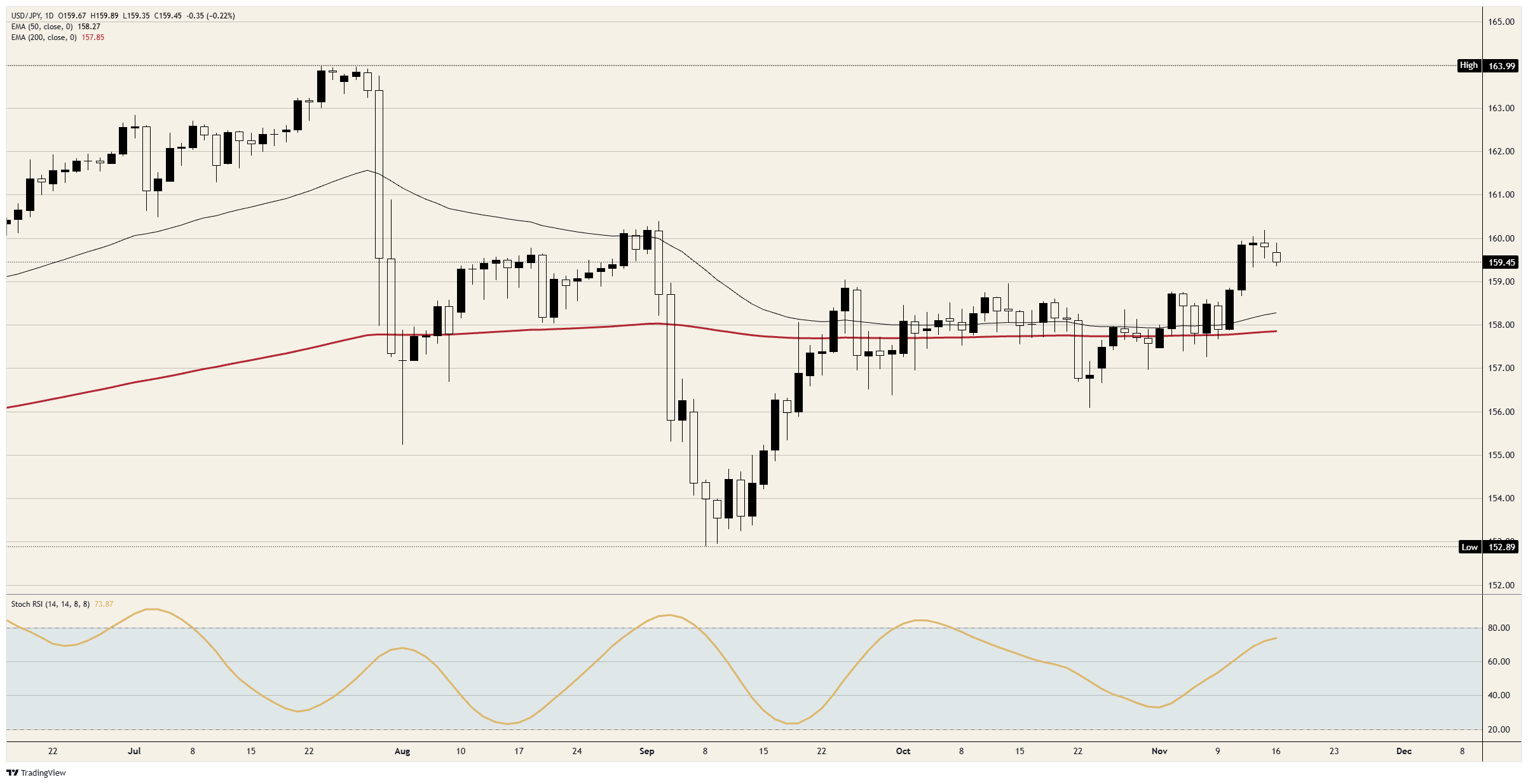
Trading around 159.50, USD/JPY has eased after three consecutive sessions in which advances stalled near 160.00. Friday's peak, just above 160.00, marked a ten-week high. Against a backdrop of weaker equities and warnings from Tokyo over the currency's weakness, the Yen was the only major currency to strengthen against the Dollar on Monday.

Technology shares sold off across markets from Asia to Wall Street, prompting flows into the Yen. Since USD/JPY touched 160.00, Tokyo has also warned against selling the Japanese currency. Finance Minister Katayama said on Friday that the government would respond appropriately to exchange-rate movements. Although Japan intervened during the summer, there has been no confirmed intervention in November.
Despite a slight contraction in Japan's economy in the third quarter, traders continue to price in fully a December interest-rate rise by the Bank of Japan (BoJ) from 1.25%. Markets also fully price in a Fed increase that month from 3.75%-4.00%, leaving the interest-rate differential unchanged at no less than two and a half percentage points. This gap explains why USD/JPY remains within a Yen of 160.00 even after a day of gains for the Japanese currency.
At 23:50 GMT on Tuesday, Japan releases its October trade figures. Exports are forecast to rise 20% year on year, following 16.7%, while imports are expected to increase 25.8%, following 18.9%. October's national Consumer Price Index (CPI) data are then due at 23:30 GMT on Thursday. Inflation excluding fresh food is forecast at 2.3%, compared with 2.1% previously; an acceleration would strengthen the argument for a December BoJ rate rise.
US October retail sales are scheduled for 13:30 GMT on Tuesday, with growth forecast to slow to 0.2% from 0.8%. Minutes of the Fed's October meeting follow at 19:00 GMT on Wednesday. Both releases will inform the Fed's December decision, which determines the US side of the interest-rate differential.
Since breaking out on 11 November, USD/JPY has remained above the 156.00-159.00 band that had contained trading from late September. Just below 158.00 sits the 200-day Exponential Moving Average (EMA), with the 50-day EMA just above that level; neither has moved much since October. The broader trading range extends from July's level just below 164.00 to September's level near 153.00.
Among the most actively traded currencies globally, the Japanese Yen (JPY) broadly reflects the performance of Japan's economy. More specific influences include Bank of Japan policy, the gap between Japanese and US bond yields and traders' appetite for risk, alongside other factors.
Currency control forms part of the Bank of Japan's mandate, making its actions important for the Yen. Direct intervention in foreign exchange markets has occurred on occasion, usually with the aim of weakening the currency. However, political concerns among Japan's main trading partners discourage the BoJ from intervening frequently. Between 2013 and 2024, its ultra-loose monetary policy weakened the Yen against its principal currency peers as the policy gap between the Bank of Japan and other major central banks grew. The more recent, gradual withdrawal of that ultra-loose stance has provided some support for the Yen.
By maintaining ultra-loose monetary policy over the past decade, the BoJ increasingly diverged from other central banks, most notably the US Federal Reserve. This helped widen the yield gap between 10-year US and Japanese bonds, favouring the US Dollar over the Japanese Yen. That differential is now narrowing as a result of the BoJ's 2024 decision to withdraw gradually from ultra-loose policy and interest-rate reductions by other major central banks.
Often regarded as a safe-haven investment, the Japanese Yen tends to attract investors during periods of market stress because of its perceived reliability and stability. In turbulent conditions, it is therefore likely to appreciate against currencies regarded as riskier investments.







Phone: +61 2 8036 8388
Fax: +61 2 8036 8388
Email: support@tmgm.com



The information provided on this website is of a general nature only and does not constitute personal financial advice. Before acting on any information on this website, you should consider the suitability of the information in relation to your objectives, financial situation and needs. Investing in CFDs and FX Margin Contracts carries significant risks and is not suitable for all investors. You may lose more than your initial deposit. You do not own, or have, any interest in the underlying asset. We recommend that you seek independent advice and ensure you fully understand the risks involved before trading. It is important that you read and consider the disclosure document before you acquire any product listed on the website. The information and advertisements offered on this website are not intended for use by any person in any country or jurisdiction where such use would be contrary to local laws and regulations. The Products and Services offered on this website are not intended for residents of the United States, Malaysia and Thailand.
TMGM is authorized and regulated in various jurisdictions.
Trademax Australia Limited, trading as TMGM, is regulated by the Australian Securities and Investments Commission (ASIC), AFSL no. 436416 and is located at Level 28, One International Tower, 100 Barangaroo Avenue, 2000 Sydney, NSW Australia.
Email: support@tmgm.com.au
Trademax Global Limited, trading as TMGM, is authorized and regulated by the Vanuatu Financial Services Commission (VFSC), registration number 40356 and registered at 1276, Kumul Highway, Port Vila, Vanuatu, Republic of Vanuatu.
Email: support@tmgm.com
Trademax Global Markets (SE) Limited, trading as TMGM, is authorized and regulated by the Financial Services Authority (FSA) of Seychelles, with license number SD224. The company is registered at Office No 13, Providence Estate ABIS Centre, Mahe, Seychelles.
Email: support@tmgm.com
Trademax Global Markets (International) Pty Ltd, trading as TMGM, is authorized and regulated by the Financial Services Commission, Mauritius (FSC) with license no. GB22201012, and registered at 33, Edith Cavell Street C/o IQ EQ Fund Services (Mauritius) Ltd Port Louis, 11324 Mauritius.
Email: support@tmgm.com
Copyright © TMGM. All rights reserved


