Introduction
A bullish engulfing pattern is a two-candles trend reversal signal used in technical analysis, that forms at the bottom of a downtrend, where a larger up candle's real body completely engulfs the prior down candle's body. This candlestick pattern is a sign that buyers have seized control from sellers. It is one of the most-watched reversal cues in technical analysis precisely because it is easy to read: trend context, reversal direction, and an invalidation level, all from two candles. Its mirror image, the bearish engulfing pattern, does the same job in reverse at the top of an uptrend. This guide covers what a bullish engulfing candle is, how it works in price action, how traders confirm and trade it, and where it fails. See our full guide to candlestick patterns for the wider family.
What is Engulfing Candlestick Pattern?
Both bullish and bearish engulfing patterns are reversal formations built from two consecutive candles.
The second candle's real body fully covers the first candle's real body, and the setup is read as a trend reversal signal from buy to sell or vice versa. Only the real bodies matter here: the second body must engulf the first body, but the wicks can extend beyond it and the pattern still counts. This is the single most misread part of an engulfing candle — it does not need to swallow the previous candle's entire high-to-low range, only its open-to-close body.
A bullish engulfing pattern forms after a decline, while a bearish engulfing pattern forms after an advanceand
What Are the Key Components of an Engulfing Candle?
A valid engulfing setup starts with context. Without a prior directional move to reverse, the pattern is just two candles and not a meaningful reversal signal.
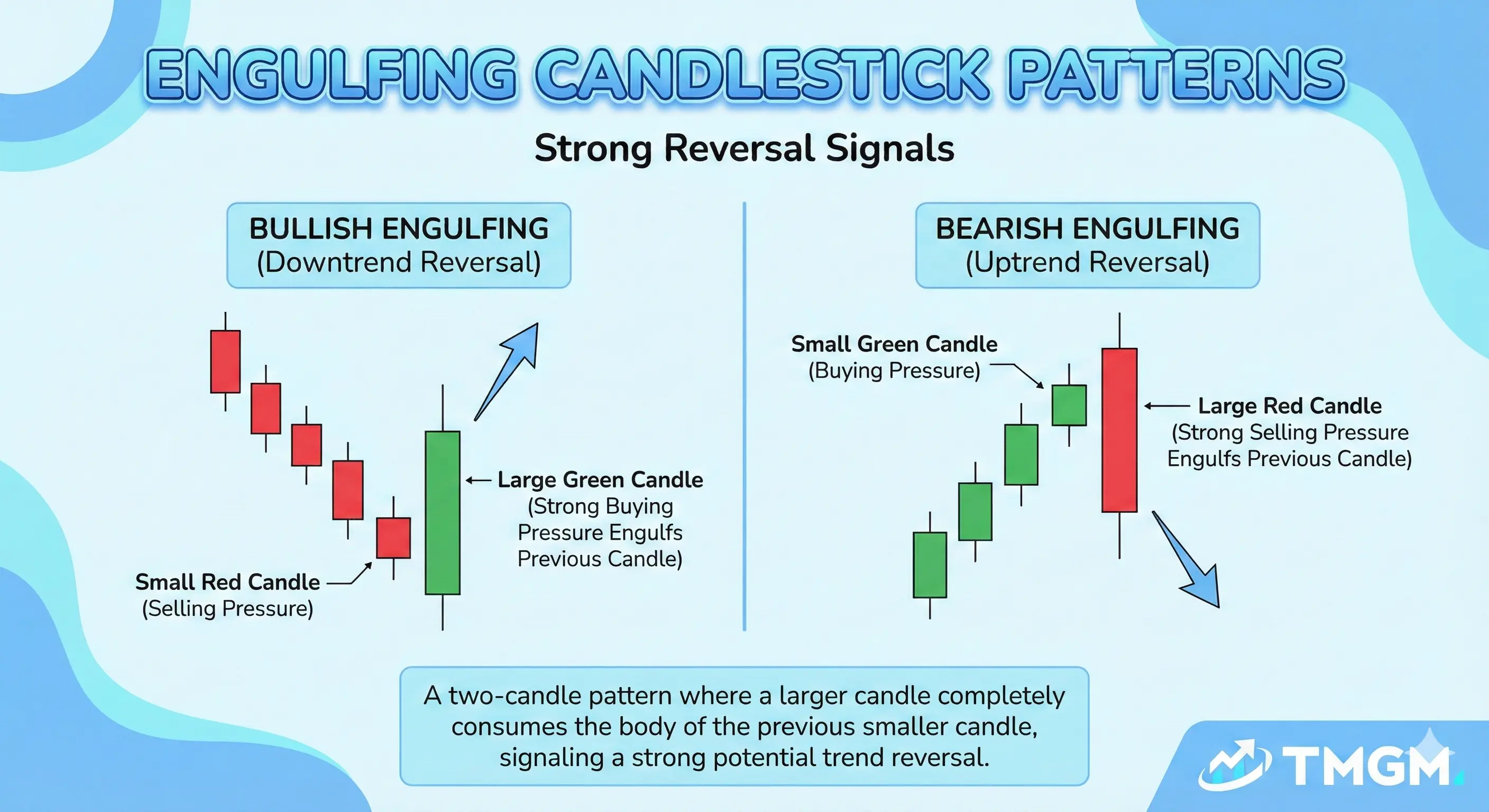
The first candle usually continues the existing move and is often smaller. The second candle flips direction and closes through the first candle’s real body, which is the core feature traders look for.
A valid bullish engulfing candle needs four things: two consecutive candles; a down candle followed by a larger up candle (opposite colours); a second real body that fully engulfs the first real body; and a prior downtrend for it to reverse. Miss the last one and you have two candles, not a signal.
How Does an Engulfing Pattern Work in Price Action?
An engulfing pattern works by showing failed continuation. The market begins the second candle in the direction of the old move, but the opposite side takes control before the close and overturns the prior session’s real body.
In a bullish engulfing candlestick pattern, sellers press the market lower early, then buyers reverse the session and close above the prior candle’s open. In a bearish engulfing pattern, buyers push higher first, then sellers reverse the session and close below the prior candle’s open.
What Are the Types of Engulfing Candlestick Patterns?
There are two core engulfing patterns, bullish engulfing and bearish engulfing candle patterns of opposite propertie. More useful day to day is telling a bullish engulfing candle apart from the candles it gets confused with.
Bullish engulfing: This pattern appears after a downtrend. A smaller bearish candle is followed by a larger bullish candle whose real body fully covers the first, signaling that buyers have seized short term control.
Bearish engulfing: This pattern appears after an uptrend. A smaller bullish candle is followed by a larger bearish candle whose real body fully covers the first, signaling that sellers have taken control.
It helps to separate the bullish engulfing candle from a few close relatives. A bullish harami ‹link› is the visual inverse — a small candle sitting inside the previous large one, rather than swallowing it. When the pattern is followed by a third candle that confirms the reversal, the three-candle version has its own name: the three outside up ‹link›. On bar charts the same idea appears as an outside bar, but there the whole range is compared, whereas a bullish engulfing is judged on the candle bodies alone. And unlike single-candle reversal signals such as the hammer, shooting star, or hanging man, a bullish engulfing always needs two candles to complete.
A bullish harami is the visual inverse — a small candle sitting inside the previous large one, rather than swallowing it.
When an engulfing pattern is followed by a third candle that confirms the reversal, the three-candle version has its own name: the three outside up (or three outside down).
On bar charts the same idea shows up as an outside bar, but there the whole range is compared, whereas an engulfing pattern is judged on the candle bodies alone. And unlike single-candle reversal signals such as the hammer, shooting star, or hanging man, an engulfing pattern always needs two candles to complete.
Bullish and Bearish Engulfing Pattern Key Differences
The two setups are structurally similar, but their meaning changes with the prior trend and the direction of the second candle. Traders read the same visual logic in opposite ways because one version implies upside reversal and the other implies downside reversal.
Trend context: Bullish engulfing candle pattern follows a decline. Bearish engulfing follows an advance.
First candle: Bullish engulfing starts with a bearish candle. Bearish engulfing starts with a bullish candle.
Second candle: Bullish engulfing closes upward through the prior real body. Bearish engulfing closes downward through the prior real body.
Trade thesis: Bullish engulfing entry setups look for upside confirmation. Bearish setups look for downside confirmation.
Invalidation: Bullish setups usually fail below the engulfing candle’s low. Bearish setups usually fail above the engulfing candle’s high.
These are close relative of engulfing pattern and not separate pattern families.
How to trade Bullish Engulfing Pattern?
Traders usually start with location, not just the candle. A bullish engulfing is more useful when it appears after an extended swing and near a clear support zone, because that is where control often shifts. Those zones are the ones you would already mark on a chart: prior swing lows, trendlines, round-number levels, and Fibonacci retracements. When a bullish engulfing prints exactly at one, two independent signals line up and the reversal odds improve.
Context before the signal matters as much as the signal itself. A bullish engulfing that forms after four or more consecutive bearish candles is a stronger reversal cue than one that appears after a single down bar — the more selling the engulfing candle absorbs, the more exhausted the downtrend likely is.
Context before the signal matters as much as the signal itself. A bullish engulfing candlestick pattern that forms after four or more consecutive bearish candles is a stronger reversal cue than one that appears after a single down bar — the more selling the engulfing candle pattern absorbs, the more exhausted the downtrend likely is. The same logic inverts for a bearish engulfing after an extended run of bullish candles.
A common workflow is simple. Wait for the engulfing candle to close, then look for confirmation such as a break of the engulfing candle's high, stronger volume, RSI confirmation, or a clean reaction at support. RSI works best as a filter, not a tick-box: a bullish engulfing carries more weight when RSI is climbing out of oversold territory, because momentum then agrees with the reversal instead of fighting it. RSI works best as a filter, not a tick-box: a bullish engulfing carries more weight when RSI is climbing out of oversold territory, and a bearish engulfing when RSI is rolling over from overbought — that alignment means momentum agrees with the reversal instead of fighting it.
Entries can be aggressive or conservative. An aggressive trader may enter near the close of the engulfing candle, while a conservative trader may wait for price to trade above the high of the bullish engulfing candle.
Risk is usually defined by the pattern itself. Many traders place a stop just below the low of the bullish engulfing candle, because a move through that level invalidates the reversal thesis.
Pro Tip: The engulfing candle gives a clear invalidation level, but it does not give a profit target, so define the exit from a nearby support/resistance level before entering.
Bullish Engulfing Pattern Example With Real Historical Price Data
This is the daily chart for EURUSD during July 2024 to August 2024. It shows a bullish engulfing pattern forming after a short pullback within a broader uptrend. The bearish prior candle reflects temporary seller control into a local swing low.
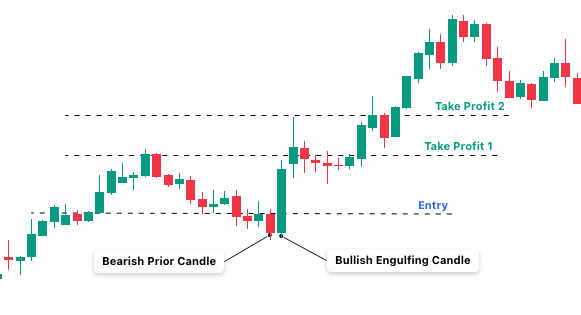
The next candle is a bullish engulfing candle. Its real body fully covers the prior bearish real body and closes strongly higher, which shows that buyers have absorbed the selling pressure and regained short term control.
Important: To confirm the candle pattern,
look at the top of the bullish engulfing candlestick. When it closes on or near its high with little or no upper wick, buyers were still in control at the close and momentum is likely to carry into the next session. A long upper wick is the opposite tell — price was pushed up and then rejected before the close, which weakens the signal even if the body still engulfs the prior candle.
In practical trade execution, the high of the bullish engulfing candle can act as the entry trigger, while the low of the same candle acts as the invalidation level. That gives the setup a clear structure because the signal candle also defines the risk boundary.
In this example, price breaks above the entry level and continues higher into Take Profit 1 before extending to Take Profit 2, both of which were drawn based on regional minor resistance level as take profit levels.
What Are the Advantages of Engulfing Candlestick Patterns?
Engulfing patterns are popular because they are easy to spot and easy to explain. A trader can quickly see trend context, reversal direction, and a logical invalidation level from just two candles.
They are also flexible. The pattern can appear on intraday, daily, weekly, or monthly charts, and traders often combine it with RSI, volume, moving averages, or support and resistance to strengthen decision making.
Another advantage is clarity of market message. The second candle shows a decisive change in session control, which makes the pattern especially useful for price action traders who want a simple visual reversal cue.
What Are the Limitations of Engulfing Candlestick Patterns?
Engulfing patterns are lagging. The signal only appears after the reversal bar has already closed, so part of the move may already be gone before the setup becomes valid.
They also fail very often in noisy markets.
This is because, when the engulfing candle is unusually large, the invalidation level sits far from the entry, which forces a wide stop loss level — and a wide stop can destroy a healthy risk-to-reward on an otherwise clean setup. The fix is position sizing, not a tighter stop: size the trade off the distance to the invalidation level so a wide signal candle costs the same fixed fraction of your account as a tight one. Pulling the stop closer just to shrink the risk usually places it inside the pattern's own noise, where it gets hit before the reversal has a chance.
Commonly cited win rates for engulfing signals sit in the 50–70% range depending on the market, the timeframe, and how much confirmation is required — which is another way of saying the pattern is an edge, not a certainty. It only pays when paired with trend context, a confirmation candle, volume, or a support/resistance level.
The pattern does not set a price target by itself. Its edge is also time sensitive, because candlestick patterns tend to lose potency within a few bars after completion.
On 24 hour FX charts, textbook gap conditions are less common because one daily close is usually the next daily open. That means traders often need to rely more on body dominance, market structure, and confirmation than on perfect candle geometry.
FAQ
Is a bullish engulfing pattern reliable?
It can be useful, but reliability improves when it forms after a clear downtrend and gets confirmation from the next candle, volume, or nearby support.
Does a bearish engulfing pattern always mean price will fall?
No. It signals a possible reversal, but false signals are common in choppy markets and traders usually wait for follow through.
What timeframe works best for engulfing patterns?
Daily charts are often cleaner because each candle captures a full session, but the pattern can also appear on intraday, weekly, or monthly charts and only has meaning within the timeframe being traded.