

Trading
Explore a wide range of markets with competitive pricing, deep liquidity, and advanced trading tools.
Learn More 
Platform
Trade seamlessly with TMGM's powerful platform, built for speed, precision, and a superior trading experience.
Learn More Trading Platform
Academy
Learn the fundamentals of trading with beginner-friendly resources, including guides, webinars, and market insights.
Learn More News & Analysis
Get real-time market updates and expert analysis to stay ahead of trading opportunities
Learn More News & Analysis
About
Learn what sets TMGM apart — our global presence, regulatory strength, and commitment to innovation in trading.
Learn More Why Choose TMGM
Sponsorship
Bitcoin Price Forecast: Can fragile BTC recovery withstand the test of Nvidia earnings and Anthropic IPO?
- Recovery remains elusive for Bitcoin below $65,000, following last week’s slide to a low near $62,000.
- For clues to broader risk appetite and AI-sector valuations, investors are watching this week’s Nvidia earnings and Anthropic IPO.
- Bitcoin’s rebound attempts face resistance from high US Treasury yields, US Dollar strength and sustained withdrawals from US-listed BTC spot ETFs.
Selling pressure continues to constrain Bitcoin (BTC), which trades below $65,000 on Tuesday. Last week, its decline deepened to $62,006, a level last seen in mid-July. With Nvidia’s (NVDA) earnings and Anthropic’s upcoming Initial Public Offering (IPO) due this week, investors are looking for fresh indications of AI-sector valuations and the wider appetite for risk.

Recovery in the Crypto King also remains constrained by high US bond yields, a firmer US Dollar (USD) and sustained institutional withdrawals from spot Bitcoin Exchange Traded Funds (ETFs).
What Could Nvidia and Anthropic Mean for Bitcoin?
A combination of headwinds detailed in the previous report drove Bitcoin sharply lower to $62,006 last week. Now struggling to recover above $65,000, the Crypto King faces a week in which traders will scrutinise Nvidia’s earnings and Anthropic’s IPO for clues to AI-sector valuations and broader risk sentiment.
Ahead of its latest earnings release, scheduled for this Tuesday after the US market close, Nvidia’s continuing leadership crisis is putting pressure on the wider industry.
Attention will then shift to Wednesday’s anticipated market debut by Anthropic, as investors assess demand for companies linked to AI.
Speaking exclusively to FXStreet, DWF Labs Market Insights Lead Martin Lee said momentum in the AI trade has faded since July. Investors, he explained, are increasingly questioning returns on enterprise token spending and hyperscalers’ capital expenditure (CapEx). Some optimism persists, but caution over AI-sector spending and valuations has grown.
According to Lee, capital inflows into crypto will hinge on whether investors leaving AI positions turn to other risk-on assets or instead allocate funds to entirely different asset classes.
As a gauge of the direction of investor appetite, he added that “how the markets shift when Anthropic IPOs will be a good indicator”.
Discussing Bitcoin, Lee said, “BTC’s immediate break below its 200-week moving average showed clear weakness. Moves this aggressive usually take time to digest, which fits the pattern from past midterm cycles: the first three to six months after a midterm have historically been weak for BTC. We expect volatility to stay high and price action to stay choppy until the market absorbs this move.”
Liquidity conditions and changes in investor appetite could transmit the impact of Nvidia’s earnings and Anthropic’s anticipated IPO to Bitcoin, warned Simon-Peter Massabni, Head of Business Development at XS.com.
Large public offerings, he explained, can draw liquidity out of financial markets temporarily. If selling intensifies, this could expose Bitcoin to more pronounced price swings. Such conditions could also quicken withdrawals from spot Bitcoin Exchange Traded Funds (ETFs), Massabni noted, after outflows exceeded $2 billion in each of the past two consecutive weeks.
Massabni outlined two possible outcomes from Nvidia’s earnings. Results that match lofty market expectations could keep capital in technology stocks, rather than redirecting it towards alternatives such as Bitcoin and Gold. A disappointing performance, by contrast, could spark a wider equity sell-off. Investors might then have to sell holdings in other assets to cover losses and meet margin calls.
Capital could nevertheless find its way back to Bitcoin as investors seek opportunities at lower prices, he added, “if the momentum surrounding artificial intelligence stocks cools down gradually without a deep collapse in the wider market,”.
How Are High US Bond Yields and a Firmer US Dollar Holding Back BTC?
Risk assets, including BTC, remain under pressure as traders overwhelmingly position for more aggressive Federal Reserve policy tightening following strong US inflation figures and hawkish central bank commentary.
A 25-basis-point (bps) rate hike at December’s Federal Open Market Committee (FOMC) policy meeting is fully priced in, according to the CME Group’s FedWatch Tool chart below. Traders attach only a small probability to a larger 50-bps rise.
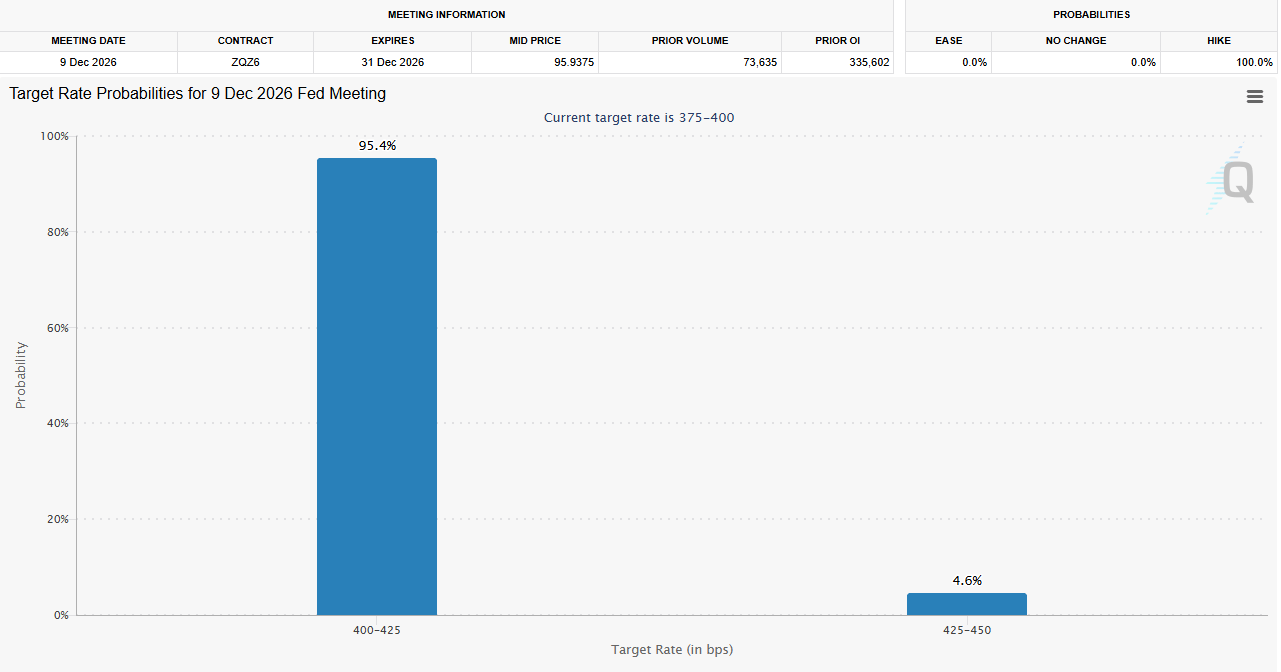
Against this backdrop, US bond yields remain elevated: the benchmark 10-year US Treasury note is holding well above 5%, close to a one-month high. Combined with continuing geopolitical tensions in the Middle East, these conditions have pushed the safe-haven USD to a fresh high of 103.70 on the US Dollar Index (DXY). That level, last seen in April 2025, leaves limited scope for a BTC recovery.
Is Institutional Demand Still Losing Ground?
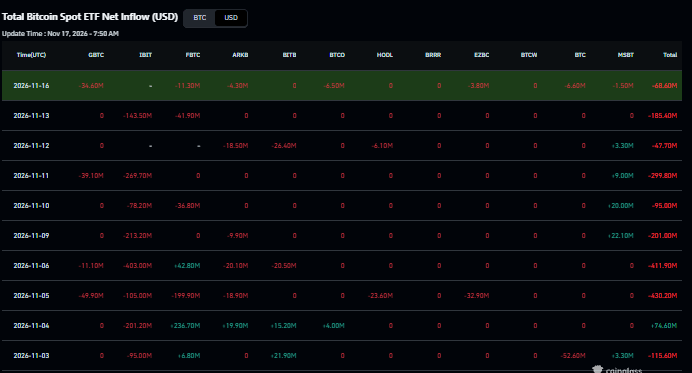
Fresh ETF withdrawals marked a weak start to the week for institutional Bitcoin demand. On Monday, BTC spot ETFs saw outflows of $68.60 million, CoinGlass data shows, following two consecutive weeks of billion-dollar withdrawals. A continuation and acceleration of this trend during the week could add to the pressure on BTC and deepen its price correction.
Bitcoin technical outlook: Can a corrective bounce counter dominant selling pressure?
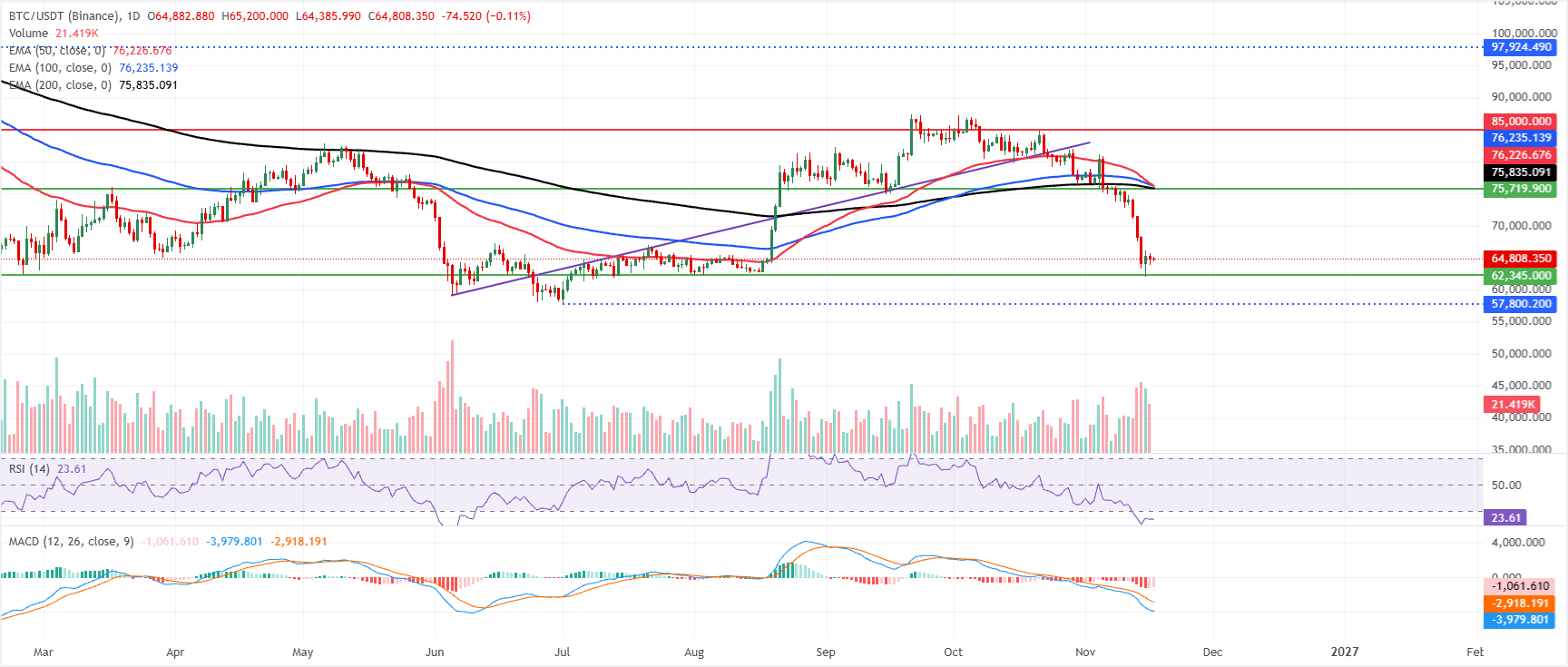
At $64,808 on Tuesday, Bitcoin remains well below its 50-day, 100-day and 200-day Exponential Moving Averages (EMAs) as the decline extends. Together, these averages restrict the upside in a band of roughly $75,835 to $76,235.
With BTC beneath every major trend gauge, the near-term outlook remains decisively bearish. The Relative Strength Index (RSI), meanwhile, sits near 23 in oversold territory, while the Moving Average Convergence Divergence (MACD) indicator is still deeply negative. These readings point to continued dominance by sellers, even as the risk of a corrective rebound persists.
Any recovery would first encounter the 200-day EMA near $75,835, followed by the 50-day EMA at $76,226 and the 100-day EMA around $76,235. Regaining this tightly grouped resistance zone would be necessary to temper the bearish outlook. Beyond it, the horizontal $85,000 level presents a more substantial hurdle, where earlier supply could resurface during a stronger rebound. Until Bitcoin tests these barriers, further declines or consolidation at depressed levels are likely to remain a risk.
(The technical analysis of this story was written with the help of an AI tool. Know more.)
FAQs on Bitcoin, altcoins and stablecoins
Designed to function as money, Bitcoin is a virtual currency and the largest cryptocurrency by market capitalisation. No single person, group or entity can control this payment method, removing the need for third parties to participate in financial transactions.
The term altcoin covers any cryptocurrency other than Bitcoin. Some, however, also exclude Ethereum, on the grounds that forks originate from these two cryptocurrencies. Under that interpretation, Litecoin is the first altcoin: it was forked from the Bitcoin protocol and is therefore an “improved” version of it.
A stablecoin is a cryptocurrency intended to maintain a steady price, backed by reserves of the asset it represents. Its value is tied to a commodity or financial instrument, such as the US Dollar (USD), while an algorithm or demand regulates supply. Stablecoins primarily give investors a way to enter and exit cryptocurrency trading and investment. They also offer a means of storing value, given the volatility generally associated with cryptocurrencies.
Measured as Bitcoin’s market capitalisation divided by the combined market capitalisation of all cryptocurrencies, Bitcoin dominance indicates the level of investor interest in Bitcoin. BTC dominance is typically high before and during a bull run, when investors favour a relatively stable cryptocurrency with a large market capitalisation, such as Bitcoin. Declining BTC dominance generally signals that investors are shifting capital and/or profits towards altcoins in search of better returns, often setting off a surge in altcoin rallies.
POPULAR ARTICLES
1GBP/USD Price Forecast: Cautious Trading Keeps Pair Near 1.32002US Dollar holds firm ahead of FOMC Meeting Minutes as Swiss Franc loses ground3Indian Rupee extends gains as sustained foreign inflows support Indian equities4Bank Indonesia interest rate decision approaches as Indonesian Rupiah edges lower5KOSPI leads gains as Asian stocks diverge following Nvidia earnings6USD/CAD Price Forecast: Can Bulls Maintain Their Hold Above 1.4300 and April 2025 Highs Ahead of FOMC Minutes?7Dogecoin Price Forecast: Can DOGE escape its bearish trend after fresh lows?8India Gold price today: FXStreet data shows a decline in Gold prices9EUR/JPY Price Forecast: Can 175.00 support hold as the pair tests it near yearly lows?


Get Started!
Sign up and access the Global Markets in less than 3 minutes

Connect With Us









Contacts
Phone: +61 2 8036 8388
Fax: +61 2 8036 8388
Email: support@tmgm.com



The information provided on this website is of a general nature only and does not constitute personal financial advice. Before acting on any information on this website, you should consider the suitability of the information in relation to your objectives, financial situation and needs. Investing in CFDs and FX Margin Contracts carries significant risks and is not suitable for all investors. You may lose more than your initial deposit. You do not own, or have, any interest in the underlying asset. We recommend that you seek independent advice and ensure you fully understand the risks involved before trading. It is important that you read and consider the disclosure document before you acquire any product listed on the website. The information and advertisements offered on this website are not intended for use by any person in any country or jurisdiction where such use would be contrary to local laws and regulations. The Products and Services offered on this website are not intended for residents of the United States, Malaysia and Thailand.
TMGM is authorized and regulated in various jurisdictions.
Trademax Australia Limited, trading as TMGM, is regulated by the Australian Securities and Investments Commission (ASIC), AFSL no. 436416 and is located at Level 28, One International Tower, 100 Barangaroo Avenue, 2000 Sydney, NSW Australia.
Email: support@tmgm.com.au
Trademax Global Limited, trading as TMGM, is authorized and regulated by the Vanuatu Financial Services Commission (VFSC), registration number 40356 and registered at 1276, Kumul Highway, Port Vila, Vanuatu, Republic of Vanuatu.
Email: support@tmgm.com
Trademax Global Markets (SE) Limited, trading as TMGM, is authorized and regulated by the Financial Services Authority (FSA) of Seychelles, with license number SD224. The company is registered at Office No 13, Providence Estate ABIS Centre, Mahe, Seychelles.
Email: support@tmgm.com
Trademax Global Markets (International) Pty Ltd, trading as TMGM, is authorized and regulated by the Financial Services Commission, Mauritius (FSC) with license no. GB22201012, and registered at 33, Edith Cavell Street C/o IQ EQ Fund Services (Mauritius) Ltd Port Louis, 11324 Mauritius.
Email: support@tmgm.com
Copyright © TMGM. All rights reserved