

Trading
Explore a wide range of markets with competitive pricing, deep liquidity, and advanced trading tools.
Learn More 
Platform
Trade seamlessly with TMGM's powerful platform, built for speed, precision, and a superior trading experience.
Learn More Trading Platform
Academy
Learn the fundamentals of trading with beginner-friendly resources, including guides, webinars, and market insights.
Learn More News & Analysis
Get real-time market updates and expert analysis to stay ahead of trading opportunities
Learn More News & Analysis
About
Learn what sets TMGM apart — our global presence, regulatory strength, and commitment to innovation in trading.
Learn More Why Choose TMGM
Sponsorship
Can the British Pound Stem Losses Below 1.3200 as Fed Rate Hike Expectations Lift the US Dollar?
- Selling pressure extends into a fifth consecutive day for GBP/USD, taking the pair to fresh one-month lows of 1.3185 so far.
- With the Fed taking a more hawkish stance than other major central banks, the US Dollar continues to dominate.
- The Pound has drawn no support from recent UK data, despite renewed hopes of a back-to-back BoE rate hike in December.
Pressure on the British Pound (GBP) persists for a fifth straight day as the US Dollar (USD) outpaces its peers on Monday. Calls from Federal Reserve (Fed) officials for additional monetary tightening are supporting the Dollar’s strength. At 1.3185, GBP/USD is trading at one-month lows and moving closer to its one-year low of 1.3137.
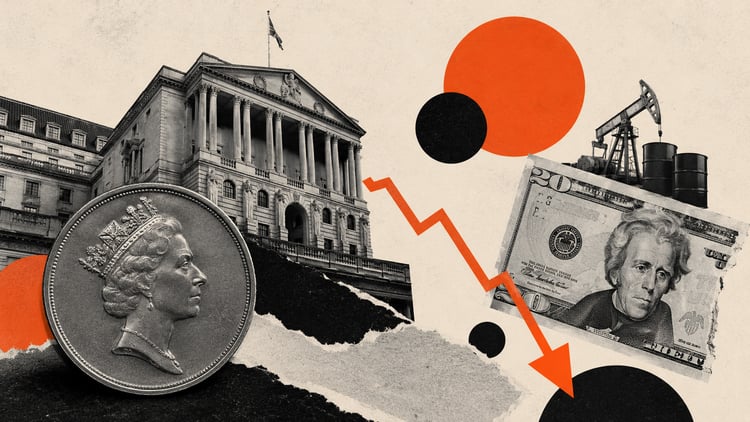
A 25-basis-point Fed rate hike on December 9 remains the market’s positioning, while the probability of a half-point increase stands at 8%, according to the CME’s FedWatch Tool.
Support for these expectations came from Fed officials over the weekend. On Sunday, Kansas Fed President Jeffrey Schmidt called on the central bank to act, arguing that “inflation is running too hot.”
Earlier, on Saturday, Boston Fed President Susan Collins had advocated a “steady pace of modest interest rate increases”. Fed Vice Chair Philip Jefferson, meanwhile, said recent data confirmed robust economic growth and labour market conditions alongside persistently high inflation. His remarks suggested support for a rate increase at next month’s meeting.
Why Is the Fed More Hawkish Than Other Major Central Banks?
Expectations of back-to-back interest rate increases by the Bank of England (BoE) have gathered pace after a series of encouraging UK macroeconomic releases last week. Among them, Gross Domestic Product (GDP) data showed growth of 0.7% in the third quarter, supported by strong Industrial Production.
Whether those expectations gain further support will be a key focus when UK employment figures arrive on Tuesday, followed by Consumer Prices Index (CPI) data on Wednesday.
Even so, Sterling remains under pressure. A hawkish reassessment of the Fed’s near-term policy path is driving broad-based gains in the US Dollar. According to MUFG’s Lee Hardman, markets “have moved to price in a more aggressive Fed tightening cycle following the third consecutive upside surprise in US core CPI in October and a hawkish shift in Fed rhetoric”.
Hardman described the implications: “As a result, the US rates market is now assigning a higher probability to three consecutive hikes in December, January, and March, which would lift the effective Fed funds rate towards 4.6%,”
Central banks: key questions answered
Maintaining price stability within a country or region is a central bank’s core responsibility. As the prices of goods and services fluctuate, economies face inflation or deflation. A sustained increase in the prices of the same goods constitutes inflation; a sustained decline constitutes deflation. By adjusting its policy rate, the central bank seeks to keep demand in check. Major central banks, including the US Federal Reserve (Fed), the European Central Bank (ECB) and the Bank of England (BoE), have a mandate to keep inflation close to 2%.
Adjusting the benchmark policy rate, commonly called the interest rate, is a central bank’s principal tool for raising or lowering inflation. At previously announced times, it publishes a statement setting out the policy rate and explaining the decision to hold, cut or increase it. Domestic banks then revise their savings and lending rates accordingly. These changes affect how easily people can earn returns on savings and how readily companies can borrow to invest in their businesses. A substantial rise in central bank interest rates is termed monetary tightening, while a reduction in the benchmark rate is known as monetary easing.
Political independence is common among central banks. Before joining a central bank’s policy board, prospective members go through a series of panels and hearings. Board members typically hold individual views on inflation management and the monetary policy needed to achieve it. Those favouring a highly accommodative stance, with low interest rates and cheap credit to provide a substantial economic boost, are known as ‘doves’. They are willing to tolerate inflation slightly above 2%. By contrast, ‘hawks’ prefer higher rates that reward savers and seek to keep inflation under control at all times. They remain focused on bringing inflation to 2% or just below it.
Meetings are generally chaired by a chairman or president, whose responsibilities include building agreement between hawks and doves. If members are evenly divided over a policy change, the chair has the final say to prevent a 50-50 tie. Speeches by the chair, often available to follow live, communicate the current policy stance and outlook. Central banks aim to advance monetary policy without causing sharp fluctuations in interest rates, equities or their currencies. Ahead of a policy meeting, all members convey their views to markets. Public comments are then prohibited from a few days before the meeting until the new policy decision has been announced. This interval is known as the blackout period.
POPULAR ARTICLES
1RBNZ Survey: NZ two-year inflation expectations reach 2.36% QoQ after rising in Q4 20262Silver Price Forecast: Bearish potential appears intact despite XAG/USD rebound above $47.003British Pound falls as UK jobs data loom4Australian Dollar slips below 0.6750 following RBA minutes as attention turns to US Retail Sales data5Euro under pressure below 1.1000 as bullish USD keeps May 2025 lows in focus6USD/CNY reference rate fixed at 6.7132 by PBOC, compared with 6.7141 previously7Canadian Dollar loses ground to US Dollar as oil prices decline amid Fed rate hike bets8RBA Minutes: Members weigh a 25 bps hike in the cash rate target against leaving it unchanged9Why is WTI edging lower to near $84.00 as Middle East exports recover?

Get Started!
Sign up and access the Global Markets in less than 3 minutes

Connect With Us









Contacts
Phone: +61 2 8036 8388
Fax: +61 2 8036 8388
Email: support@tmgm.com



The information provided on this website is of a general nature only and does not constitute personal financial advice. Before acting on any information on this website, you should consider the suitability of the information in relation to your objectives, financial situation and needs. Investing in CFDs and FX Margin Contracts carries significant risks and is not suitable for all investors. You may lose more than your initial deposit. You do not own, or have, any interest in the underlying asset. We recommend that you seek independent advice and ensure you fully understand the risks involved before trading. It is important that you read and consider the disclosure document before you acquire any product listed on the website. The information and advertisements offered on this website are not intended for use by any person in any country or jurisdiction where such use would be contrary to local laws and regulations. The Products and Services offered on this website are not intended for residents of the United States, Malaysia and Thailand.
TMGM is authorized and regulated in various jurisdictions.
Trademax Australia Limited, trading as TMGM, is regulated by the Australian Securities and Investments Commission (ASIC), AFSL no. 436416 and is located at Level 28, One International Tower, 100 Barangaroo Avenue, 2000 Sydney, NSW Australia.
Email: support@tmgm.com.au
Trademax Global Limited, trading as TMGM, is authorized and regulated by the Vanuatu Financial Services Commission (VFSC), registration number 40356 and registered at 1276, Kumul Highway, Port Vila, Vanuatu, Republic of Vanuatu.
Email: support@tmgm.com
Trademax Global Markets (SE) Limited, trading as TMGM, is authorized and regulated by the Financial Services Authority (FSA) of Seychelles, with license number SD224. The company is registered at Office No 13, Providence Estate ABIS Centre, Mahe, Seychelles.
Email: support@tmgm.com
Trademax Global Markets (International) Pty Ltd, trading as TMGM, is authorized and regulated by the Financial Services Commission, Mauritius (FSC) with license no. GB22201012, and registered at 33, Edith Cavell Street C/o IQ EQ Fund Services (Mauritius) Ltd Port Louis, 11324 Mauritius.
Email: support@tmgm.com
Copyright © TMGM. All rights reserved