

Trading
Explore a wide range of markets with competitive pricing, deep liquidity, and advanced trading tools.
Learn More 
Platform
Trade seamlessly with TMGM's powerful platform, built for speed, precision, and a superior trading experience.
Learn More Trading Platform
Academy
Learn the fundamentals of trading with beginner-friendly resources, including guides, webinars, and market insights.
Learn More News & Analysis
Get real-time market updates and expert analysis to stay ahead of trading opportunities
Learn More News & Analysis
About
Learn what sets TMGM apart — our global presence, regulatory strength, and commitment to innovation in trading.
Learn More Why Choose TMGM
Sponsorship
United States Dollar Index retains bullish outlook despite pullback from 19-month peak of 103.70
- A pullback takes the US Dollar Index towards 103.53 after it reached a 19-month high of 103.70.
- Further interest rate increases are needed to curb upside inflation risks, several Fed policymakers have warned.
- Markets have factored in three successive Fed interest rate increases, according to MUFG.
Some corrective pressure has emerged in the US Dollar (USD) after its rally extended during Tuesday’s Asian session. At the time of writing, the US Dollar Index (DXY) is marginally lower near 103.53, having pulled back from a 19-month peak of 103.70. The index measures the Greenback against a basket of six major currencies.

Expectations of a lengthy Federal Reserve (Fed) monetary tightening cycle have helped the Greenback outperform other currencies over the past few weeks. Financial markets remain confident that persistent inflationary pressures will keep the tightening cycle in place.
Recent comments by several Fed officials have also pointed to their deep concern over elevated inflationary pressures.
Why does Hammack favour smaller rate hikes as inflation pressures broaden?
Inflation risks remained central to the moderately hawkish message delivered by the Fed’s Hammack on Monday. The FXS Speechtracker score came in at 7.1/10, a little below the historical average of 7.6/10. Hammack’s references to inflation “going in the wrong direction,” price pressures spreading more widely and businesses becoming more willing to pass on price increases highlight concerns over troublesome underlying inflation dynamics. Even so, Hammack again favoured steady, smaller interest rate increases that would give the economy time to adjust. With financial conditions described as “still not restraining the economy” and the economy seen as capable of absorbing further restraint, the remarks support a bias towards additional tightening while retaining a firm commitment to the 2% inflation target.
Despite the slightly softer FXS Speechtracker reading, the overall hawkish stance was unaffected by the speech: the FXS Fed Sentiment Index recorded a 0.00-point change to remain at 147.36. Its position well above 100 confirms that Fed communication continues to be hawkish. That reading is consistent with persistent inflation concerns and the need for higher market borrowing costs to restrain economic activity.
Kansas City Fed President Jeffrey Schmid struck a similar note over the weekend, saying, “Inflation is running too hot,” and adding that the central bank “has some work to do on inflation”.
How does Schmid’s warning on sticky inflation reinforce the Fed’s hawkish bias?
Growing concern about persistent price pressures shaped the distinctly hawkish remarks from the Fed’s Schmid. His FXS Speechtracker score of 7/10 was slightly above the historical average of 6.9/10. Schmid said that bringing inflation under control has “only gotten harder,” with inflation “uncomfortably above” the 2% target and still likely to be close to 3% without energy. His assessment that the Fed “has some work to do on inflation” came alongside a description of the labour market as broadly balanced rather than a key source of current price pressures. He focused on managing demand and rejected the targeting of individual prices, including those of AI-related technology goods. Combined with his view that influencing any particular good or service is not the Fed’s responsibility, these remarks favour a broad, policy-led effort to cool inflation, providing support for the Dollar.
A 1.00-point increase took the FXS Fed Sentiment Index to 148.44, leaving it firmly in hawkish territory and aligning with the slightly above-baseline tone of the FXS Speechtracker score. Although Schmid did not explicitly advocate immediate tightening, the modest rise suggests that market participants are likely to read his comments as preserving the Fed’s bias towards further restraint in its policy response. Such a backdrop generally supports the Dollar against the Euro and Yen.
The sharp hawkish reassessment of Fed policy is feeding directly into the US rates market, according to analysts at MUFG/BTMU. They note that the market is now "assigning a higher probability to three consecutive hikes in December, January and March, which would lift the effective Fed funds rate towards 4.6%."
US Dollar Index Technical Analysis: Is 104.00 the Next Key Hurdle?
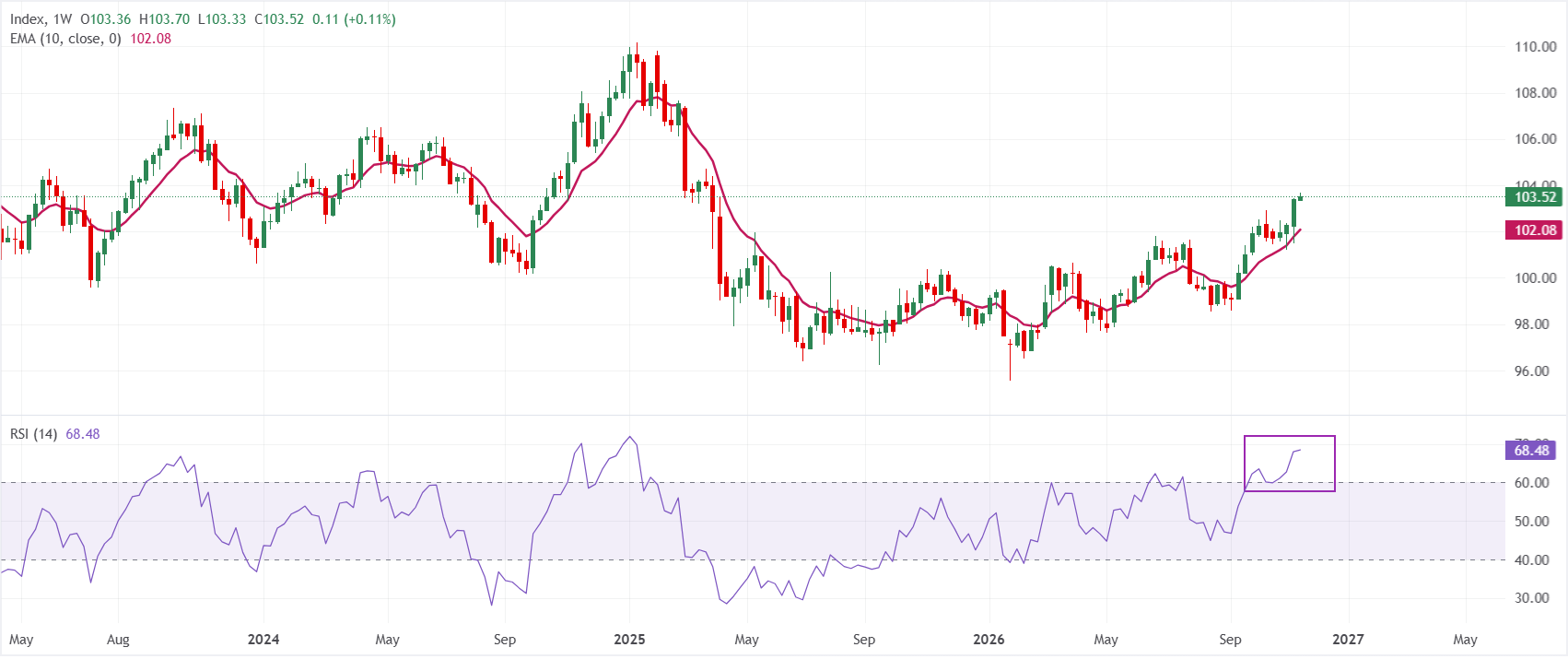
The near-term technical structure remains bullish on the weekly chart, where Dollar Index Spot is trading at 103.52, above its 10-week exponential moving average (EMA) of 102.08. Prices continue to edge higher, moving away from trend support. At 68.46, the Relative Strength Index (RSI) is just short of overbought territory, indicating robust upward momentum with only initial signs that conditions are becoming stretched.
The key obstacle on the upside is 104.00. If the index corrects lower, the first support lies at the 10-week EMA of 102.08; a pullback would be expected to stabilise there, provided buyers continue to defend this dynamic support.
Frequently Asked Questions About the Fed
The Federal Reserve (Fed) sets US monetary policy with a dual mandate of maintaining price stability and promoting full employment. Interest rate adjustments are its main means of pursuing these objectives. If prices increase too rapidly and inflation exceeds the Fed’s 2% target, the central bank raises interest rates, pushing up borrowing costs across the economy. Higher rates make the US a more appealing destination for international investors’ funds, strengthening the US Dollar (USD). Conversely, inflation below 2% or an excessively high Unemployment Rate may prompt the Fed to cut interest rates to stimulate borrowing, putting pressure on the Greenback.
At eight policy meetings each year, the Federal Reserve’s Federal Open Market Committee (FOMC) reviews economic conditions and decides on monetary policy. Twelve Fed officials take part in FOMC meetings: the seven members of the Board of Governors, the president of the Federal Reserve Bank of New York and four of the other eleven regional Reserve Bank presidents. These four presidents serve rotating one-year terms.
When faced with extreme conditions, the Federal Reserve may turn to Quantitative Easing (QE), a policy that substantially expands the flow of credit through a stalled financial system. Used in crises or periods of exceptionally low inflation, this unconventional measure was the Fed’s preferred response during the Great Financial Crisis in 2008. Under QE, the Fed prints additional Dollars to purchase high-grade bonds from financial institutions. The policy generally weakens the US Dollar.
As the opposite of QE, quantitative tightening (QT) involves the Federal Reserve halting bond purchases from financial institutions. It also refrains from reinvesting the principal received when its existing bond holdings mature into new bonds. This process is generally supportive of the US Dollar’s value.
(The technical analysis of this story was written with the help of an AI tool. Know more.)
POPULAR ARTICLES
1Singapore Dollar: Can Export Support Sustain a Stable Range? – Commerzbank2Indonesian Rupiah: Why has BI’s surprise hike eased pressure only partly? – BBH3Singapore Dollar: What do US yields mean for SGD recovery prospects? - OCBC4Chinese Yuan: Is a gradual rise towards 6.6520 against the US Dollar likely? – UOB5Silver Price Forecast: What does an oversold RSI signal as the downtrend intensifies?6United Kingdom: Societe Generale forecasts inflation peak of 4.5% in Q1 20277US Dollar: Is Upside Pressure Building on Fed Tightening Expectations? – ING8Why has the New Zealand Dollar hit pandemic-era lows as Fed and RBNZ policies diverge?9Are lingering intervention risks supporting the Japanese Yen near 160.00?


Get Started!
Sign up and access the Global Markets in less than 3 minutes

Connect With Us









Contacts
Phone: +61 2 8036 8388
Fax: +61 2 8036 8388
Email: support@tmgm.com



The information provided on this website is of a general nature only and does not constitute personal financial advice. Before acting on any information on this website, you should consider the suitability of the information in relation to your objectives, financial situation and needs. Investing in CFDs and FX Margin Contracts carries significant risks and is not suitable for all investors. You may lose more than your initial deposit. You do not own, or have, any interest in the underlying asset. We recommend that you seek independent advice and ensure you fully understand the risks involved before trading. It is important that you read and consider the disclosure document before you acquire any product listed on the website. The information and advertisements offered on this website are not intended for use by any person in any country or jurisdiction where such use would be contrary to local laws and regulations. The Products and Services offered on this website are not intended for residents of the United States, Malaysia and Thailand.
TMGM is authorized and regulated in various jurisdictions.
Trademax Australia Limited, trading as TMGM, is regulated by the Australian Securities and Investments Commission (ASIC), AFSL no. 436416 and is located at Level 28, One International Tower, 100 Barangaroo Avenue, 2000 Sydney, NSW Australia.
Email: support@tmgm.com.au
Trademax Global Limited, trading as TMGM, is authorized and regulated by the Vanuatu Financial Services Commission (VFSC), registration number 40356 and registered at 1276, Kumul Highway, Port Vila, Vanuatu, Republic of Vanuatu.
Email: support@tmgm.com
Trademax Global Markets (SE) Limited, trading as TMGM, is authorized and regulated by the Financial Services Authority (FSA) of Seychelles, with license number SD224. The company is registered at Office No 13, Providence Estate ABIS Centre, Mahe, Seychelles.
Email: support@tmgm.com
Trademax Global Markets (International) Pty Ltd, trading as TMGM, is authorized and regulated by the Financial Services Commission, Mauritius (FSC) with license no. GB22201012, and registered at 33, Edith Cavell Street C/o IQ EQ Fund Services (Mauritius) Ltd Port Louis, 11324 Mauritius.
Email: support@tmgm.com
Copyright © TMGM. All rights reserved