

Trading
Explore a wide range of markets with competitive pricing, deep liquidity, and advanced trading tools.
Learn More 
Platform
Trade seamlessly with TMGM's powerful platform, built for speed, precision, and a superior trading experience.
Learn More Trading Platform
Academy
Learn the fundamentals of trading with beginner-friendly resources, including guides, webinars, and market insights.
Learn More News & Analysis
Get real-time market updates and expert analysis to stay ahead of trading opportunities
Learn More News & Analysis
About
Learn what sets TMGM apart — our global presence, regulatory strength, and commitment to innovation in trading.
Learn More Why Choose TMGM
Sponsorship
Gold recovery gains ground amid post-election volatility as focus turns to US jobs data
- With traders weighing the consequences of Democratic control of Congress, Gold extends Wednesday’s strong advance.
- Expectations of a hawkish Fed continue to constrain the non-yielding metal.
- With the 21-day SMA providing immediate support, bullish momentum in XAU/USD is strengthening.
XAU/USD is trading around $4,130 at the time of writing, close to two-week highs. Thursday’s further gains in Gold (XAU/USD) widen the distance from last week’s year-to-date low of $3,870. Buying interest comes as the US midterm election results stir volatility across financial markets.

Wednesday saw the precious metal jump 3.64% and West Texas Intermediate (WTI) drop 8%. Traders speculated that a Democratic sweep of Congress could curb funding for Trump’s military campaign against Iran and intensify pressure to end the war, which has entered its ninth month.
A divided government could also make new tax cuts or spending packages harder to pass, easing fiscal concerns. The prospect encourages Treasury purchases, lowering yields and putting pressure on the US Dollar (USD). Meanwhile, falling Oil prices temper inflation worries. Together, these factors are reviving demand for Gold.
Following Wednesday’s sharp declines, however, selling pressure on the US Dollar, Treasury yields and Oil prices is easing on Thursday. This should limit additional gains in Gold.
Around 79% is the probability of a December rate hike indicated by the CME FedWatch Tool, as a hawkish Federal Reserve (Fed) outlook continues to challenge bullion. With Oil prices still substantially above pre-war levels, inflation risks persist. The Fed remains committed to returning inflation to its 2% target, and traders expect interest rates to stay high for longer, anticipating an increase in December.
By raising the opportunity cost of holding a non-yielding asset, higher borrowing costs put pressure on the metal.
The next focus is US employment data and its potential influence on expectations for the Fed’s policy trajectory. Thursday brings Initial Jobless Claims later in the day, ahead of Friday’s Nonfarm Payrolls (NFP) report.
$4,200 in Focus: Gold Bulls Target 50-Day and 100-Day SMAs
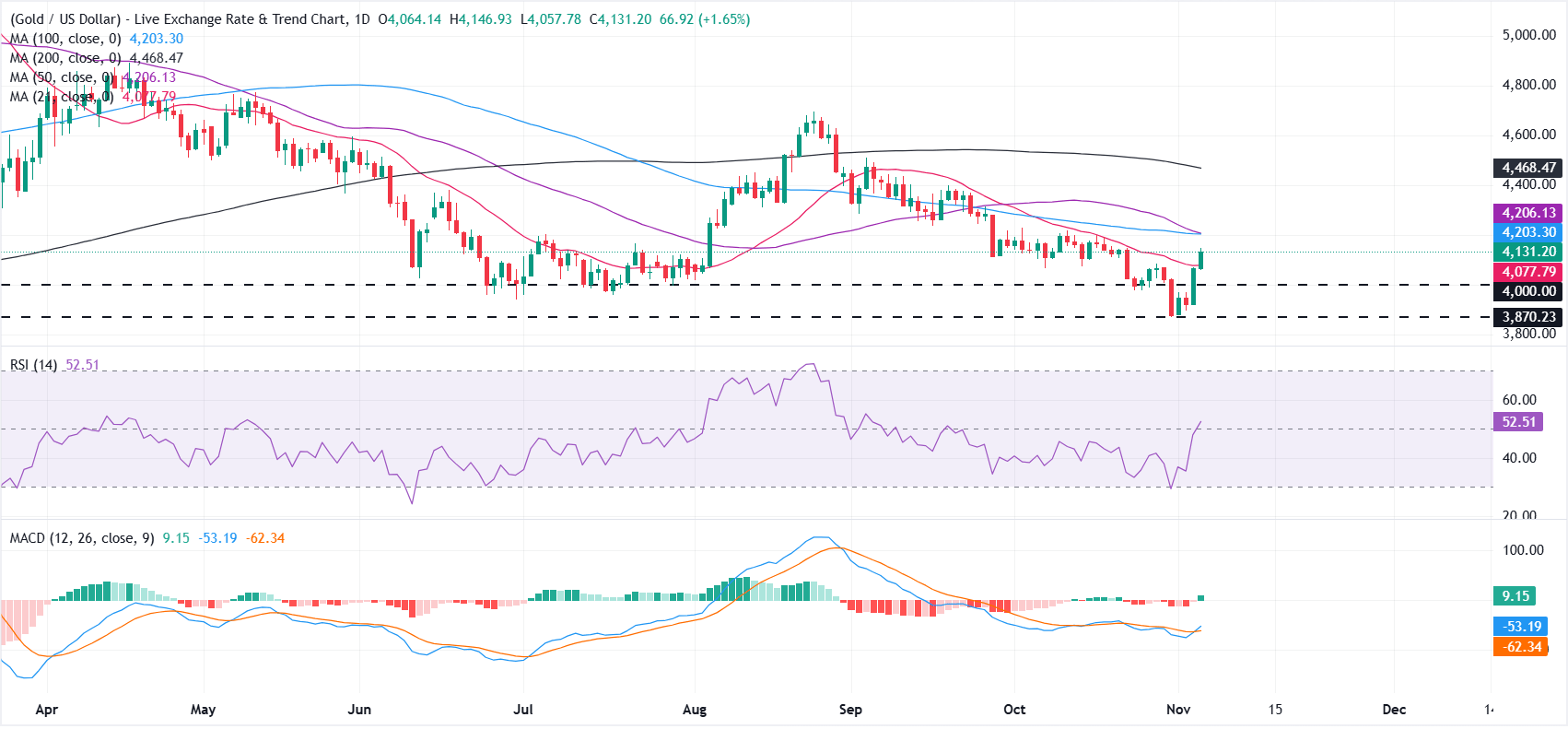
At $4,077, the 21-day simple moving average (SMA) provides immediate support for the recovery on the daily XAU/USD chart. Yet upside remains constrained: spot prices are below the medium- and long-term moving averages, including the 50-day, 100-day and 200-day SMAs.
A Relative Strength Index reading near 52 and a positive turn in the Moving Average Convergence Divergence (MACD) signal stronger momentum. These indicators suggest bullish pressure is rebuilding, although the structurally bearish setup has yet to be reversed.
Below current prices, the 21-day SMA around $4,077 marks the first support level. The psychological $4,000 threshold comes next, ahead of the year-to-date low at $3,870.
Above current levels, the tightly grouped 100-day and 50-day SMAs offer immediate resistance at $4,203 and $4,206, respectively. A stronger hurdle lies near $4,468 at the 200-day SMA. A decisive daily close above these clustered moving averages would be needed to begin weakening the prevailing bearish bias.
(The technical analysis of this story was written with the help of an AI tool. Know more.)
Gold: Key Questions Answered
As a widely used store of value and medium of exchange, Gold has held an important place throughout human history. Beyond its lustre and use in jewellery, the metal is now broadly regarded as a safe-haven asset, considered a sound investment during periods of turmoil. Its independence from any particular issuer or government also underpins its widespread role as a hedge against inflation and currency depreciation.
The largest holders of Gold are central banks. To support their currencies during turbulent periods, they typically diversify reserves and purchase Gold, strengthening perceptions of their economies and currencies. Substantial Gold reserves can bolster confidence in a country’s solvency. World Gold Council data show that central banks expanded their reserves by 1,136 tonnes of Gold in 2022, worth around $70 billion. That was the largest annual purchase since records began. Emerging-economy central banks, including those in China, India and Turkey, are rapidly building their Gold reserves.
Both the US Dollar and US Treasuries are major reserve and safe-haven assets, and Gold is inversely correlated with them. A weaker Dollar generally accompanies a rise in Gold, allowing investors and central banks to diversify holdings during turbulent periods. The metal also has an inverse relationship with risk assets: stock market gains tend to depress Gold prices, whereas selling in riskier markets generally supports the precious metal.
A broad set of influences can shift Gold prices. Its safe-haven status means geopolitical turmoil or concerns over a severe recession can trigger rapid gains. Lower interest rates generally support the non-yielding metal, while more expensive borrowing usually puts it under pressure. Nevertheless, because Gold is denominated in dollars (XAU/USD), most price movements depend on the performance of the US Dollar (USD). Dollar strength tends to restrain Gold prices; a weaker Dollar, by contrast, is likely to lift them.
POPULAR ARTICLES
1Norwegian Krone: Gradual disinflation delays rate cuts – Nomura2Swiss Franc weakens as US employment data comes into focus3US Dollar rebound after election shock erodes Japanese Yen gains4Czech Koruna: CNB hike fails to relieve CZK pressure – Commerzbank50.5660: New Zealand Dollar pulls back as US Dollar recovers ground6XRP advances as Ripple CEO urges clear rules and says US crypto users will stay beyond midterms7Japanese Yen: Broad range persists against US Dollar despite volatility – UOB8US Dollar Index (DXY) trims losses as the aftermath of the US midterm elections becomes clearer9December rate rise a strong possibility, says ECB’s Zigman

Get Started!
Sign up and access the Global Markets in less than 3 minutes

Connect With Us









Contacts
Phone: +61 2 8036 8388
Fax: +61 2 8036 8388
Email: support@tmgm.com



The information provided on this website is of a general nature only and does not constitute personal financial advice. Before acting on any information on this website, you should consider the suitability of the information in relation to your objectives, financial situation and needs. Investing in CFDs and FX Margin Contracts carries significant risks and is not suitable for all investors. You may lose more than your initial deposit. You do not own, or have, any interest in the underlying asset. We recommend that you seek independent advice and ensure you fully understand the risks involved before trading. It is important that you read and consider the disclosure document before you acquire any product listed on the website. The information and advertisements offered on this website are not intended for use by any person in any country or jurisdiction where such use would be contrary to local laws and regulations. The Products and Services offered on this website are not intended for residents of the United States, Malaysia and Thailand.
TMGM is authorized and regulated in various jurisdictions.
Trademax Australia Limited, trading as TMGM, is regulated by the Australian Securities and Investments Commission (ASIC), AFSL no. 436416 and is located at Level 28, One International Tower, 100 Barangaroo Avenue, 2000 Sydney, NSW Australia.
Email: support@tmgm.com.au
Trademax Global Limited, trading as TMGM, is authorized and regulated by the Vanuatu Financial Services Commission (VFSC), registration number 40356 and registered at 1276, Kumul Highway, Port Vila, Vanuatu, Republic of Vanuatu.
Email: support@tmgm.com
Trademax Global Markets (SE) Limited, trading as TMGM, is authorized and regulated by the Financial Services Authority (FSA) of Seychelles, with license number SD224. The company is registered at Office No 13, Providence Estate ABIS Centre, Mahe, Seychelles.
Email: support@tmgm.com
Trademax Global Markets (International) Pty Ltd, trading as TMGM, is authorized and regulated by the Financial Services Commission, Mauritius (FSC) with license no. GB22201012, and registered at 33, Edith Cavell Street C/o IQ EQ Fund Services (Mauritius) Ltd Port Louis, 11324 Mauritius.
Email: support@tmgm.com
Copyright © TMGM. All rights reserved