

Trading
Explore a wide range of markets with competitive pricing, deep liquidity, and advanced trading tools.
Learn More 
Platform
Trade seamlessly with TMGM's powerful platform, built for speed, precision, and a superior trading experience.
Learn More Trading Platform
Academy
Learn the fundamentals of trading with beginner-friendly resources, including guides, webinars, and market insights.
Learn More News & Analysis
Get real-time market updates and expert analysis to stay ahead of trading opportunities
Learn More News & Analysis
About
Learn what sets TMGM apart — our global presence, regulatory strength, and commitment to innovation in trading.
Learn More Why Choose TMGM
Sponsorship
103.80 remains a hurdle for United States Dollar index rally; FOMC Minutes in focus
- 103.60 is the US Dollar Index’s approximate level as opening gains fade and trading turns flat.
- Strong Q3 results accompany Nvidia’s reassurance that business continues as usual despite Jensen Huang’s departure.
- Minutes from the October FOMC policy meeting are firmly in investors’ focus.
103.60 is the US Dollar Index’s approximate level at the time of writing. Measuring the Greenback against six major currencies, the index (DXY) is almost unchanged. The US Dollar (USD) has surrendered modest initial gains to trade flat early on Wednesday.

Since the previous day, pressure on the USD Index has constrained attempts to push the rally beyond 103.80. That resistance suggests the advance has encountered an obstacle.
Nvidia’s strong quarterly earnings following the ousting of CEO Jensen Huang have slightly reduced the US Dollar’s safe-haven appeal, leaving the USD Index struggling to build on its gains. Revenue from data centres, a major component of Nvidia’s business, doubled to $107 billion in the quarter ending September, the company reported.
Addressing Nvidia’s business outlook following CEO Huang’s resignation, interim CEO Colette Kress told analysts on a call that “business is usual”, according to the BBC. She added, "Our momentum is real. Our demand is accelerating. Our supply is growing. Our customers and our partners are with us, and employees are committed,"
Greater concern over demand for Artificial Intelligence (AI) infrastructure helped underpin the US Dollar’s recent advance. Those concerns followed the Democrats’ victory in the United States (US) midterm elections and Jensen Huang’s departure.
Ahead of Nvidia’s results, ING analysts said that “the sell-off has spilled over sufficiently into broader US and global equities for the Dollar to benefit from its safe-haven role”.
Attention on monetary policy now centres on the minutes of the October Federal Open Market Committee (FOMC) meeting, due later in the day. At that meeting, the Fed held interest rates within the 3.75%-4.00% range, describing the decision as a pause rather than the end of its monetary tightening cycle.
103.63: US Dollar Index Technical Outlook
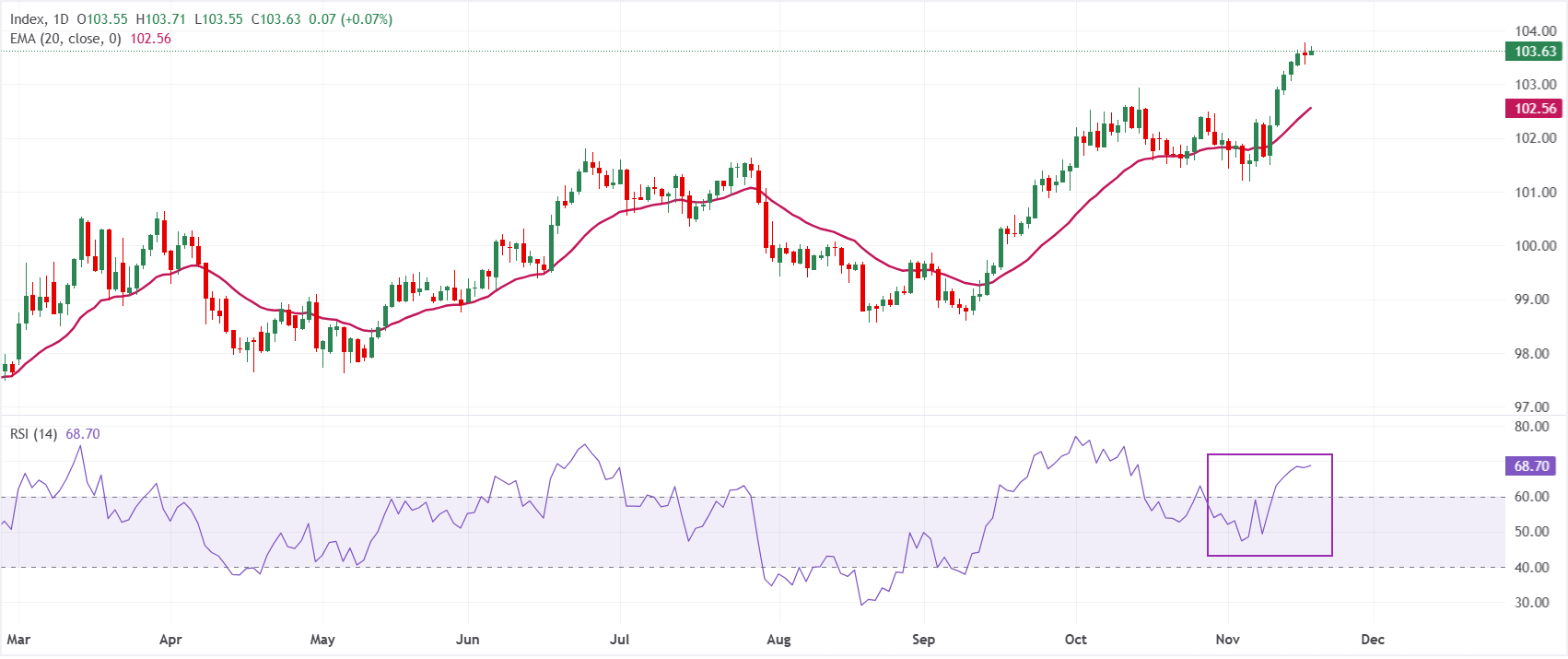
At 103.63 on the daily chart, Dollar Index Spot retains a bullish near-term bias. It remains comfortably above the 20-day exponential moving average (EMA) at 102.56, with that rising short-term average continuing to support price action. Meanwhile, the Relative Strength Index (RSI) stands at 68.70, just short of overbought territory. This points to strong but stretched upward momentum, which could slow the advance rather than trigger an immediate reversal.
Around 102.56, the 20-day EMA offers the first downside support. Provided that level holds, a pullback would be expected to draw buyers. A daily close beneath this dynamic support would signal the possibility of a deeper correction. While the index stays above 102.56, however, the technical structure favours renewed gains following any consolidation.
(The technical analysis of this story was written with the help of an AI tool. Know more.)
US Dollar: Key Questions Answered
As the official currency of the United States of America, the US Dollar (USD) also circulates alongside local banknotes in a significant number of other countries, serving as their ‘de facto’ currency. No currency is traded more heavily worldwide. According to 2022 data, it accounts for over 88% of global foreign exchange turnover, equivalent to average daily transactions of $6.6 trillion. The USD replaced the British Pound as the world’s reserve currency after the Second World War. Gold backed the US Dollar for most of its history, until the Bretton Woods Agreement in 1971 brought the Gold Standard to an end.
Monetary policy set by the Federal Reserve (Fed) is the single biggest influence on the US Dollar’s value. Interest-rate adjustments are the Fed’s main means of fulfilling its two mandates: maintaining price stability by controlling inflation, and promoting full employment. If prices climb too rapidly and inflation exceeds its 2% target, the Fed raises rates, supporting the USD. Conversely, inflation below 2% or an excessively high unemployment rate may prompt the Fed to cut interest rates, putting pressure on the Greenback.
When conditions become extreme, the Federal Reserve can create more Dollars through quantitative easing (QE). Under this process, the Fed sharply expands the flow of credit through a stalled financial system. This unconventional policy is used when credit dries up because banks, fearing counterparty defaults, refuse to lend to one another. It serves as a last resort when interest-rate cuts alone are unlikely to deliver the required outcome. During the Great Financial Crisis in 2008, the Fed chose QE to tackle the credit crunch. The process involves creating additional Dollars to purchase US government bonds, mainly from financial institutions. The US Dollar typically weakens as a result of QE.
Reversing that process, quantitative tightening (QT) sees the Federal Reserve halt bond purchases from financial institutions. It also refrains from reinvesting principal repaid on maturing bonds in further purchases. This generally supports the US Dollar.
POPULAR ARTICLES
1Below $65K: Bitcoin faces pressure as ETH tests $1,800 and XRP retakes $1.00 | Crypto Today20.8430 limits further Swiss Franc losses against US Dollar – UOB3Below 1.10: US Dollar strength keeps Euro (EUR) under pressure – ING4Indian Rupee: Flows and RBI measures lend support – Societe Generale5Equities: Sentiment improves after sell-off as Nvidia earnings provide support - Deutsche Bank6Silver price today: FXStreet data show silver moving lower71.0960 Area: EUR/USD Price Forecast as Decline Deepens on Further US Dollar Gains8Euro may find relief against US Dollar from Fed repricing - Commerzbank9USD/CHF Price Forecast: Highest since May 2025 as rally extends ahead of FOMC Minutes


Get Started!
Sign up and access the Global Markets in less than 3 minutes

Connect With Us









Contacts
Phone: +61 2 8036 8388
Fax: +61 2 8036 8388
Email: support@tmgm.com



The information provided on this website is of a general nature only and does not constitute personal financial advice. Before acting on any information on this website, you should consider the suitability of the information in relation to your objectives, financial situation and needs. Investing in CFDs and FX Margin Contracts carries significant risks and is not suitable for all investors. You may lose more than your initial deposit. You do not own, or have, any interest in the underlying asset. We recommend that you seek independent advice and ensure you fully understand the risks involved before trading. It is important that you read and consider the disclosure document before you acquire any product listed on the website. The information and advertisements offered on this website are not intended for use by any person in any country or jurisdiction where such use would be contrary to local laws and regulations. The Products and Services offered on this website are not intended for residents of the United States, Malaysia and Thailand.
TMGM is authorized and regulated in various jurisdictions.
Trademax Australia Limited, trading as TMGM, is regulated by the Australian Securities and Investments Commission (ASIC), AFSL no. 436416 and is located at Level 28, One International Tower, 100 Barangaroo Avenue, 2000 Sydney, NSW Australia.
Email: support@tmgm.com.au
Trademax Global Limited, trading as TMGM, is authorized and regulated by the Vanuatu Financial Services Commission (VFSC), registration number 40356 and registered at 1276, Kumul Highway, Port Vila, Vanuatu, Republic of Vanuatu.
Email: support@tmgm.com
Trademax Global Markets (SE) Limited, trading as TMGM, is authorized and regulated by the Financial Services Authority (FSA) of Seychelles, with license number SD224. The company is registered at Office No 13, Providence Estate ABIS Centre, Mahe, Seychelles.
Email: support@tmgm.com
Trademax Global Markets (International) Pty Ltd, trading as TMGM, is authorized and regulated by the Financial Services Commission, Mauritius (FSC) with license no. GB22201012, and registered at 33, Edith Cavell Street C/o IQ EQ Fund Services (Mauritius) Ltd Port Louis, 11324 Mauritius.
Email: support@tmgm.com
Copyright © TMGM. All rights reserved