

Trading
Explora una amplia gama de mercados con precios competitivos, liquidez profunda y herramientas de trading avanzadas.
Más información 
Plataforma
Opera sin interrupciones con la potente plataforma de TMGM, diseñada para ofrecer velocidad, precisión y una experiencia de trading superior.
Más información Plataforma de trading
Herramientas de trading
Academia
Aprende los fundamentos del trading con recursos ideales para principiantes, incluidas guías, seminarios web y análisis del mercado.
Más información Academia TMGM
Noticias y análisis
Obtén actualizaciones del mercado en tiempo real y análisis de expertos para adelantarte a las oportunidades de trading
Más información Noticias y análisis
Acerca de
Descubre qué distingue a TMGM: nuestra presencia global, solidez regulatoria y compromiso con la innovación en el trading.
Más información Por qué elegir TMGM
Australia Unemployment Rate expected to remain at 4.7%
- The Australian Unemployment Rate is set to remain at 4.7% in October, a five-year high.
- Australia is expected to have added 25K new jobs in the month.
- AUD/USD aims to pierce the year’s low and extend its slump toward 0.6600.
The Australian Bureau of Statistics (ABS) will publish the October employment report on Thursday at 00:30 GMT. Market participants expect the country to have created 25K new job positions in the month, after losing 39.3K in August.
ABS separately reports full-time and part-time positions through the monthly Employment Change. Generally speaking, full-time jobs entail working 38 hours or more per week, usually include additional benefits, and typically provide a consistent income. On the other hand, part-time employment generally means higher hourly rates but lacks consistency and benefits. That’s why the economy prefers full-time jobs. In August, Australia lost 73.7K part-time positions and added 34.4K full-time ones. The Unemployment Rate is expected to remain unchanged at 4.7%

The Australian Dollar (AUD) trades a handful of pips above the 0.6700 level against the US Dollar (USD) ahead of the announcement, not far above the yearly low posted in January at 0.6663.
What to expect from the Australian Unemployment Rate?
The Australian Unemployment Rate hit 4.7% in August, as per a later revision, its highest in roughly five years. Additionally, the economy unexpectedly lost jobs in September. The slowing economic momentum, however, was not enough to halt the Reserve Bank of Australia (RBA) from hiking the Official Cash Rate (OCR) when it met earlier this month.
The OCR now stands at 4.85% following the fifth hike in 2026. The decision, however, was split. Six Board members voted for the hike amid too-high inflation, while three preferred to wait for the full impact of previous rate hikes on the economy. At this point, market participants anticipate the RBA will remain pat in December.
The majority cited strong market services inflation, high unit labor costs, broad cost pressures and a likely rise in the neutral rate.
Besides the Unemployment Rate, market participants will pay attention not only to headline job creation, but also to the breakdown of full-time and part-time positions. A discouraging reading, however, is unlikely to boost the odds for a rate hike in December, but it will likely keep the door open for additional hikes in 2027.
The latest RBA meeting minutes revolved around inflation-related concerns, although regarding employment, the document states: “The unemployment rate had increased by more than expected over preceding months. The staff’s judgment was that this largely reflected stronger-than-expected labor supply,” adding a revision to the Unemployment Rate, now expected to reach 5.1% in 2028, around ¼ percentage point higher than previously expected.
Meanwhile, the USD strengthens across the board as investors anticipate the United States (US) Federal Reserve (Fed) will hike rates at its December meeting. A 25-basis-point (bps) hike is already priced in, although policymakers’ hawkishness has lately opened the door for potentially more aggressive hikes.
How could the Australian employment report affect AUD/USD?
Considering the full picture, the AUD has little room for an advance. A lower-than-anticipated Unemployment Rate, coupled with strong job creation, usually supports Aussie gains by boosting RBA rate-hike bets, although that is unlikely given the five hikes already delivered this year. If anything, it could trigger a near-term AUD/USD rally, which will likely attract sellers.
The opposite scenario, in which the Unemployment Rate continues to deteriorate while job creation results below expectations, would back the case for no RBA action in December, putting the AUD/USD pair under additional selling pressure.
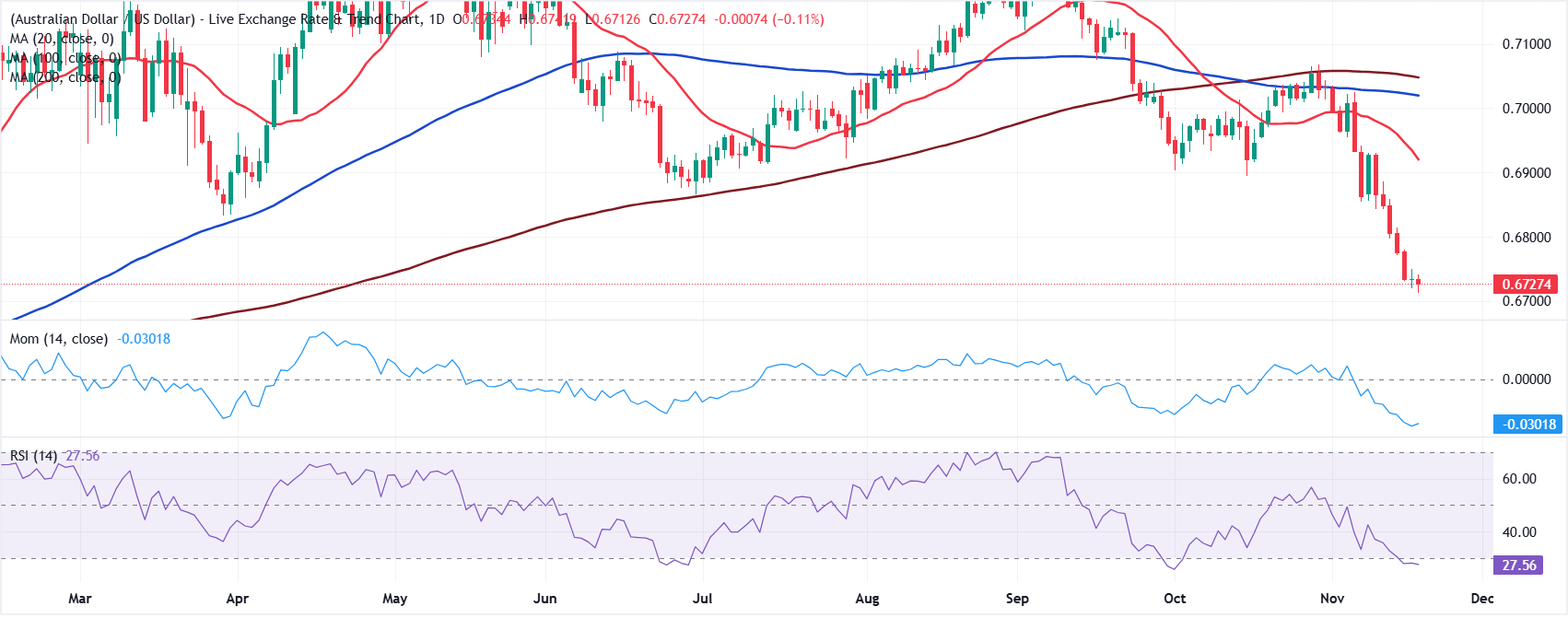
Valeria Bednarik, Chief Analyst at FXStreet, notes: “The AUD/USD pair trades at levels that were last seen in January, and despite looking oversold in the daily chart, there are no signs it has already found an interim bottom. A decline beyond the yearly low in the 0.6660 region is on the cards, particularly if 0.6700 gives up, with the pair likely to test the 0.6600 psychological threshold in the upcoming sessions.”
Bednarik adds: “As previously mentioned, the bearish case is strong, although technical indicators have lost momentum within oversold territory on the daily chart. Initial resistance can be found at 0.6770 ahead of the 0.6810 price zone.”
Economic Indicator
Unemployment Rate s.a.
The Unemployment Rate, released by the Australian Bureau of Statistics, is the number of unemployed workers divided by the total civilian labor force, expressed as a percentage. If the rate increases, it indicates a lack of expansion within the Australian labor market and a weakness within the Australian economy. A decrease in the figure is seen as bullish for the Australian Dollar (AUD), while an increase is seen as bearish.
Read more.Next release: Thu Nov 19, 2026 00:30
Frequency: Monthly
Consensus: 4.7%
Previous: 4.7%
Source: Australian Bureau of Statistics
The Australian Bureau of Statistics (ABS) publishes an overview of trends in the Australian labour market, with unemployment rate a closely watched indicator. It is released about 15 days after the month end and throws light on the overall economic conditions, as it is highly correlated to consumer spending and inflation. Despite the lagging nature of the indicator, it affects the Reserve Bank of Australia’s (RBA) interest rate decisions, in turn, moving the Australian dollar. Upbeat figure tends to be AUD positive.
Employment FAQs
Labor market conditions are a key element to assess the health of an economy and thus a key driver for currency valuation. High employment, or low unemployment, has positive implications for consumer spending and thus economic growth, boosting the value of the local currency. Moreover, a very tight labor market – a situation in which there is a shortage of workers to fill open positions – can also have implications on inflation levels and thus monetary policy as low labor supply and high demand leads to higher wages.
The pace at which salaries are growing in an economy is key for policymakers. High wage growth means that households have more money to spend, usually leading to price increases in consumer goods. In contrast to more volatile sources of inflation such as energy prices, wage growth is seen as a key component of underlying and persisting inflation as salary increases are unlikely to be undone. Central banks around the world pay close attention to wage growth data when deciding on monetary policy.
The weight that each central bank assigns to labor market conditions depends on its objectives. Some central banks explicitly have mandates related to the labor market beyond controlling inflation levels. The US Federal Reserve (Fed), for example, has the dual mandate of promoting maximum employment and stable prices. Meanwhile, the European Central Bank’s (ECB) sole mandate is to keep inflation under control. Still, and despite whatever mandates they have, labor market conditions are an important factor for policymakers given its significance as a gauge of the health of the economy and their direct relationship to inflation.
Artículos destacados
1Dólar de Singapur: perspectivas de estabilidad dentro de un rango con el respaldo de las exportaciones – Commerzbank2Rupia indonesia: la subida inesperada de tipos del Banco de Indonesia solo alivia parcialmente la presión – BBH3Dólar de Singapur: los rendimientos de los bonos estadounidenses condicionan las perspectivas de recuperación del SGD - OCBC4Yuan chino: sesgo alcista gradual hacia 6,6520 frente al dólar estadounidense – UOB5Previsión del precio de la plata: la tendencia bajista se acentúa mientras el RSI entra en zona de sobreventa6Reino Unido: la inflación alcanzará un máximo del 4,5 % en el primer trimestre de 2027 - Societe Generale7Dólar estadounidense: aumenta la presión alcista ante las expectativas de un endurecimiento monetario de la Fed – ING8El dólar neozelandés cae a mínimos de la pandemia ante la divergencia entre las políticas de la Fed y el RBNZ9El yen japonés encuentra apoyo ante la persistencia del riesgo de intervención cerca de 160,00


¡Comience ahora!
Regístrese y acceda a los mercados globales en menos de 3 minutos

Conéctese con nosotros









Contactos
Teléfono: +61 2 8036 8388
Fax: +61 2 8036 8388
Correo electrónico: support@tmgm.com



La información proporcionada en este sitio web es únicamente de carácter general y no constituye asesoramiento financiero personal. Antes de actuar sobre cualquier información de este sitio web, debe considerar la idoneidad de la información en relación con sus objetivos, situación financiera y necesidades. Invertir en CFD y contratos de margen de FX conlleva riesgos significativos y no es adecuado para todos los inversores. Puede perder más que su depósito inicial. Usted no posee ni tiene ningún interés en el activo subyacente. Le recomendamos que busque asesoramiento independiente y se asegure de comprender plenamente los riesgos involucrados antes de operar. Es importante que lea y considere el documento de divulgación antes de adquirir cualquier producto listado en el sitio web. La información y los anuncios ofrecidos en este sitio web no están destinados al uso por parte de ninguna persona en ningún país o jurisdicción donde dicho uso sea contrario a las leyes y regulaciones locales. Los productos y servicios ofrecidos en este sitio web no están destinados a residentes de Estados Unidos, Malasia y Tailandia.
TMGM está autorizado y regulado en varias jurisdicciones.
Trademax Australia Limited, que opera como TMGM, está regulada por la Comisión Australiana de Valores e Inversiones (ASIC), AFSL n.º 436416, y está ubicada en Level 28, One International Tower, 100 Barangaroo Avenue, 2000 Sydney, NSW Australia.
Correo electrónico: support@tmgm.com.au
Trademax Global Limited, que opera como TMGM, está autorizada y regulada por la Comisión de Servicios Financieros de Vanuatu (VFSC), número de registro 40356, y está registrada en 1276, Kumul Highway, Port Vila, Vanuatu, República de Vanuatu.
Correo electrónico: support@tmgm.com
Trademax Global Markets (SE) Limited, que opera como TMGM, está autorizada y regulada por la Autoridad de Servicios Financieros (FSA) de Seychelles, con número de licencia SD224. La empresa está registrada en Office No 13, Providence Estate ABIS Centre, Mahe, Seychelles.
Correo electrónico: support@tmgm.com
Trademax Global Markets (International) Pty Ltd, que opera como TMGM, está autorizada y regulada por la Comisión de Servicios Financieros de Mauricio (FSC) con licencia n.º GB22201012, y está registrada en 33, Edith Cavell Street C/o IQ EQ Fund Services (Mauritius) Ltd Port Louis, 11324 Mauricio.
Correo electrónico: support@tmgm.com
Copyright © TMGM. Todos los derechos reservados