

Trading
Explora una amplia gama de mercados con precios competitivos, liquidez profunda y herramientas de trading avanzadas.
Más información 
Plataforma
Opera sin interrupciones con la potente plataforma de TMGM, diseñada para ofrecer velocidad, precisión y una experiencia de trading superior.
Más información Plataforma de trading
Herramientas de trading
Academia
Aprende los fundamentos del trading con recursos ideales para principiantes, incluidas guías, seminarios web y análisis del mercado.
Más información Academia TMGM
Noticias y análisis
Obtén actualizaciones del mercado en tiempo real y análisis de expertos para adelantarte a las oportunidades de trading
Más información Noticias y análisis
Acerca de
Descubre qué distingue a TMGM: nuestra presencia global, solidez regulatoria y compromiso con la innovación en el trading.
Más información Por qué elegir TMGM
Indian Rupee hits roadblock after rally amid fears of back-to-back Fed rate hikes
- The Indian Rupee struggles to extend its rally against the US Dollar.
- Fears of back-to-back Fed interest rate hikes have strengthened the US Dollar.
- Lower oil prices and continuous FIIs’ buying are expected to limit the INR’s downside.
The Indian Rupee’s (INR) rally hits a pause against the US Dollar (USD) after rallying for almost six weeks. In the opening trade on Thursday, the USD/INR pair is marginally up to near 93.50 after recovering from its six-month low of 93.25 posted the previous day.

The USD/INR pair has regained ground as the US Dollar extends its rally due to fears of a series of interest rate hikes by the Federal Reserve (Fed) in the near term.
In the Asian trade, the US Dollar Index (DXY), which gauges the Greenback’s value against six major currencies, hits a fresh 19-month high near 104.00.
What to expect From Fed in near term?
According to the CME FedWatch Tool, the Fed is almost certain to deliver interest rate hikes of 25 basis points (bps) at the December and January policy meetings. The tool shows an almost 50% chance of another rate hike in March 2027.
The Federal Open Market Committee (FOMC) minutes of the October policy meeting also showed on Wednesday that policymakers have explicitly supported further interest rate hikes, while warning that “inflation may be more persistent than anticipated”.
The minutes also showed that a couple of policymakers warned of a bigger interest rate hike in the December meeting if inflation data continues to remain negative.
FIIs buying and lower oil prices to keep INR’s downside limited
Analysts at Societe Generale highlight the Indian Rupee as “the surprise star performer in EMs this month,” noting that the move has been “powered by FPI inflows” as investors broaden market bets beyond “AI-themed markets like South Korea and Taiwan.” They add that sentiment has also been supported by “optimism over Iran truce following US midterm election that has deflated Brent towards $90/b,” reinforcing the constructive backdrop for INR.
So far in November, Foreign Institutional Investors (FIIs) have remained net buyers in all full-length trading days and have increased their stake worth Rs. 94,229.56 crore.
Meanwhile, lower oil prices due to eased fears of energy supply risks from the Middle East are also expected to support the INR’s downside. As of writing, the MCX Crude Oil contract expiring on December 18 is up 0.78% to near Rs. 7,709, but is close to its 11-week low of Rs. 7,850.
USD/INR Technical Analysis
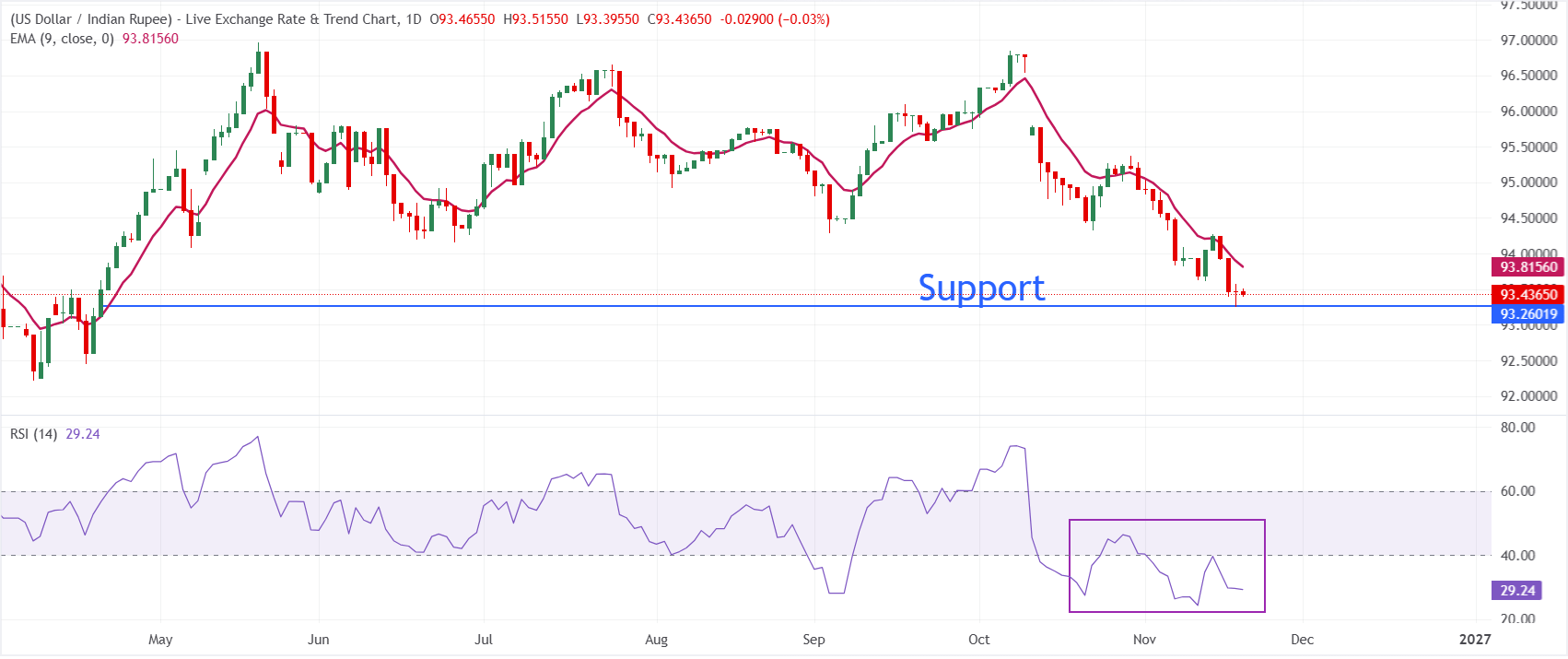
In the daily chart, USD/INR trades at 93.44, maintaining a bearish near-term tone as it holds below the 9-period exponential moving average (EMA) at 93.82. The pair remains pressured by this overhead dynamic resistance, while the Relative Strength Index (RSI) at 29.24 sits in oversold territory, hinting that while downside momentum is stretched, sellers still dominate the short-term structure.
On the topside, the immediate level to watch is the 9-period EMA resistance at 93.82, which would need to be reclaimed to ease the current bearish bias and open room for a corrective bounce. On the downside, the November 18 low at 93.25 is the immediate support; below that the 93.00 level would act as key cushion.
(The technical analysis of this story was written with the help of an AI tool. Know more.)
Indian Rupee FAQs
The Indian Rupee (INR) is one of the most sensitive currencies to external factors. The price of Crude Oil (the country is highly dependent on imported Oil), the value of the US Dollar – most trade is conducted in USD – and the level of foreign investment, are all influential. Direct intervention by the Reserve Bank of India (RBI) in FX markets to keep the exchange rate stable, as well as the level of interest rates set by the RBI, are further major influencing factors on the Rupee.
The Reserve Bank of India (RBI) actively intervenes in forex markets to maintain a stable exchange rate, to help facilitate trade. In addition, the RBI tries to maintain the inflation rate at its 4% target by adjusting interest rates. Higher interest rates usually strengthen the Rupee. This is due to the role of the ‘carry trade’ in which investors borrow in countries with lower interest rates so as to place their money in countries’ offering relatively higher interest rates and profit from the difference.
Macroeconomic factors that influence the value of the Rupee include inflation, interest rates, the economic growth rate (GDP), the balance of trade, and inflows from foreign investment. A higher growth rate can lead to more overseas investment, pushing up demand for the Rupee. A less negative balance of trade will eventually lead to a stronger Rupee. Higher interest rates, especially real rates (interest rates less inflation) are also positive for the Rupee. A risk-on environment can lead to greater inflows of Foreign Direct and Indirect Investment (FDI and FII), which also benefit the Rupee.
Higher inflation, particularly, if it is comparatively higher than India’s peers, is generally negative for the currency as it reflects devaluation through oversupply. Inflation also increases the cost of exports, leading to more Rupees being sold to purchase foreign imports, which is Rupee-negative. At the same time, higher inflation usually leads to the Reserve Bank of India (RBI) raising interest rates and this can be positive for the Rupee, due to increased demand from international investors. The opposite effect is true of lower inflation.
Artículos destacados
1Previsión del precio de Pi Network: la persistente presión vendedora contrarresta el impulso de la cumbre del ecosistema Pi2La rupia indonesia cae mientras los comentarios restrictivos de la Fed impulsan al dólar estadounidense3Previsión del EUR/USD: retrocede hacia 1,0950 y mantiene un sesgo bajista por debajo de la media móvil simple de 100 días4104,00: el índice del dólar estadounidense marca un nuevo máximo de 19 meses ante el tono restrictivo de la Fed5Precio del oro hoy en la India: el oro se estabiliza, según datos de FXStreet6El dólar neozelandés se estabiliza cerca de 0,5500 mientras las actas de la Fed apuntan a más subidas de tipos7Previsión de precios de las principales altcoins: Ripple, Cardano y Solana, limitadas al alza y vulnerables a caídas8Previsión del precio de la plata: el XAG/USD mantiene las pérdidas cerca de mínimos de 14 meses ante el tono restrictivo de la Fed9Perspectivas de Ripple y Stellar: el debilitamiento de las señales del mercado pone en riesgo a XRP y XLM


¡Comience ahora!
Regístrese y acceda a los mercados globales en menos de 3 minutos

Conéctese con nosotros









Contactos
Teléfono: +61 2 8036 8388
Fax: +61 2 8036 8388
Correo electrónico: support@tmgm.com



La información proporcionada en este sitio web es únicamente de carácter general y no constituye asesoramiento financiero personal. Antes de actuar sobre cualquier información de este sitio web, debe considerar la idoneidad de la información en relación con sus objetivos, situación financiera y necesidades. Invertir en CFD y contratos de margen de FX conlleva riesgos significativos y no es adecuado para todos los inversores. Puede perder más que su depósito inicial. Usted no posee ni tiene ningún interés en el activo subyacente. Le recomendamos que busque asesoramiento independiente y se asegure de comprender plenamente los riesgos involucrados antes de operar. Es importante que lea y considere el documento de divulgación antes de adquirir cualquier producto listado en el sitio web. La información y los anuncios ofrecidos en este sitio web no están destinados al uso por parte de ninguna persona en ningún país o jurisdicción donde dicho uso sea contrario a las leyes y regulaciones locales. Los productos y servicios ofrecidos en este sitio web no están destinados a residentes de Estados Unidos, Malasia y Tailandia.
TMGM está autorizado y regulado en varias jurisdicciones.
Trademax Australia Limited, que opera como TMGM, está regulada por la Comisión Australiana de Valores e Inversiones (ASIC), AFSL n.º 436416, y está ubicada en Level 28, One International Tower, 100 Barangaroo Avenue, 2000 Sydney, NSW Australia.
Correo electrónico: support@tmgm.com.au
Trademax Global Limited, que opera como TMGM, está autorizada y regulada por la Comisión de Servicios Financieros de Vanuatu (VFSC), número de registro 40356, y está registrada en 1276, Kumul Highway, Port Vila, Vanuatu, República de Vanuatu.
Correo electrónico: support@tmgm.com
Trademax Global Markets (SE) Limited, que opera como TMGM, está autorizada y regulada por la Autoridad de Servicios Financieros (FSA) de Seychelles, con número de licencia SD224. La empresa está registrada en Office No 13, Providence Estate ABIS Centre, Mahe, Seychelles.
Correo electrónico: support@tmgm.com
Trademax Global Markets (International) Pty Ltd, que opera como TMGM, está autorizada y regulada por la Comisión de Servicios Financieros de Mauricio (FSC) con licencia n.º GB22201012, y está registrada en 33, Edith Cavell Street C/o IQ EQ Fund Services (Mauritius) Ltd Port Louis, 11324 Mauricio.
Correo electrónico: support@tmgm.com
Copyright © TMGM. Todos los derechos reservados