

Trading
Explora una amplia gama de mercados con precios competitivos, liquidez profunda y herramientas de trading avanzadas.
Más información 
Plataforma
Opera sin interrupciones con la potente plataforma de TMGM, diseñada para ofrecer velocidad, precisión y una experiencia de trading superior.
Más información Plataforma de trading
Herramientas de trading
Academia
Aprende los fundamentos del trading con recursos ideales para principiantes, incluidas guías, seminarios web y análisis del mercado.
Más información Academia TMGM
Noticias y análisis
Obtén actualizaciones del mercado en tiempo real y análisis de expertos para adelantarte a las oportunidades de trading
Más información Noticias y análisis
Acerca de
Descubre qué distingue a TMGM: nuestra presencia global, solidez regulatoria y compromiso con la innovación en el trading.
Más información Por qué elegir TMGM
The British Pound slides again as UK government bonds sell off
- GBP/USD slides again under 1.3200, its lowest since late June, as UK bonds sell off.
- UK 30-year gilt yield above 6% for the first time since 1998.
- Up to four BoE rate hikes priced by next summer.
Britain's 30-year gilt yield went above 6% on Thursday for the first time since 1998, and GBP/USD fell to its lowest since late June. Bank of England (BoE) external member Mann said in a speech the same day that UK financial conditions aren't tight enough. The pair is on track for a third straight weekly loss, trading just under 1.3200.

By Mann's reading, a 6% gilt yield is inflation risk, not tight money
Mann said the rise in UK market borrowing costs since the US-Iran war began reflects investors expecting more inflation, and possibly a premium for uncertainty over BoE policy. Neither makes money tighter once inflation is counted, so she argued the BoE has to raise the UK's Bank Rate from 3.75% to keep its credibility. Markets already price as many as four increases by next summer.
Ten-year gilt yields reached their highest since July 2007 on Thursday, two days after the government sold new 10-year debt at the highest yield for that maturity since 1999. Chancellor Healey presents his first budget later in October.
Higher gilt yields haven't helped GBP/USD, because investors who expect more inflation sell the bonds and the currency together. Mann traced part of the uncertainty to the BoE's response to the war in March, which she said investors read as a central bank waiting, and the BoE has held at every meeting since.
US payrolls on Friday, then Mann again on Tuesday
Nothing from the UK is scheduled on Friday, so the event for GBP/USD is US Nonfarm Payrolls (NFP) at 12:30 GMT, forecast at 90K after 162K in August. Unemployment is forecast at 4.1%, and average hourly earnings at 3.2% YoY from 3.1%. Mann speaks again on Tuesday at 08:40 GMT.
A strong count could hit GBP/USD twice, through the Dollar and through gilts, which rose on Thursday after US Treasury yields did. Fed Chair Warsh has dropped the practice of signalling the next move in advance, which leaves a jobs report as the nearest thing to a signal before the October 28 decision.
The Pound's levels and lean
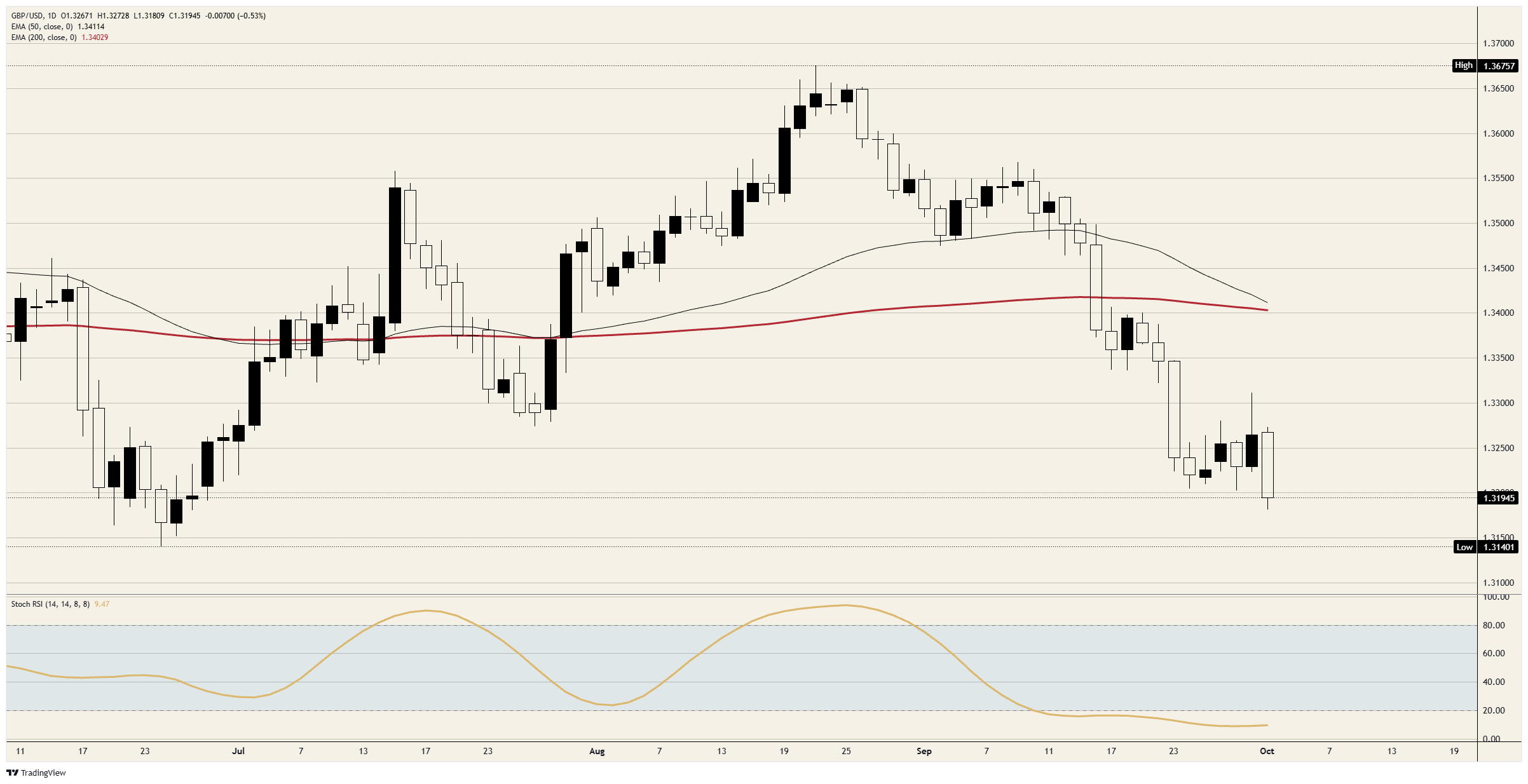
Resistance: 1.3250 capped Thursday's bounce from the first leg lower. No daily close has come above 1.3300 since the September 23 drop, though Wednesday's high went just through it.
Support: Thursday's low, just under 1.3200, is the lowest since late June. 1.3150, near the late-June lows, comes next, then 1.3100.
Bias: The lean is short while 1.3250 caps on a closing basis, with 1.3150 the first objective and 1.3100 the second. The daily Stochastic Relative Strength Index (Stoch RSI) is near 9 and has been below 20 for about three weeks, so a bounce toward 1.3250 may come first without changing the call. A daily close above 1.3300 ends it.
GBP/USD daily chart
Pound Sterling FAQs
The Pound Sterling (GBP) is the oldest currency in the world (886 AD) and the official currency of the United Kingdom. It is the fourth most traded unit for foreign exchange (FX) in the world, accounting for 12% of all transactions, averaging $630 billion a day, according to 2022 data. Its key trading pairs are GBP/USD, also known as ‘Cable’, which accounts for 11% of FX, GBP/JPY, or the ‘Dragon’ as it is known by traders (3%), and EUR/GBP (2%). The Pound Sterling is issued by the Bank of England (BoE).
The single most important factor influencing the value of the Pound Sterling is monetary policy decided by the Bank of England. The BoE bases its decisions on whether it has achieved its primary goal of “price stability” – a steady inflation rate of around 2%. Its primary tool for achieving this is the adjustment of interest rates. When inflation is too high, the BoE will try to rein it in by raising interest rates, making it more expensive for people and businesses to access credit. This is generally positive for GBP, as higher interest rates make the UK a more attractive place for global investors to park their money. When inflation falls too low it is a sign economic growth is slowing. In this scenario, the BoE will consider lowering interest rates to cheapen credit so businesses will borrow more to invest in growth-generating projects.
Data releases gauge the health of the economy and can impact the value of the Pound Sterling. Indicators such as GDP, Manufacturing and Services PMIs, and employment can all influence the direction of the GBP. A strong economy is good for Sterling. Not only does it attract more foreign investment but it may encourage the BoE to put up interest rates, which will directly strengthen GBP. Otherwise, if economic data is weak, the Pound Sterling is likely to fall.
Another significant data release for the Pound Sterling is the Trade Balance. This indicator measures the difference between what a country earns from its exports and what it spends on imports over a given period. If a country produces highly sought-after exports, its currency will benefit purely from the extra demand created from foreign buyers seeking to purchase these goods. Therefore, a positive net Trade Balance strengthens a currency and vice versa for a negative balance.
Artículos destacados
1Tokyo core inflation hits 2.7% and the Yen firms2Fed’s Logan: Policy rate must increase by additional 50 bps or more32.7%: Japan’s Tokyo CPI inflation climbs in September4Australian Dollar drifts toward 0.69 as USD shrugs off Fed patience5The Japanese Yen weakens as traders pare Bank of Japan October hike bets6The New Zealand Dollar extends its slide as the US Dollar hits a yearly high7The Euro sells off hard as the French-German bond gap widens8The British Pound slides again as UK government bonds sell off9Gold defies US Dollar surge as US yield slide revives Bullion demand
COTIZACIONES EN VIVO

¡Comience ahora!
Regístrese y acceda a los mercados globales en menos de 3 minutos

Conéctese con nosotros









Contactos
Teléfono: +61 2 8036 8388
Fax: +61 2 8036 8388
Correo electrónico: support@tmgm.com



La información proporcionada en este sitio web es únicamente de carácter general y no constituye asesoramiento financiero personal. Antes de actuar sobre cualquier información de este sitio web, debe considerar la idoneidad de la información en relación con sus objetivos, situación financiera y necesidades. Invertir en CFD y contratos de margen de FX conlleva riesgos significativos y no es adecuado para todos los inversores. Puede perder más que su depósito inicial. Usted no posee ni tiene ningún interés en el activo subyacente. Le recomendamos que busque asesoramiento independiente y se asegure de comprender plenamente los riesgos involucrados antes de operar. Es importante que lea y considere el documento de divulgación antes de adquirir cualquier producto listado en el sitio web. La información y los anuncios ofrecidos en este sitio web no están destinados al uso por parte de ninguna persona en ningún país o jurisdicción donde dicho uso sea contrario a las leyes y regulaciones locales. Los productos y servicios ofrecidos en este sitio web no están destinados a residentes de Estados Unidos, Malasia y Tailandia.
TMGM está autorizado y regulado en varias jurisdicciones.
Trademax Australia Limited, que opera como TMGM, está regulada por la Comisión Australiana de Valores e Inversiones (ASIC), AFSL n.º 436416, y está ubicada en Level 28, One International Tower, 100 Barangaroo Avenue, 2000 Sydney, NSW Australia.
Correo electrónico: support@tmgm.com.au
Trademax Global Limited, que opera como TMGM, está autorizada y regulada por la Comisión de Servicios Financieros de Vanuatu (VFSC), número de registro 40356, y está registrada en 1276, Kumul Highway, Port Vila, Vanuatu, República de Vanuatu.
Correo electrónico: support@tmgm.com
Trademax Global Markets (SE) Limited, que opera como TMGM, está autorizada y regulada por la Autoridad de Servicios Financieros (FSA) de Seychelles, con número de licencia SD224. La empresa está registrada en Office No 13, Providence Estate ABIS Centre, Mahe, Seychelles.
Correo electrónico: support@tmgm.com
Trademax Global Markets (International) Pty Ltd, que opera como TMGM, está autorizada y regulada por la Comisión de Servicios Financieros de Mauricio (FSC) con licencia n.º GB22201012, y está registrada en 33, Edith Cavell Street C/o IQ EQ Fund Services (Mauritius) Ltd Port Louis, 11324 Mauricio.
Correo electrónico: support@tmgm.com
Copyright © TMGM. Todos los derechos reservados