

Торговля
Изучите широкий спектр рынков с конкурентными ценами, высокой ликвидностью и передовыми торговыми инструментами.
Узнать больше 
Платформа
Торгуйте без сбоев на мощной платформе TMGM, созданной для скорости, точности и превосходного торгового опыта.
Узнать больше Торговая платформа
Торговые инструменты
Академия
Изучите основы торговли с помощью материалов для начинающих, включая руководства, вебинары и аналитические обзоры рынка.
Узнать больше Новости и аналитика
Получайте актуальные рыночные обновления и экспертную аналитику, чтобы быть на шаг впереди торговых возможностей
Узнать больше Новости и аналитика
О нас
Узнайте, что отличает TMGM — наше глобальное присутствие, надежное регулирование и приверженность инновациям в трейдинге.
Узнать больше Почему выбирают TMGM
Спонсорство
104.00: United States Dollar Index hits fresh 19-month high on Fed’s hawkish undertone
- The US Dollar Index jumps to near 104.00 amid hawkish Fed rhetoric.
- Traders are confident about back-to-back Fed interest rate hikes in December and March.
- Fed’s Waller is expected to be one of couple policymakers who warned of bigger rate hike in December.
The US Dollar (USD) outperforms its major currency peers on Thursday as Federal Open Market Committee (FOMC) minutes from the October policy meeting signaled that almost all members see further interest rate hikes as “justified” and warn that “inflation may be more persistent than anticipated”.

US Dollar Price Today
The table below shows the percentage change of US Dollar (USD) against listed major currencies today. US Dollar was the strongest against the Australian Dollar.
| USD | EUR | GBP | JPY | CAD | AUD | NZD | CHF | |
|---|---|---|---|---|---|---|---|---|
| USD | 0.14% | 0.17% | 0.19% | 0.17% | 0.52% | -0.02% | 0.12% | |
| EUR | -0.14% | 0.02% | 0.03% | 0.02% | 0.39% | -0.17% | -0.04% | |
| GBP | -0.17% | -0.02% | 0.02% | -0.00% | 0.36% | -0.19% | -0.06% | |
| JPY | -0.19% | -0.03% | -0.02% | -0.03% | 0.34% | -0.24% | -0.09% | |
| CAD | -0.17% | -0.02% | 0.00% | 0.03% | 0.36% | -0.20% | -0.06% | |
| AUD | -0.52% | -0.39% | -0.36% | -0.34% | -0.36% | -0.54% | -0.45% | |
| NZD | 0.02% | 0.17% | 0.19% | 0.24% | 0.20% | 0.54% | 0.16% | |
| CHF | -0.12% | 0.04% | 0.06% | 0.09% | 0.06% | 0.45% | -0.16% |
The heat map shows percentage changes of major currencies against each other. The base currency is picked from the left column, while the quote currency is picked from the top row. For example, if you pick the US Dollar from the left column and move along the horizontal line to the Japanese Yen, the percentage change displayed in the box will represent USD (base)/JPY (quote).
As of writing, the US Dollar Index (DXY), which gauges the Greenback’s value against six major currencies, trades 0.2% higher at around 104.00. This is the highest level seen in over 19 months.
According to the CME FedWatch tool, the Fed is almost certain to deliver interest rate hikes of 25 basis points (bps) at the December and January policy meetings. The tool shows an almost 50% chance of another rate hike in March.
The FOMC minutes also showed on Wednesday that a couple of policymakers warned of a bigger interest rate hike in December, “if incoming inflation figures were negative”.
One of them appears to be Fed Governor Christopher Waller who said before the October inflation data release that a bigger interest rate hike in the December meeting would become appropriate if core Consumer Price Index (CPI) growth remains 0.3% or above.
US Dollar Index Technical Analysis
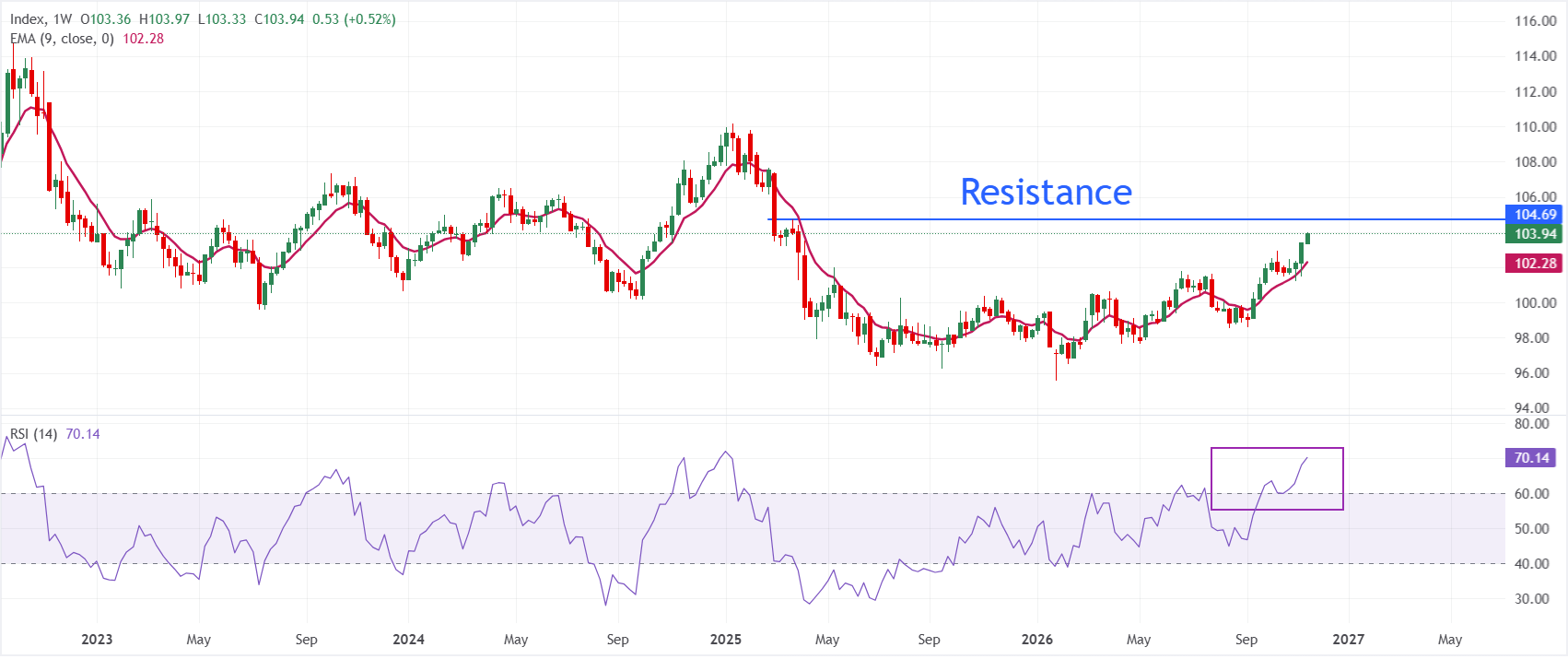
In the weekly chart, Dollar Index Spot trades at 103.95. The index holds a bullish near-term bias as it trades above the nine-week exponential moving average (EMA) at 102.28, keeping the medium-term uptrend supported. The Relative Strength Index (14) at 70.15 has entered overbought territory, suggesting stretched upside conditions even as price action remains underpinned by trend support.
On the downside, the 20-week EMA near 101.33 to act as key dynamic cushion. Looking up, the index could extend the rally toward 104.70.
(The technical analysis of this story was written with the help of an AI tool. Know more.)
Fed FAQs
Monetary policy in the US is shaped by the Federal Reserve (Fed). The Fed has two mandates: to achieve price stability and foster full employment. Its primary tool to achieve these goals is by adjusting interest rates. When prices are rising too quickly and inflation is above the Fed’s 2% target, it raises interest rates, increasing borrowing costs throughout the economy. This results in a stronger US Dollar (USD) as it makes the US a more attractive place for international investors to park their money. When inflation falls below 2% or the Unemployment Rate is too high, the Fed may lower interest rates to encourage borrowing, which weighs on the Greenback.
The Federal Reserve (Fed) holds eight policy meetings a year, where the Federal Open Market Committee (FOMC) assesses economic conditions and makes monetary policy decisions. The FOMC is attended by twelve Fed officials – the seven members of the Board of Governors, the president of the Federal Reserve Bank of New York, and four of the remaining eleven regional Reserve Bank presidents, who serve one-year terms on a rotating basis.
In extreme situations, the Federal Reserve may resort to a policy named Quantitative Easing (QE). QE is the process by which the Fed substantially increases the flow of credit in a stuck financial system. It is a non-standard policy measure used during crises or when inflation is extremely low. It was the Fed’s weapon of choice during the Great Financial Crisis in 2008. It involves the Fed printing more Dollars and using them to buy high grade bonds from financial institutions. QE usually weakens the US Dollar.
Quantitative tightening (QT) is the reverse process of QE, whereby the Federal Reserve stops buying bonds from financial institutions and does not reinvest the principal from the bonds it holds maturing, to purchase new bonds. It is usually positive for the value of the US Dollar.
Лучшие статьи
1Цена на золото в Индии сегодня: золото стабилизируется, согласно данным FXStreet2Новозеландский доллар стабилизируется вблизи 0,5500 на фоне сигналов о дальнейших повышениях ставок в протоколе ФРС3Прогноз цен ведущих альткоинов: рост Ripple, Cardano и Solana ограничен, сохраняется риск падения4Прогноз цены серебра: XAG/USD остается в минусе вблизи 14-месячных минимумов на фоне жесткой риторики ФРС5Прогноз по Ripple и Stellar: ослабление рыночных сигналов ставит XRP и XLM под угрозу6Израиль добивается от США совместных ударов на фоне начала восстановления военной мощи Ирана - NYT7Канадский доллар отстает от доллара США на фоне жесткой риторики ФРС8Глава МВФ Георгиева: шоки спроса на энергоносители и в сфере ИИ подстегивают мировую инфляцию9Биткоин и крипторынок демонстрируют сдержанную динамику: жесткая риторика в протоколе ФРС укрепляет ожидания повышения ставки в декабре


Начать!
Зарегистрируйтесь и получите доступ к глобальным рынкам менее чем за 3 минуты

Свяжитесь с нами









Контакты
Телефон: +61 2 8036 8388
Факс: +61 2 8036 8388
Эл. почта: support@tmgm.com
Веб-сайт: https://www.tmg-max.com



Информация, представленная на этом веб-сайте, носит исключительно общий характер и не является персональной финансовой консультацией. Прежде чем действовать на основании любой информации на этом веб-сайте, вам следует оценить ее уместность с учетом ваших целей, финансового положения и потребностей. Инвестирование в CFD и маржинальные контракты на FX сопряжено со значительными рисками и подходит не всем инвесторам. Вы можете потерять больше, чем ваш первоначальный депозит. Вы не владеете базовым активом и не имеете в нем какой-либо доли. Мы рекомендуем вам обратиться за независимой консультацией и убедиться, что вы полностью понимаете связанные с этим риски, прежде чем начинать торговлю. Важно прочитать и принять во внимание документ с раскрытием информации, прежде чем приобретать любой продукт, указанный на веб-сайте. Информация и рекламные материалы, предлагаемые на этом веб-сайте, не предназначены для использования любым лицом в любой стране или юрисдикции, где такое использование противоречило бы местным законам и нормативным актам. Продукты и услуги, предлагаемые на этом веб-сайте, не предназначены для резидентов США, Малайзии и Таиланда.
TMGM уполномочена и регулируется в различных юрисдикциях.
Trademax Australia Limited, работающая под брендом TMGM, регулируется Australian Securities and Investments Commission (ASIC), AFSL № 436416 и находится по адресу: Level 28, One International Tower, 100 Barangaroo Avenue, 2000 Sydney, NSW Australia.
Email: support@tmgm.com.au
Trademax Global Limited, работающая под брендом TMGM, уполномочена и регулируется Vanuatu Financial Services Commission (VFSC), регистрационный номер 40356, и зарегистрирована по адресу: 1276, Kumul Highway, Port Vila, Vanuatu, Republic of Vanuatu.
Email: support@tmgm.com
Trademax Global Markets (SE) Limited, работающая под брендом TMGM, уполномочена и регулируется Financial Services Authority (FSA) Сейшельских Островов, номер лицензии SD224. Компания зарегистрирована по адресу: Office No 13, Providence Estate ABIS Centre, Mahe, Seychelles.
Email: support@tmgm.com
Trademax Global Markets (International) Pty Ltd, работающая под брендом TMGM, уполномочена и регулируется Financial Services Commission, Mauritius (FSC), лицензия № GB22201012, и зарегистрирована по адресу: 33, Edith Cavell Street C/o IQ EQ Fund Services (Mauritius) Ltd Port Louis, 11324 Mauritius.
Email: support@tmgm.com
Авторское право © TMGM. Все права защищены