

Торговля
Изучите широкий спектр рынков с конкурентными ценами, высокой ликвидностью и передовыми торговыми инструментами.
Узнать больше 
Платформа
Торгуйте без сбоев на мощной платформе TMGM, созданной для скорости, точности и превосходного торгового опыта.
Узнать больше Торговая платформа
Торговые инструменты
Академия
Изучите основы торговли с помощью материалов для начинающих, включая руководства, вебинары и аналитические обзоры рынка.
Узнать больше Новости и аналитика
Получайте актуальные рыночные обновления и экспертную аналитику, чтобы быть на шаг впереди торговых возможностей
Узнать больше Новости и аналитика
О нас
Узнайте, что отличает TMGM — наше глобальное присутствие, надежное регулирование и приверженность инновациям в трейдинге.
Узнать больше Почему выбирают TMGM
Спонсорство
AUD/USD Price Forecast: Attracts bids near fresh YTD low at 0.6610
- The Australian Dollar bounces back to near 0.6710 against the US Dollar as the latter retreats.
- The US Dollar Index retreats after hitting a fresh 19-month high near 104.00.
- Weak Australian employment data has further raised the bar for another RBA interest rate hike.
The Australian Dollar (AUD) claws back its almost entire early losses against the US Dollar (USD) after hitting a fresh Year-Till-Date (YTD) low near 0.6610. In the European trade, the Aussie pair is almost flat at around 0.6710. The AUD/USD pair bounces back as the US Dollar turns upside down.

As of writing, the US Dollar Index (DXY), which gauges the Greenback’s value against six major currencies, trades 0.2% lower to near 103.60. The DXY corrects after hitting a fresh 19-month high near 104.00.
US Dollar Price Today
The table below shows the percentage change of US Dollar (USD) against listed major currencies today. US Dollar was the weakest against the New Zealand Dollar.
| USD | EUR | GBP | JPY | CAD | AUD | NZD | CHF | |
|---|---|---|---|---|---|---|---|---|
| USD | -0.28% | -0.15% | 0.37% | -0.15% | 0.02% | -0.66% | -0.14% | |
| EUR | 0.28% | 0.13% | 0.67% | 0.12% | 0.31% | -0.38% | 0.13% | |
| GBP | 0.15% | -0.13% | 0.55% | -0.01% | 0.18% | -0.51% | 0.00% | |
| JPY | -0.37% | -0.67% | -0.55% | -0.54% | -0.35% | -1.06% | -0.53% | |
| CAD | 0.15% | -0.12% | 0.00% | 0.54% | 0.18% | -0.51% | 0.02% | |
| AUD | -0.02% | -0.31% | -0.18% | 0.35% | -0.18% | -0.67% | -0.18% | |
| NZD | 0.66% | 0.38% | 0.51% | 1.06% | 0.51% | 0.67% | 0.54% | |
| CHF | 0.14% | -0.13% | -0.00% | 0.53% | -0.02% | 0.18% | -0.54% |
The heat map shows percentage changes of major currencies against each other. The base currency is picked from the left column, while the quote currency is picked from the top row. For example, if you pick the US Dollar from the left column and move along the horizontal line to the Japanese Yen, the percentage change displayed in the box will represent USD (base)/JPY (quote).
The outlook of the US Dollar remains firm as financial markets are confident that the Federal Reserve (Fed) will deliver back-to-back interest rate hikes in the near term.
Analysts at MUFG/BTMU note that “almost all Fed officials have judged that additional rate hikes would likely be appropriate in the months ahead to bring inflation back to the 2% target.” They add that “markets continue to fully price in a 25bps hike in December, three 25bps hikes by June next year, leaving elevated US rates and a resilient Dollar”.
On the Aussie Dollar front, weak employment data for October has further raised the bar for another Reserve Bank of Australia (RBA) interest rate hike.
Aussie labour market softens as RBA seen less likely to hike again
Analysts at Rabobank highlight that the RBA is now confronting an Australian economy where “unemployment is spiking (from 4.7% to 4.9%) and jobs growth was -43.5K vs. an expected +25K,” developments that, in their view, are “making further rate hikes less likely.” They caution, however, that next week’s October CPI release “could still show a sharp headline lift,” leaving the policy outlook finely balanced even as softer labour market data temper expectations for additional tightening.
Hawkish RBA narrative was already faded after the release of October monetary policy meeting minutes where policymakers seemed hesitant to endorse more rate hike due to growing economic concerns.
AUD/USD Technical Analysis
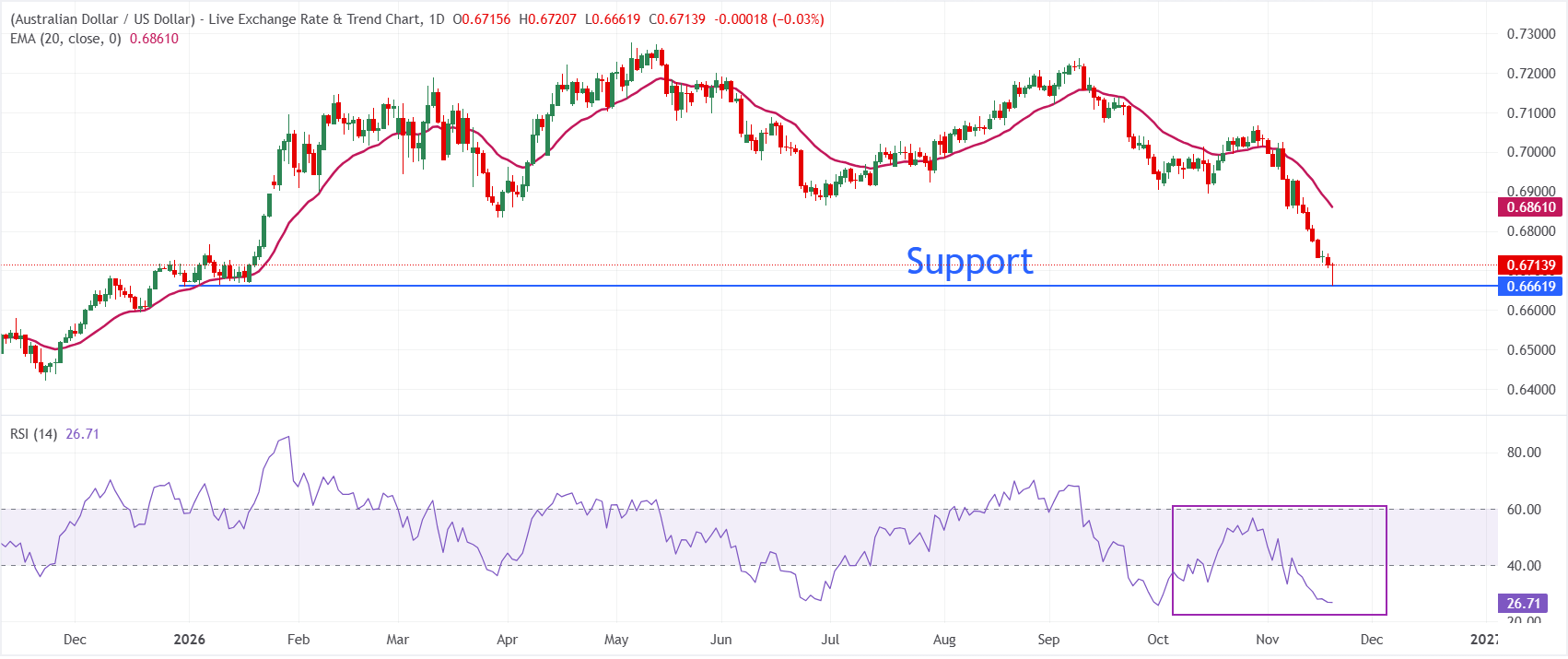
In the daily chart, AUD/USD trades at 0.6714, extending its decline beneath the 20-day exponential moving average (EMA) at 0.6861, which now caps the topside and reinforces a bearish near-term bias. The Relative Strength Index (14) has slipped to around 27, flirting with oversold territory and hinting that while downside pressure remains dominant, the pace of the sell-off could start to moderate if sellers lose conviction at these lower levels.
On the topside, initial resistance is defined by the 20-day EMA at 0.6861, and a daily close back above this barrier would be needed to ease immediate bearish pressure and signal room for a corrective bounce. Looking down, the intraday low at 0.6662 is the immediate support level; a break below the same would open the door for a further decline towards 0.6600.
(The technical analysis of this story was written with the help of an AI tool. Know more.)
Economic Indicator
Unemployment Rate s.a.
The Unemployment Rate, released by the Australian Bureau of Statistics, is the number of unemployed workers divided by the total civilian labor force, expressed as a percentage. If the rate increases, it indicates a lack of expansion within the Australian labor market and a weakness within the Australian economy. A decrease in the figure is seen as bullish for the Australian Dollar (AUD), while an increase is seen as bearish.
Read more.Last release: Thu Nov 19, 2026 00:30
Frequency: Monthly
Actual: 4.9%
Consensus: 4.7%
Previous: 4.7%
Source: Australian Bureau of Statistics
The Australian Bureau of Statistics (ABS) publishes an overview of trends in the Australian labour market, with unemployment rate a closely watched indicator. It is released about 15 days after the month end and throws light on the overall economic conditions, as it is highly correlated to consumer spending and inflation. Despite the lagging nature of the indicator, it affects the Reserve Bank of Australia’s (RBA) interest rate decisions, in turn, moving the Australian dollar. Upbeat figure tends to be AUD positive.
Лучшие статьи
1Пульс крипторынка: отток средств из ETF и макроэкономическое давление грозят свести на нет оптимизм вокруг IPO Anthropic2Евро сокращает потери на фоне улучшения аппетита к риску и сохранения низких цен на нефть3Золото: под давлением ниже отметки 3 800 – OCBC4Цена серебра сегодня: серебро дорожает, согласно данным FXStreet5Акции: распродажа продолжается, рынок снижается пятый день подряд – Deutsche Bank6Прогноз цен на серебро: XAG/USD остается вблизи $45,00 на фоне ожиданий повышения ставки ФРС7Доллар США: жесткий курс денежно-кредитной политики поддерживает устойчивость – TD Securities8Евро укрепляется к канадскому доллару в преддверии выступления главы ЕЦБ Лагард9Прогноз цены биткоина: рост BTC застопорился на фоне продолжающегося оттока средств из ETF и жестких сигналов в протоколе ФРС, сдерживающих аппетит к риску


Начать!
Зарегистрируйтесь и получите доступ к глобальным рынкам менее чем за 3 минуты

Свяжитесь с нами









Контакты
Телефон: +61 2 8036 8388
Факс: +61 2 8036 8388
Эл. почта: support@tmgm.com
Веб-сайт: https://www.tmg-max.com



Информация, представленная на этом веб-сайте, носит исключительно общий характер и не является персональной финансовой консультацией. Прежде чем действовать на основании любой информации на этом веб-сайте, вам следует оценить ее уместность с учетом ваших целей, финансового положения и потребностей. Инвестирование в CFD и маржинальные контракты на FX сопряжено со значительными рисками и подходит не всем инвесторам. Вы можете потерять больше, чем ваш первоначальный депозит. Вы не владеете базовым активом и не имеете в нем какой-либо доли. Мы рекомендуем вам обратиться за независимой консультацией и убедиться, что вы полностью понимаете связанные с этим риски, прежде чем начинать торговлю. Важно прочитать и принять во внимание документ с раскрытием информации, прежде чем приобретать любой продукт, указанный на веб-сайте. Информация и рекламные материалы, предлагаемые на этом веб-сайте, не предназначены для использования любым лицом в любой стране или юрисдикции, где такое использование противоречило бы местным законам и нормативным актам. Продукты и услуги, предлагаемые на этом веб-сайте, не предназначены для резидентов США, Малайзии и Таиланда.
TMGM уполномочена и регулируется в различных юрисдикциях.
Trademax Australia Limited, работающая под брендом TMGM, регулируется Australian Securities and Investments Commission (ASIC), AFSL № 436416 и находится по адресу: Level 28, One International Tower, 100 Barangaroo Avenue, 2000 Sydney, NSW Australia.
Email: support@tmgm.com.au
Trademax Global Limited, работающая под брендом TMGM, уполномочена и регулируется Vanuatu Financial Services Commission (VFSC), регистрационный номер 40356, и зарегистрирована по адресу: 1276, Kumul Highway, Port Vila, Vanuatu, Republic of Vanuatu.
Email: support@tmgm.com
Trademax Global Markets (SE) Limited, работающая под брендом TMGM, уполномочена и регулируется Financial Services Authority (FSA) Сейшельских Островов, номер лицензии SD224. Компания зарегистрирована по адресу: Office No 13, Providence Estate ABIS Centre, Mahe, Seychelles.
Email: support@tmgm.com
Trademax Global Markets (International) Pty Ltd, работающая под брендом TMGM, уполномочена и регулируется Financial Services Commission, Mauritius (FSC), лицензия № GB22201012, и зарегистрирована по адресу: 33, Edith Cavell Street C/o IQ EQ Fund Services (Mauritius) Ltd Port Louis, 11324 Mauritius.
Email: support@tmgm.com
Авторское право © TMGM. Все права защищены