

Торговля
Изучите широкий спектр рынков с конкурентными ценами, высокой ликвидностью и передовыми торговыми инструментами.
Узнать больше 
Платформа
Торгуйте без сбоев на мощной платформе TMGM, созданной для скорости, точности и превосходного торгового опыта.
Узнать больше Торговая платформа
Торговые инструменты
Академия
Изучите основы торговли с помощью материалов для начинающих, включая руководства, вебинары и аналитические обзоры рынка.
Узнать больше Новости и аналитика
Получайте актуальные рыночные обновления и экспертную аналитику, чтобы быть на шаг впереди торговых возможностей
Узнать больше Новости и аналитика
О нас
Узнайте, что отличает TMGM — наше глобальное присутствие, надежное регулирование и приверженность инновациям в трейдинге.
Узнать больше Почему выбирают TMGM
Спонсорство
US Dollar Index Price Forecast: Struggles to extend rally beyond 61.8% Fibo retracement at 104.65
- The US Dollar regains ground after a corrective move on Tuesday.
- Investors keenly await the US PCE Inflation data for October.
- The US headline and core PCE are seen higher at 3.8% and 3.2% YoY, respectively.
The US Dollar (USD) bounces back against its major peers on Wednesday after a corrective move the previous day. As of writing, the US Dollar Index (DXY), which gauges the Greenback’s value against six major currencies, trades 0.2% higher to near 104.05.
The DXY rebounds as investors turn cautious ahead of the United States (US) Personal Consumption Expenditure (PCE) Price Index data for October, which will be published at 13:30 GMT.

Dollar focus turns to October PCE as inflation gauges seen edging higher
Analysts at Commerzbank note that attention is now firmly on the October PCE release, with the bank highlighting that “the Bloomberg consensus expects headline PCE inflation to pick up to 3.8% yoy from 3.6% in September.” They add that the underlying trend is also expected to firm slightly, as “the core PCE deflator is expected at 3.2% yoy from 3.1% previously,” underscoring market expectations for a modest re-acceleration in the Fed’s preferred inflation gauges.
The US PCE inflation is expected to have a significant influence on Federal Reserve’s (Fed) interest rate expectations. Currently, the CME FedWatch tool shows traders are confident that the Fed will hike interest rates in the December policy meeting.
US Dollar Index Technical Analysis
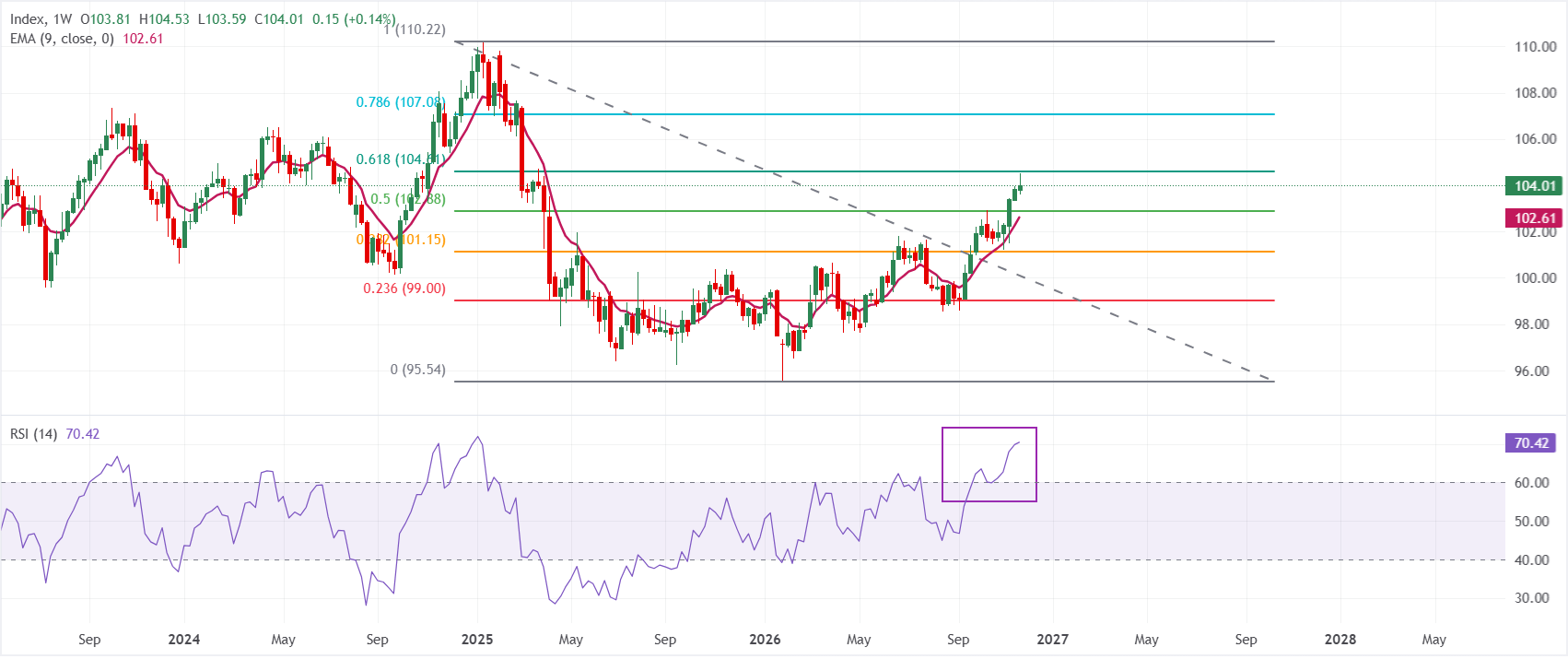
In the weekly chart, Dollar Index Spot trades at 104.01. The index holds above both the 9-week exponential moving average (EMA) at 102.61 and the 50.0% Fibonacci retracement at 102.88, keeping the near‑term bias bullish while it probes higher into the upper half of the recent range. The Relative Strength Index (14) at 70.42 has entered overbought territory, which hints that upside momentum is strong but also that the advance risks becoming stretched near the next Fibonacci barriers.
On the topside, immediate resistance is clustered at the 61.8% Fibonacci retracement at 104.61, with further hurdles at the 78.6% level near 107.08 and the cycle high area marked by the 100% retracement at 110.22. On the downside, initial support is seen at the 50.0% retracement at 102.88 and the nearby 9-week EMA at 102.61, followed by deeper structural support at the 38.2% retracement at 101.15 and the 23.6% level at 99.00, ahead of the anchor low at 95.54.
(The technical analysis of this story was written with the help of an AI tool. Know more.)
Inflation FAQs
Inflation measures the rise in the price of a representative basket of goods and services. Headline inflation is usually expressed as a percentage change on a month-on-month (MoM) and year-on-year (YoY) basis. Core inflation excludes more volatile elements such as food and fuel which can fluctuate because of geopolitical and seasonal factors. Core inflation is the figure economists focus on and is the level targeted by central banks, which are mandated to keep inflation at a manageable level, usually around 2%.
The Consumer Price Index (CPI) measures the change in prices of a basket of goods and services over a period of time. It is usually expressed as a percentage change on a month-on-month (MoM) and year-on-year (YoY) basis. Core CPI is the figure targeted by central banks as it excludes volatile food and fuel inputs. When Core CPI rises above 2% it usually results in higher interest rates and vice versa when it falls below 2%. Since higher interest rates are positive for a currency, higher inflation usually results in a stronger currency. The opposite is true when inflation falls.
Although it may seem counter-intuitive, high inflation in a country pushes up the value of its currency and vice versa for lower inflation. This is because the central bank will normally raise interest rates to combat the higher inflation, which attract more global capital inflows from investors looking for a lucrative place to park their money.
Formerly, Gold was the asset investors turned to in times of high inflation because it preserved its value, and whilst investors will often still buy Gold for its safe-haven properties in times of extreme market turmoil, this is not the case most of the time. This is because when inflation is high, central banks will put up interest rates to combat it. Higher interest rates are negative for Gold because they increase the opportunity-cost of holding Gold vis-a-vis an interest-bearing asset or placing the money in a cash deposit account. On the flipside, lower inflation tends to be positive for Gold as it brings interest rates down, making the bright metal a more viable investment alternative.
Лучшие статьи
1Норвежская крона: цены на газ помогут удержать позиции, завоёванные на фоне войны – Commerzbank2Шведская крона: влияние потоков средств PPM и сезонные факторы – Nordea3Прогноз цены биткоина: BTC рискует обновить годовой минимум перед публикацией индекса PCE в США4Евро сокращает потери к британскому фунту, несмотря на слабые данные по ВВП Германии5Валюты ЦВЕ: «ястребиная» риторика ограничивает снижение – ING6Прогноз по AUD/USD: снижение продолжается ниже уровня коррекции Фибоначчи 50%7Венгерский форинт: ограничения со стороны денежно-кредитной и бюджетной политики – Commerzbank8Швейцарский франк: торговля в диапазоне с риском укрепления к доллару США – UOB9Напор продавцов японской иены ослабевает на фоне высокой инфляции в секторе услуг и торговых пошлин


Начать!
Зарегистрируйтесь и получите доступ к глобальным рынкам менее чем за 3 минуты

Свяжитесь с нами









Контакты
Телефон: +61 2 8036 8388
Факс: +61 2 8036 8388
Эл. почта: support@tmgm.com
Веб-сайт: https://www.tmg-max.com



Информация, представленная на этом веб-сайте, носит исключительно общий характер и не является персональной финансовой консультацией. Прежде чем действовать на основании любой информации на этом веб-сайте, вам следует оценить ее уместность с учетом ваших целей, финансового положения и потребностей. Инвестирование в CFD и маржинальные контракты на FX сопряжено со значительными рисками и подходит не всем инвесторам. Вы можете потерять больше, чем ваш первоначальный депозит. Вы не владеете базовым активом и не имеете в нем какой-либо доли. Мы рекомендуем вам обратиться за независимой консультацией и убедиться, что вы полностью понимаете связанные с этим риски, прежде чем начинать торговлю. Важно прочитать и принять во внимание документ с раскрытием информации, прежде чем приобретать любой продукт, указанный на веб-сайте. Информация и рекламные материалы, предлагаемые на этом веб-сайте, не предназначены для использования любым лицом в любой стране или юрисдикции, где такое использование противоречило бы местным законам и нормативным актам. Продукты и услуги, предлагаемые на этом веб-сайте, не предназначены для резидентов США, Малайзии и Таиланда.
TMGM уполномочена и регулируется в различных юрисдикциях.
Trademax Australia Limited, работающая под брендом TMGM, регулируется Australian Securities and Investments Commission (ASIC), AFSL № 436416 и находится по адресу: Level 28, One International Tower, 100 Barangaroo Avenue, 2000 Sydney, NSW Australia.
Email: support@tmgm.com.au
Trademax Global Limited, работающая под брендом TMGM, уполномочена и регулируется Vanuatu Financial Services Commission (VFSC), регистрационный номер 40356, и зарегистрирована по адресу: 1276, Kumul Highway, Port Vila, Vanuatu, Republic of Vanuatu.
Email: support@tmgm.com
Trademax Global Markets (SE) Limited, работающая под брендом TMGM, уполномочена и регулируется Financial Services Authority (FSA) Сейшельских Островов, номер лицензии SD224. Компания зарегистрирована по адресу: Office No 13, Providence Estate ABIS Centre, Mahe, Seychelles.
Email: support@tmgm.com
Trademax Global Markets (International) Pty Ltd, работающая под брендом TMGM, уполномочена и регулируется Financial Services Commission, Mauritius (FSC), лицензия № GB22201012, и зарегистрирована по адресу: 33, Edith Cavell Street C/o IQ EQ Fund Services (Mauritius) Ltd Port Louis, 11324 Mauritius.
Email: support@tmgm.com
Авторское право © TMGM. Все права защищены