

Trading
Explore a wide range of markets with competitive pricing, deep liquidity, and advanced trading tools.
Learn More 
Platform
Trade seamlessly with TMGM's powerful platform, built for speed, precision, and a superior trading experience.
Learn More Trading Platform
Academy
Learn the fundamentals of trading with beginner-friendly resources, including guides, webinars, and market insights.
Learn More News & Analysis
Get real-time market updates and expert analysis to stay ahead of trading opportunities
Learn More News & Analysis
About
Learn what sets TMGM apart — our global presence, regulatory strength, and commitment to innovation in trading.
Learn More Why Choose TMGM
Sponsorship
Canada Unemployment Rate expected to rise to 6.5% as US tariffs test labor market
- Canada's Unemployment Rate is expected to rise to 6.5% in September from 6.4% in August.
- The labour market faces its first full test since new US tariffs took effect in August.
- The Canadian Dollar remains under pressure ahead of the jobs report and the Bank of Canada's October meeting.
Statistics Canada will release its September Labour Force Survey on Friday, with markets anticipating a modest recovery in employment following August's sharp decline. The report takes on particular importance as it will be the first to fully reflect the impact of new United States (US) tariffs that took effect on August 22. These additional trade barriers could weigh on hiring, particularly in export-oriented industries, raising concerns about the resilience of the Canadian labour market.

According to Royal Bank of Canada (RBC), the new tariffs could have stalled the labour market's recovery without necessarily reversing it. The bank expects employment to increase by a modest 5K in September, while forecasting the Unemployment Rate to remain unchanged at 6.4%. Similarly, Canadian Imperial Bank of Commerce (CIBC) anticipates a modest increase of 5K jobs, warning that trade tensions could continue to weigh on manufacturing employment. The bank expects the Unemployment Rate to rise to 6.5%, in line with market consensus.
The employment figures could also influence expectations surrounding the Bank of Canada (BoC), which has maintained its policy rate at 2.25% since October 2025. The central bank is expected to remain cautious at its October 28 meeting, balancing signs of economic weakness against persistent inflationary pressures.
Indeed, Canada's headline Consumer Price Index (CPI) steadied at 3% YoY in August, remaining well above the BoC’s 2% target amid elevated energy prices. Against this backdrop, a stronger-than-expected employment report could revive speculation about a potential BoC interest rate hike, while another disappointing reading could reinforce expectations of a prolonged monetary policy pause.
What can we expect from the next Canadian jobs report?
Consensus among analysts sees Canada's Unemployment Rate rising to 6.5% in September, from 6.4% in August. Additionally, investors expect the economy to add around 7K jobs, partially reversing the substantial 41.7K decline recorded in the previous month.
It is worth recalling that Average Hourly Wages increased by 2% YoY in August, slowing from 3% in July and 3.7% in June, suggesting that wage inflation is gradually losing momentum.
Beyond the headline figures, market participants will pay particular attention to full-time employment, wage growth and the participation rate to assess whether the Canadian labour market is showing further signs of weakness.
When is the Canadian unemployment rate released, and how could it affect USD/CAD?
Statistics Canada will publish its September employment report on Friday at 12:30 GMT. A stronger-than-expected reading could provide some support to the Canadian Dollar (CAD), particularly if accompanied by resilient wage growth and a decline in unemployment.
Conversely, another disappointing employment report could weigh on the Loonie by reducing expectations of monetary tightening from the BoC.
USD/CAD remains in a consolidative phase near 1.4200 ahead of the release, with the pair's next directional move potentially influenced by the strength of Friday's labour market figures.
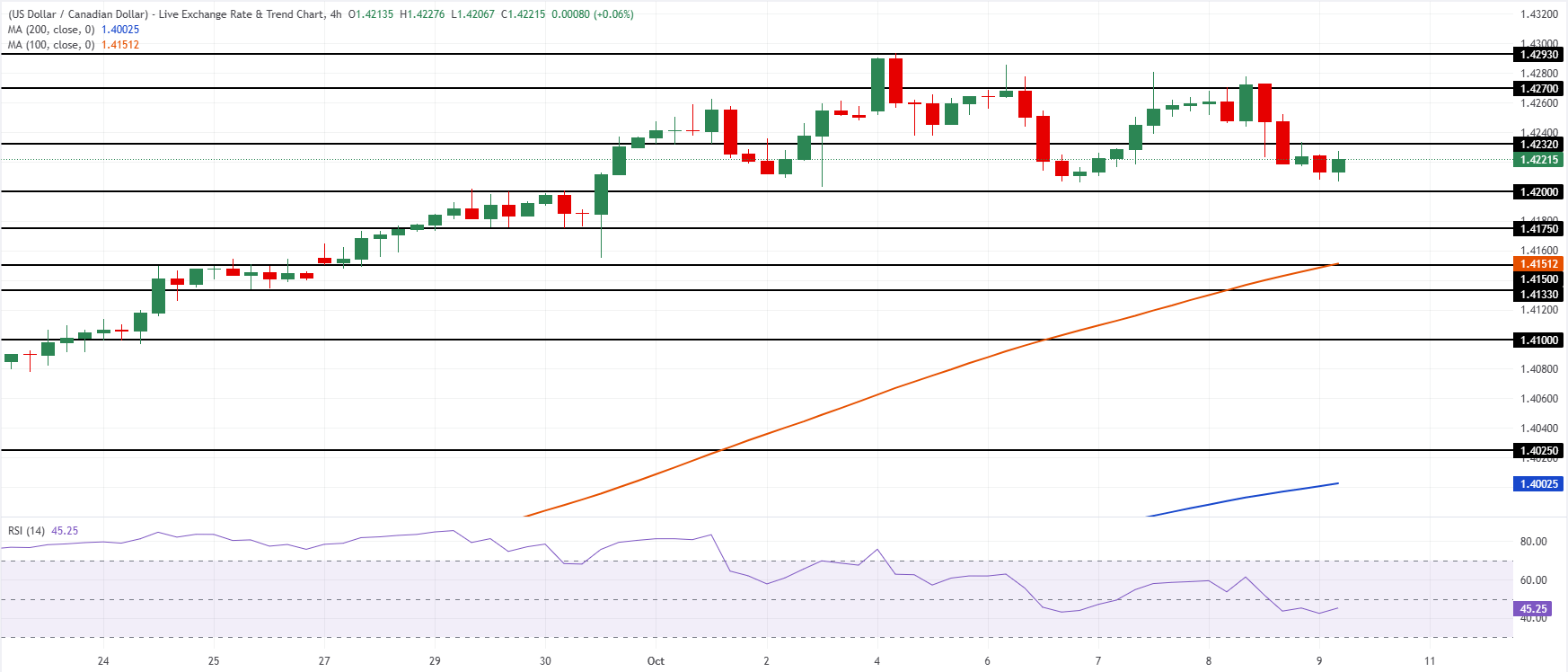
In the four-hour chart, USD/CAD maintains a constructive bullish bias while holding above the 100-period Simple Moving Average (SMA) at 1.4151 and the 200-period SMA at 1.4003. The clustering of horizontal supports between 1.4175 and 1.4200 reinforces a rising structure, even as the Relative Strength Index (RSI) near 45 hints at easing momentum after the recent advance.
On the topside, immediate resistance appears at 1.4232, ahead of 1.4270 and the recent cap near 1.4293. On the downside, initial support is seen at 1.4200, followed by 1.4175, with the 100-period SMA around 1.4151 and nearby horizontal levels at 1.4150 and 1.4133 forming a broader demand zone; deeper pullbacks would expose 1.4100 and then 1.4025 before the longer-term 200-period SMA at 1.4003.
(The technical analysis of this story was written with the help of an AI tool. Know more.)
Economic Indicator
Net Change in Employment
The Net Change in Employment released by Statistics Canada is a measure of the change in the number of people in employment in Canada. Generally speaking, a rise in this indicator has positive implications for consumer spending and indicates economic growth. Therefore, a high reading is seen as bullish for the Canadian Dollar (CAD), while a low reading is seen as bearish.
Read more.Next release: Fri Oct 09, 2026 12:30
Frequency: Monthly
Consensus: 7K
Previous: -41.7K
Source: Statistics Canada
Canada’s labor market statistics tend to have a significant impact on the Canadian dollar, with the Employment Change figure carrying most of the weight. There is a significant correlation between the amount of people working and consumption, which impacts inflation and the Bank of Canada’s rate decisions, in turn moving the C$. Actual figures beating consensus tend to be CAD bullish, with currency markets usually reacting steadily and consistently in response to the publication.
Employment FAQs
Labor market conditions are a key element to assess the health of an economy and thus a key driver for currency valuation. High employment, or low unemployment, has positive implications for consumer spending and thus economic growth, boosting the value of the local currency. Moreover, a very tight labor market – a situation in which there is a shortage of workers to fill open positions – can also have implications on inflation levels and thus monetary policy as low labor supply and high demand leads to higher wages.
The pace at which salaries are growing in an economy is key for policymakers. High wage growth means that households have more money to spend, usually leading to price increases in consumer goods. In contrast to more volatile sources of inflation such as energy prices, wage growth is seen as a key component of underlying and persisting inflation as salary increases are unlikely to be undone. Central banks around the world pay close attention to wage growth data when deciding on monetary policy.
The weight that each central bank assigns to labor market conditions depends on its objectives. Some central banks explicitly have mandates related to the labor market beyond controlling inflation levels. The US Federal Reserve (Fed), for example, has the dual mandate of promoting maximum employment and stable prices. Meanwhile, the European Central Bank’s (ECB) sole mandate is to keep inflation under control. Still, and despite whatever mandates they have, labor market conditions are an important factor for policymakers given its significance as a gauge of the health of the economy and their direct relationship to inflation.
Top Articles
1Euro: China trade tensions and CNY strength pose downside risks - MUFG2Romanian Leu: Coalition hopes support RON assets – Societe Generale3Silver price today: Silver rises, according to FXStreet data4Polish Zloty: Dovish NBP signals weigh on PLN – Commerzbank5Canadian Dollar: Jobs data and BoC path – ING6Ethereum activates Glamsterdam on Sepolia testnet: Why the price is falling anyway7Euro extends recovery due to relief from drop in French bond yields8British Pound: Mild downside bias against US Dollar - UOB9WTI Price Forecast: Slides back to mid-$89.00s as Mideast jitters limit losses
LIVE QUOTES

Get Started!
Sign up and access the Global Markets in less than 3 minutes

Connect With Us









Contacts
Phone: +61 2 8036 8388
Fax: +61 2 8036 8388
Email: support@tmgm.com



The information provided on this website is of a general nature only and does not constitute personal financial advice. Before acting on any information on this website, you should consider the suitability of the information in relation to your objectives, financial situation and needs. Investing in CFDs and FX Margin Contracts carries significant risks and is not suitable for all investors. You may lose more than your initial deposit. You do not own, or have, any interest in the underlying asset. We recommend that you seek independent advice and ensure you fully understand the risks involved before trading. It is important that you read and consider the disclosure document before you acquire any product listed on the website. The information and advertisements offered on this website are not intended for use by any person in any country or jurisdiction where such use would be contrary to local laws and regulations. The Products and Services offered on this website are not intended for residents of the United States, Malaysia and Thailand.
TMGM is authorized and regulated in various jurisdictions.
Trademax Australia Limited, trading as TMGM, is regulated by the Australian Securities and Investments Commission (ASIC), AFSL no. 436416 and is located at Level 28, One International Tower, 100 Barangaroo Avenue, 2000 Sydney, NSW Australia.
Email: support@tmgm.com.au
Trademax Global Limited, trading as TMGM, is authorized and regulated by the Vanuatu Financial Services Commission (VFSC), registration number 40356 and registered at 1276, Kumul Highway, Port Vila, Vanuatu, Republic of Vanuatu.
Email: support@tmgm.com
Trademax Global Markets (SE) Limited, trading as TMGM, is authorized and regulated by the Financial Services Authority (FSA) of Seychelles, with license number SD224. The company is registered at Office No 13, Providence Estate ABIS Centre, Mahe, Seychelles.
Email: support@tmgm.com
Trademax Global Markets (International) Pty Ltd, trading as TMGM, is authorized and regulated by the Financial Services Commission, Mauritius (FSC) with license no. GB22201012, and registered at 33, Edith Cavell Street C/o IQ EQ Fund Services (Mauritius) Ltd Port Louis, 11324 Mauritius.
Email: support@tmgm.com
Copyright © TMGM. All rights reserved