

Trading
Explore a wide range of markets with competitive pricing, deep liquidity, and advanced trading tools.
Learn More 
Platform
Trade seamlessly with TMGM's powerful platform, built for speed, precision, and a superior trading experience.
Learn More Trading Platform
Academy
Learn the fundamentals of trading with beginner-friendly resources, including guides, webinars, and market insights.
Learn More News & Analysis
Get real-time market updates and expert analysis to stay ahead of trading opportunities
Learn More News & Analysis
About
Learn what sets TMGM apart — our global presence, regulatory strength, and commitment to innovation in trading.
Learn More Why Choose TMGM
Sponsorship
Indian Rupee is under pressure ahead of Fed’s monetary policy
- The Indian Rupee trades lower against the US Dollar ahead of the Fed’s policy announcement.
- The Fed is seen leaving interest rates steady.
- Higher oil prices have weakened the Indian Rupee.
The Indian Rupee (INR) gives back its opening gains and turns slightly negative against the US Dollar (USD) on Wednesday. The USD/INR pair ticks up to near 95.16 as the Indian currency underperforms due to multiple headwinds, such as the oil price recovery and caution ahead of the Federal Reserve’s (Fed) monetary policy announcement.
In the opening trade, the MCX Crude Oil contract expiring on November 19 is up 1.82% to near Rs. 9,671, closer to its recent highs of Rs. 9,828.
Higher oil prices bode poorly for currencies from economies, such as India, which rely heavily on oil imports to meet their energy needs.
Oil prices gain as Houthis attack Saudi’s biggest refinery
On Tuesday, a military spokesperson from Yemen's Iran-aligned Houthis said that they launched a ballistic missile toward the Ras Tanura oil refinery in eastern Saudi Arabia, the kingdom’s largest refinery, Reuters reported.
The incident has reinforced fears of further acceleration in energy supply risks, prompting oil prices to rise.
Higher oil prices have also lent support to United States (US) Treasury Yields. Such a case diminishes the appeal of riskier currencies, like the Indian Rupee. As of writing, 10-year US bond yields are up 0.46% to near 5.02%.
Fed’s policy decision awaited
Later in the day, the Fed’s monetary policy announcement will be the key trigger for global markets. According to the CME FedWatch tool, the Fed is expected to leave interest rates unchanged in the 3.75%-4.00%.
In the September policy meeting, the Fed hiked interest rates by quarter-to-a-percent and signaled at least one more this year through the dot plot.
Financial markets were confident after the September policy announcement that the Fed will hike again in October; however, they pared hawkish bets as several policymakers signaled no urgency for another interest rate hike.
Waller flags more hikes but slower pace, keeping Dollar bulls on alert
Fed’s Waller delivered a distinctly hawkish message, with an 8/10 FXS Speechtracker score that is firmer relative to the historical average of 7.2/10, underscoring a bias toward further tightening. The insistence that “more hikes [are] needed” while allowing that they “do not need to come at consecutive meetings” signals a higher terminal rate but a more flexible path, a mix that supports the Dollar via expectations of prolonged restrictive policy rather than an aggressive near-term hiking cadence. Emphasis on persistent inflation drivers such as AI-related investment, ongoing energy shocks, and a still “solid and stable” labor market reinforces the risk that inflation expectations could de-anchor after nearly 5½ years above-target inflation, keeping the policy skew clearly on the hawkish side.
The FXS Fed Sentiment Index rose by 0.42 points to 138.34, confirming that the speech pushed the policy tone deeper into hawkish territory well above the neutral 100 mark. This elevated index level, aligned with the above-baseline FXS Speechtracker score, should underpin Dollar support as markets price in a longer period of restrictive rates even if individual meetings do not always deliver consecutive hikes.
USD/INR Technical Analysis
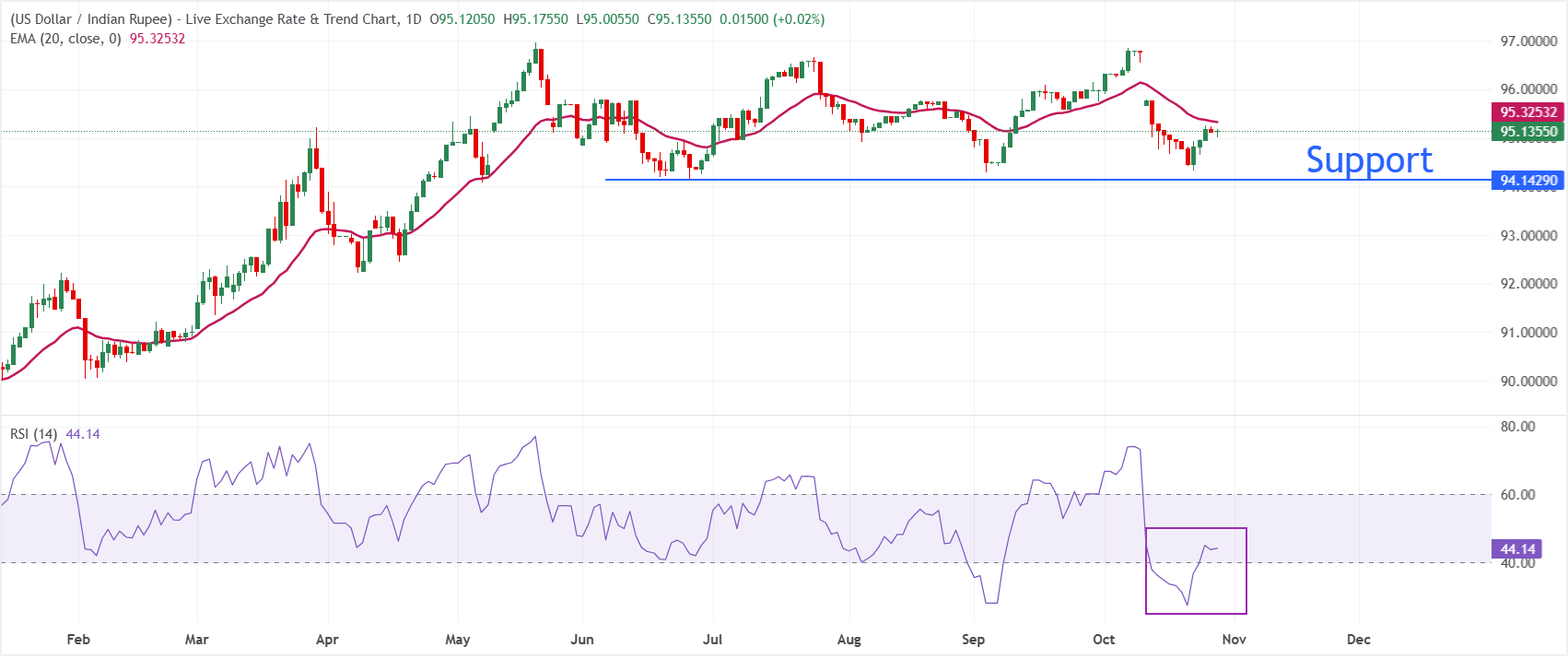
In the daily chart, USD/INR trades at 95.1355, keeping a bearish near-term tone as spot remains below the 20-period exponential moving average (EMA) at 95.3253. The pair’s inability to reclaim this short-term EMA suggests rallies are being sold into, while the Relative Strength Index (RSI) at around 44 stays in neutral-to-soft territory, hinting at a lack of upside momentum rather than outright oversold conditions.
On the topside, initial resistance is aligned with the 20-day EMA at 95.3253, and a sustained break above this barrier would be needed to ease immediate downside pressure and open the way for a more meaningful recovery. In the absence of clearly defined nearby support levels from the available indicators, the focus stays on price action relative to this EMA pivot, with continued trading beneath it likely to preserve the bearish bias in the short term.
(The technical analysis of this story was written with the help of an AI tool. Know more.)
Indian Rupee FAQs
The Indian Rupee (INR) is one of the most sensitive currencies to external factors. The price of Crude Oil (the country is highly dependent on imported Oil), the value of the US Dollar – most trade is conducted in USD – and the level of foreign investment, are all influential. Direct intervention by the Reserve Bank of India (RBI) in FX markets to keep the exchange rate stable, as well as the level of interest rates set by the RBI, are further major influencing factors on the Rupee.
The Reserve Bank of India (RBI) actively intervenes in forex markets to maintain a stable exchange rate, to help facilitate trade. In addition, the RBI tries to maintain the inflation rate at its 4% target by adjusting interest rates. Higher interest rates usually strengthen the Rupee. This is due to the role of the ‘carry trade’ in which investors borrow in countries with lower interest rates so as to place their money in countries’ offering relatively higher interest rates and profit from the difference.
Macroeconomic factors that influence the value of the Rupee include inflation, interest rates, the economic growth rate (GDP), the balance of trade, and inflows from foreign investment. A higher growth rate can lead to more overseas investment, pushing up demand for the Rupee. A less negative balance of trade will eventually lead to a stronger Rupee. Higher interest rates, especially real rates (interest rates less inflation) are also positive for the Rupee. A risk-on environment can lead to greater inflows of Foreign Direct and Indirect Investment (FDI and FII), which also benefit the Rupee.
Higher inflation, particularly, if it is comparatively higher than India’s peers, is generally negative for the currency as it reflects devaluation through oversupply. Inflation also increases the cost of exports, leading to more Rupees being sold to purchase foreign imports, which is Rupee-negative. At the same time, higher inflation usually leads to the Reserve Bank of India (RBI) raising interest rates and this can be positive for the Rupee, due to increased demand from international investors. The opposite effect is true of lower inflation.
Top Articles
1Forex Today: US Dollar consolidates weekly gains ahead of all-important Fed rate call2Japanese Yen: Range trading seen at 157.00-158.60 against US Dollar - UOB3Silver Price Forecast: XAG/USD keeps downward bias below $55.00 as traders await FOMC4New Zealand Dollar plummets as RBNZ unexpectedly leaves rates steady5Euro: Fed rate outlook and ECB credit signals in focus - Danske Bank6USD/JPY Price Forecast: V-shape recovery extends to near 158.007AUD/NZD Price Forecast: Aussie might test support at previous highs around 1.24908Gold: Two-way risks after cautious rebound – OCBC9Robinhood crypto revenue falls 55% as Galaxy posts $323M profit
LIVE QUOTES

ALL ABOUT OIL
5 Best Oil Trading Platforms 2026 (Brent and WTI)
WTI vs Brent Crude
What Are Oil Futures: How They Work, Pros & Cons, How to Trade
Gold to Oil Ratio: How does Iran War affect Gold Prices?
How to Choose the Best Oil Trading Platform
Oil Trading Hours: Best Time to Trade Crude Oil (Brent and WTI)
8 Factors That Affect Oil Prices
What is Oil Trading: How It Works, Ways to Trade
What is WTI Oil: Importance, Purpose, How To Trade
Get Started!
Sign up and access the Global Markets in less than 3 minutes

Connect With Us









Contacts
Phone: +61 2 8036 8388
Fax: +61 2 8036 8388
Email: support@tmgm.com



The information provided on this website is of a general nature only and does not constitute personal financial advice. Before acting on any information on this website, you should consider the suitability of the information in relation to your objectives, financial situation and needs. Investing in CFDs and FX Margin Contracts carries significant risks and is not suitable for all investors. You may lose more than your initial deposit. You do not own, or have, any interest in the underlying asset. We recommend that you seek independent advice and ensure you fully understand the risks involved before trading. It is important that you read and consider the disclosure document before you acquire any product listed on the website. The information and advertisements offered on this website are not intended for use by any person in any country or jurisdiction where such use would be contrary to local laws and regulations. The Products and Services offered on this website are not intended for residents of the United States, Malaysia and Thailand.
TMGM is authorized and regulated in various jurisdictions.
Trademax Australia Limited, trading as TMGM, is regulated by the Australian Securities and Investments Commission (ASIC), AFSL no. 436416 and is located at Level 28, One International Tower, 100 Barangaroo Avenue, 2000 Sydney, NSW Australia.
Email: support@tmgm.com.au
Trademax Global Limited, trading as TMGM, is authorized and regulated by the Vanuatu Financial Services Commission (VFSC), registration number 40356 and registered at 1276, Kumul Highway, Port Vila, Vanuatu, Republic of Vanuatu.
Email: support@tmgm.com
Trademax Global Markets (SE) Limited, trading as TMGM, is authorized and regulated by the Financial Services Authority (FSA) of Seychelles, with license number SD224. The company is registered at Office No 13, Providence Estate ABIS Centre, Mahe, Seychelles.
Email: support@tmgm.com
Trademax Global Markets (International) Pty Ltd, trading as TMGM, is authorized and regulated by the Financial Services Commission, Mauritius (FSC) with license no. GB22201012, and registered at 33, Edith Cavell Street C/o IQ EQ Fund Services (Mauritius) Ltd Port Louis, 11324 Mauritius.
Email: support@tmgm.com
Copyright © TMGM. All rights reserved