

Trading
Explore a wide range of markets with competitive pricing, deep liquidity, and advanced trading tools.
Learn More 
Platform
Trade seamlessly with TMGM's powerful platform, built for speed, precision, and a superior trading experience.
Learn More Trading Platform
Academy
Learn the fundamentals of trading with beginner-friendly resources, including guides, webinars, and market insights.
Learn More News & Analysis
Get real-time market updates and expert analysis to stay ahead of trading opportunities
Learn More News & Analysis
About
Learn what sets TMGM apart — our global presence, regulatory strength, and commitment to innovation in trading.
Learn More Why Choose TMGM
Sponsorship
US banking approval for Ripple: A pivotal moment for the crypto sector?
A low-key but significant regulatory milestone marked this week in crypto. Ripple, a leading blockchain solutions provider spanning traditional and digital finance, secured final clearance from the Office of the Comptroller of the Currency (OCC) to establish Ripple National Trust Bank (RNTB) on Monday. The decision allows the company to run its own federally supervised national bank, following the OCC’s conditional approval in December 2025.
Ripple’s banking approval: reserves and custody
Under the approval, the new bank will serve as trustee for the reserves backing Ripple’s RLUSD stablecoin, holding and managing those assets while providing institutions with digital-asset custody services.
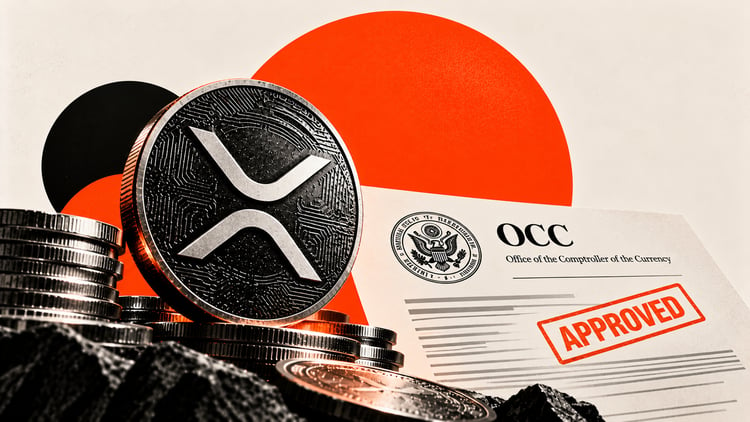
RLUSD issuance will remain with Standard Custody & Trust Company (SCTC), the Ripple entity supervised by the New York Department of Financial Services (NYDFS). Federal supervision introduces an additional layer of oversight for reserves and custody.
Commenting on the approval, Ripple’s CEO Brad Garlinghouse stated: “For years, we’ve said crypto and banks work better together. Final approval for Ripple National Trust Bank is what that looks like in practice.”
His remarks highlight the substance beyond attention-grabbing token headlines: under federal rules, Ripple is making further tangible progress into the traditional financial system. The approval is particularly significant for a company that has spent years working through regulatory requirements.
An additional development came in mid-October, when one of the world’s largest international banks, Standard Chartered, confirmed support for institutional custody of RLUSD issued on the XRP Ledger (XRPL), via its Dubai International Financial Center (DIFC) branch.
Together, these developments further integrate blockchain-based assets with established financial infrastructure. They also reinforce institutional confidence in RLUSD and Ripple’s custody services, while signalling a clearer route through regulation.
XRP price fails to rally on approval
Rather than providing an immediate trading catalyst, the news represents a structural advance in regulation, leaving XRP without a price surge. For longer-term traders, however, regulated stablecoins, institutional uptake and crypto firms participating in the banking system remain important. These changes may deepen liquidity, expand applications and widen adoption across the XRPL ecosystem, potentially lending support to the cryptocurrency.
At the same time, macroeconomic pressures, geopolitical tensions and this week’s Binance wallet hacks continue to limit XRP’s price gains.
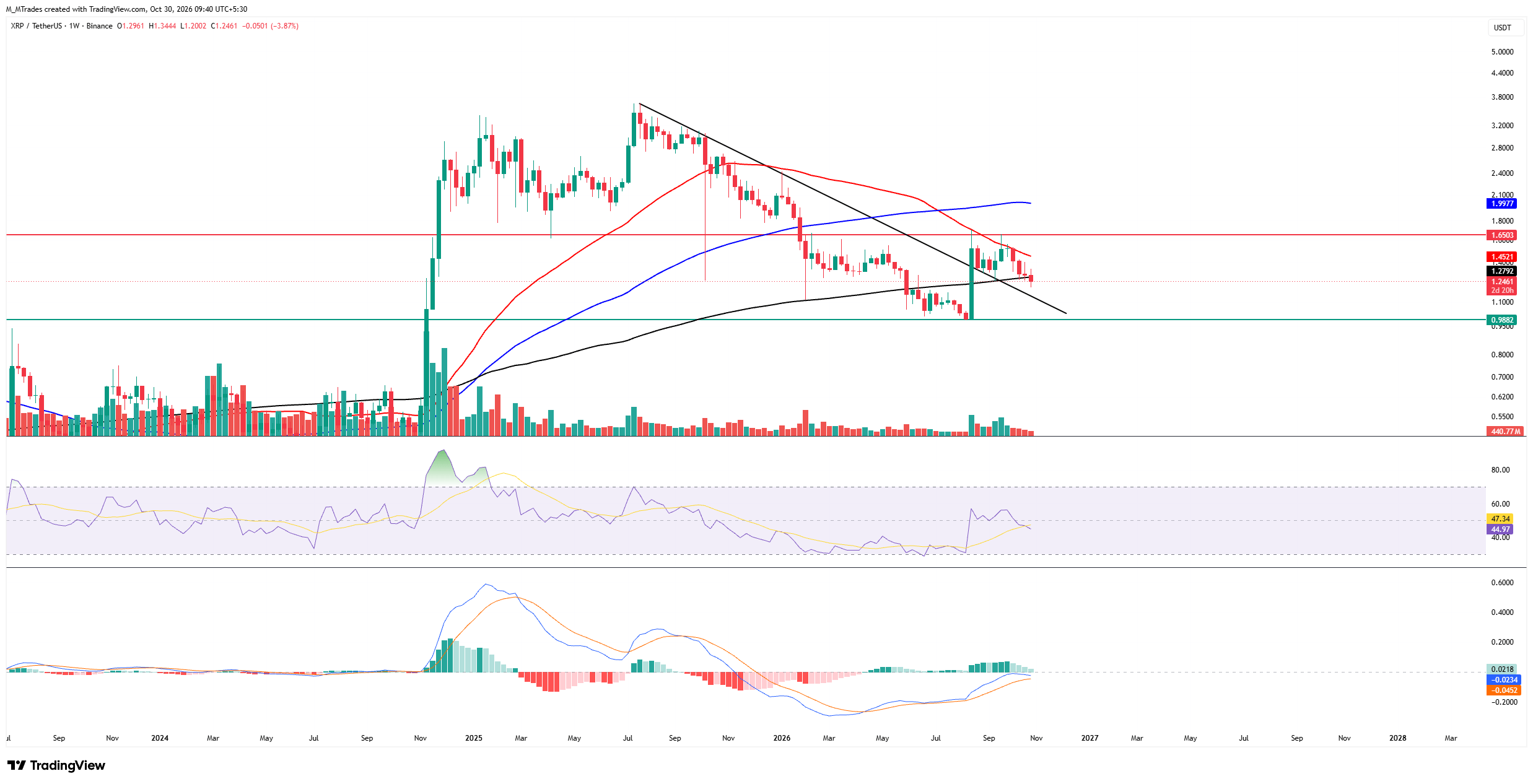
At this week’s two-day October policy meeting, the Federal Reserve (Fed) left interest rates on hold at 3.75%-4.00%. Its cautious decision, however, alongside hawkish policy guidance and inflation worries linked to Middle East tensions, reinforces market caution and pressures risk assets including XRP.
Selling pressure increased on Thursday after reports of a potential $6 billion security breach at Binance exchange unsettled investors further. Outflows were flagged on several blockchain networks, among them the XRP Ledger.
$1.200 was XRP’s low on Friday. The developments triggered a steep correction, putting the token on course for a fourth consecutive weekly loss since early October.
Ripple’s trust bank and institutional crypto adoption
Establishing a national trust bank may attract less social-media attention than other crypto headlines, yet Ripple’s initiative could have greater long-term significance. With reserve management and custody brought under federal oversight, Ripple is reinforcing the institutional foundations supporting its stablecoin and other financial products. This could make those products more robust and more accessible to traditional banking institutions.
Regulatory uncertainty continues to challenge the industry. Against that backdrop, Ripple’s banking approval marks substantial progress in linking traditional finance with crypto, with potential consequences reaching well beyond XRP’s price.
Ripple: frequently asked questions
Specialising in cross-border remittances, payments company Ripple uses blockchain technology to deliver its services. Ripple Labs Inc. created RippleNet as a payment transfer network available to financial institutions around the world. Ripple also makes use of the XRP token.
The decentralised XRPLedger blockchain has XRP as its native token. Ripple Labs uses it to support transactions on XRPLedger, enabling financial institutions to transfer value across borders. By facilitating instant, trustless payments on the XRPLedger chain, XRP helps financial firms reduce the cost of global transactions.
Distributed ledger technology underpins XRPLedger, whose blockchain uses XRP to power transactions. Unlike other blockchains, the ledger includes a built-in inflammatory protocol to help counter spam and distributed denial-of-service (DDOS) attacks. Maintenance of XRPL is handled by a peer-to-peer network called the global XRP Ledger community.
The interledger standard used by XRP is a blockchain protocol that facilitates payments between different networks. XRP’s blockchain can, for example, link the ledgers of two or more banks, effectively eliminating intermediaries and the need for centralisation within the system. Engineered by Jed McCaleb, Arthur Britto and David Schwartz, the XRPLedger blockchain uses XRP as its native token.
POPULAR ARTICLES
1US Dollar: Rate hike expectations gain support from stronger growth – Commerzbank21.3968 six-week lows tested: USD/CAD Price Forecast as US Dollar weakens3Near 0.5650: New Zealand Dollar recovery extends on hawkish RBNZ outlook4Silver price today: FXStreet data shows a decline5December ECB hike expectations underpin Euro (EUR) – ING6Oil: War Risks Sustain Elevated Prices – Rabobank7101.75: US Dollar Index price forecast as DXY struggles near this level while bond yields fall8Six-week highs tested by British Pound as traders prepare for BoE tightening90.2%: Germany’s flash Q3 GDP growth unchanged, exceeding 0.1% estimates


Get Started!
Sign up and access the Global Markets in less than 3 minutes

Connect With Us









Contacts
Phone: +61 2 8036 8388
Fax: +61 2 8036 8388
Email: support@tmgm.com



The information provided on this website is of a general nature only and does not constitute personal financial advice. Before acting on any information on this website, you should consider the suitability of the information in relation to your objectives, financial situation and needs. Investing in CFDs and FX Margin Contracts carries significant risks and is not suitable for all investors. You may lose more than your initial deposit. You do not own, or have, any interest in the underlying asset. We recommend that you seek independent advice and ensure you fully understand the risks involved before trading. It is important that you read and consider the disclosure document before you acquire any product listed on the website. The information and advertisements offered on this website are not intended for use by any person in any country or jurisdiction where such use would be contrary to local laws and regulations. The Products and Services offered on this website are not intended for residents of the United States, Malaysia and Thailand.
TMGM is authorized and regulated in various jurisdictions.
Trademax Australia Limited, trading as TMGM, is regulated by the Australian Securities and Investments Commission (ASIC), AFSL no. 436416 and is located at Level 28, One International Tower, 100 Barangaroo Avenue, 2000 Sydney, NSW Australia.
Email: support@tmgm.com.au
Trademax Global Limited, trading as TMGM, is authorized and regulated by the Vanuatu Financial Services Commission (VFSC), registration number 40356 and registered at 1276, Kumul Highway, Port Vila, Vanuatu, Republic of Vanuatu.
Email: support@tmgm.com
Trademax Global Markets (SE) Limited, trading as TMGM, is authorized and regulated by the Financial Services Authority (FSA) of Seychelles, with license number SD224. The company is registered at Office No 13, Providence Estate ABIS Centre, Mahe, Seychelles.
Email: support@tmgm.com
Trademax Global Markets (International) Pty Ltd, trading as TMGM, is authorized and regulated by the Financial Services Commission, Mauritius (FSC) with license no. GB22201012, and registered at 33, Edith Cavell Street C/o IQ EQ Fund Services (Mauritius) Ltd Port Louis, 11324 Mauritius.
Email: support@tmgm.com
Copyright © TMGM. All rights reserved