

Trading
Explore a wide range of markets with competitive pricing, deep liquidity, and advanced trading tools.
Learn More 
Platform
Trade seamlessly with TMGM's powerful platform, built for speed, precision, and a superior trading experience.
Learn More Trading Platform
Academy
Learn the fundamentals of trading with beginner-friendly resources, including guides, webinars, and market insights.
Learn More News & Analysis
Get real-time market updates and expert analysis to stay ahead of trading opportunities
Learn More News & Analysis
About
Learn what sets TMGM apart — our global presence, regulatory strength, and commitment to innovation in trading.
Learn More Why Choose TMGM
Sponsorship
Near 0.5650: New Zealand Dollar recovery extends on hawkish RBNZ outlook
- 0.5650 in sight as NZD/USD extends recovery on hawkish RBNZ expectations.
- Wednesday’s RBNZ rate hold represented a temporary pause, according to OCBC.
- Ahead of the US midterm elections, the US Dollar loses ground.
0.5650 is within reach for NZD/USD. In Friday’s European trading, the New Zealand Dollar (NZD) builds on Thursday’s recovery against the US Dollar (USD). Expectations that the Reserve Bank of New Zealand (RBNZ) will continue its monetary tightening path are supporting the Kiwi pair, despite Wednesday’s decision to leave the Official Cash Rate (OCR) at 2.75%.

Markets had anticipated a 25 basis points (bps) OCR increase to 3%. Instead, the RBNZ kept rates unchanged, putting substantial pressure on the New Zealand Dollar.
0.5600 limits NZD downside as Kiwi stabilises on temporary RBNZ pause view
Wednesday’s OCR hold was not unanimous, OCBC analysts point out. While “Governor Anna Breman” joined the majority in favour of unchanged rates, “Chief Economist Paul Conway backed a hike.” Explaining the majority’s position, the analysts say committee members “preferred to give the July and September rate increases more time to work through the economy, particularly with domestic demand still subdued.”
Describing the decision as “more of a pause than a dovish pivot.”, OCBC maintains its policy outlook. The bank notes that “the RBNZ said tighter monetary policy is likely to be required, although the timing remains data-dependent,” adding that “attention now shifts to December.” Its forecast remains unchanged: “we continue to expect two further hikes, in December and 1Q27, which should limit further NZD downside.” For the exchange rate, the bank says that “for NZD/USD, 0.5600 remains the key near-term level to watch after being tested around the decision.”
Heading into the weekend, the US Dollar remains under pressure. News surrounding Tuesday’s scheduled midterm elections will be a significant driver in the period ahead.
Safe-haven Treasury demand has accompanied renewed weakness in technology shares, according to ING analysts: “fresh pressure on tech stocks has triggered some safe-haven buying in US Treasuries and weighed on the Dollar as the front end followed lower.” They describe the episode as “a reminder that the greenback still faces downside risks from oscillating AI sentiment.” Nevertheless, they emphasise that “moves are contained in both equities and FX,”
Away from technology-led headlines, ING sees continued demand for the US currency, observing that “whenever tech stocks don’t dominate headlines, the Dollar has had no trouble attracting buyers,” and that they “don’t think Wednesday’s FOMC changed that.” Recent economic releases also leaned towards tighter policy, the bank notes: “yesterday’s US data was hawkish-leaning, with 3Q growth slightly above consensus at 3.4% and core PCE at 0.3% month-on-month in September – enough to keep the Federal Reserve on high alert.”
For today, ING identifies positioning ahead of the election as the principal threat: “the main risk for the Dollar today is some precautionary unwinding of net-long positions ahead of Tuesday’s US midterm elections.” Explaining the political risks, the analysts say that “a Democratic sweep is trading around 68% in prediction markets, and that could be seen as slightly negative for the US Dollar from a few angles, from higher risk of government shutdown and gridlock on debt ceiling negotiations to potential damage to already shaky AI-related sentiment.” Their conclusion is measured: “We’d be cautious in chasing the USD upside in the next few days.”
0.5659 EMA caps NZD/USD: Technical Analysis
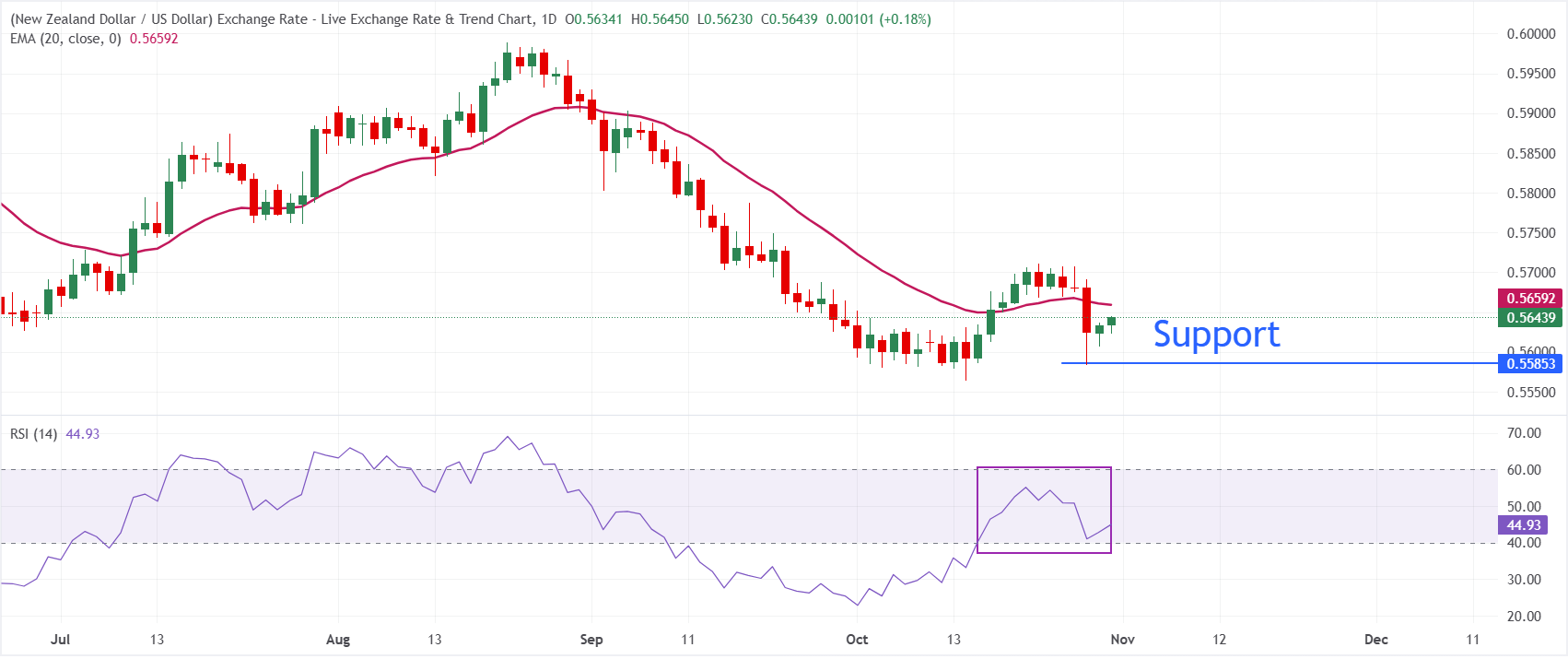
At 0.5644 on the daily chart, NZD/USD retains a bearish near-term outlook. The 20-day exponential moving average (EMA) at 0.5659 continues to cap spot prices, leaving the recent rebound struggling for traction below this short-term trend indicator. Around 45, the Relative Strength Index (RSI) signals moderate momentum without a clear directional commitment, offering little counterweight to the prevailing downside bias.
The first upside hurdle is the 20-day EMA at 0.5659. Bulls would need to regain that level to reduce bearish pressure and create scope for a more durable recovery. Below it, further consolidation or an extension lower remains the greater risk, while selling interest near the moving average is likely to challenge intraday rebounds.
(The technical analysis of this story was written with the help of an AI tool. Know more.)
RBNZ: Key questions answered
New Zealand’s central bank is the Reserve Bank of New Zealand (RBNZ). It pursues two economic objectives: achieving and preserving price stability, and supporting maximum sustainable employment. Price stability is achieved when inflation, as measured by the Consumer Price Index (CPI), is within the 1% to 3% band.
Responsibility for setting the Official Cash Rate (OCR) rests with the Reserve Bank of New Zealand’s (RBNZ) Monetary Policy Committee (MPC), which chooses a level consistent with its objectives. Inflation above target prompts the bank to try to curb price pressures by increasing the OCR. Higher borrowing costs for households and businesses then cool economic activity. By lifting yields and increasing New Zealand’s appeal to investors, higher interest rates generally support the New Zealand Dollar (NZD). Lower rates, by contrast, tend to weaken the currency.
A tight labour market can drive inflation, making employment a key consideration for the Reserve Bank of New Zealand (RBNZ). The bank defines “maximum sustainable employment” as the greatest use of labour resources that can be maintained over time without accelerating inflation. Explaining the relationship, it says: “When employment is at its maximum sustainable level, there will be low and stable inflation. However, if employment is above the maximum sustainable level for too long, it will eventually cause prices to rise more and more quickly, requiring the MPC to raise interest rates to keep inflation under control,”
Quantitative Easing is a monetary policy tool available to the Reserve Bank of New Zealand (RBNZ) in extreme circumstances. Under QE, the RBNZ creates local currency to purchase assets, usually government or corporate bonds, from banks and other financial institutions. The aim is to expand the domestic money supply and stimulate economic activity. The New Zealand Dollar (NZD) typically weakens as a result. Used as a last resort when interest rate cuts alone are unlikely to meet the central bank’s objectives, QE was deployed by the RBNZ during the Covid-19 pandemic.
POPULAR ARTICLES
1Crypto Today: Selling pressure eases in Bitcoin, Ethereum, XRP following Binance security breach2ECB’s Nagel: Central bank will act decisively to lower inflation if needed3Dogecoin Price Forecast: ETF outflows and long unwinding heighten downside risk for DOGE40.4% Eurozone GDP growth in Q3 exceeds 0.2% estimates5US Dollar: Rate hike expectations gain support from stronger growth – Commerzbank61.3968 six-week lows tested: USD/CAD Price Forecast as US Dollar weakens7Near 0.5650: New Zealand Dollar recovery extends on hawkish RBNZ outlook8Silver price today: FXStreet data shows a decline9December ECB hike expectations underpin Euro (EUR) – ING


Get Started!
Sign up and access the Global Markets in less than 3 minutes

Connect With Us









Contacts
Phone: +61 2 8036 8388
Fax: +61 2 8036 8388
Email: support@tmgm.com



The information provided on this website is of a general nature only and does not constitute personal financial advice. Before acting on any information on this website, you should consider the suitability of the information in relation to your objectives, financial situation and needs. Investing in CFDs and FX Margin Contracts carries significant risks and is not suitable for all investors. You may lose more than your initial deposit. You do not own, or have, any interest in the underlying asset. We recommend that you seek independent advice and ensure you fully understand the risks involved before trading. It is important that you read and consider the disclosure document before you acquire any product listed on the website. The information and advertisements offered on this website are not intended for use by any person in any country or jurisdiction where such use would be contrary to local laws and regulations. The Products and Services offered on this website are not intended for residents of the United States, Malaysia and Thailand.
TMGM is authorized and regulated in various jurisdictions.
Trademax Australia Limited, trading as TMGM, is regulated by the Australian Securities and Investments Commission (ASIC), AFSL no. 436416 and is located at Level 28, One International Tower, 100 Barangaroo Avenue, 2000 Sydney, NSW Australia.
Email: support@tmgm.com.au
Trademax Global Limited, trading as TMGM, is authorized and regulated by the Vanuatu Financial Services Commission (VFSC), registration number 40356 and registered at 1276, Kumul Highway, Port Vila, Vanuatu, Republic of Vanuatu.
Email: support@tmgm.com
Trademax Global Markets (SE) Limited, trading as TMGM, is authorized and regulated by the Financial Services Authority (FSA) of Seychelles, with license number SD224. The company is registered at Office No 13, Providence Estate ABIS Centre, Mahe, Seychelles.
Email: support@tmgm.com
Trademax Global Markets (International) Pty Ltd, trading as TMGM, is authorized and regulated by the Financial Services Commission, Mauritius (FSC) with license no. GB22201012, and registered at 33, Edith Cavell Street C/o IQ EQ Fund Services (Mauritius) Ltd Port Louis, 11324 Mauritius.
Email: support@tmgm.com
Copyright © TMGM. All rights reserved