

Trading
Explore a wide range of markets with competitive pricing, deep liquidity, and advanced trading tools.
Learn More 
Platform
Trade seamlessly with TMGM's powerful platform, built for speed, precision, and a superior trading experience.
Learn More Trading Platform
Academy
Learn the fundamentals of trading with beginner-friendly resources, including guides, webinars, and market insights.
Learn More News & Analysis
Get real-time market updates and expert analysis to stay ahead of trading opportunities
Learn More News & Analysis
About
Learn what sets TMGM apart — our global presence, regulatory strength, and commitment to innovation in trading.
Learn More Why Choose TMGM
Sponsorship
Yen holds steady ahead of Tokyo inflation despite strong US data
- 158.50–159.50 remains USD/JPY's range. US inflation and growth data leave the pair little changed.
- 4.2% annual growth in Japan's services producer prices marks the strongest increase since 1990.
- Thursday brings remarks from BoJ board member Tamura and Tokyo's November CPI release.
USD/JPY is just above 159.00, close to its opening level. Wednesday's trading has spanned less than a Yen as stronger US figures and Japan's fastest services inflation since 1990 exerted opposing pressures, with neither prevailing. The pair is spending an eighth session within the range established after the November 13 high.

A 4.2% annual increase in Japan's services producer prices in October, the largest since 1990, strengthened the argument for a December rate rise by the Bank of Japan (BoJ). On November 13, Finance Minister Katayama said she saw rapid, one-sided Yen moves. That was also the last day USD/JPY traded above 160.00. Both factors have helped keep the pair from returning above that level.
With a December Fed rate rise already almost fully priced in, the US releases offered little scope for a further adjustment. Core inflation exceeded forecasts, third-quarter economic growth reached a 4.3% pace versus the 3.4% forecast, and jobless claims fell to 189K. Yet Treasury yields declined as investors sold technology shares, removing the usual support that strong US figures provide for USD/JPY.
01:00 GMT: Tamura leads Thursday's calendar
Thursday's schedule starts with BoJ board member Tamura's remarks at 01:00 GMT. At 23:30 GMT, Tokyo releases its November Consumer Price Index (CPI). Inflation excluding fresh food is forecast at 3%, up from 2.6%; the measure excluding food and energy is also expected at 3%, following 2.4%. Both readings will inform the BoJ's December decision and, in turn, the Japanese side of USD/JPY's interest-rate differential.
With US markets closed for Thanksgiving on Thursday, New York will be on holiday when Tokyo's data arrive. Saturday marks the start of the Fed's pre-meeting blackout, ahead of its December 8-9 meeting. That meeting precedes the BoJ's.
158.50: 50-day EMA remains in focus
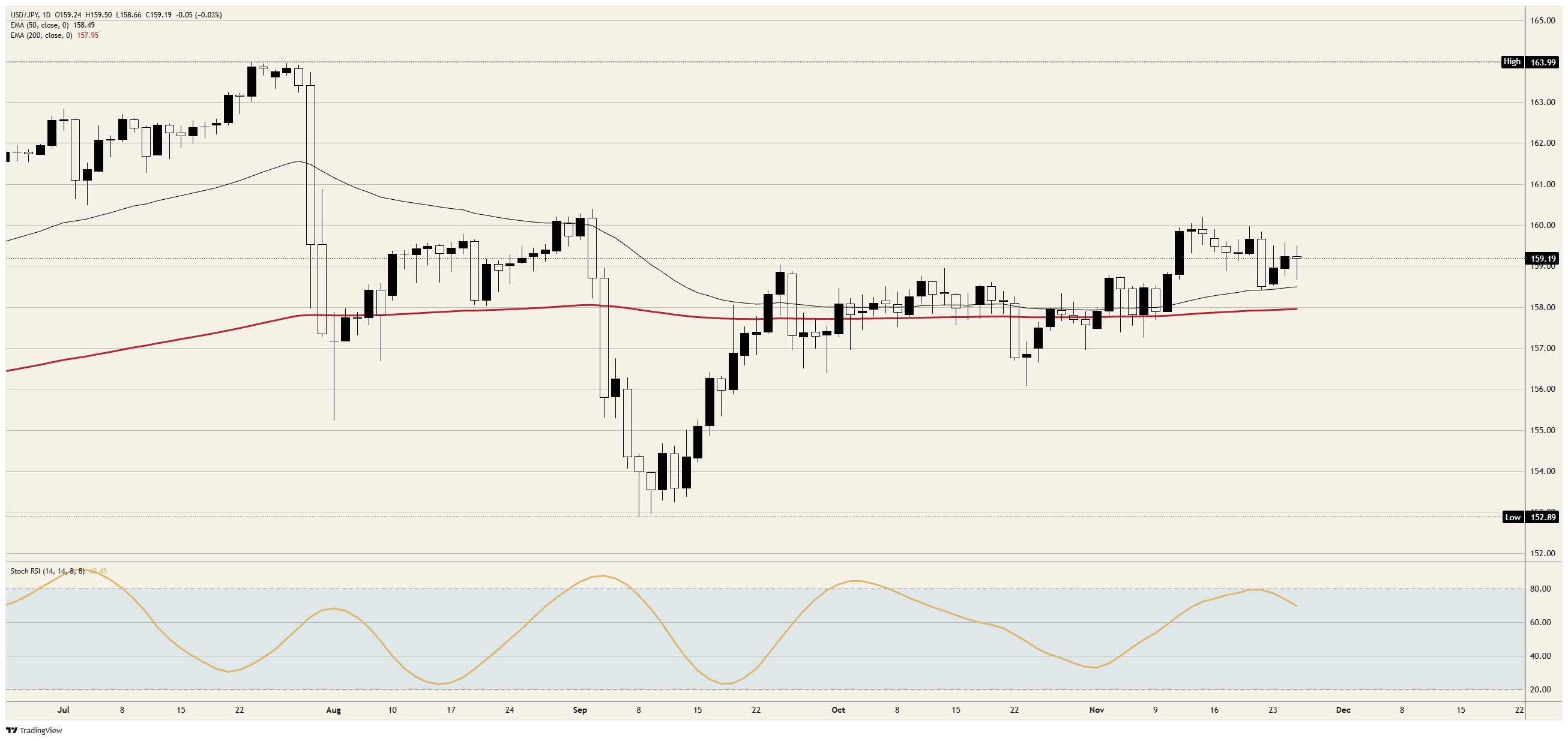
Just above 160.00, the November 12 and 13 highs marked USD/JPY's first trading at those levels since early September. The 50-day Exponential Moving Average (EMA), near 158.50, was reached at Friday's low; Wednesday's low held just above it. The 200-day EMA sits near 158.00. On the daily chart, momentum has turned lower after approaching overbought territory.
Daily price chart: USD/JPY
Japanese Yen: Key Questions
Among the world's most actively traded currencies, the Japanese Yen (JPY) draws broad direction from Japan's economic performance. More specific influences include Bank of Japan policy, the gap between Japanese and US bond yields, and traders' appetite for risk, alongside other factors.
Currency control forms part of the Bank of Japan's mandate, making its actions important for the Yen. Direct intervention in currency markets has occasionally been used, usually to weaken the currency. Such action remains infrequent because of political concerns among Japan's main trading partners. Between 2013 and 2024, the BoJ's ultra-loose monetary stance increasingly diverged from the policies of other major central banks, driving Yen depreciation against its principal peers. More recently, a gradual withdrawal of that ultra-loose policy has provided the Yen with some support.
Over the past decade, the BoJ's commitment to ultra-loose monetary policy increased its policy divergence from other central banks, notably the US Federal Reserve. The resulting widening in the yield gap between 10-year US and Japanese bonds favoured the US Dollar over the Japanese Yen. That gap is now narrowing as the BoJ implements its 2024 decision to move gradually away from ultra-loose policy and other major central banks cut interest rates.
Often regarded as a safe-haven investment, the Japanese Yen tends to attract funds during periods of market stress because of its perceived reliability and stability. During turbulence, investors are more likely to allocate money to the Japanese currency, potentially strengthening it against currencies regarded as riskier investments.
POPULAR ARTICLES
1$3,550 topped: Gold rebounds as lower yields and a softer US Dollar offset hot US inflation data2Hot CPI meets Fed hike bets as Australian Dollar loses momentum3Yen holds steady ahead of Tokyo inflation despite strong US data42009 low: New Zealand Dollar recovers ahead of confidence data5Pound holds steady ahead of BoE stability report following rate hearing619-month low: Euro regains ground ahead of ECB meeting accounts7Dow Jones Industrial Average recovers losses as AI stocks retreat8FX Today: Strong US data fails to halt US Dollar decline; focus turns to ECB minutes93.3% core PCE reading: Gold slides despite lower US yields


Get Started!
Sign up and access the Global Markets in less than 3 minutes

Connect With Us









Contacts
Phone: +61 2 8036 8388
Fax: +61 2 8036 8388
Email: support@tmgm.com



The information provided on this website is of a general nature only and does not constitute personal financial advice. Before acting on any information on this website, you should consider the suitability of the information in relation to your objectives, financial situation and needs. Investing in CFDs and FX Margin Contracts carries significant risks and is not suitable for all investors. You may lose more than your initial deposit. You do not own, or have, any interest in the underlying asset. We recommend that you seek independent advice and ensure you fully understand the risks involved before trading. It is important that you read and consider the disclosure document before you acquire any product listed on the website. The information and advertisements offered on this website are not intended for use by any person in any country or jurisdiction where such use would be contrary to local laws and regulations. The Products and Services offered on this website are not intended for residents of the United States, Malaysia and Thailand.
TMGM is authorized and regulated in various jurisdictions.
Trademax Australia Limited, trading as TMGM, is regulated by the Australian Securities and Investments Commission (ASIC), AFSL no. 436416 and is located at Level 28, One International Tower, 100 Barangaroo Avenue, 2000 Sydney, NSW Australia.
Email: support@tmgm.com.au
Trademax Global Limited, trading as TMGM, is authorized and regulated by the Vanuatu Financial Services Commission (VFSC), registration number 40356 and registered at 1276, Kumul Highway, Port Vila, Vanuatu, Republic of Vanuatu.
Email: support@tmgm.com
Trademax Global Markets (SE) Limited, trading as TMGM, is authorized and regulated by the Financial Services Authority (FSA) of Seychelles, with license number SD224. The company is registered at Office No 13, Providence Estate ABIS Centre, Mahe, Seychelles.
Email: support@tmgm.com
Trademax Global Markets (International) Pty Ltd, trading as TMGM, is authorized and regulated by the Financial Services Commission, Mauritius (FSC) with license no. GB22201012, and registered at 33, Edith Cavell Street C/o IQ EQ Fund Services (Mauritius) Ltd Port Louis, 11324 Mauritius.
Email: support@tmgm.com
Copyright © TMGM. All rights reserved