

Trading
Explore a wide range of markets with competitive pricing, deep liquidity, and advanced trading tools.
Learn More 
Platform
Trade seamlessly with TMGM's powerful platform, built for speed, precision, and a superior trading experience.
Learn More Trading Platform
Academy
Learn the fundamentals of trading with beginner-friendly resources, including guides, webinars, and market insights.
Learn More News & Analysis
Get real-time market updates and expert analysis to stay ahead of trading opportunities
Learn More News & Analysis
About
Learn what sets TMGM apart — our global presence, regulatory strength, and commitment to innovation in trading.
Learn More Why Choose TMGM
Sponsorship
Dow Jones Industrial Average recovers losses as AI stocks retreat
- 50,000 regained: DJIA rebounds from near 48,900 towards a third session of gains.
- Nearly 5% lost by Nvidia as IBM, Salesforce and Sherwin-Williams support the index.
- Thursday US market closure precedes Friday's half-day and Fed communications blackout.
50,000 has been regained by the Dow Jones Industrial Average. After slipping below Tuesday's low to near 48,900, the index is heading for a third consecutive session of gains. Selling in artificial intelligence (AI) shares extended into a second day and spread across the broader market, but the recovery has been confined to stocks outside AI. At their session lows, losses reached 4.6% for the Nasdaq Composite and 3.2% for the S&P 500; both remain in negative territory.

A decline of nearly 5% in Nvidia (NVDA) accompanies losses of 4%-5% in Micron (MU) and Oracle (ORCL). Investors instead bought into the S&P 500's materials, energy and real estate sectors, all gaining more than 1%. The Dow is drawing support from IBM (IBM), Salesforce (CRM) and Sherwin-Williams (SHW). Thin holiday trading accounts for part of the rebound, according to traders. They also point to investor Michael Burry closing his bets against the NASDAQ 100 and switching to buying for now.
A 3.3% annual rise in October's core Personal Consumption Expenditures Price Index (PCE) exceeded the 3.2% forecast, leaving the priced-in probability of a December Fed rate rise near 94%. Tariffs on 14 trading partners were also proposed by the White House, including an additional 20% on China. With third-quarter Gross Domestic Product (GDP) growth at 4.3%, ahead of the 3.4% forecast, interest rates and tariffs weighed on the Dow rather than an economic slowdown.
18:00 GMT Friday close ahead of Fed blackout
Thanksgiving keeps US stock markets closed on Thursday. Trading on Friday finishes at 18:00 GMT rather than 21:00 GMT. Saturday marks the start of the quiet period ahead of the December 8-9 Federal Open Market Committee (FOMC) meeting, leaving Friday as the final opportunity for Fed officials to comment before the decision. A December 9 rate rise would bring the Fed's rate to 4.00%-4.25%. Traders link that borrowing cost to the AI sell-off that spread to the Dow on Wednesday.
50,800 EMA remains above the Dow
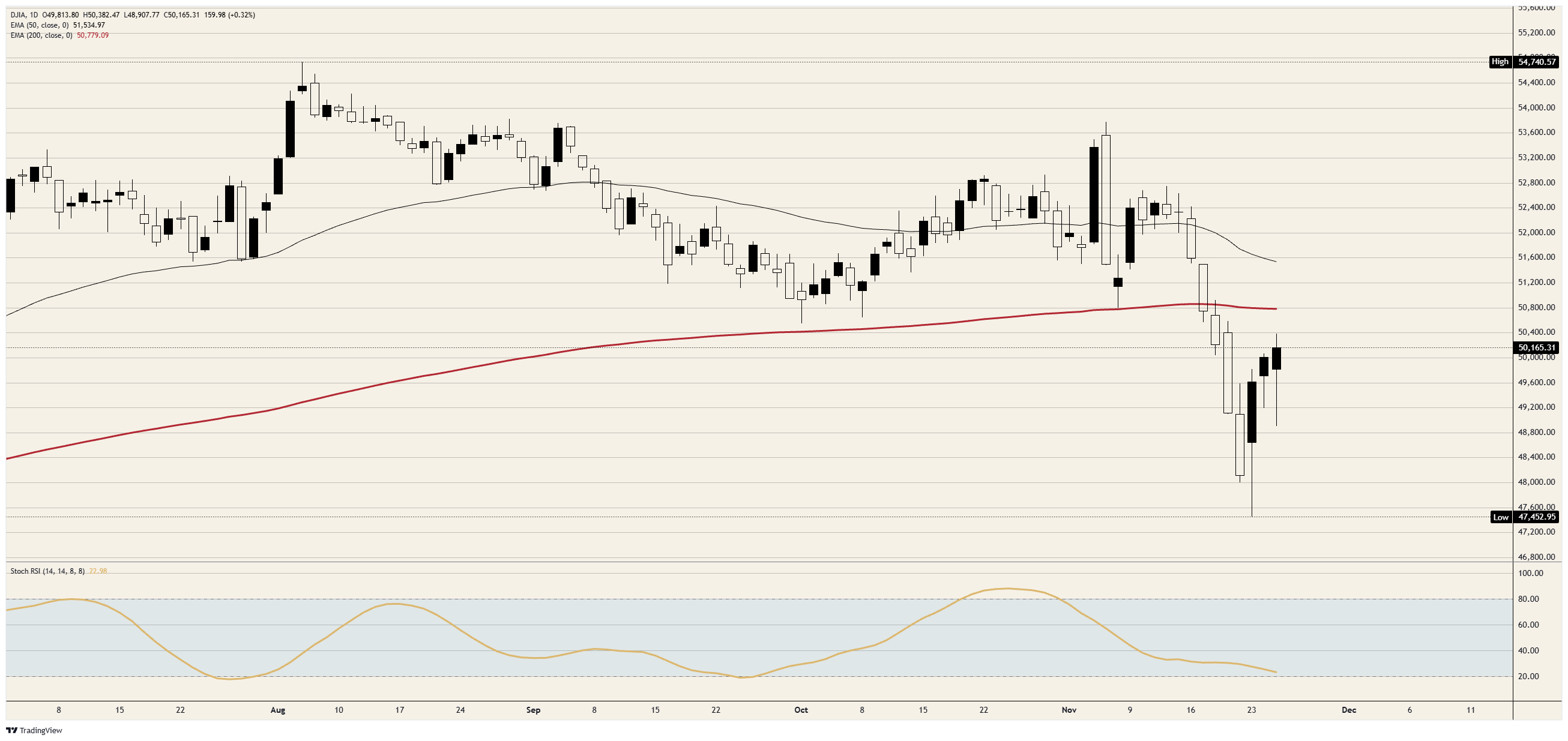
About two-fifths of the decline from the November 5 peak near 53,800 has been recouped over three advancing sessions since Monday's low near 47,500. Just below 50,800, the 200-day Exponential Moving Average (EMA) remains above the index following its November 17 break beneath that average. The 50-day EMA stands near 51,500. Despite the three-session advance, daily momentum continues to weaken and is close to oversold territory.
Dow Jones: daily price chart
Dow Jones: key questions answered
Comprising the 30 most actively traded US stocks, the Dow Jones Industrial Average ranks among the world's oldest stock market indices. Weightings reflect share prices, not market capitalisation. To calculate the index, the constituent share prices are added together and divided by a factor, currently 0.152. Its founder, Charles Dow, also established the Wall Street Journal. Critics in later years have questioned how broadly it represents the market: it follows only 30 conglomerates, in contrast to wider indices such as the S&P 500.
Quarterly earnings reports provide the principal driver of the Dow Jones Industrial Average (DJIA) by revealing the combined performance of its constituent companies. Other influences include US and international macroeconomic releases, which shape investor sentiment. Interest rates set by the Federal Reserve (Fed) affect borrowing costs and therefore the DJIA, since many companies depend heavily on credit. Inflation can consequently be a major influence, alongside other indicators that inform Fed decisions.
Developed by Charles Dow, Dow Theory seeks to identify the stock market's primary trend. It compares movements in the Dow Jones Industrial Average (DJIA) with those in the Dow Jones Transportation Average (DJTA), following a trend only when both indices move in the same direction. Trading volume supplies confirmation, while peak-and-trough analysis also forms part of the approach. The theory sets out three phases: accumulation, as smart money begins buying or selling; public participation, as the broader public enters; and distribution, as smart money leaves.
Investors have several routes to trading the DJIA. ETFs offer exposure through a single security, removing the need to purchase shares in each of the 30 constituent companies. The SPDR Dow Jones Industrial Average ETF (DIA) is a leading example. Traders can use DJIA futures contracts to speculate on the index's future value. Options, by contrast, confer the right, without an obligation, to buy or sell the index at a preset price at a future date. Buying a share in a mutual fund's diversified portfolio of DJIA stocks also gives investors exposure to the index as a whole.
POPULAR ARTICLES
1Pound holds steady ahead of BoE stability report following rate hearing219-month low: Euro regains ground ahead of ECB meeting accounts3Dow Jones Industrial Average recovers losses as AI stocks retreat4FX Today: Strong US data fails to halt US Dollar decline; focus turns to ECB minutes53.3% core PCE reading: Gold slides despite lower US yields6Chinese Yuan takes a larger role in global portfolios – DBS7Hawkish Fed outlook and weak risk appetite fail to prevent Australian Dollar rebound8LatAm FX: Regional currencies weaken as carry trades unwind – ING9$58K briefly gives way as Bitcoin slips on hot PCE inflation and rising Fed rate hike bets


Get Started!
Sign up and access the Global Markets in less than 3 minutes

Connect With Us









Contacts
Phone: +61 2 8036 8388
Fax: +61 2 8036 8388
Email: support@tmgm.com



The information provided on this website is of a general nature only and does not constitute personal financial advice. Before acting on any information on this website, you should consider the suitability of the information in relation to your objectives, financial situation and needs. Investing in CFDs and FX Margin Contracts carries significant risks and is not suitable for all investors. You may lose more than your initial deposit. You do not own, or have, any interest in the underlying asset. We recommend that you seek independent advice and ensure you fully understand the risks involved before trading. It is important that you read and consider the disclosure document before you acquire any product listed on the website. The information and advertisements offered on this website are not intended for use by any person in any country or jurisdiction where such use would be contrary to local laws and regulations. The Products and Services offered on this website are not intended for residents of the United States, Malaysia and Thailand.
TMGM is authorized and regulated in various jurisdictions.
Trademax Australia Limited, trading as TMGM, is regulated by the Australian Securities and Investments Commission (ASIC), AFSL no. 436416 and is located at Level 28, One International Tower, 100 Barangaroo Avenue, 2000 Sydney, NSW Australia.
Email: support@tmgm.com.au
Trademax Global Limited, trading as TMGM, is authorized and regulated by the Vanuatu Financial Services Commission (VFSC), registration number 40356 and registered at 1276, Kumul Highway, Port Vila, Vanuatu, Republic of Vanuatu.
Email: support@tmgm.com
Trademax Global Markets (SE) Limited, trading as TMGM, is authorized and regulated by the Financial Services Authority (FSA) of Seychelles, with license number SD224. The company is registered at Office No 13, Providence Estate ABIS Centre, Mahe, Seychelles.
Email: support@tmgm.com
Trademax Global Markets (International) Pty Ltd, trading as TMGM, is authorized and regulated by the Financial Services Commission, Mauritius (FSC) with license no. GB22201012, and registered at 33, Edith Cavell Street C/o IQ EQ Fund Services (Mauritius) Ltd Port Louis, 11324 Mauritius.
Email: support@tmgm.com
Copyright © TMGM. All rights reserved