

Trading
Erkunden Sie eine breite Palette von Märkten mit wettbewerbsfähigen Preisen, tiefer Liquidität und fortschrittlichen Trading-Tools.
Mehr erfahren 
Plattform
Handeln Sie nahtlos mit TMGMs leistungsstarker Plattform, die für Geschwindigkeit, Präzision und ein überlegenes Trading-Erlebnis entwickelt wurde.
Mehr erfahren Trading-Plattform
Akademie
Lernen Sie die Grundlagen des Tradings mit anfängerfreundlichen Ressourcen, einschließlich Leitfäden, Webinaren und Markteinblicken.
Mehr erfahren Nachrichten & Analyse
Erhalten Sie Echtzeit-Markt-Updates und Expertenanalysen, um Trading-Gelegenheiten voraus zu sein
Mehr erfahren Nachrichten & Analyse
Über uns
Erfahren Sie, was TMGM auszeichnet — unsere globale Präsenz, regulatorische Stärke und unser Engagement für Innovation im Trading.
Mehr erfahren Warum TMGM wählen
EUR/GBP Price Forecast: Downtrend remains firm despite deeply oversold RSI
- EUR/GBP struggles near its lowest level since June 2025 as French fiscal risks weigh on sentiment.
- The pair remains below its 50-, 100- and 200-day SMAs, reinforcing the bearish outlook.
- Sellers target the 0.8400 psychological mark, although oversold conditions could limit further losses.
EUR/GBP reverses earlier gains on Tuesday as fiscal and political concerns in France limit the Euro’s (EUR) upside, while the technical picture also suggests sellers remain dominant. At the time of writing, the cross trades around 0.8445, near its lowest level since June 2025, after reaching an intraday high of 0.8457.

Euro Price Today
The table below shows the percentage change of Euro (EUR) against listed major currencies today. Euro was the strongest against the US Dollar.
| USD | EUR | GBP | JPY | CAD | AUD | NZD | CHF | |
|---|---|---|---|---|---|---|---|---|
| USD | -0.28% | -0.29% | -0.32% | -0.30% | -0.27% | -0.46% | -0.32% | |
| EUR | 0.28% | -0.02% | -0.05% | -0.01% | -0.01% | -0.18% | -0.03% | |
| GBP | 0.29% | 0.02% | -0.04% | -0.03% | 0.01% | -0.18% | -0.01% | |
| JPY | 0.32% | 0.05% | 0.04% | 0.02% | 0.04% | -0.16% | 0.01% | |
| CAD | 0.30% | 0.00% | 0.03% | -0.02% | 0.03% | -0.17% | -0.01% | |
| AUD | 0.27% | 0.00% | -0.01% | -0.04% | -0.03% | -0.20% | -0.04% | |
| NZD | 0.46% | 0.18% | 0.18% | 0.16% | 0.17% | 0.20% | 0.17% | |
| CHF | 0.32% | 0.03% | 0.01% | -0.01% | 0.00% | 0.04% | -0.17% |
The heat map shows percentage changes of major currencies against each other. The base currency is picked from the left column, while the quote currency is picked from the top row. For example, if you pick the Euro from the left column and move along the horizontal line to the US Dollar, the percentage change displayed in the box will represent EUR (base)/USD (quote).
Pound support builds as EUR/GBP seen anchored in tight range despite UK budget risk
Analysts at ING have turned more constructive on the Pound, noting that they have "lowered our EUR/GBP forecast and now expect the pair to trade in a 0.84-0.85 range for at least several more months." They argue that "idiosyncratic risks surrounding the euro are unlikely to fade anytime soon," while the BoE "has sent a clear enough signal that it is prepared to hike," creating a supportive backdrop for GBP.
At the same time, ING flags the forthcoming "UK budget on 28 October" as "a potential risk for sterling, as markets are pricing in little fiscal concern." Even so, the bank points out that "Chancellor John Healey and Prime Minister Andy Burnham have appeared mindful of market sensitivities," and stresses that "while the budget will be closely scrutinised, we do not currently expect it to trigger significant bond volatility or leave a lasting negative mark on GBP."
Traders look ahead to the UK’s August Gross Domestic Product (GDP) report on Thursday, followed by the final Eurozone inflation reading for September on Friday. These releases, alongside comments from European Central Bank (ECB) and Bank of England (BoE) officials throughout the week, could trigger some price swings over the coming days.
Technical analysis
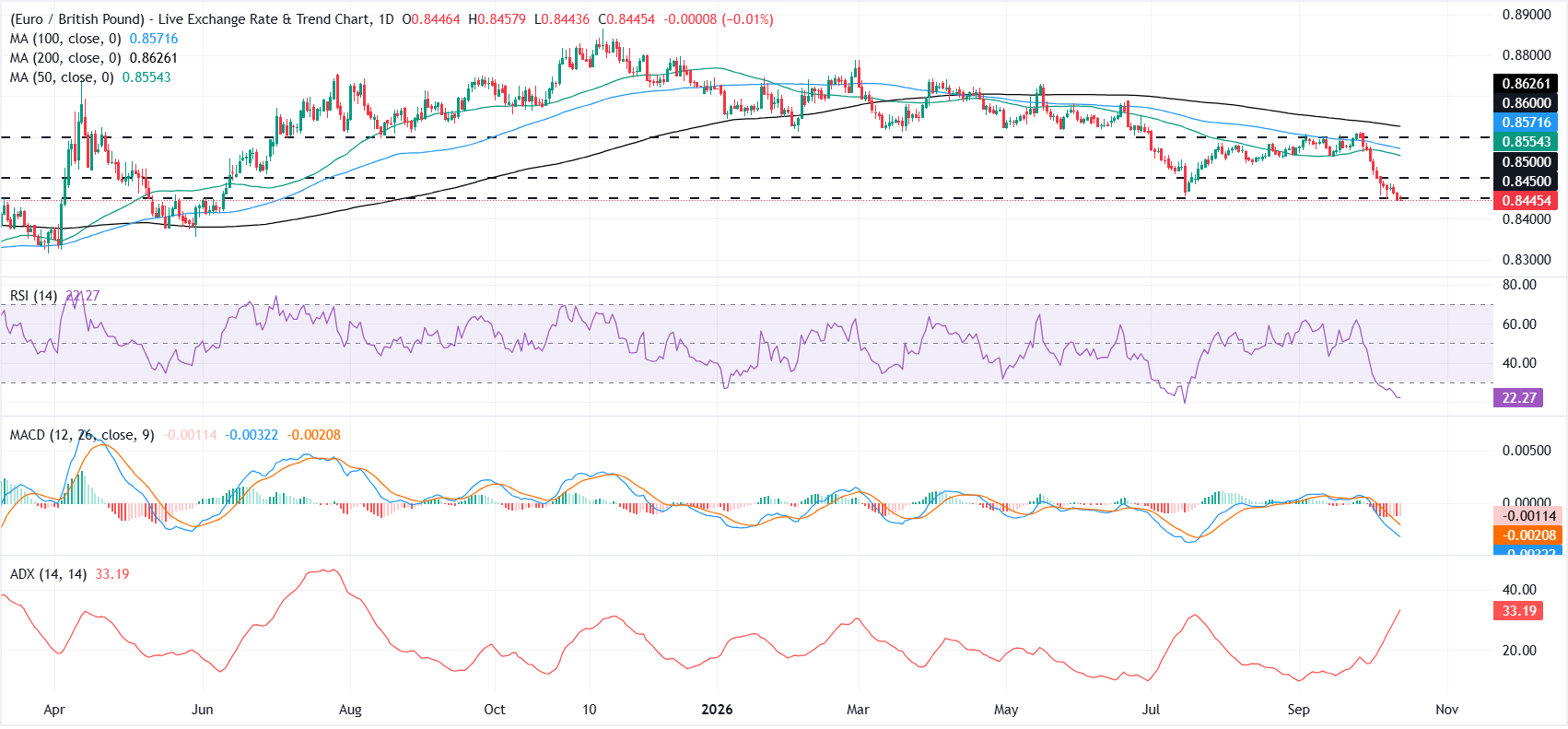
EUR/GBP has reversed sharply after testing 0.8600 in late September, slipping below the 50-day and 100-day Simple Moving Averages (SMAs). The 200-day SMA sits further overhead, reinforcing the bearish structure.
Momentum remains weak, with the Relative Strength Index (RSI) near 22 signalling deeply oversold conditions, while the Moving Average Convergence Divergence (MACD) remains in negative territory. The Average Directional Index (ADX) around 33 points to a strong prevailing downtrend, although oversold conditions leave room for a short-term recovery.
On the topside, initial resistance appears just above the market at the 0.8450 horizontal level, followed by a stronger barrier at 0.8500. Beyond these, the 50-day SMA at 0.8554 and the 100-day SMA at 0.8572 form a dense technical zone ahead of the 0.8600 horizontal line, with the 200-day SMA at 0.8626 marking a more strategic hurdle. On the downside, a further decline could bring the 0.8400 psychological mark into focus as the next support level.
(The technical analysis of this story was written with the help of an AI tool. Know more.)
Euro FAQs
The Euro is the currency for the 20 European Union countries that belong to the Eurozone. It is the second most heavily traded currency in the world behind the US Dollar. In 2022, it accounted for 31% of all foreign exchange transactions, with an average daily turnover of over $2.2 trillion a day. EUR/USD is the most heavily traded currency pair in the world, accounting for an estimated 30% off all transactions, followed by EUR/JPY (4%), EUR/GBP (3%) and EUR/AUD (2%).
The European Central Bank (ECB) in Frankfurt, Germany, is the reserve bank for the Eurozone. The ECB sets interest rates and manages monetary policy. The ECB’s primary mandate is to maintain price stability, which means either controlling inflation or stimulating growth. Its primary tool is the raising or lowering of interest rates. Relatively high interest rates – or the expectation of higher rates – will usually benefit the Euro and vice versa. The ECB Governing Council makes monetary policy decisions at meetings held eight times a year. Decisions are made by heads of the Eurozone national banks and six permanent members, including the President of the ECB, Christine Lagarde.
Eurozone inflation data, measured by the Harmonized Index of Consumer Prices (HICP), is an important econometric for the Euro. If inflation rises more than expected, especially if above the ECB’s 2% target, it obliges the ECB to raise interest rates to bring it back under control. Relatively high interest rates compared to its counterparts will usually benefit the Euro, as it makes the region more attractive as a place for global investors to park their money.
Data releases gauge the health of the economy and can impact on the Euro. Indicators such as GDP, Manufacturing and Services PMIs, employment, and consumer sentiment surveys can all influence the direction of the single currency. A strong economy is good for the Euro. Not only does it attract more foreign investment but it may encourage the ECB to put up interest rates, which will directly strengthen the Euro. Otherwise, if economic data is weak, the Euro is likely to fall. Economic data for the four largest economies in the euro area (Germany, France, Italy and Spain) are especially significant, as they account for 75% of the Eurozone’s economy.
Another significant data release for the Euro is the Trade Balance. This indicator measures the difference between what a country earns from its exports and what it spends on imports over a given period. If a country produces highly sought after exports then its currency will gain in value purely from the extra demand created from foreign buyers seeking to purchase these goods. Therefore, a positive net Trade Balance strengthens a currency and vice versa for a negative balance.
BELIEBTE ARTIKEL
1Australian Dollar edges higher as softer US Dollar, hawkish RBA offer support2Indian Rupee: RBI defense limits losses against US Dollar – Societe Generale3US Dollar: Supported but capped by CPI risks – OCBC4Euro: Lower year-end target at 1.13 against US Dollar – ING5Australian Dollar: RBA inflation focus shapes outlook – Commerzbank6Japanese Yen: Weakness may deepen toward 159.05 against US Dollar – UOB7US ADP Employment Change 4-week average drops to 24.75K8Copper: El Niño risks cap African supply growth – Societe Generale9EUR/GBP Price Forecast: Downtrend remains firm despite deeply oversold RSI
LIVE-KURSE

ALLES ÜBER TECHNICAL
Was ist ICT-Trading? Die Konzepte des Inner Circle Trader erklärt
Unterstützung und Widerstand: Bedeutung, Arten, wie man Niveaus einzeichnet & Handelsstrategien
Was ist Liquidität? Bedeutung im Trading und an den Finanzmärkten
Liquiditäts-Sweep: Bedeutung, Beispiele & Handelsstrategie
Marktstruktur im Trading: Der vollständige Leitfaden (bullisch, bärisch, seitwärts)
Charakterwechsel (CHoCH): Definition, Beispiele & Strategie
Was ist das bullische Kicker-Muster und wie handelt man es?
Was ist ein umgekehrtes Hammer-Candlestick-Muster und wie handelt man es?
Was ist ein bullishes Abandoned-Baby-Muster und wie handelt man es?
Jetzt loslegen!
Registrieren Sie sich und erhalten Sie in weniger als 3 Minuten Zugang zu den globalen Märkten

Verbinden Sie sich mit uns









Kontakte
Telefon: +61 2 8036 8388
Fax: +61 2 8036 8388
E-Mail: support@tmgm.com



Die auf dieser Website bereitgestellten Informationen sind ausschließlich allgemeiner Natur und stellen keine persönliche Finanzberatung dar. Bevor Sie auf Grundlage von Informationen auf dieser Website handeln, sollten Sie die Eignung dieser Informationen im Hinblick auf Ihre Ziele, Ihre finanzielle Situation und Ihre Bedürfnisse prüfen. Investitionen in CFDs und FX-Margin-Kontrakte sind mit erheblichen Risiken verbunden und nicht für alle Anleger geeignet. Sie können mehr als Ihre ursprüngliche Einzahlung verlieren. Sie besitzen weder das zugrunde liegende Vermögenswert noch haben Sie ein Interesse daran. Wir empfehlen Ihnen, unabhängigen Rat einzuholen und sicherzustellen, dass Sie die damit verbundenen Risiken vor dem Handel vollständig verstehen. Es ist wichtig, dass Sie das Offenlegungsdokument lesen und berücksichtigen, bevor Sie ein auf der Website aufgeführtes Produkt erwerben. Die auf dieser Website angebotenen Informationen und Werbeanzeigen sind nicht für die Nutzung durch Personen in Ländern oder Rechtsordnungen bestimmt, in denen eine solche Nutzung gegen lokale Gesetze und Vorschriften verstoßen würde. Die auf dieser Website angebotenen Produkte und Dienstleistungen sind nicht für Einwohner der Vereinigten Staaten, Malaysias und Thailands bestimmt.
TMGM ist in verschiedenen Gerichtsbarkeiten autorisiert und reguliert.
Trademax Australia Limited, handelnd als TMGM, wird von der Australian Securities and Investments Commission (ASIC) reguliert, AFSL Nr. 436416 und befindet sich in Level 28, One International Tower, 100 Barangaroo Avenue, 2000 Sydney, NSW Australien.
E-Mail: support@tmgm.com.au
Trademax Global Limited, handelnd als TMGM, ist von der Vanuatu Financial Services Commission (VFSC) autorisiert und reguliert, Registrierungsnummer 40356 und registriert unter 1276, Kumul Highway, Port Vila, Vanuatu, Republik Vanuatu.
E-Mail: support@tmgm.com
Die Trademax Global Markets (SE) Limited, tätig unter dem Namen TMGM, ist durch die Financial Services Authority (FSA) der Seychellen autorisiert und reguliert, Lizenznummer SD224. Das Unternehmen ist registriert im Büro Nr. 13, Providence Estate ABIS Centre, Mahé, Seychellen.
E-Mail: support@tmgm.com
Trademax Global Markets (International) Pty Ltd, handelnd als TMGM, ist von der Financial Services Commission, Mauritius (FSC) autorisiert und reguliert mit der Lizenznummer GB22201012 und registriert unter 33, Edith Cavell Street C/o IQ EQ Fund Services (Mauritius) Ltd Port Louis, 11324 Mauritius.
E-Mail: support@tmgm.com
Copyright © TMGM. Alle Rechte vorbehalten