
News & AnalysisCareer

Minutes from the Reserve Bank of Australia’s (RBA) October policy meeting have been followed by underperformance in the Australian Dollar (AUD), weighing on AUD/USD. During Tuesday’s European trading session, the pair is hovering around 0.6730 against the US Dollar (USD), close to a fresh 10-month low.

Today’s percentage moves in the Australian Dollar (AUD) against the major currencies listed are set out below. Its weakest performance was against the Swiss Franc.
| USD | EUR | GBP | JPY | CAD | AUD | NZD | CHF | |
|---|---|---|---|---|---|---|---|---|
| USD | -0.12% | -0.11% | -0.18% | 0.00% | 0.02% | 0.00% | -0.17% | |
| EUR | 0.12% | 0.00% | -0.05% | 0.13% | 0.13% | 0.15% | -0.05% | |
| GBP | 0.11% | 0.00% | -0.04% | 0.12% | 0.13% | 0.15% | -0.05% | |
| JPY | 0.18% | 0.05% | 0.04% | 0.17% | 0.18% | 0.19% | -0.01% | |
| CAD | -0.01% | -0.13% | -0.12% | -0.17% | 0.00% | 0.02% | -0.17% | |
| AUD | -0.02% | -0.13% | -0.13% | -0.18% | -0.01% | 0.02% | -0.18% | |
| NZD | -0.01% | -0.15% | -0.15% | -0.19% | -0.02% | -0.02% | -0.19% | |
| CHF | 0.17% | 0.05% | 0.05% | 0.00% | 0.17% | 0.18% | 0.19% |
Percentage movements between the major currencies are displayed in the heat map. Select the base currency in the left-hand column and the quote currency in the top row. Selecting the Australian Dollar on the left and following its row across to the US Dollar, for instance, gives the percentage change for AUD (base)/USD (quote) in the corresponding cell.
Financial conditions are regarded by members as “restrictive”, according to the RBA minutes, which also include the warning “warns of sharper economic slowdown”. Nevertheless, members continue to “see risks to latest inflation forecast as skewed to upside”.
Ahead of the minutes’ publication, market experts were confident that the Australian central bank had reached the end of its monetary tightening cycle.
Mixed messages in the latest RBA decision have been highlighted by analysts at OCBC Group Research. To support the rate rise, they note, the statement emphasised that “inflation remains elevated and recent data indicate that it is broadly based”. Yet it also recognised that “the increases in the cash rate target since the beginning of the year have tightened financial conditions. The economy is slowing, housing prices have fallen significantly and the unemployment rate has risen”. In the analysts’ view, dropping the previous guidance “including increasing the cash rate target further if needed” marks a further softening of the RBA’s stance. OCBC therefore concludes: “We expect no more hike in this cycle, and the next policy move is likely to be a cut.”
With October Retail Sales figures for the United States (US) due at 13:30 GMT, the US Dollar has meanwhile eased from its intraday peak. Having failed to build on gains above 103.70, the US Dollar Index (DXY) stands near 103.48 at the time of writing, down 0.1%. The index measures the Greenback against six major currencies.
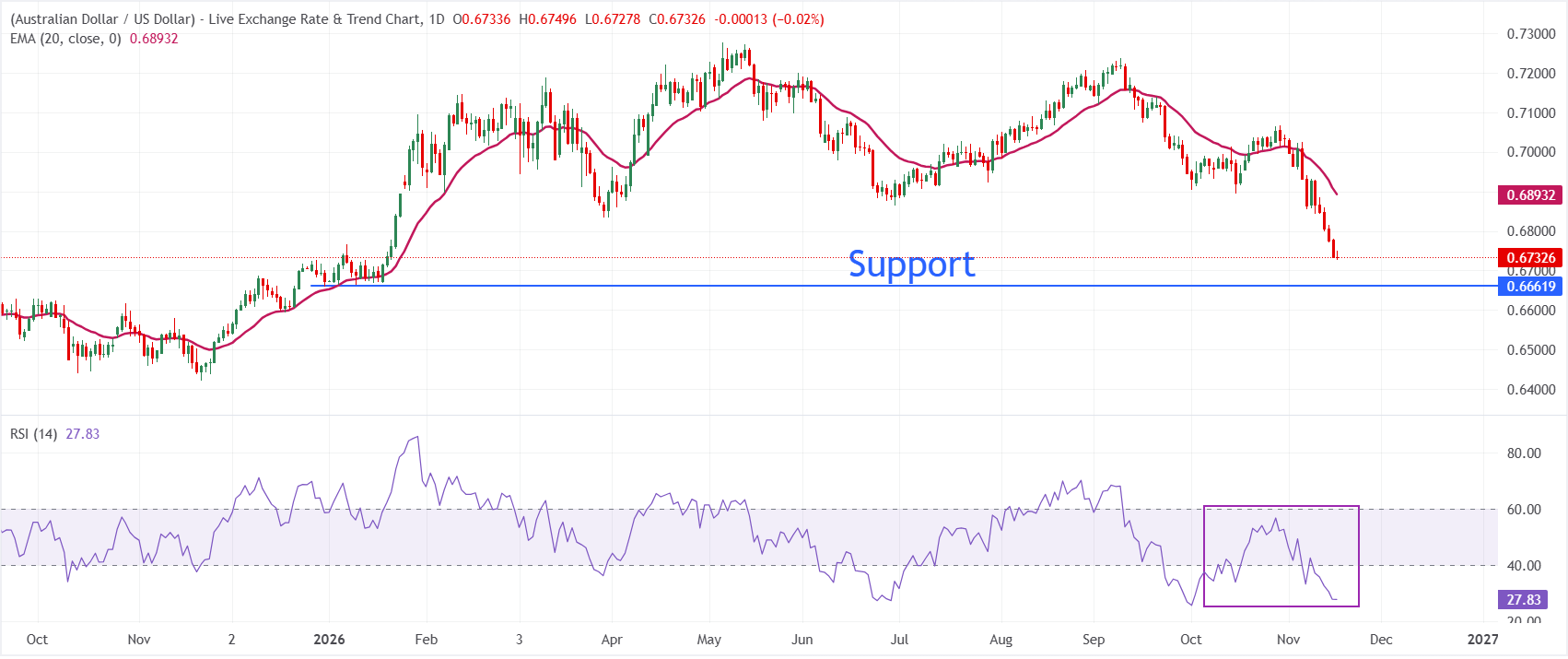
A further decline beneath the 20-day exponential moving average (EMA) at 0.6893 leaves AUD/USD trading at 0.6733 on the daily chart, with the short-term outlook still bearish. This EMA continues to provide a firm ceiling for the pair. Although a Relative Strength Index (RSI) reading of 27.85 places it in oversold territory and suggests that downward momentum is stretched, sellers remain in control below the principal trend indicator.
To relieve selling pressure and pave the way for a more durable recovery, the pair would need a daily close above immediate resistance at the 20-day EMA, around 0.6893. Further tests of the downside remain a risk until that barrier is overcome. Traders are likely to sell into rallies for as long as AUD/USD stays beneath the EMA resistance area.
(The technical analysis of this story was written with the help of an AI tool. Know more.)
Two weeks after each interest rate decision, the Reserve Bank of Australia publishes its meeting minutes. These provide a comprehensive account of the policy debate, covering differing opinions and recording how individual Committee members voted. Markets generally interpret a hawkish RBA assessment of the economy’s inflation outlook as signalling a greater likelihood of an interest rate rise, which is supportive of the AUD.
Find out more.Latest release: Tue 17 Nov 2026 00:30
Release frequency: Weekly
Actual figure: -
Consensus estimate: -
Previous figure: -
Data source: Reserve Bank of Australia
Two weeks after announcing its interest rate decision, the Reserve Bank of Australia (RBA) releases the minutes of its monetary policy meeting. With a significant impact on the AUD, this detailed account sets out board members’ discussions of monetary policy and the economic conditions behind their decision on changes to interest rates and/or bond purchases. The minutes also shed light on their assessment of international economic developments and the value of the exchange rate.







Phone: +61 2 8036 8388
Fax: +61 2 8036 8388
Email: support@tmgm.com



The information provided on this website is of a general nature only and does not constitute personal financial advice. Before acting on any information on this website, you should consider the suitability of the information in relation to your objectives, financial situation and needs. Investing in CFDs and FX Margin Contracts carries significant risks and is not suitable for all investors. You may lose more than your initial deposit. You do not own, or have, any interest in the underlying asset. We recommend that you seek independent advice and ensure you fully understand the risks involved before trading. It is important that you read and consider the disclosure document before you acquire any product listed on the website. The information and advertisements offered on this website are not intended for use by any person in any country or jurisdiction where such use would be contrary to local laws and regulations. The Products and Services offered on this website are not intended for residents of the United States, Malaysia and Thailand.
TMGM is authorized and regulated in various jurisdictions.
Trademax Australia Limited, trading as TMGM, is regulated by the Australian Securities and Investments Commission (ASIC), AFSL no. 436416 and is located at Level 28, One International Tower, 100 Barangaroo Avenue, 2000 Sydney, NSW Australia.
Email: support@tmgm.com.au
Trademax Global Limited, trading as TMGM, is authorized and regulated by the Vanuatu Financial Services Commission (VFSC), registration number 40356 and registered at 1276, Kumul Highway, Port Vila, Vanuatu, Republic of Vanuatu.
Email: support@tmgm.com
Trademax Global Markets (SE) Limited, trading as TMGM, is authorized and regulated by the Financial Services Authority (FSA) of Seychelles, with license number SD224. The company is registered at Office No 13, Providence Estate ABIS Centre, Mahe, Seychelles.
Email: support@tmgm.com
Trademax Global Markets (International) Pty Ltd, trading as TMGM, is authorized and regulated by the Financial Services Commission, Mauritius (FSC) with license no. GB22201012, and registered at 33, Edith Cavell Street C/o IQ EQ Fund Services (Mauritius) Ltd Port Louis, 11324 Mauritius.
Email: support@tmgm.com
Copyright © TMGM. All rights reserved


