
News & AnalysisCareer

A fresh year-to-date (YTD) low near 0.6646 on Friday was followed by a brief recovery in the Australian Dollar (AUD) against the US Dollar (USD). During European trading, the pair is up 0.18% at around 0.6670.
Against the major currencies listed below, the Australian Dollar (AUD) recorded its weakest performance this week versus the Japanese Yen. The table sets out its percentage changes against each currency.
| USD | EUR | GBP | JPY | CAD | AUD | NZD | CHF | |
|---|---|---|---|---|---|---|---|---|
| USD | 0.57% | 0.87% | -0.48% | 0.47% | 1.71% | 0.60% | 0.45% | |
| EUR | -0.57% | 0.28% | -1.06% | -0.15% | 1.12% | -0.01% | -0.17% | |
| GBP | -0.87% | -0.28% | -1.31% | -0.42% | 0.84% | -0.29% | -0.44% | |
| JPY | 0.48% | 1.06% | 1.31% | 0.83% | 2.17% | 0.99% | 0.94% | |
| CAD | -0.47% | 0.15% | 0.42% | -0.83% | 1.36% | 0.16% | -0.02% | |
| AUD | -1.71% | -1.12% | -0.84% | -2.17% | -1.36% | -1.11% | -1.27% | |
| NZD | -0.60% | 0.00% | 0.29% | -0.99% | -0.16% | 1.11% | -0.16% | |
| CHF | -0.45% | 0.17% | 0.44% | -0.94% | 0.02% | 1.27% | 0.16% |
Percentage movements between the major currencies are displayed in the heat map. Select the base currency in the left-hand column and the quote currency in the top row. Selecting the Australian Dollar on the left and following its row across to the US Dollar, for instance, gives the percentage change in AUD (base)/USD (quote) in the corresponding cell.

A marked retreat in expectations of a hawkish Reserve Bank of Australia (RBA) has left the Australian Dollar underperforming this week, putting AUD/USD on course for a third consecutive lower weekly close. Five interest rate increases of a quarter of a percentage point each have been delivered by the RBA so far this year, taking the Official Cash Rate (OCR) to 4.85%.
The latest employment figures are central to the shift, with Commerzbank analysts observing that “yesterday’s Australian labour market data disappointed significantly.” They contrast the “expected increase of 25,000 jobs, employment fell sharply by 43,500,” and describe the October release as “follow[ing] an already weak September.” They also note that “the unemployment rate rose to 4.9%, its highest level since late 2021,” concluding that “the Australian labour market therefore continues to cool, likely reflecting in particular the impact of higher interest rates and the associated weakness in demand.”
For Commerzbank, the implication is that “this suggests that the RBA’s rate-hiking cycle likely came to an end with its latest meeting, which is also what markets are pricing in,” a view consistent with its own position: “we, too, had recently expected no further rate hikes.” The bank nevertheless cautions that “markets are now pricing in around 1.5 rate cuts by the end of 2027, which we still consider premature based on the latest labour market data alone.” It acknowledges that “clearly, the risks of a more pronounced economic slowdown have increased,” but adds that “the incoming data will first have to confirm that this trend is continuing.”
Upcoming economic releases will be the main source of event risk, in Commerzbank’s assessment: “The next labour market data will therefore be key to determining whether markets’ rate-cut bets are justified, while inflation data will remain in focus as well. The October figures are due next week.” The bank outlines the downside scenario for the currency as follows: “if inflation comes in as expected or even slightly lower, this would likely lend further support to rate-cut expectations. The Aussie could then lose some more ground, although quite a bit is already priced in given current rate-cut expectations.” It contrasts this with the alternative: “if inflation instead surprises to the upside, the AUD could benefit as markets would likely scale back some of their rate-cut expectations.”
Adding to the pressure on AUD/USD, hawkish expectations for the Federal Reserve (Fed) have supported the US Dollar. At the time of writing, the US Dollar Index (DXY) is retaining its recent gains near 104.00. The index measures the Greenback against a basket of six major currencies.
In a research note, ING strategists described markets as now “quite settled on pricing 25bp hikes in December, January and next summer.”
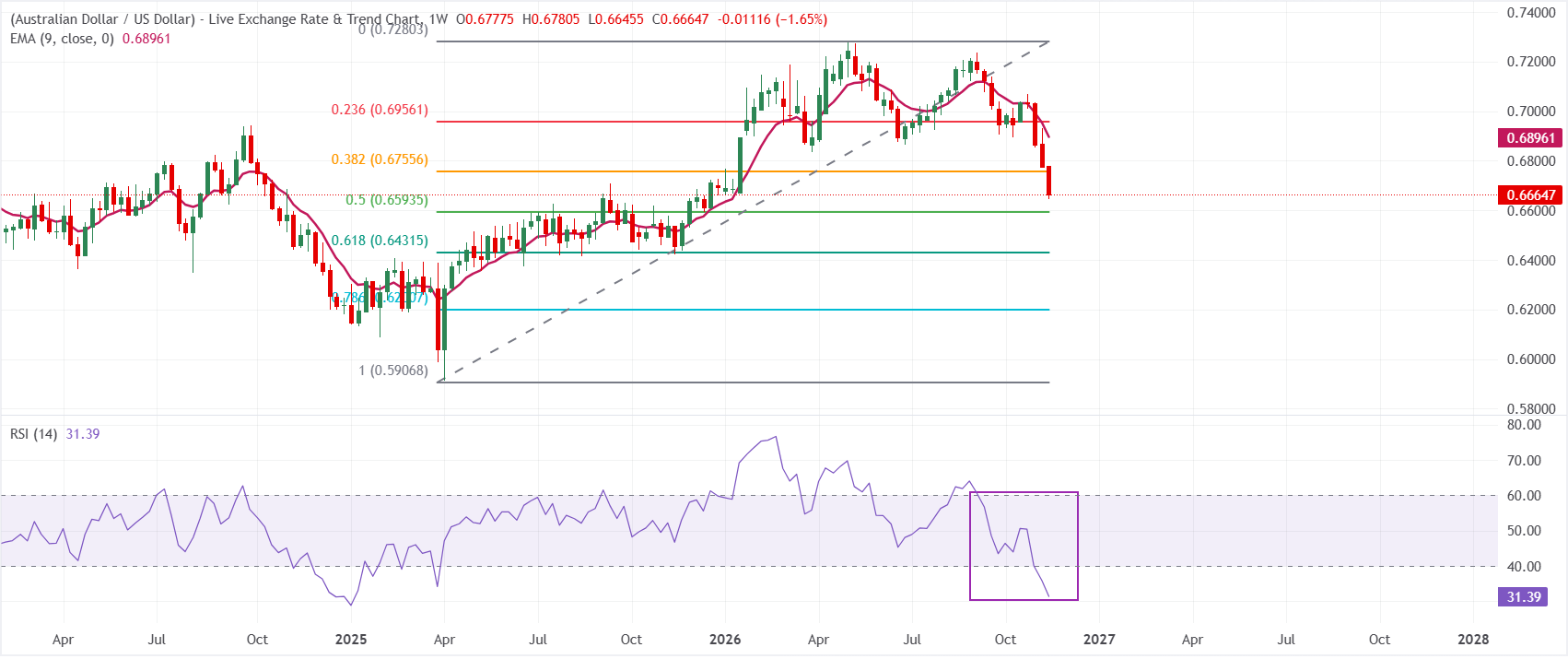
Trading at 0.6665 on the weekly chart, AUD/USD retains a bearish near-term outlook below both the 23.6% Fibonacci retracement at 0.6956 and the 38.2% retracement at 0.6756. Earlier gains proved unsustainable, leaving the pair retreating from those overhead Fibonacci levels. At 0.6896, the nine-week exponential moving average (EMA) stands well above the current price, further illustrating that the pair remains below its short-term trend indicator. The weekly Relative Strength Index (RSI) has eased towards the low-30s and is nearing oversold territory. Although sellers retain control, this suggests downward momentum could begin to fade if continued selling fails to produce fresh lows.
The first support on a further decline lies around 0.6594 at the 50% retracement, followed by a lower Fibonacci floor at 0.6431. Should selling pressure intensify, the 78.6% retracement near 0.6201 would become a more distant downside objective. A recovery would initially need to clear the 38.2% retracement at 0.6756 to reduce immediate downside risks. Moving above that level would bring the more significant 23.6% retracement at 0.6956 into view, where the falling cluster of EMAs overhead would be expected to provide further resistance.
(The technical analysis of this story was written with the help of an AI tool. Know more.)
Published by the Australian Bureau of Statistics, Employment Change tracks movements in the number of people employed in Australia, with seasonal influences removed from the figures. An increase is generally positive for consumer spending and supportive of economic growth, making it bullish for the Australian Dollar (AUD). Conversely, a low reading is regarded as bearish for the currency.
Find out more.Latest release: Thu 19 Nov 2026 00:30
Release frequency: Monthly
Reported figure: -43.5K
Consensus estimate: 25K
Prior reading: -39.3K
Data source: Australian Bureau of Statistics







Phone: +61 2 8036 8388
Fax: +61 2 8036 8388
Email: support@tmgm.com



The information provided on this website is of a general nature only and does not constitute personal financial advice. Before acting on any information on this website, you should consider the suitability of the information in relation to your objectives, financial situation and needs. Investing in CFDs and FX Margin Contracts carries significant risks and is not suitable for all investors. You may lose more than your initial deposit. You do not own, or have, any interest in the underlying asset. We recommend that you seek independent advice and ensure you fully understand the risks involved before trading. It is important that you read and consider the disclosure document before you acquire any product listed on the website. The information and advertisements offered on this website are not intended for use by any person in any country or jurisdiction where such use would be contrary to local laws and regulations. The Products and Services offered on this website are not intended for residents of the United States, Malaysia and Thailand.
TMGM is authorized and regulated in various jurisdictions.
Trademax Australia Limited, trading as TMGM, is regulated by the Australian Securities and Investments Commission (ASIC), AFSL no. 436416 and is located at Level 28, One International Tower, 100 Barangaroo Avenue, 2000 Sydney, NSW Australia.
Email: support@tmgm.com.au
Trademax Global Limited, trading as TMGM, is authorized and regulated by the Vanuatu Financial Services Commission (VFSC), registration number 40356 and registered at 1276, Kumul Highway, Port Vila, Vanuatu, Republic of Vanuatu.
Email: support@tmgm.com
Trademax Global Markets (SE) Limited, trading as TMGM, is authorized and regulated by the Financial Services Authority (FSA) of Seychelles, with license number SD224. The company is registered at Office No 13, Providence Estate ABIS Centre, Mahe, Seychelles.
Email: support@tmgm.com
Trademax Global Markets (International) Pty Ltd, trading as TMGM, is authorized and regulated by the Financial Services Commission, Mauritius (FSC) with license no. GB22201012, and registered at 33, Edith Cavell Street C/o IQ EQ Fund Services (Mauritius) Ltd Port Louis, 11324 Mauritius.
Email: support@tmgm.com
Copyright © TMGM. All rights reserved

