
News & AnalysisCareer

Weakening demand and mounting realised losses, alongside worsening market sentiment, have reinforced the bearish outlook for Bitcoin (BTC), signalling further pressure on the leading cryptocurrency.

Falling spot demand has driven the fastest contraction in Bitcoin demand growth since 1 July, on-chain analytics firm CryptoQuant said in a report published on Wednesday.
On a 30-day basis, total Bitcoin demand growth has slipped below -400,000 BTC, the report showed. After spot demand turned negative in early September, demand for perpetual futures followed in early November, as traders sold and liquidated leveraged long positions.
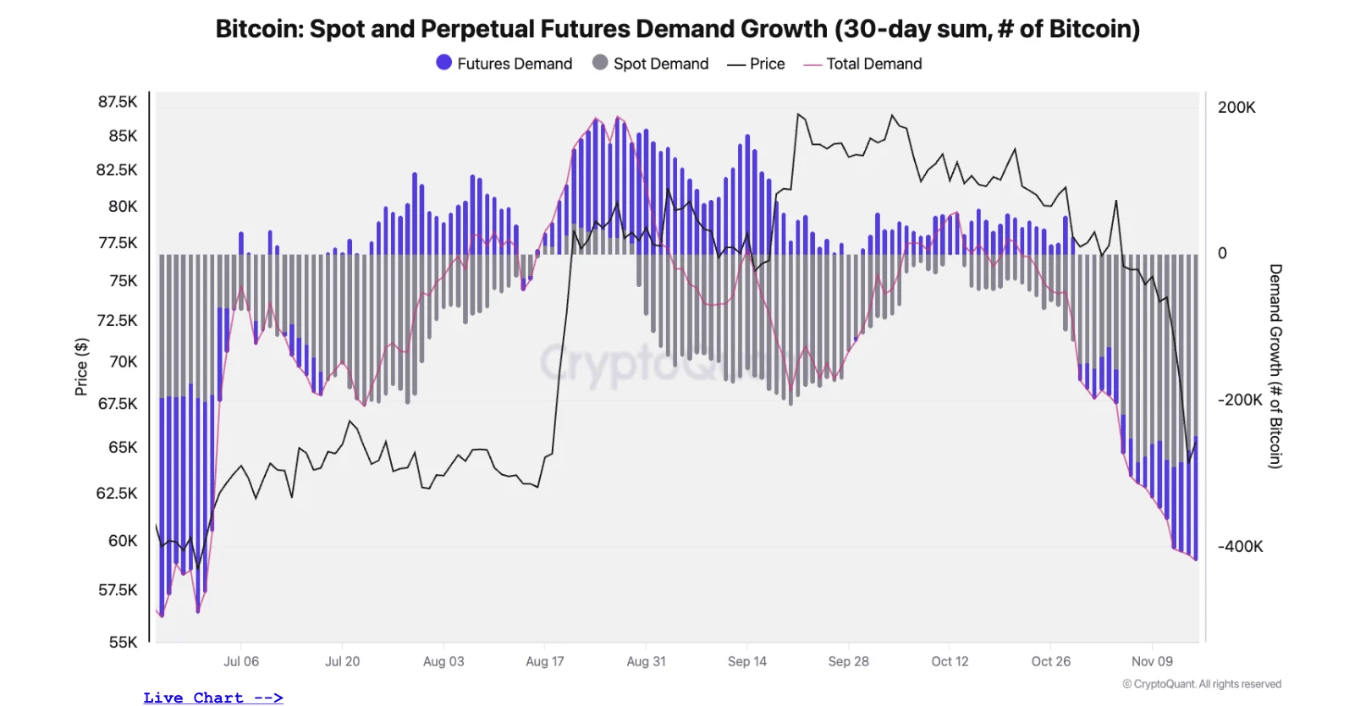
For a sustainable recovery to take hold, CryptoQuant said demand growth would need to stop contracting, with renewed spot purchases taking the lead rather than greater speculation in derivatives markets.
The report identified an initial signal to watch: “The first constructive sign would be the 30-day total moving back toward zero, led by spot buying rather than by new leverage in the perpetual futures markets,”
As the market has fallen, investors have also been driven to sell their Bitcoin for less than they paid.
During the latest sell-off, holders realised net losses of 25,800 BTC, the largest daily figure since 13 July, according to CryptoQuant. This marks a reversal from late August through October: holders consistently booked profits during that period as Bitcoin prices advanced towards $80,000.
CryptoQuant put the losses in context: “Loss realization on this scale was last seen in June and July, when Bitcoin was trading in the low $60Ks,”
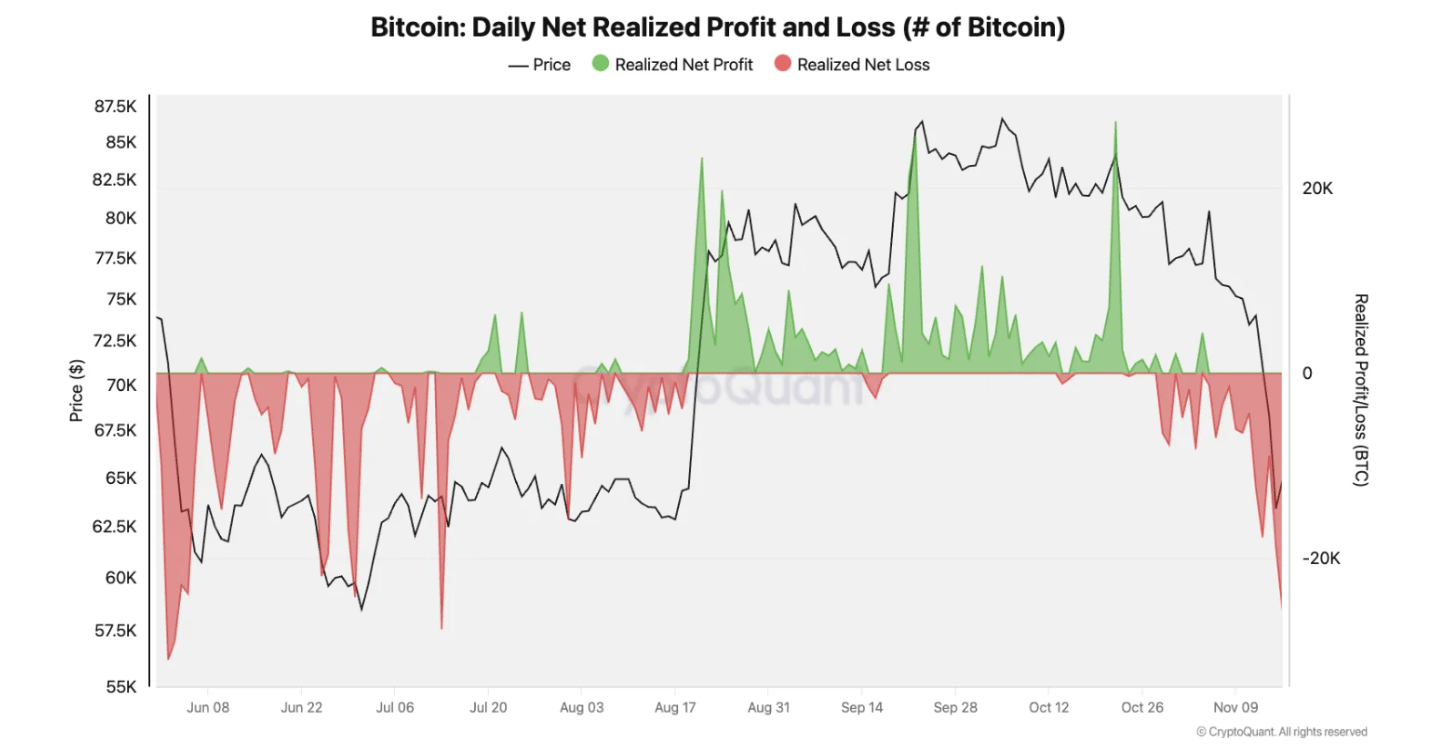
Investors who bought Bitcoin during the rally are now selling below their cost basis, the latest figure suggests, according to the report. Such a pattern is associated with bearish market conditions.
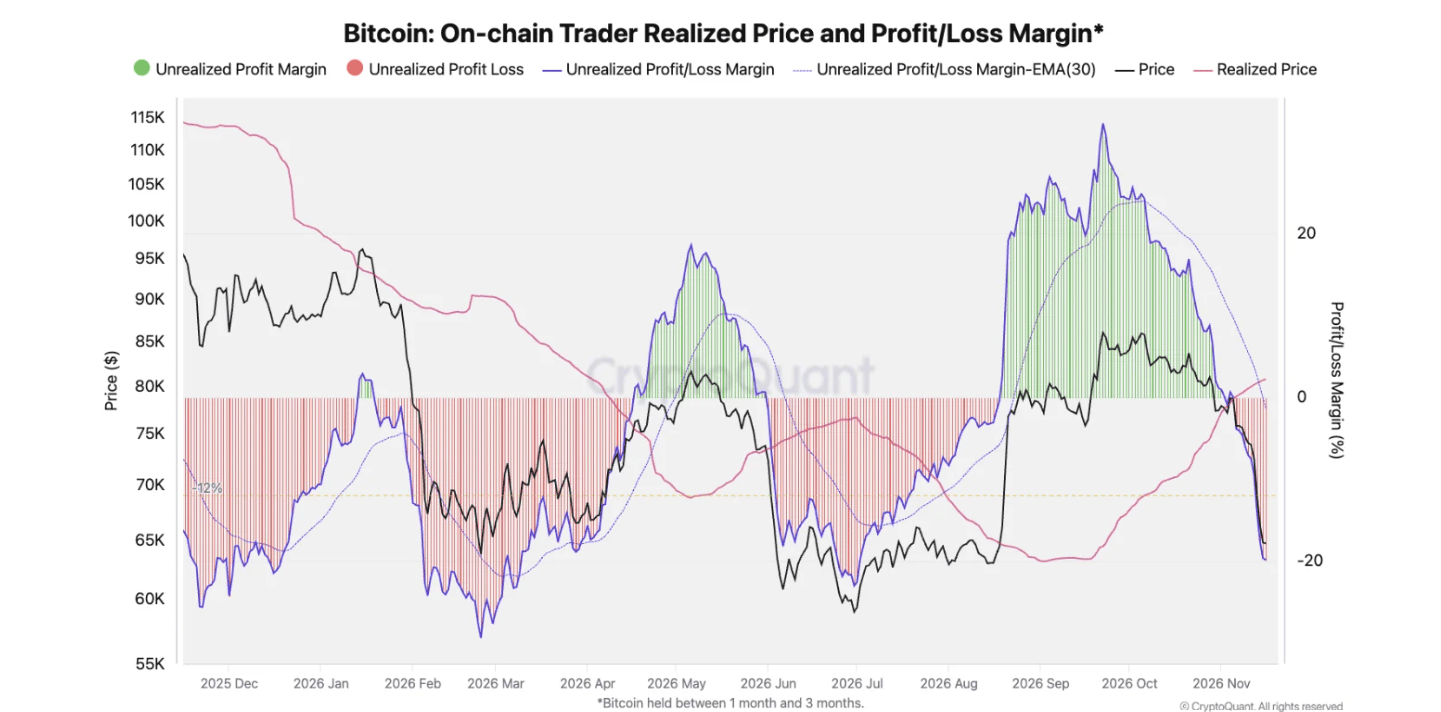
Traders' unrealised profit and loss margin has fallen to -20%, its weakest reading since 1 July, providing another sign of deteriorating market conditions. According to CryptoQuant, this shows that active traders are sitting on substantial unrealised losses, returning Bitcoin to what the firm calls a value zone.
The report traced the margin's decline: “It peaked at 33% in late September, when the price was trading well above traders' cost basis, crossed below zero in early November and has now dropped to -20%,”
Comparable unrealised losses have historically coincided with “price bottoming formations.” The report nevertheless warned that a sustainable recovery typically takes at least two months to begin after such formations.
The report also draws attention to a marked concentration of long-term holder spending in the $62,000 to $65,000 range. New investors acquired Bitcoin from long-term holders within this band, potentially creating a support zone near their purchase prices.
Should Bitcoin remain below $62,000 following a breakdown, recent buyers could be pushed into unrealised losses, weakening this potential support, the report warned.
Analyst sentiment has also weakened, CryptoQuant noted: the proportion remaining bullish on Bitcoin has fallen to just 58%, compared with 77% on 7 October.
A fall in the Bull Score Index to 10 provides another bearish signal, putting Bitcoin firmly in the extreme bear phase. On 10 November, the index briefly reached zero while Bitcoin was still changing hands at around $74,000.
According to CryptoQuant, the reading “indicates there are no conditions for a sustainable price recovery and rally.”
At the time of writing, Bitcoin is changing hands at $62,380, having lost nearly 2% over the past 24 hours.







Phone: +61 2 8036 8388
Fax: +61 2 8036 8388
Email: support@tmgm.com



The information provided on this website is of a general nature only and does not constitute personal financial advice. Before acting on any information on this website, you should consider the suitability of the information in relation to your objectives, financial situation and needs. Investing in CFDs and FX Margin Contracts carries significant risks and is not suitable for all investors. You may lose more than your initial deposit. You do not own, or have, any interest in the underlying asset. We recommend that you seek independent advice and ensure you fully understand the risks involved before trading. It is important that you read and consider the disclosure document before you acquire any product listed on the website. The information and advertisements offered on this website are not intended for use by any person in any country or jurisdiction where such use would be contrary to local laws and regulations. The Products and Services offered on this website are not intended for residents of the United States, Malaysia and Thailand.
TMGM is authorized and regulated in various jurisdictions.
Trademax Australia Limited, trading as TMGM, is regulated by the Australian Securities and Investments Commission (ASIC), AFSL no. 436416 and is located at Level 28, One International Tower, 100 Barangaroo Avenue, 2000 Sydney, NSW Australia.
Email: support@tmgm.com.au
Trademax Global Limited, trading as TMGM, is authorized and regulated by the Vanuatu Financial Services Commission (VFSC), registration number 40356 and registered at 1276, Kumul Highway, Port Vila, Vanuatu, Republic of Vanuatu.
Email: support@tmgm.com
Trademax Global Markets (SE) Limited, trading as TMGM, is authorized and regulated by the Financial Services Authority (FSA) of Seychelles, with license number SD224. The company is registered at Office No 13, Providence Estate ABIS Centre, Mahe, Seychelles.
Email: support@tmgm.com
Trademax Global Markets (International) Pty Ltd, trading as TMGM, is authorized and regulated by the Financial Services Commission, Mauritius (FSC) with license no. GB22201012, and registered at 33, Edith Cavell Street C/o IQ EQ Fund Services (Mauritius) Ltd Port Louis, 11324 Mauritius.
Email: support@tmgm.com
Copyright © TMGM. All rights reserved

