
News & AnalysisCareer

Trading below $58,700 on Wednesday, Bitcoin (BTC) is deepening its correction, with the yearly trough of $55,130 once again in focus. Persistent withdrawals from BTC spot exchange-traded funds (ETFs), together with wider market uncertainty weighing on sentiment, reinforce the bearish outlook. Attention is turning to US Personal Consumption Expenditures (PCE) figures for further indications of the Federal Reserve’s (Fed) policy outlook, potentially setting the stage for renewed volatility in the Crypto King.

Net withdrawals of $231.56 million from BTC spot ETFs on Tuesday extended the run of outflows to six consecutive days, according to SoSoValue. The figures point to weaker institutional appetite for Bitcoin so far this week.
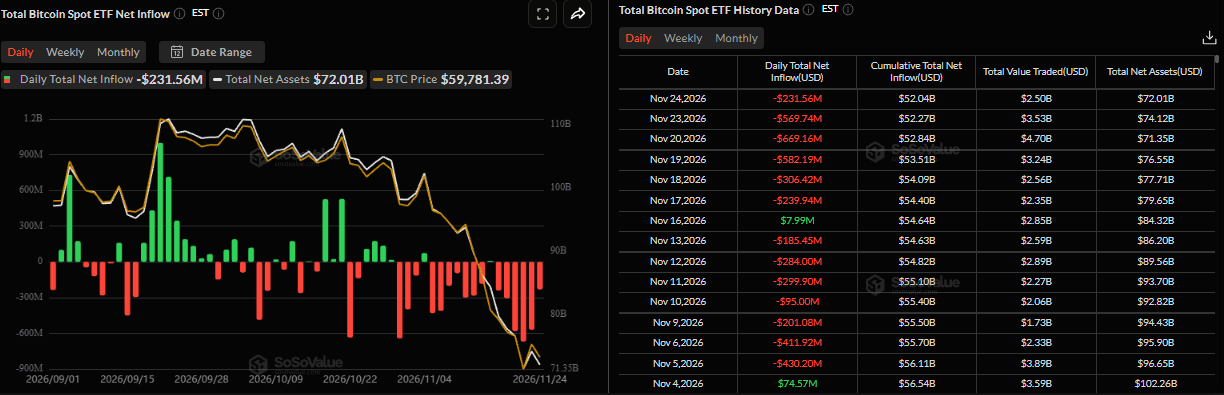
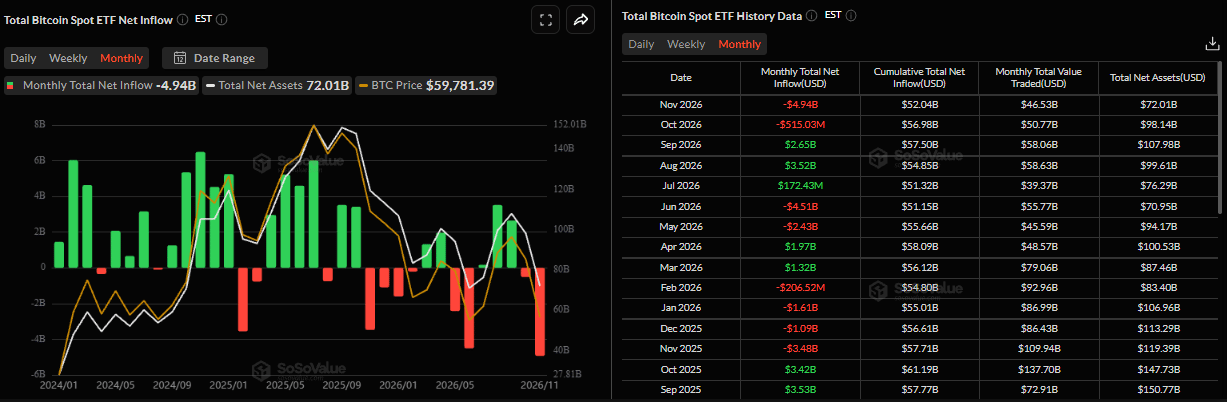
November’s net outflows from BTC spot ETFs have now reached $4.94 billion, exceeding every other monthly withdrawal total since the funds launched in January 2024. Should withdrawals continue or gather pace over the course of the week, the resulting selling pressure could put Bitcoin under further strain and raise the risk of another test of its yearly low of $55,130.
Later in the North American session, the US Personal Consumption Expenditures (PCE) Price Index will be released alongside the second estimate of US Q3 Gross Domestic Product (GDP). As the Fed’s preferred measure of inflation, the PCE index could help reshape expectations for monetary policy, with implications for demand for the US Dollar (USD) and appetite for risk.
Geopolitical tensions, meanwhile, are intensifying and could lend further support to the USD while constraining any BTC recovery. Attacks on shipping near the Strait of Hormuz, coupled with a lack of progress in diplomatic efforts to resolve the US-Iran conflict, have sustained elevated geopolitical risks.
According to Iran’s Islamic Revolutionary Guard Corps (IRGC), it has targeted a non-compliant container ship that was illegally passing through the strategic waterway. Iran-backed Houthis have also threatened attacks on Saudi Arabia’s Red Sea ports in response to a Saudi-led coalition strike on Yemen’s Hodeidah port. These developments maintain the geopolitical risk premium and favour USD bulls.
Against this backdrop, any rebound in BTC appears more likely to attract selling and remain limited. Neither the earlier optimism surrounding Nvidia’s reinstatement of Jensen Huang as CEO nor a wave of short liquidations signalled a lasting improvement in market sentiment, leaving the outlook for BTC cautious.
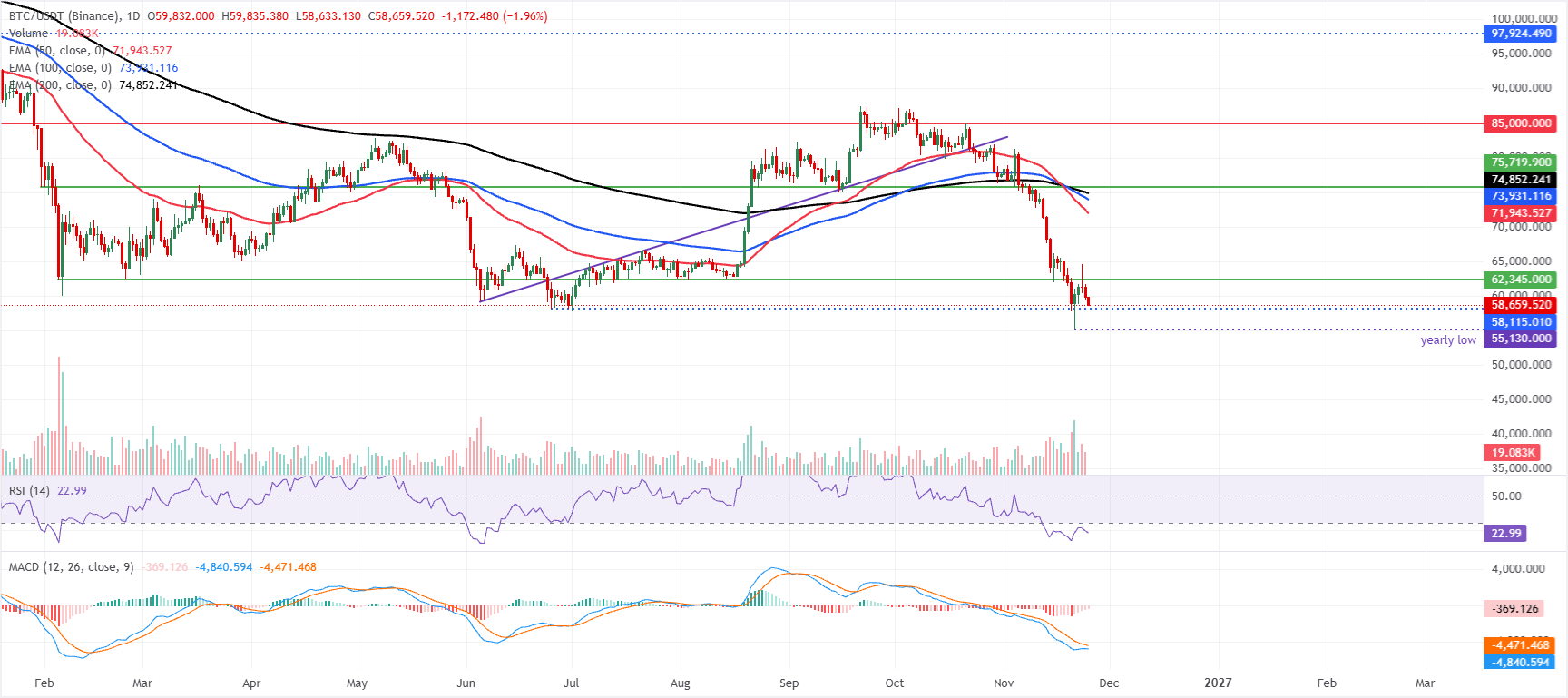
At the time of writing on Wednesday, Bitcoin remains below $58,700, prolonging its bearish phase following an unsuccessful attempt earlier this week to close above the key $62,345 resistance level. The price also sits a considerable distance beneath the 50-day, 100-day and 200-day Exponential Moving Averages (EMAs), which are grouped between approximately $71,943 and $74,852.
At 22 on the daily chart, the Relative Strength Index (RSI) is in oversold territory, while the Moving Average Convergence Divergence (MACD) histogram continues to register negative readings. Taken together, these indicators suggest that downward pressure persists, although the sell-off risks becoming overextended.
The first upside obstacle is the horizontal resistance level at $62,345. Beyond it lie the 50-day EMA near $71,943, the 100-day EMA at $73,931 and the 200-day EMA at $74,852. This tightly packed overhead supply zone would need to be regained for the bearish bias to ease. Further up, the horizontal level around $85,000 presents a more substantial hurdle; a sustained break above it would be needed to indicate a more lasting recovery. In the meantime, Bitcoin remains exposed to further weakness, keeping its yearly low of $55,130 in view.
(The technical analysis of this story was written with the help of an AI tool. Know more.)
Designed to function as money, Bitcoin is a virtual currency and the largest cryptocurrency by market capitalisation. No single person, group or entity can control this payment method, removing the need for a third party to participate in financial transactions.
The term altcoin covers every cryptocurrency other than Bitcoin. Some, however, exclude Ethereum as well, on the basis that these two cryptocurrencies are the source of forks. Under that interpretation, Litecoin is the first altcoin: it was forked from the Bitcoin protocol and is therefore an “improved” version of it.
To maintain a stable price, stablecoins are backed by reserves of the assets they represent. Each stablecoin is pegged to a commodity or financial instrument, such as the US Dollar (USD), while an algorithm or demand regulates its supply. Their primary purpose is to give investors a route into and out of cryptocurrency trading and investment. They also offer a means of storing value, given the volatility generally associated with cryptocurrencies.
Dividing Bitcoin’s market capitalisation by the combined market capitalisation of all cryptocurrencies gives its dominance ratio, a clear indication of investor interest in Bitcoin. BTC dominance tends to be high before and during a bull run, as investors favour relatively stable cryptocurrencies with large market capitalisations, such as Bitcoin. When BTC dominance falls, it generally indicates that investors are shifting capital and/or profits into altcoins in pursuit of greater returns, a move that often sparks a surge in altcoin rallies.







Phone: +61 2 8036 8388
Fax: +61 2 8036 8388
Email: support@tmgm.com



The information provided on this website is of a general nature only and does not constitute personal financial advice. Before acting on any information on this website, you should consider the suitability of the information in relation to your objectives, financial situation and needs. Investing in CFDs and FX Margin Contracts carries significant risks and is not suitable for all investors. You may lose more than your initial deposit. You do not own, or have, any interest in the underlying asset. We recommend that you seek independent advice and ensure you fully understand the risks involved before trading. It is important that you read and consider the disclosure document before you acquire any product listed on the website. The information and advertisements offered on this website are not intended for use by any person in any country or jurisdiction where such use would be contrary to local laws and regulations. The Products and Services offered on this website are not intended for residents of the United States, Malaysia and Thailand.
TMGM is authorized and regulated in various jurisdictions.
Trademax Australia Limited, trading as TMGM, is regulated by the Australian Securities and Investments Commission (ASIC), AFSL no. 436416 and is located at Level 28, One International Tower, 100 Barangaroo Avenue, 2000 Sydney, NSW Australia.
Email: support@tmgm.com.au
Trademax Global Limited, trading as TMGM, is authorized and regulated by the Vanuatu Financial Services Commission (VFSC), registration number 40356 and registered at 1276, Kumul Highway, Port Vila, Vanuatu, Republic of Vanuatu.
Email: support@tmgm.com
Trademax Global Markets (SE) Limited, trading as TMGM, is authorized and regulated by the Financial Services Authority (FSA) of Seychelles, with license number SD224. The company is registered at Office No 13, Providence Estate ABIS Centre, Mahe, Seychelles.
Email: support@tmgm.com
Trademax Global Markets (International) Pty Ltd, trading as TMGM, is authorized and regulated by the Financial Services Commission, Mauritius (FSC) with license no. GB22201012, and registered at 33, Edith Cavell Street C/o IQ EQ Fund Services (Mauritius) Ltd Port Louis, 11324 Mauritius.
Email: support@tmgm.com
Copyright © TMGM. All rights reserved


