
News & AnalysisCareer

Last week’s decline to $62,006 took Bitcoin (BTC) to levels last seen in mid-July, leaving it under pressure below $65,000 on Tuesday. Against that backdrop, investors are looking to this week’s Nvidia (NVDA) earnings and Anthropic Initial Public Offering (IPO) for further clues about AI-sector valuations and broader risk appetite.
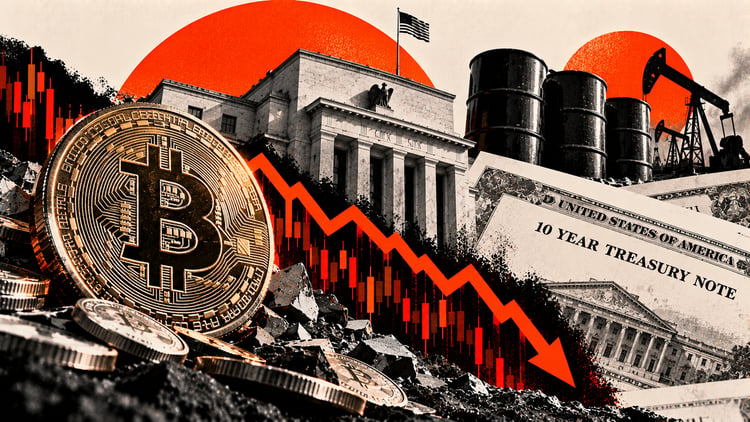
The leading cryptocurrency’s recovery also remains constrained by high US bond yields, a firmer US Dollar (USD) and sustained institutional withdrawals from spot Bitcoin Exchange Traded Funds (ETFs).
Last week’s $62,006 low followed a steep Bitcoin sell-off driven by several headwinds outlined in the previous report. With the leading cryptocurrency struggling below $65,000, traders are looking to Nvidia’s earnings and Anthropic’s IPO this week for further insight into AI-sector valuations and the wider appetite for risk.
Ahead of Nvidia’s latest results, due this Tuesday after the US market close, the company’s continuing leadership crisis is putting pressure on the wider industry.
Attention will then shift to Anthropic’s expected stock market debut on Wednesday, which should offer further clues about investor demand for AI-related businesses.
Investors have increasingly questioned the returns from enterprise token spending and hyperscalers’ capital expenditure (CapEx), Martin Lee, Market Insights Lead at DWF Labs, told FXStreet in an exclusive interview. As a result, he said, the AI trade has lost momentum since July. Although optimism has not disappeared, investors are taking a more cautious view of AI-sector valuations and expenditure.
For Lee, the prospect of capital entering crypto hinges on where investors turn after unwinding AI positions: towards other risk-on assets or towards entirely different asset classes.
As he put it, “how the markets shift when Anthropic IPOs will be a good indicator” of the direction of investor appetite.
Turning to Bitcoin, Lee said: “BTC’s immediate break below its 200-week moving average showed clear weakness. Moves this aggressive usually take time to digest, which fits the pattern from past midterm cycles: the first three to six months after a midterm have historically been weak for BTC. We expect volatility to stay high and price action to stay choppy until the market absorbs this move.”
Liquidity conditions and changes in investor appetite could transmit the effects of Nvidia’s earnings and Anthropic’s expected IPO to Bitcoin, warned Simon-Peter Massabni, Head of Business Development at XS.com.
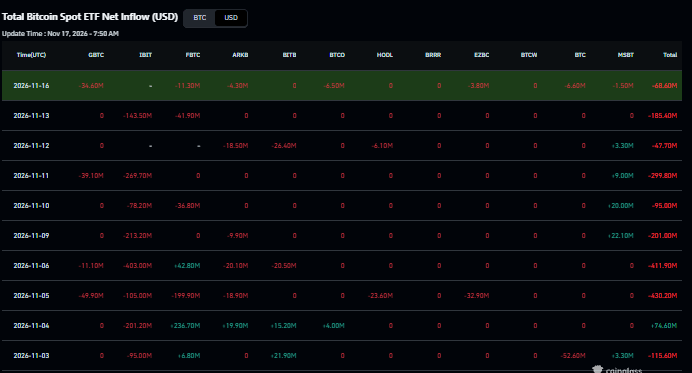
According to Massabni, large public offerings can temporarily draw liquidity out of financial markets. That could expose Bitcoin to more pronounced price swings should selling pressure strengthen. He also noted that withdrawals from spot Bitcoin Exchange Traded Funds (ETFs) could accelerate further, following two consecutive weeks in which outflows exceeded $2 billion each.
Massabni set out two possible outcomes for Nvidia’s earnings. Results that match the market’s high expectations could keep capital concentrated in technology shares, rather than redirecting it towards alternatives such as Bitcoin and Gold. If the figures disappoint, however, a wider equity sell-off could prompt investors to sell holdings in other assets to meet margin calls and cover losses.
There is another possibility, he added: “if the momentum surrounding artificial intelligence stocks cools down gradually without a deep collapse in the wider market,” investors could eventually direct capital back into Bitcoin to take advantage of lower prices.
Strong US inflation readings and hawkish central bank commentary have prompted traders to bet overwhelmingly on more aggressive Federal Reserve tightening. Those expectations continue to put pressure on risk assets, including BTC.
As the CME Group’s FedWatch Tool chart below indicates, a 25-basis-point (bps) interest rate increase at the December Federal Open Market Committee (FOMC) policy meeting is fully priced in. Traders also attach a small probability to a larger 50-bps rise.
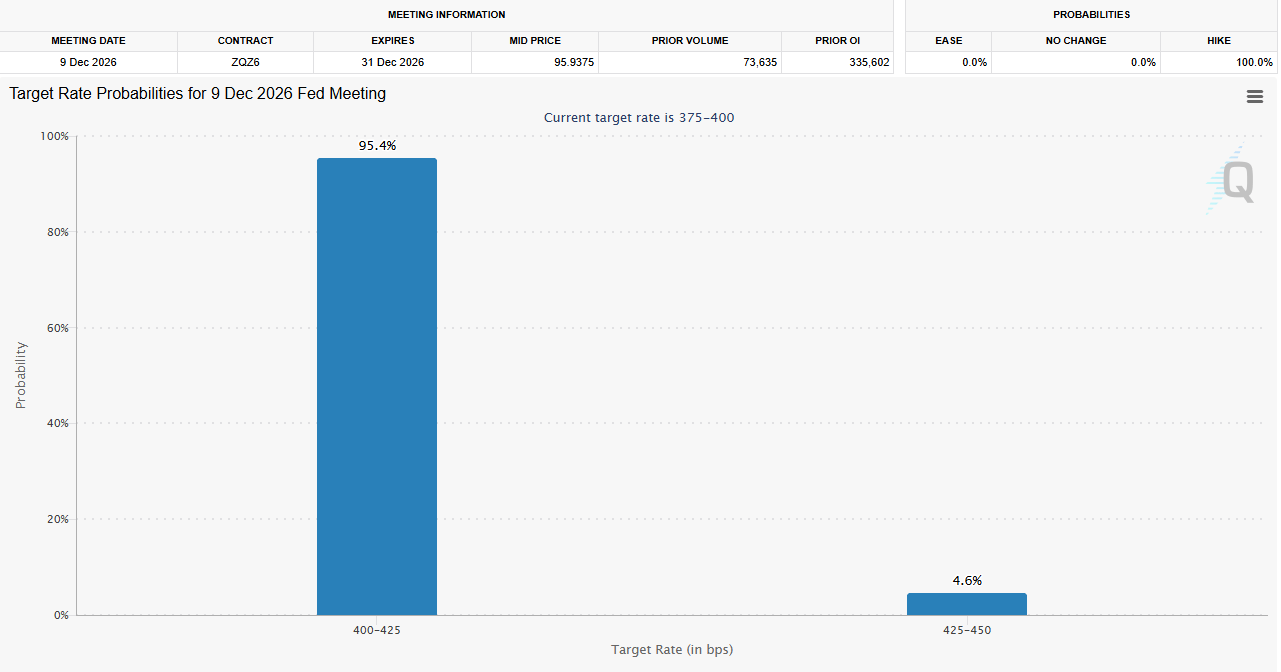
Such expectations continue to underpin high US bond yields. The benchmark 10-year US Treasury note yield remains comfortably above 5%, close to its highest level in one month. Together with continuing geopolitical tensions in the Middle East, this has supported the safe-haven USD, taking the US Dollar Index (DXY) to a fresh high of 103.70, a level last seen in April 2025. The stronger currency leaves less scope for a BTC recovery.
A $68.60 million withdrawal from BTC spot ETFs on Monday marked a weak start to the week for institutional Bitcoin demand, according to CoinGlass data. It followed two consecutive weeks of billion-dollar outflows. Should withdrawals persist and gather pace through the rest of this week, BTC could face additional pressure and a deeper price correction.
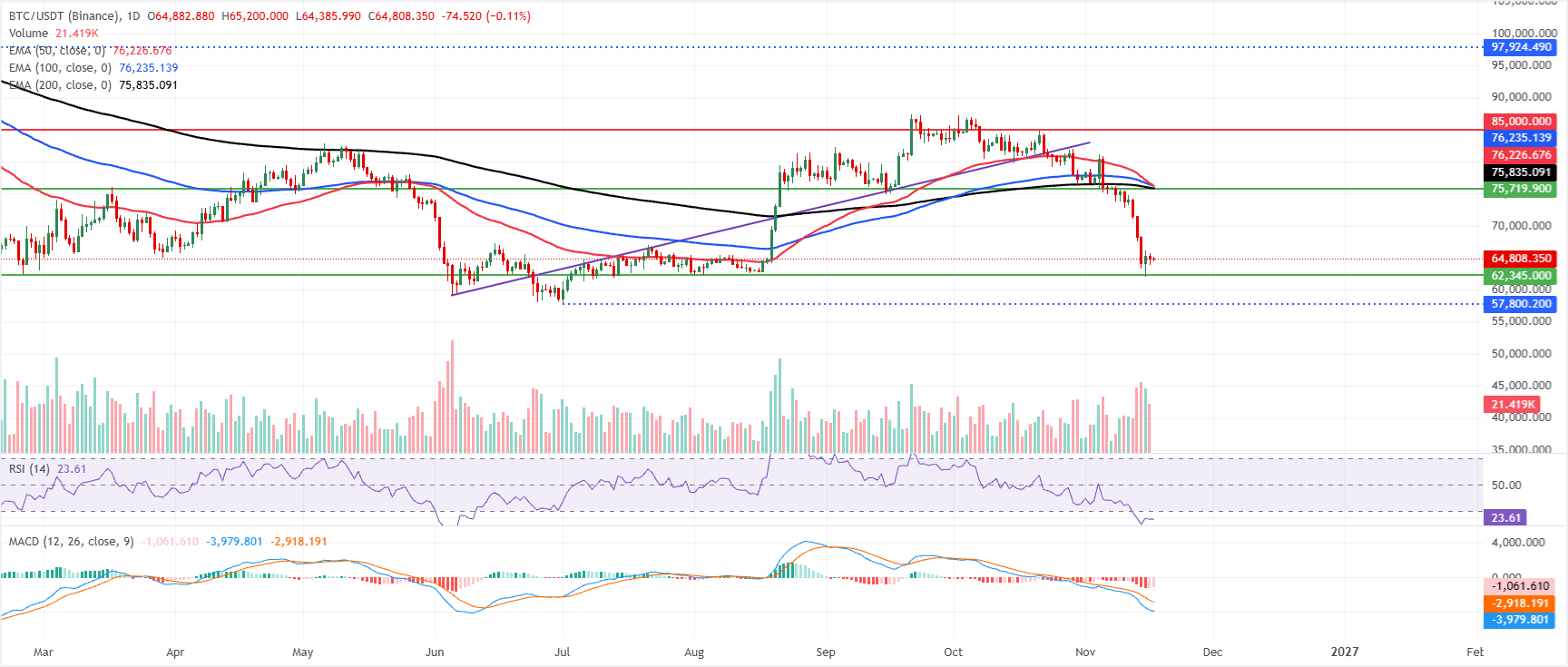
At $64,808 on Tuesday, Bitcoin is extending its decline far below its 50-day, 100-day and 200-day Exponential Moving Averages (EMAs). Together, those averages constrain the upside in a band of roughly $75,835 to $76,235.
With BTC beneath every major trend gauge, the near-term outlook remains firmly bearish. The Relative Strength Index (RSI) is also stuck in oversold territory around 23, while the Moving Average Convergence Divergence (MACD) indicator is deeply negative. These readings point to continued selling pressure, although a corrective bounce remains a risk.
The first upside hurdle is the 200-day EMA near $75,835. Just above it sit the 50-day EMA at $76,226 and the 100-day EMA around $76,235, creating a tight resistance cluster that BTC would need to regain to temper the bearish outlook. Beyond that, the $85,000 horizontal level presents a more substantial obstacle, with previous supply potentially returning should a stronger recovery develop. Until these resistance levels are tested, BTC is likely to remain exposed to further losses or consolidation at subdued levels.
(The technical analysis of this story was written with the help of an AI tool. Know more.)
Ranked by market capitalisation, Bitcoin is the largest cryptocurrency. It is a virtual currency intended to function as money. No single person, group or entity can control this means of payment, removing the need for third parties to participate in financial transactions.
The term altcoin covers cryptocurrencies other than Bitcoin. Some also exclude Ethereum, however, because these two cryptocurrencies are the origins of forks. Under that definition, Litecoin is the first altcoin: it was forked from the Bitcoin protocol and is therefore an “improved” version of it.
Designed to maintain a steady price, stablecoins are cryptocurrencies backed by reserves of the assets they represent. Each stablecoin’s value is therefore pegged to a commodity or financial instrument, such as the US Dollar (USD), while an algorithm or demand regulates its supply. Their principal purpose is to give investors a route into and out of cryptocurrency trading and investment. Given the volatility generally associated with cryptocurrencies, stablecoins also provide a way for investors to store value.
Calculated by dividing Bitcoin’s market capitalisation by the combined market capitalisation of all cryptocurrencies, Bitcoin dominance offers a clear indication of investor interest in Bitcoin. BTC dominance is typically high ahead of and during a bull run, when investors favour relatively stable cryptocurrencies with large market capitalisations, such as Bitcoin. Falling BTC dominance, by contrast, generally signals that investors are transferring capital and/or profits into altcoins in pursuit of greater returns. This shift usually sparks a surge in altcoin rallies.







Phone: +61 2 8036 8388
Fax: +61 2 8036 8388
Email: support@tmgm.com



The information provided on this website is of a general nature only and does not constitute personal financial advice. Before acting on any information on this website, you should consider the suitability of the information in relation to your objectives, financial situation and needs. Investing in CFDs and FX Margin Contracts carries significant risks and is not suitable for all investors. You may lose more than your initial deposit. You do not own, or have, any interest in the underlying asset. We recommend that you seek independent advice and ensure you fully understand the risks involved before trading. It is important that you read and consider the disclosure document before you acquire any product listed on the website. The information and advertisements offered on this website are not intended for use by any person in any country or jurisdiction where such use would be contrary to local laws and regulations. The Products and Services offered on this website are not intended for residents of the United States, Malaysia and Thailand.
TMGM is authorized and regulated in various jurisdictions.
Trademax Australia Limited, trading as TMGM, is regulated by the Australian Securities and Investments Commission (ASIC), AFSL no. 436416 and is located at Level 28, One International Tower, 100 Barangaroo Avenue, 2000 Sydney, NSW Australia.
Email: support@tmgm.com.au
Trademax Global Limited, trading as TMGM, is authorized and regulated by the Vanuatu Financial Services Commission (VFSC), registration number 40356 and registered at 1276, Kumul Highway, Port Vila, Vanuatu, Republic of Vanuatu.
Email: support@tmgm.com
Trademax Global Markets (SE) Limited, trading as TMGM, is authorized and regulated by the Financial Services Authority (FSA) of Seychelles, with license number SD224. The company is registered at Office No 13, Providence Estate ABIS Centre, Mahe, Seychelles.
Email: support@tmgm.com
Trademax Global Markets (International) Pty Ltd, trading as TMGM, is authorized and regulated by the Financial Services Commission, Mauritius (FSC) with license no. GB22201012, and registered at 33, Edith Cavell Street C/o IQ EQ Fund Services (Mauritius) Ltd Port Louis, 11324 Mauritius.
Email: support@tmgm.com
Copyright © TMGM. All rights reserved


