
News & AnalysisCareer

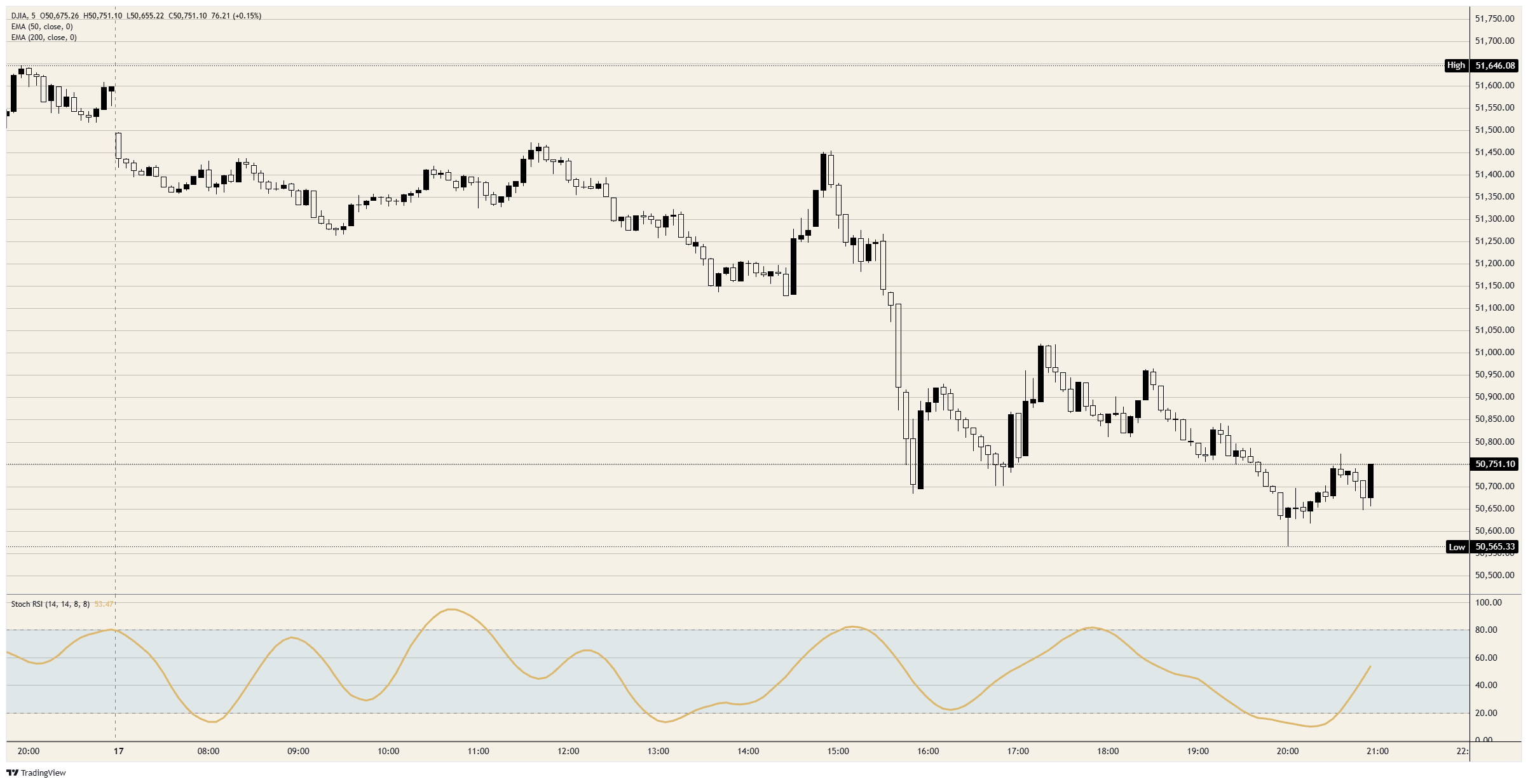
A drop of more than 1,000 points took the Dow Jones Industrial Average (DJIA) to just below 50,600 before it finished Tuesday near 50,750. The sharp decline, its second in as many sessions, followed a report of a National Security Agency (NSA) network outage. Elsewhere, the S&P 500 recorded its weakest close since late July, while the Nasdaq Composite hit its lowest level since April.

Losses in Home Depot (HD) and Salesforce (CRM) had already weighed on the index. Home Depot was down about 2.5% after appointing a new chief executive, while Salesforce had shed more than 8%. A subsequent CNN report said a classified NSA network had gone down, with no indication of a cyberattack. Across five five-minute bars, the index slid from about 51,250 to near 50,700. Although the NSA later attributed the network degradation to scheduled maintenance, the index subsequently extended its decline to the session low.
Ahead of results from index constituent Nvidia (NVDA), chip shares came under selling pressure. This was Nvidia's first earnings report since Jensen Huang stepped down as chief executive following reports of affairs with a company executive and a woman whom US officials allege is a Chinese spy. Both revenue of $115.8 billion and the current-quarter forecast of $130.0 billion exceeded estimates. After the release, the shares climbed above $160, with Nasdaq futures also advancing.
Housing starts are due on Wednesday at 13:30 GMT, with a forecast of 1.27 million compared with the previous 1.221 million. The Fed's October minutes follow at 19:00 GMT. Thursday brings initial jobless claims at 13:30 GMT, forecast at 196K against 200K. All three releases are relevant to the Fed's 8-9 December decision, for which a rate rise is already priced in.
Following the NSA statement, the index set a second low below its initial trough. By contrast, the S&P 500 and Nasdaq remained above the lows reached after CNN's report. In between its two troughs, the index rebounded to just above 51,000, retracing a little more than half of the report-driven fall. The final five-minute bar closed above the first low, but none of the session's bars reached Monday's late high of just under 51,700.
Comprising the 30 most actively traded US stocks, the Dow Jones Industrial Average ranks among the world's oldest stock market indices. Prices, rather than market capitalisation, determine its weighting: the constituent share prices are added together and divided by a factor currently set at 0.152. Its founder, Charles Dow, also established the Wall Street Journal. More recently, critics have argued that tracking just 30 conglomerates makes it insufficiently representative compared with broader indices such as the S&P 500.
For the Dow Jones Industrial Average (DJIA), the principal driver is the combined performance of its constituent companies, as shown in their quarterly earnings reports. Other influences include US and international macroeconomic releases, which shape investor sentiment. Interest rates set by the Federal Reserve (Fed) also matter because they determine borrowing costs for the many companies that rely heavily on credit. Inflation can therefore have a significant effect, alongside other indicators that influence the Fed's decisions.
Developed by Charles Dow, Dow Theory seeks to establish the stock market's primary trend. It involves comparing the direction of the Dow Jones Industrial Average (DJIA) with that of the Dow Jones Transportation Average (DJTA), following a trend only when both indices move in the same direction. Trading volume serves as confirmation, and the approach incorporates analysis of peaks and troughs. Three phases underpin Dow's theory: accumulation, when smart money begins buying or selling; public participation, when the broader public becomes involved; and distribution, when smart money withdraws.
Investors can access the DJIA through several instruments. ETFs provide a way to trade it as one security without purchasing shares in each of its 30 constituent companies; the SPDR Dow Jones Industrial Average ETF (DIA) is a prominent example. Futures contracts on the DJIA allow traders to speculate on the index's future value. Options, meanwhile, confer the right, but not the obligation, to buy or sell the index at a price agreed in advance for a future date. By purchasing a share in a diversified portfolio of DJIA stocks through mutual funds, investors can also gain exposure to the index as a whole.







Phone: +61 2 8036 8388
Fax: +61 2 8036 8388
Email: support@tmgm.com



The information provided on this website is of a general nature only and does not constitute personal financial advice. Before acting on any information on this website, you should consider the suitability of the information in relation to your objectives, financial situation and needs. Investing in CFDs and FX Margin Contracts carries significant risks and is not suitable for all investors. You may lose more than your initial deposit. You do not own, or have, any interest in the underlying asset. We recommend that you seek independent advice and ensure you fully understand the risks involved before trading. It is important that you read and consider the disclosure document before you acquire any product listed on the website. The information and advertisements offered on this website are not intended for use by any person in any country or jurisdiction where such use would be contrary to local laws and regulations. The Products and Services offered on this website are not intended for residents of the United States, Malaysia and Thailand.
TMGM is authorized and regulated in various jurisdictions.
Trademax Australia Limited, trading as TMGM, is regulated by the Australian Securities and Investments Commission (ASIC), AFSL no. 436416 and is located at Level 28, One International Tower, 100 Barangaroo Avenue, 2000 Sydney, NSW Australia.
Email: support@tmgm.com.au
Trademax Global Limited, trading as TMGM, is authorized and regulated by the Vanuatu Financial Services Commission (VFSC), registration number 40356 and registered at 1276, Kumul Highway, Port Vila, Vanuatu, Republic of Vanuatu.
Email: support@tmgm.com
Trademax Global Markets (SE) Limited, trading as TMGM, is authorized and regulated by the Financial Services Authority (FSA) of Seychelles, with license number SD224. The company is registered at Office No 13, Providence Estate ABIS Centre, Mahe, Seychelles.
Email: support@tmgm.com
Trademax Global Markets (International) Pty Ltd, trading as TMGM, is authorized and regulated by the Financial Services Commission, Mauritius (FSC) with license no. GB22201012, and registered at 33, Edith Cavell Street C/o IQ EQ Fund Services (Mauritius) Ltd Port Louis, 11324 Mauritius.
Email: support@tmgm.com
Copyright © TMGM. All rights reserved


