
News & AnalysisCareer

With a decline of more than 3% this week, Bitcoin (BTC) is approaching its fourth consecutive weekly loss. A hawkish outlook from the Federal Reserve (Fed) at its October meeting, together with a reported $6.3 billion hack at Binance, is fuelling risk aversion and substantial liquidations. These pressures leave the largest cryptocurrency by market capitalisation facing a bearish outlook.

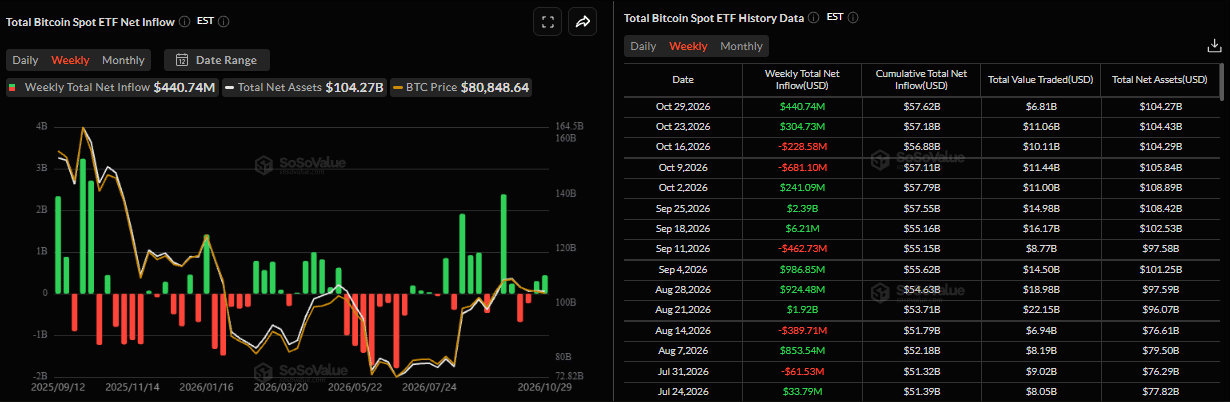
Net inflows into spot Bitcoin Exchange Traded Funds (ETFs) reached $440.74 million through Thursday, keeping the funds on course for a second successive week of net inflows despite the continuing correction. Nevertheless, weakness across the wider market leaves the Crypto King vulnerable to a deeper pullback.
A negative October close now looks likely for Bitcoin, challenging the market’s “Uptober” narrative and making it a “Rektober” month instead. Having touched $76,500 in the early Asian trading session, the Crypto King is trading below $78,000 on Friday.
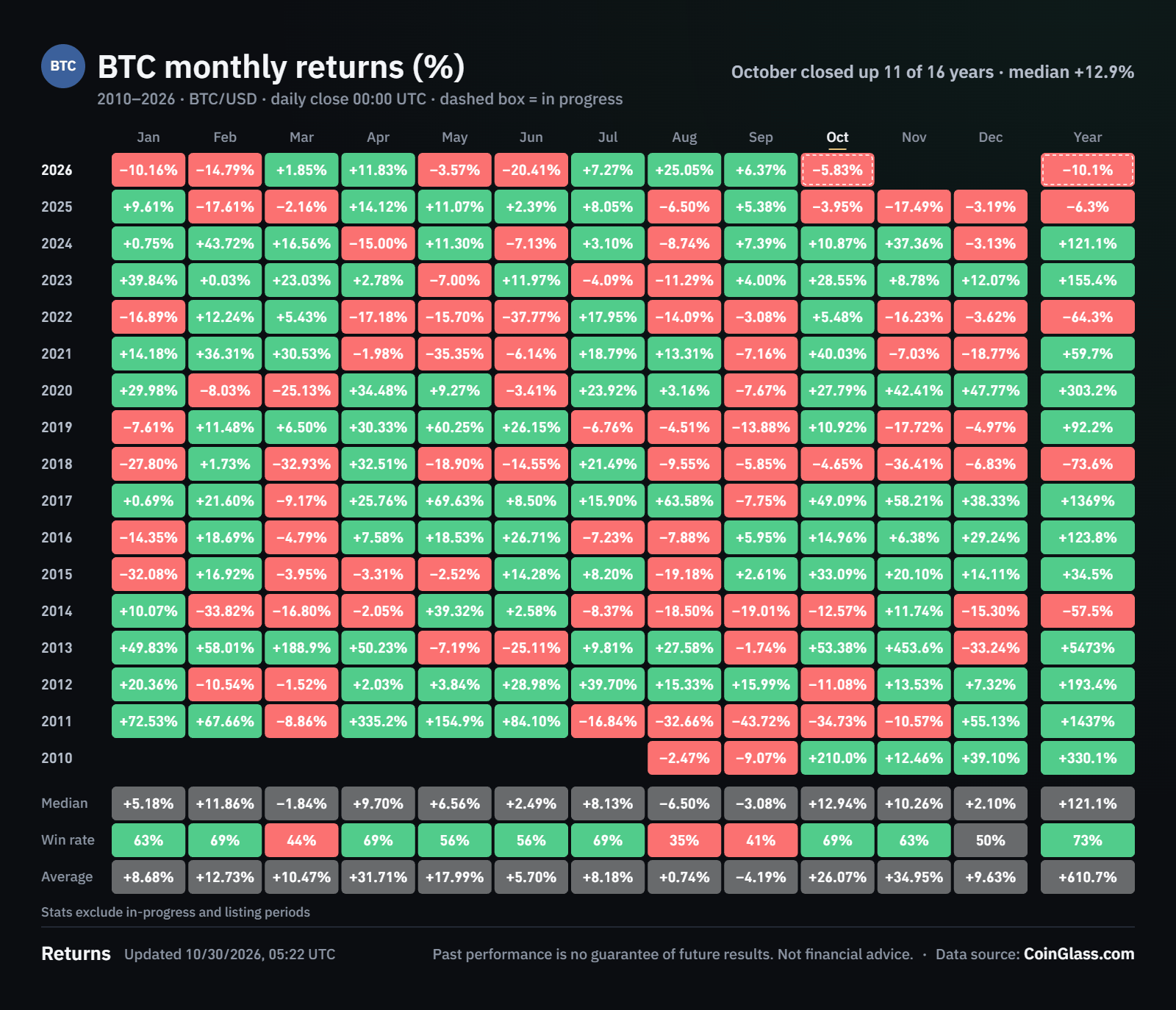
The Coinglass chart of BTC monthly returns below puts October’s correction so far at 5.83%. In 3 out of 5 historical instances when BTC finished October in negative territory, double-digit losses followed in November. That pattern points to the possibility of additional downside next month.
Speaking exclusively to FXStreet, Simon-Peter Massabni, Head of Business Development at XS.com, said rising Middle East tensions could restrict global oil supplies. Shocks in energy markets could then deepen concerns about monetary tightening by the Fed, potentially squeezing cryptocurrency market liquidity and reducing the scope for a lasting recovery.
With geopolitical uncertainty persisting and investor confidence fragile ahead of November, Massabni expects Bitcoin to trade within a $70,000 to $80,000 range.
A sustainable return to the broader uptrend is not yet supported by clear signs, he added. As a result, recovery attempts could prove brief: with confidence in a wider market rebound limited, investors are likely to be quick to take profits.
Late Thursday brought a significant security breach at Binance, the largest centralised cryptocurrency exchange.
A Binance post on X stated: “The estimated total impact sits at around $6.3 billion. We have worked with blockchain partners to freeze affected assets, with $3 billion frozen on-chain so far. Binance will cover all losses from the Secure Asset Fund for Users (SAFU) fund and the company’s funds. User funds are safe,”
According to the company’s preliminary investigation, a compromised laptop belonging to a DevOps engineer may have been involved. This allowed an attacker to gain access to a service container and submit unauthorised withdrawal transactions.
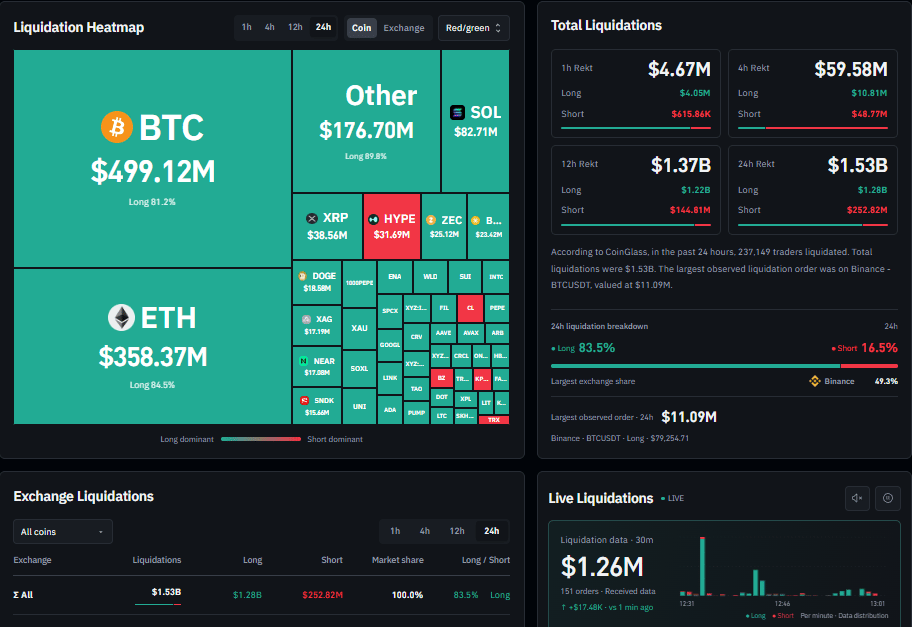
A wave of cryptocurrency market liquidations followed the incident. As the CoinGlass chart below illustrates, liquidations affected 237,149 traders in the past 24 hours, reaching a total of $1.53 billion.
At $11.09 million, the biggest liquidation order occurred on Binance’s BTCUSDT. The scale of these liquidations reflects increased market stress, as forced position closures compound this week’s downward pressure on BTC.
Interest rates were left at 3.75%-4.00% by the Fed on Wednesday following its two-day October policy meeting, as this week’s economic releases weighed on risk assets including Bitcoin. The decision was not unanimous: Lisa Cook and Beth Hammack were the two officials seeking a 25-basis-point (bps) increase. Chair Kevin Warsh, meanwhile, said incoming information would guide the central bank’s assessment of whether further action was necessary.
At his press conference, Warsh said officials had “made clear our readiness to act as circumstances require, and we have shown our willingness to act.”
He added: “It’s our responsibility to get inflation down (...) That’s the reason the FOMC’s discussion over the last couple of days focused mainly on the price stability side of our remit,”
Although unchanged rates were already priced in, the hawkish tone and inflation concerns in the forward guidance reinforce market caution, putting pressure on risk assets such as cryptocurrencies.
Thursday’s US economic figures added to that pressure, showing resilient growth alongside persistent inflation and reinforcing expectations of an imminent Fed rate rise in December.
US growth accelerated to an annualised 3.4% in the preliminary third-quarter Gross Domestic Product (GDP) estimate, compared with 2.2% in the preceding quarter and a consensus forecast of 3.2%. Separately, the US Commerce Department reported a 0.5% September increase in the Personal Consumption Expenditures (PCE) Price Index, taking the annual rise to 3.6%. Excluding volatile food and energy prices, the core measure increased 0.3% month on month and 3.1% year on year.
Alongside elevated US bond yields, these figures add to inflation concerns and strengthen the case for further Fed tightening, continuing to constrain risk assets such as BTC.
Although fresh hopes of a diplomatic resolution to the Middle East conflict have put pressure on the safe-haven US Dollar (USD), the weaker Greenback has offered little respite from Bitcoin’s bearish pressure.
The Guardian reported on Thursday that US Vice President JD Vance had written directly to Mohsen Rezaei, secretary of Iran’s Supreme National Security Council, seeking to revive peace talks.
A new draft proposal to end the war involving the US and Israel was also put to Iran by Qatar. Investors nonetheless remain cautious as hostilities intensify between Saudi Arabia and the Iran-backed Houthi group in Yemen. Threats by the US and Israel to resume attacks after the US midterm elections have further sustained geopolitical risks. On Thursday, Iran’s navy also claimed that four oil tankers had hit sea mines in the Strait of Hormuz, heightening supply disruption concerns and lending support to oil prices.
Uncertainty therefore remains high. With concerns about rising oil prices continuing to undermine investor sentiment, the Crypto King has found little relief.
Net outflows of $440.74 million through Thursday followed last week’s $304.73 million in positive flows, according to SoSoValue data, which show spot ETFs on course for a second consecutive week of inflows. Institutional appetite for Bitcoin is showing modest signs of revival. Should Friday’s inflows persist and strengthen, they could soften BTC’s decline and help a recovery.
In a Monday post on its X account, Lookonchain said Strategy had made no BTC purchases last week, whereas Strive bought 6,182 BTC. After several weeks of purchases, Strategy’s decision to step back signals a change in institutional accumulation, even as Strive increases its buying. Continued accumulation by Strive could absorb some selling pressure and lend support to BTC.
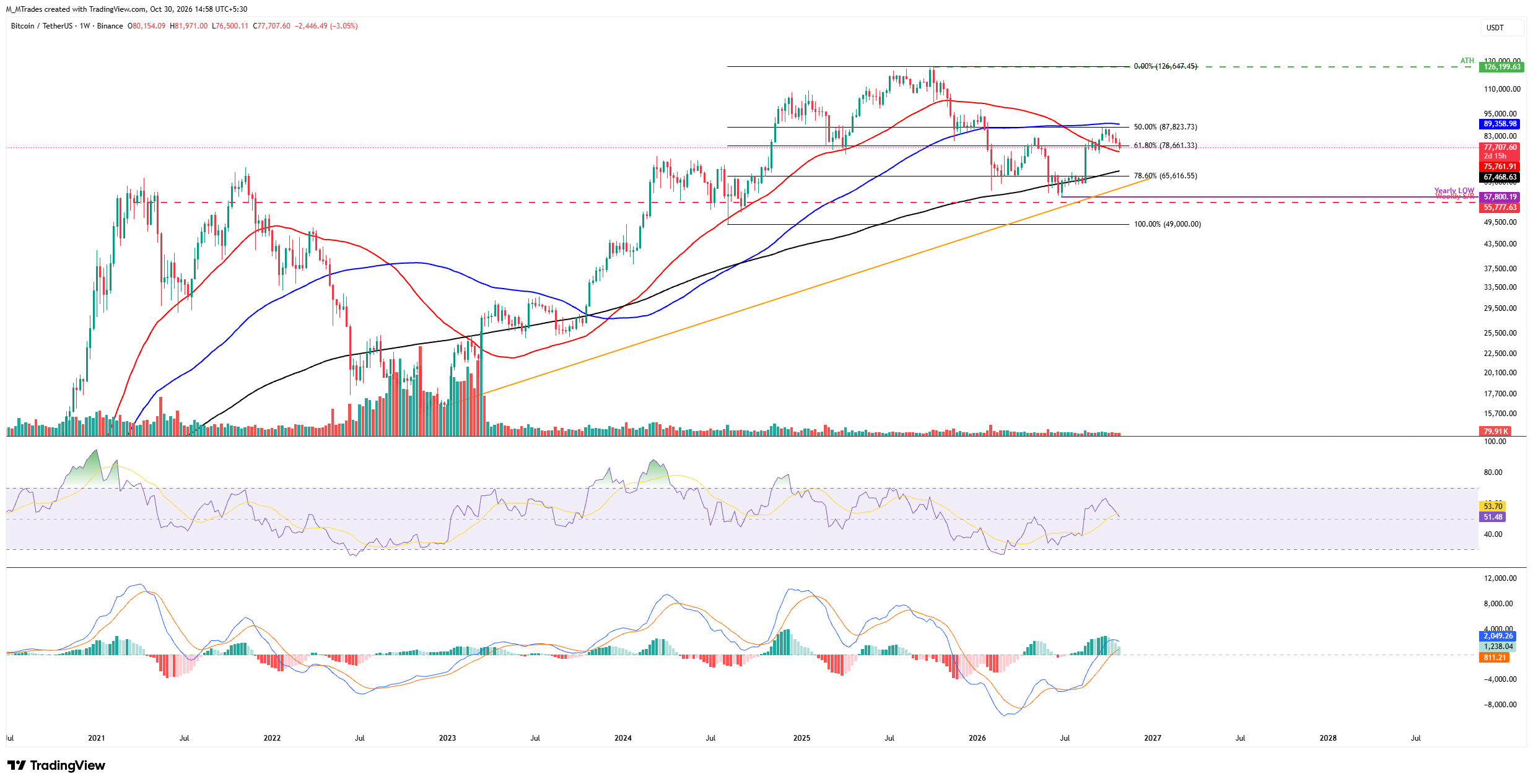
A fall of more than 3% so far this week leaves the Crypto King trading below $78,000 on Friday. It is approaching a fourth successive week of correction, extending the pullback that began in early October.
Further corrective pressure could take BTC towards its 50-week Simple Moving Average (SMA) at $75,761. Were the week to close below that level, additional losses towards the 200-week SMA at $67,468 could follow.
At 51, the weekly Relative Strength Index (RSI) sits near the neutral threshold of 50, signalling a moderation in bullish momentum. The Moving Average Convergence Divergence (MACD) histogram is still positive, but its bars are diminishing. Taken together, this indicates that the broader upward momentum has not broken down, though it is fading in the face of nearby resistance and the continuing pullback.
A recovery, by contrast, could carry BTC towards $78,661, the 61.8% Fibonacci retracement level drawn between the August 2024 low of $49,000 and the October 2025 record high of $126,199. If this level holds, the next potential objectives would be the 50% retracement at $87,823 and then the 100-week SMA at $89,358.
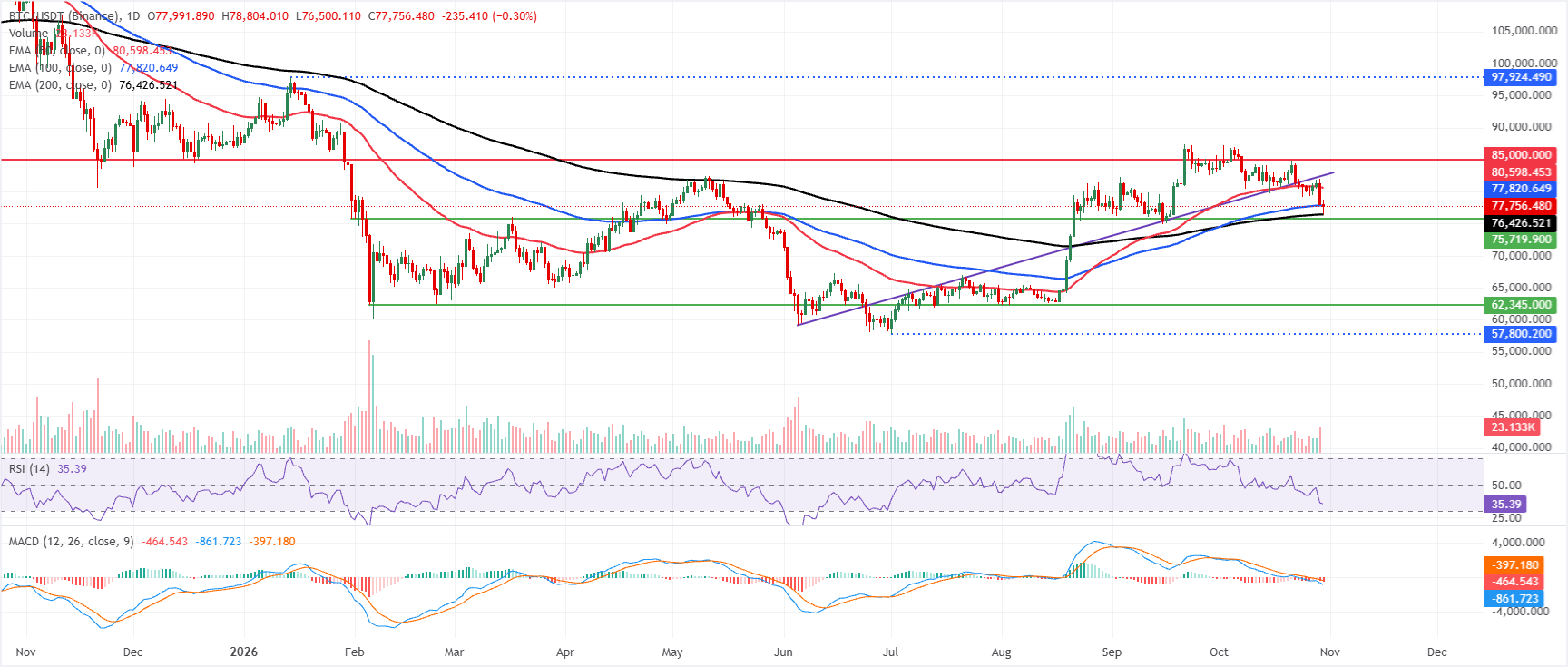
Although BTC remains above the 200-day Exponential Moving Average (EMA) at $76,426, the 100-day EMA at $77,820 continues to restrict gains. The daily chart therefore retains a bearish near-term bias.
Underlying support is still provided by the longer-term trend structure through the 200-day EMA. However, trading well below the 50-day EMA at $80,598 keeps the corrective tone firmly in place.
Just above oversold territory, the daily RSI reads 35, while the MACD remains subdued and negative. Both indicators point to sustained downward pressure, even with long-term support nearby.
The first upside hurdle is the 100-day EMA near $77,820, ahead of the 50-day EMA around $80,598. Beyond these, a more substantial horizontal resistance level at $85,000 would be likely to limit a stronger rebound if tested.
Key downside support lies at the 200-day EMA of $76,426. A clear break beneath it would leave room for a steeper decline; holding above it, however, would preserve the interpretation of the current retreat as a downward correction within the wider bullish structure.
(The technical analysis of this story was written with the help of an AI tool. Know more.)
Designed as a virtual form of money, Bitcoin ranks as the largest cryptocurrency by market capitalisation. No single person, group or entity can control this means of payment, removing the need for third parties to participate in financial transactions.
The term altcoin covers cryptocurrencies other than Bitcoin. Some people also exclude Ethereum, however, on the grounds that forking originates from these two cryptocurrencies. On that interpretation, Litecoin is the first altcoin: a fork of the Bitcoin protocol and thus an “improved” version of it.
Backed by a reserve of the asset they represent, stablecoins are cryptocurrencies intended to maintain a stable price. Each stablecoin’s value is therefore pegged to a commodity or financial instrument, such as the US Dollar (USD), while an algorithm or demand regulates its supply. Their primary purpose is to give investors a route into and out of cryptocurrency trading and investment. As cryptocurrencies are generally volatile, stablecoins also provide investors with a way to store value.
Calculated as Bitcoin’s market capitalisation divided by the combined market capitalisation of all cryptocurrencies, Bitcoin dominance indicates the level of investor interest in Bitcoin. High BTC dominance generally occurs before and during a bull run, when investors favour a relatively stable cryptocurrency with a large market capitalisation, such as Bitcoin. Falling BTC dominance, by contrast, usually signals that investors are shifting capital and/or profits into altcoins in pursuit of higher returns. This typically sparks a surge in altcoin rallies.







Phone: +61 2 8036 8388
Fax: +61 2 8036 8388
Email: support@tmgm.com



The information provided on this website is of a general nature only and does not constitute personal financial advice. Before acting on any information on this website, you should consider the suitability of the information in relation to your objectives, financial situation and needs. Investing in CFDs and FX Margin Contracts carries significant risks and is not suitable for all investors. You may lose more than your initial deposit. You do not own, or have, any interest in the underlying asset. We recommend that you seek independent advice and ensure you fully understand the risks involved before trading. It is important that you read and consider the disclosure document before you acquire any product listed on the website. The information and advertisements offered on this website are not intended for use by any person in any country or jurisdiction where such use would be contrary to local laws and regulations. The Products and Services offered on this website are not intended for residents of the United States, Malaysia and Thailand.
TMGM is authorized and regulated in various jurisdictions.
Trademax Australia Limited, trading as TMGM, is regulated by the Australian Securities and Investments Commission (ASIC), AFSL no. 436416 and is located at Level 28, One International Tower, 100 Barangaroo Avenue, 2000 Sydney, NSW Australia.
Email: support@tmgm.com.au
Trademax Global Limited, trading as TMGM, is authorized and regulated by the Vanuatu Financial Services Commission (VFSC), registration number 40356 and registered at 1276, Kumul Highway, Port Vila, Vanuatu, Republic of Vanuatu.
Email: support@tmgm.com
Trademax Global Markets (SE) Limited, trading as TMGM, is authorized and regulated by the Financial Services Authority (FSA) of Seychelles, with license number SD224. The company is registered at Office No 13, Providence Estate ABIS Centre, Mahe, Seychelles.
Email: support@tmgm.com
Trademax Global Markets (International) Pty Ltd, trading as TMGM, is authorized and regulated by the Financial Services Commission, Mauritius (FSC) with license no. GB22201012, and registered at 33, Edith Cavell Street C/o IQ EQ Fund Services (Mauritius) Ltd Port Louis, 11324 Mauritius.
Email: support@tmgm.com
Copyright © TMGM. All rights reserved


