
News & AnalysisCareer

With its fresh yearly low of 1.3011 recorded the previous day still close at hand, the British Pound (GBP) remains under pressure against the US Dollar (USD) during Tuesday’s Asian session. Renewed interest in the global Artificial Intelligence (AI) trade has lent further support to the US Dollar, leaving GBP/USD on a weak footing.

Monday’s fresh 20-month high of 104.53 remains within reach for the US Dollar Index (DXY) at the time of writing. The index measures the greenback against a basket of six major currencies.
Jensen Huang’s reinstatement as CEO of chipmaking giant Nvidia prompted strong buying in US AI-related shares on Monday, with Nvidia attracting particular interest. Huang had been forced to resign the previous week after acknowledging extramarital affairs, including one with an alleged Chinese spy. NVIDIA rose over 31% on Monday to $165.05.
Huang’s removal had triggered a substantial unwinding of the global AI trade, with financial markets questioning whether spending on AI infrastructure would continue.
Capital inflows into the United States (US) have increased alongside the sharp recovery in US technology shares, adding to the US Dollar’s appeal.
Even before this recovery, the US Dollar had been outpacing its peers, supported by traders’ confidence that the Federal Reserve (Fed) would deliver consecutive interest rate rises in the near term.
Wednesday’s release of the US Personal Consumption Expenditure (PCE) Price Index for October will put these hawkish Fed expectations to the test.
Forecasts point to an acceleration in annual US core PCE inflation to 3.2% Year-on-Year (YoY), compared with the previous reading of 3.1%. Fed officials monitor this measure closely.
For sterling, the United Kingdom’s (UK) flash S&P Global Purchasing Managers’ Index (PMI) readings for November delivered an unexpected disappointment. Manufacturing PMI fell to 52.7 and Services PMI to 52.0, whereas both had been forecast to rise from their previous readings of 53.0.
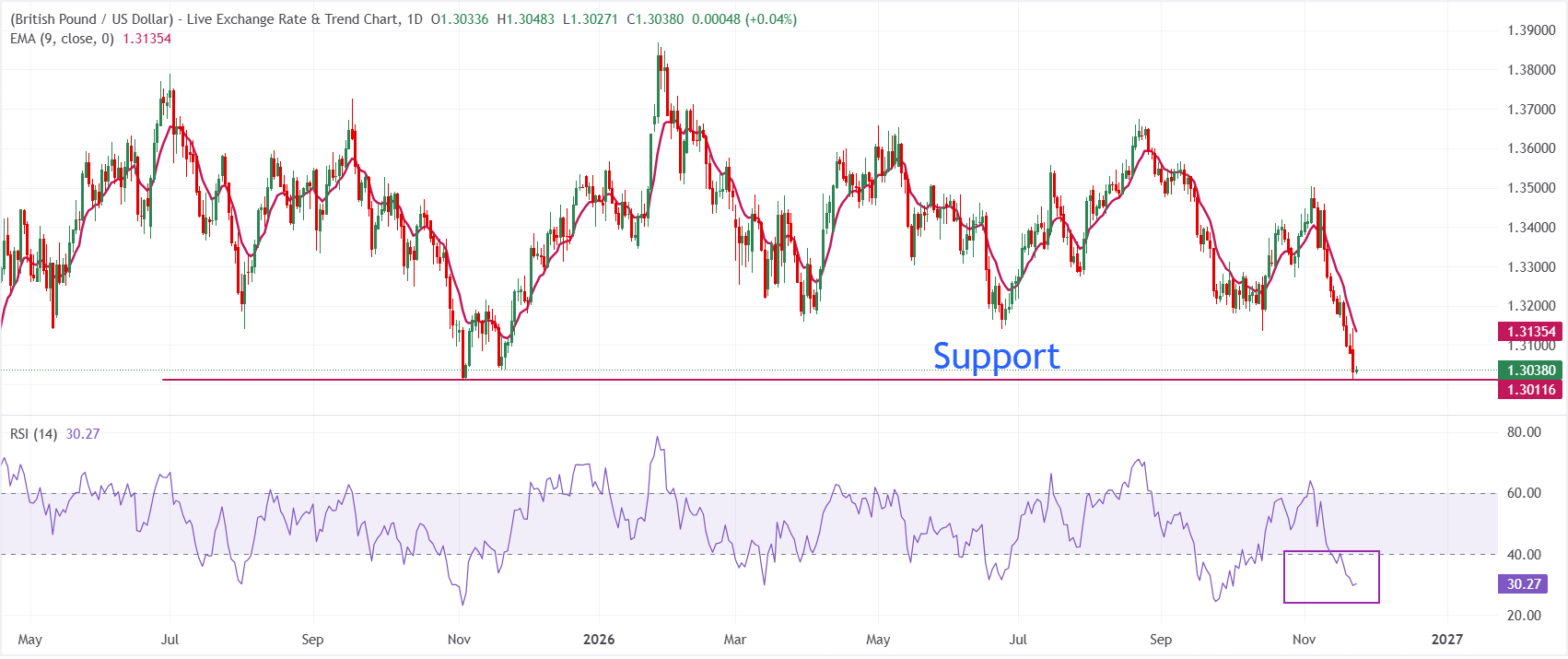
At 1.3038 on the daily chart, GBP/USD remains beneath its nine-day Exponential Moving Average (EMA), which stands near 1.3135 and signals a bearish trend. Strong downward momentum is also evident in the 14-day Relative Strength Index (RSI), which has slipped towards 30.00.
The nine-day EMA around 1.3135 remains a significant obstacle to any recovery. On the upside, immediate support lies at the psychological 1.3000 level; a breach below it would leave 1.2900 exposed.
Published monthly by the US Bureau of Economic Analysis, the Core Personal Consumption Expenditures (PCE) measure tracks price changes in goods and services bought by consumers in the United States (US). The Federal Reserve (Fed) also uses the PCE Price Index as its preferred inflation gauge. To calculate the YoY reading, goods prices in the reference month are compared with those in the corresponding month a year earlier. Food and energy, generally regarded as more volatile components, are excluded from the core measure to provide a more accurate picture of price pressures. A high reading is generally supportive of the US Dollar (USD), whereas a low reading tends to weigh on it.
Find out more.Next scheduled release: Wed 25 Nov 2026 13:30
Release frequency: Every month
Consensus forecast: 3.2%
Previous reading: 3.1%
Data source: US Bureau of Economic Analysis
The annual Core Personal Consumption Expenditures (PCE) Price Index is FOMC policymakers’ main measure of inflation and excludes volatile food and energy prices. Following publication of its GDP report, the US Bureau of Economic Analysis issues the PCE Price Index data together with monthly changes in Personal Spending and Personal Income. Should the reading exceed expectations, the USD could outperform other currencies, as the figures would suggest a possible hawkish shift in the Fed’s forward guidance. A weaker-than-expected reading could have the opposite effect.







Phone: +61 2 8036 8388
Fax: +61 2 8036 8388
Email: support@tmgm.com



The information provided on this website is of a general nature only and does not constitute personal financial advice. Before acting on any information on this website, you should consider the suitability of the information in relation to your objectives, financial situation and needs. Investing in CFDs and FX Margin Contracts carries significant risks and is not suitable for all investors. You may lose more than your initial deposit. You do not own, or have, any interest in the underlying asset. We recommend that you seek independent advice and ensure you fully understand the risks involved before trading. It is important that you read and consider the disclosure document before you acquire any product listed on the website. The information and advertisements offered on this website are not intended for use by any person in any country or jurisdiction where such use would be contrary to local laws and regulations. The Products and Services offered on this website are not intended for residents of the United States, Malaysia and Thailand.
TMGM is authorized and regulated in various jurisdictions.
Trademax Australia Limited, trading as TMGM, is regulated by the Australian Securities and Investments Commission (ASIC), AFSL no. 436416 and is located at Level 28, One International Tower, 100 Barangaroo Avenue, 2000 Sydney, NSW Australia.
Email: support@tmgm.com.au
Trademax Global Limited, trading as TMGM, is authorized and regulated by the Vanuatu Financial Services Commission (VFSC), registration number 40356 and registered at 1276, Kumul Highway, Port Vila, Vanuatu, Republic of Vanuatu.
Email: support@tmgm.com
Trademax Global Markets (SE) Limited, trading as TMGM, is authorized and regulated by the Financial Services Authority (FSA) of Seychelles, with license number SD224. The company is registered at Office No 13, Providence Estate ABIS Centre, Mahe, Seychelles.
Email: support@tmgm.com
Trademax Global Markets (International) Pty Ltd, trading as TMGM, is authorized and regulated by the Financial Services Commission, Mauritius (FSC) with license no. GB22201012, and registered at 33, Edith Cavell Street C/o IQ EQ Fund Services (Mauritius) Ltd Port Louis, 11324 Mauritius.
Email: support@tmgm.com
Copyright © TMGM. All rights reserved


