
News & AnalysisCareer

Tuesday’s US midterm elections dominated this week’s news, with control of both the House and the Senate going to Democrats in a decisive blue wave.
The outcome revealed US voters’ dissatisfaction with high prices and economic conditions. This discontent carried Democratic candidates to victory even in traditionally Republican areas.
As investors assessed what a Democrat-controlled Congress might mean, the US political shift set off pronounced price fluctuations throughout the cryptocurrency market, bringing extreme volatility and liquidations across risk assets this week.
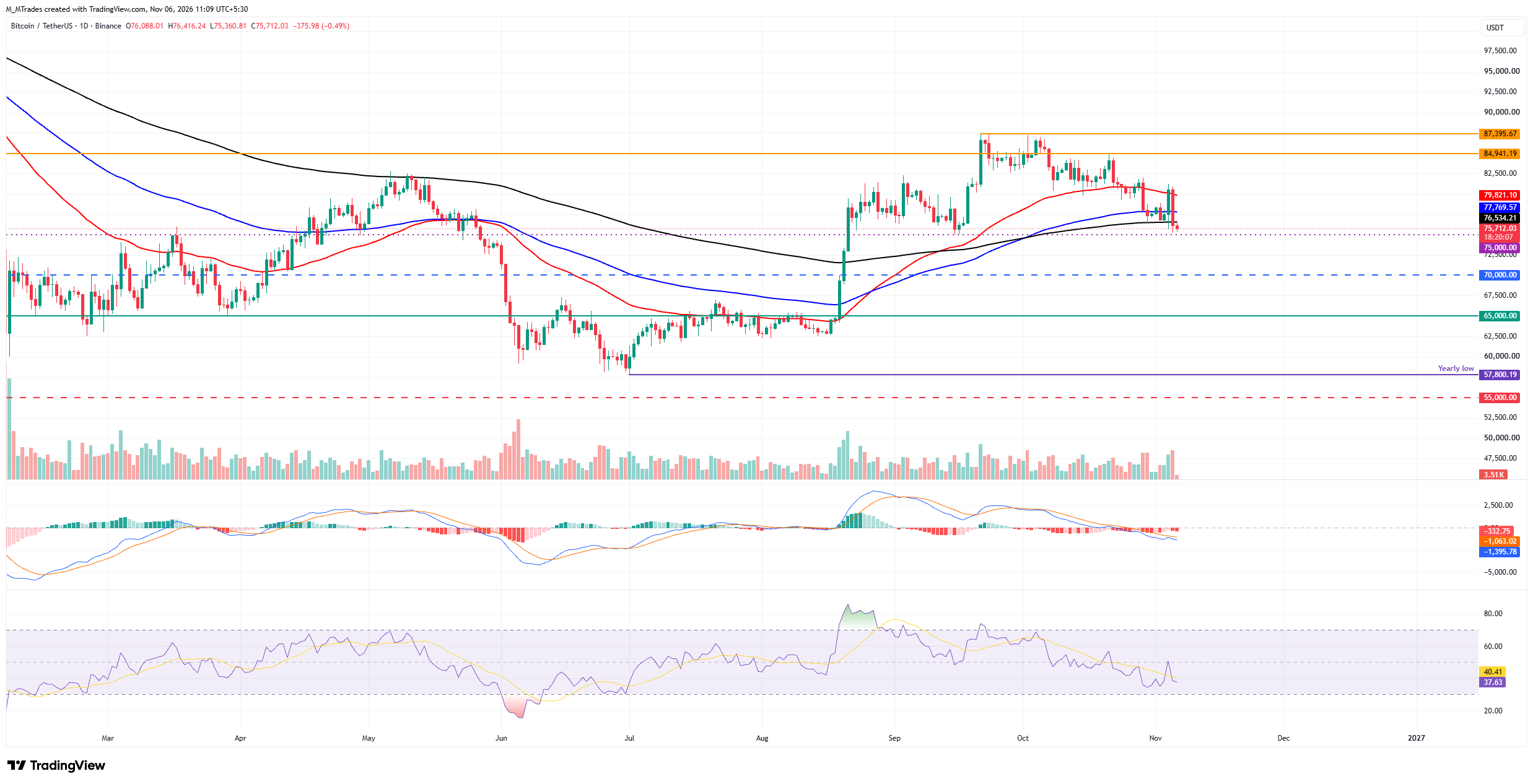
Major political developments can provoke extreme market volatility. As election results began to emerge early in Wednesday’s Asian session, Bitcoin (BTC) briefly slipped towards the mid-$75,000s. It subsequently recovered as the picture became clearer, ending the day above $80,500 with a gain of nearly 4%.
That level proved unsustainable, however, as selling pressure returned on Thursday, with investors concerned that Democratic control of both chambers of the US Congress could bring stricter regulation of crypto and Artificial Intelligence (AI). A steep decline in US technology shares on Thursday wiped out BTC’s recent advance. The Crypto King lost 5.49%, finishing below support at the 200-day Exponential Moving Average (EMA), around $76,534.
Technical momentum is also deteriorating. At around 37, the daily Relative Strength Index (RSI) is heading lower towards oversold territory, signalling a strong bearish trend. The Moving Average Convergence Divergence (MACD) adds to that picture: it remains negative, while expanding red histogram bars provide further evidence of a bearish outlook for BTC.
Losses have extended into Friday, with BTC trading below $75,800 at the time of writing.
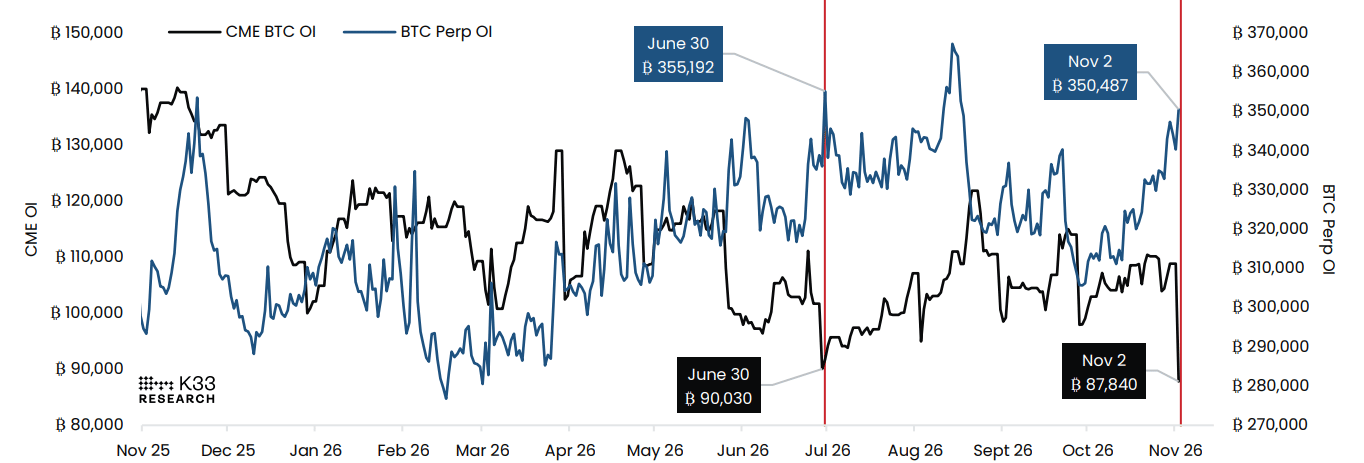
A sharp post-midterm move in either direction had been anticipated, owing to the gap in positioning between Bitcoin futures on the Chicago Mercantile Exchange (CME) and perpetual (perp) futures, alongside three-month implied volatility sitting close to historic lows.
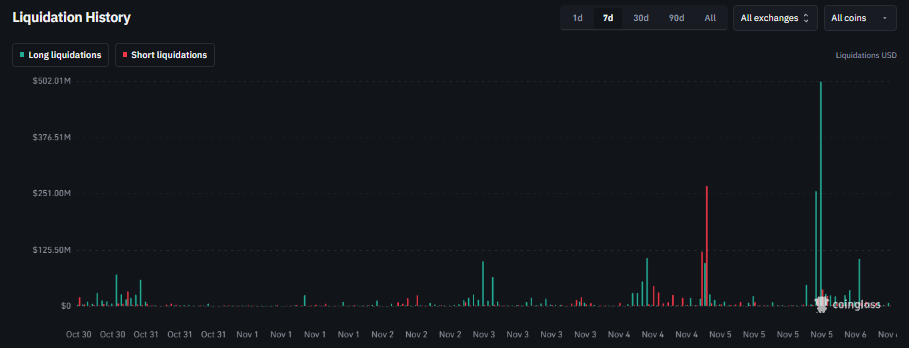
Crypto positions worth more than $2.25 billion were liquidated during the US midterm elections. As the chart below shows, Wednesday’s recovery primarily forced the liquidation of shorts, whereas Thursday’s sell-off wiped out long positions. The scale of these liquidations points to a marked change in sentiment, underscoring both uncertainty and leveraged exposure across the sector.
For cryptocurrencies, a Washington stalemate can prove beneficial. When Congress and the White House share power across political divides, risk assets face fewer sudden, significant policy surprises.
Yet Democratic control of the House and Senate also presents a genuine concern for the crypto sector. The passage of key industry legislation could be held up or delayed, including the CLARITY Act.
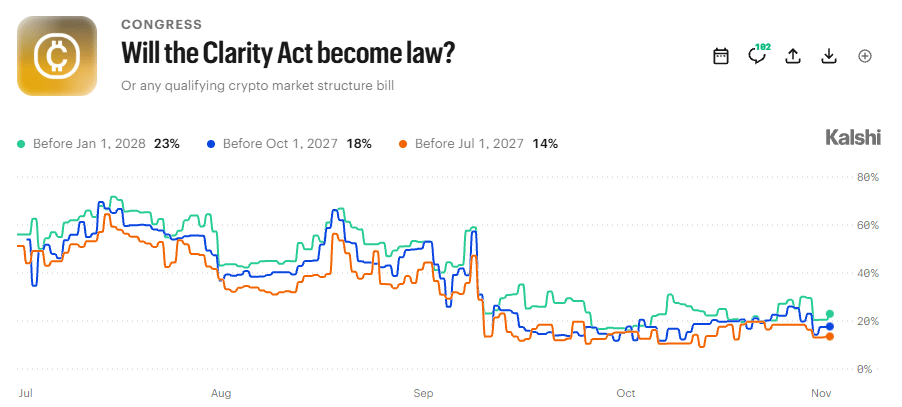
A more difficult route for industry-friendly legislation is already reflected in prediction markets such as Kalshi. The probability of the CLARITY Act passing before 1 July 2027 has declined to 14%, compared with 19% before the US midterm elections on 1 November.
Expectations have also deteriorated further out. During that same period, the probabilities of passage before 1 October 2027 and 1 January 2028 fell from 27% and 29% to 18% and 23%, respectively.
Away from the election coverage, last week’s hack at Binance continues to loom in the background. Although midterm headlines have dominated attention, concerns over security have not gone away.
To date, Binance has borne the entire financial impact and has restored 98% of affected users’ balances using its corporate treasury, SAFU fund and other internal resources.
Nevertheless, stolen assets worth roughly $3 billion are still controlled by the attackers. Most are held in BTC and ETH, which are not easily frozen. Renewed movement of those funds could revive FUD (fear, uncertainty, and doubt) across the market.
The Democratic victory has, on balance, introduced further uncertainty for the industry. Investors are weighing how a Democrat-controlled Congress could influence crypto and AI regulation once the new Congress meets on 3 January 2027.
Even with Washington’s political landscape altered, crypto prices are likely to be influenced more heavily by interest rate decisions, developments in the Middle East, wider market liquidity and demand for Exchange Traded Funds (ETFs).
For each cryptocurrency, its developer or creator sets the total number of tokens that may be minted or issued. The algorithm underpinning the blockchain determines how many of these assets can be minted through mining, staking or other mechanisms. Circulating supply can also shrink, whether through token burning or assets being mistakenly sent to addresses on other, incompatible blockchains.
Multiplying an asset’s circulating supply by its current market value gives its market capitalisation.
Over a specified trading period, such as 24 hours, trading volume measures the total number of tokens of a particular asset exchanged between buyers and sellers. By combining volumes across centralised and decentralised exchanges, the metric helps assess market sentiment. A rise in volume often indicates demand for an asset, with more participants buying and selling the cryptocurrency.
Designed to encourage traders to take positions, funding rates help keep perpetual contract prices aligned with spot markets. Exchanges use this mechanism of regular periodic payments to bring futures and index prices into convergence. A positive funding rate indicates that the perpetual contract trades above the mark price, so bullish traders holding long positions pay those holding shorts. Conversely, when the funding rate is negative, perpetual prices sit below the mark price and traders with short positions pay those with long positions.







Phone: +61 2 8036 8388
Fax: +61 2 8036 8388
Email: support@tmgm.com



The information provided on this website is of a general nature only and does not constitute personal financial advice. Before acting on any information on this website, you should consider the suitability of the information in relation to your objectives, financial situation and needs. Investing in CFDs and FX Margin Contracts carries significant risks and is not suitable for all investors. You may lose more than your initial deposit. You do not own, or have, any interest in the underlying asset. We recommend that you seek independent advice and ensure you fully understand the risks involved before trading. It is important that you read and consider the disclosure document before you acquire any product listed on the website. The information and advertisements offered on this website are not intended for use by any person in any country or jurisdiction where such use would be contrary to local laws and regulations. The Products and Services offered on this website are not intended for residents of the United States, Malaysia and Thailand.
TMGM is authorized and regulated in various jurisdictions.
Trademax Australia Limited, trading as TMGM, is regulated by the Australian Securities and Investments Commission (ASIC), AFSL no. 436416 and is located at Level 28, One International Tower, 100 Barangaroo Avenue, 2000 Sydney, NSW Australia.
Email: support@tmgm.com.au
Trademax Global Limited, trading as TMGM, is authorized and regulated by the Vanuatu Financial Services Commission (VFSC), registration number 40356 and registered at 1276, Kumul Highway, Port Vila, Vanuatu, Republic of Vanuatu.
Email: support@tmgm.com
Trademax Global Markets (SE) Limited, trading as TMGM, is authorized and regulated by the Financial Services Authority (FSA) of Seychelles, with license number SD224. The company is registered at Office No 13, Providence Estate ABIS Centre, Mahe, Seychelles.
Email: support@tmgm.com
Trademax Global Markets (International) Pty Ltd, trading as TMGM, is authorized and regulated by the Financial Services Commission, Mauritius (FSC) with license no. GB22201012, and registered at 33, Edith Cavell Street C/o IQ EQ Fund Services (Mauritius) Ltd Port Louis, 11324 Mauritius.
Email: support@tmgm.com
Copyright © TMGM. All rights reserved


